New here? Just sign up with Google — your account includes Matilda, our gift book, forever.
My Side of the Mountain · Garden Heights
Part 1
for My Side of the Mountain · Part 1 · Chapters 1–3
8 Parts40 min
What Happens in Part 1
The story opens deep in winter, with a boy named Sam Gribley snug inside a hollowed-out tree on a snowbound mountain, so well hidden that people pass without ever guessing he is there. Then Sam tells us how he came to be living alone in the wild. He is one of many children packed into a small, crowded New York City apartment, and he longs for space and independence. So he announces to his father that he is going to run away to the Catskill Mountains and live off the land on the abandoned farm that once belonged to his great-grandfather, a man named Gribley. His father, sure the boy will be back by nightfall, lets him go. Sam sets out with almost nothing — a penknife, a ball of cord, an ax, flint and steel to make fire, and forty dollars — and travels by train and by hitching rides up into the mountains. But the wilderness is not the easy adventure he imagined. On his first cold, hungry nights he cannot even get a fire started, and he is close to giving up when a kind stranger shows him the trick of striking sparks the right way. Humbled but determined, Sam realizes that surviving in the wild will take real skill, patience, and learning — and that he has everything to learn.
The frame opening, first-person voice, and a hero with everything to learn
Cross-Curricular
Wilderness survival — the first priorities that keep you alive
Chapter Summary
Ch.
What happens
Chapter 1
Snug in the Tree — the book opens with Sam living inside a hollow tree in a snowstorm, safely hidden; then he begins the story of how he got there.
Chapters 2–3
Leaving the City — Sam runs from his crowded NYC home to his great-grandfather’s Catskill farm with a few tools; unable to make fire, he learns his first hard lesson.
Part 1
Vocabulary
Study 10 key words from Chapters 1–3, then answer each question.
🧠Knowledge Bank · The Three Things a Fire Needs
Wilderness Skills · Making Fire
Fire needs three things at once, and firecraft is mostly about supplying them in order. Chemists call the set the fire triangle: fuel, oxygen and enough heat to start the reaction. Beginners usually fail on fuel size. A flame cannot jump straight from a spark to a log, so woodsmen build in three grades — tinder fine enough to catch a spark, kindling no thicker than a pencil, and only then split wood. Dry standing deadwood burns far better than anything lying on damp ground, and the inner bark of birch will light even when wet because it holds natural oils. Friction methods work but demand practice and dry materials. What experienced campers stress is preparation: gather three times what you think you need and lay it within reach before striking anything, because a young fire dies in the seconds you spend hunting for more fuel.
Visual AidThree at once, and three sizes
Diagram for the Knowledge Bank on making fire. Cards 1 to 3 are the three things a fire needs at the same time, which chemists call the fire triangle, and cards 4 to 6 are the three grades of fuel in the order a woodsman feeds them. Card 7 is where beginners actually fail. Notice that the top row is about chemistry and the bottom row is about patience. Sam has the spark long before he has the tinder fine enough to catch it.
The fire triangle and the three grades of fuel, as described in the Knowledge Bank. Drawn for Garden Heights Academy.
wildernessn.Ch.1
Wild land untouched by people
“Sam wanted to live in the wilderness.”
independencen.Ch.2
Freedom to rely on oneself
“He longed for independence and space.”
flintn.Ch.3
A hard stone that makes sparks
“He struck the flint to start a fire.”
kindlev.Ch.3
To start a fire burning
“It was hard to kindle the first flame.”
determinedadj.Ch.3
Firmly decided; not giving up
“Sam grew determined to learn the skills.”
abandonedadj.Ch.2
Left empty and unused
“The Gribley farm had been abandoned for years.”
sheltern.Ch.1
A place giving protection from weather
“Warm shelter comes before food in the wild.”
hitchv.Ch.2
To get a free ride from a driver
“He would hitch rides toward the mountains.”
humblev.Ch.3
To make someone feel less proud
“The cold nights would humble him.”
survivev.Ch.1
To stay alive through hardship
“To survive, Sam had everything to learn.”
ⓘ The vocabulary words in this list are selected to help you understand and complete this workbook. Some may not appear verbatim in the original novel.
🧠Knowledge Bank question
1According to the Knowledge Bank, where do beginners usually fail when making a fire?Ch.1
2‘Independence’ means depending on others for everything.Ch.2
3A hard stone struck to make sparks is ___.Ch.3
4To ‘kindle’ a fire is to put it out.Ch.3
5Fill in each blank with the correct word.Ch.2
Word choices:abandonedwildernessflintsneer- some words will not be used
Sam headed for the of the Catskills.
His great-grandfather’s farm had been for years.
6Someone ‘determined’ ___.Ch.3
7In the wild, warm ‘shelter’ matters before food.Ch.1
8To ‘hitch’ a ride is to get one that is ___.Ch.2
9Fill in each blank with the correct word.Ch.3
Word choices:kindledeterminedsurviveflint- some words will not be used
It was hard to the first flame.
To , Sam had everything to learn.
10To ‘humble’ someone is to make them feel ___.Ch.3
Part 2
Comprehension
Show you understood what happens in Chapters 1–3.
🧠Knowledge Bank · A Forest That Grew Back
Forest Ecology · The Catskills
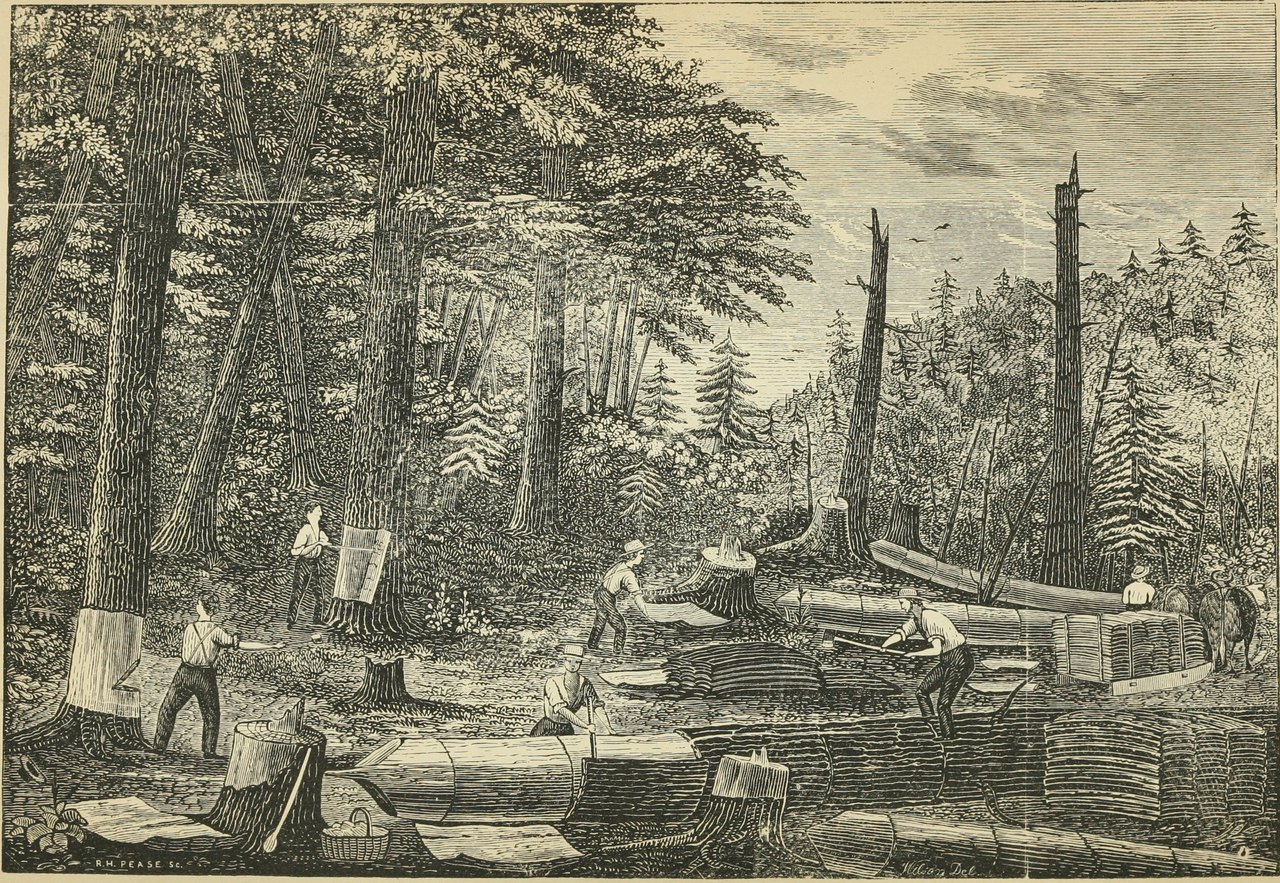
The eastern American woods a runaway would meet today are not ancient. By the mid-1800s most of New York’s Catskill region had been cleared for farms, sheep pasture and hemlock bark, which tanneries stripped for the chemicals used in curing leather. When farming moved west and the tanneries closed, the fields were abandoned and the forest returned on its own — a process ecologists call succession. First come sun-loving weeds and grasses, then birch and aspen, then slower, shade-tolerant maple, beech and hemlock, which eventually crowd the pioneers out. Stone walls running through deep woods are the giveaway that a place was once open field. This history matters to anyone living off the land there, because a second-growth forest is thick with the young trees, berries and edge species that abundant sunlight creates, and offers far more food than a dark, undisturbed old-growth stand.
Visual AidWhy the forest came down
A nineteenth-century engraving of men peeling hemlock bark. The Knowledge Bank explains that the eastern woods a runaway would meet today are not ancient: by the mid-1800s most of the Catskill region had been cleared for farms, pasture and hemlock bark, which tanneries stripped for the chemicals used in curing leather. Look at the stacked sheets on the right and the trunks left lying. The tree was felled for its skin, and when the tanneries closed the fields were abandoned and the forest grew back on its own.
Peeling hemlock bark for tanning, nineteenth-century engraving. Source: Wikimedia Commons, public domain.
🧠Knowledge Bank question
1The Knowledge Bank explains that today's Catskill forest is ___.Ch.1
2Sam runs away to live on ___.Ch.2
3Sam is stranded in the wild by accident.Ch.2
4Sam leaves home because his family’s apartment is ___.Ch.2
5Write the numbers 1–5 in the boxes to show the correct order of events. Number 1 = what happens first.Chapters 1–3
Sam tells his father he will live off the land.
He sets out with a knife, cord, ax, flint, and $40.
He travels to the Catskill Mountains.
Unable to make fire, he learns his first hard lesson.
We glimpse Sam surviving winter in his tree home.
6Sam’s father is sure the boy will never come back.Ch.2
7On his first nights, Sam cannot ___.Ch.3
8Sam finally learns the fire trick from ___.Ch.3
9The wilderness turns out to be an easy adventure for Sam.Ch.3
10By the end of Part 1, Sam realizes surviving will take ___.Ch.3
Part 3
Literary Elements
Understanding HOW and WHY Jean Craighead George tells the story across Chapters 1–3.
🧠Knowledge Bank · A Story Told as a Record
Literary Craft · The Diary Voice
Writing a novel as a journal changes what the book can do. The form is called epistolary when built from letters and diary fiction when built from entries, and both create immediacy: the narrator does not yet know how things turn out, so suspense comes from a real uncertainty rather than a withheld one. The cost is that a diarist can only report what they have already survived, which quietly removes certain dangers. Writers work around this by varying the entries — long reflective passages beside hurried fragments — so the pace of the writing mirrors the pace of the life. A journal also permits ordinary practical detail that a conventional narrator would skip, and in a survival story that detail is the pleasure. Notice which days get many pages and which get a line, because the gaps are as deliberate as anything the narrator chose to write.
Frame narrative
The book opens in the middle — Sam already surviving — then flashes back to the start.
First-person narrator
Sam tells his own story with ‘I,’ sharing his fears, plans, and discoveries directly.
Theme
Wildness versus society — Sam’s choice to leave people for independence in nature.
🧠Knowledge Bank question
1According to the Knowledge Bank, what does a diary form give a novel?Ch.1
2Fill in each blank with the correct literary term.Ch.1
Word choices:frame narrativefirst-person narratorsettingrhyme- some words will not be used
Opening in winter, then flashing back, makes a .
Because Sam tells his own story with ‘I,’ he is the .
3A first-person narrator tells the story using the word ‘I.’Ch.1
4The frame shows Sam surviving first, so the reader can enjoy ___.Ch.1
5Sam’s choice to leave people for nature introduces the ___ of wildness versus society.Ch.2
6In a frame narrative, one story is told inside another moment.Ch.1
7First-person narration lets us know Sam’s ___ directly.Ch.1
8Fill in each blank with the correct literary term.Ch.2
Word choices:themeframe narrativenarratormotif- some words will not be used
Wildness versus society is the book’s .
Opening in winter then flashing back is a .
9The confident woodsman of chapter one and the helpless boy of chapter three are the same person.Ch.3
10The frame quietly promises a story about how a person becomes ___.Ch.1
Part 4
Think Deeper
Four deeper challenges — no single-word recall. Read, weigh the evidence, and reason it out.
🧠Knowledge Bank · Being Alone on Purpose
Psychology · Solitude and Loneliness
Psychologists separate two things ordinary speech confuses. Solitude is chosen time alone, and studies link it to recovery, concentration and creative work; loneliness is the distress of having less connection than you want, and it tracks with poor sleep and worse health. The difference is not the number of people nearby but whether the state was chosen and can be ended. Researchers who ask people to sit alone with no phone and no book find most report it as unpleasant at first and considerably better after several sessions, which suggests tolerance for one’s own company is a skill rather than a trait. Long-duration studies of polar crews and sailors add a warning: chosen isolation stays healthy while there is meaningful work and a date it ends. Take either away, and solitude begins turning into something the person no longer controls.
Think back over the opening. Snow falls on a mountain, and inside a hollow tree a boy sits warm and unseen, so at home in the wild that hikers pass within feet and never know. Then the tale rewinds: a crowded apartment, a restless boy, a father who shrugs and says go. And off he goes with a knife, a rope, an ax, a bit of flint, and forty dollars, sure he is ready — until the first freezing nights, when he cannot coax a single spark into flame and hunger gnaws and the great adventure suddenly feels like a mistake. A stranger’s kindness saves him, and the boy understands, at last, that the wild will not be conquered by wishing. It must be learned.
Original passage written for Garden Heights — not a quotation from the novel.
1Claim: “Part 1 promises a realistic survival story by showing that Sam’s wish for the wild is not the same as being ready for it.” — choose the two details that best prove it.Claim & Evidence
2What Sam imagined, or What the wild is really like? Tap each detail to sort it — tap again to switch sides. You can keep tapping to change your answer.Sort into two
◄ What Sam imaginedWhat the wild is really like ►
3Match each cause to its result. For each cause, pick its result.Cause & Effect
The book opens in a snug winter tree→
Sam leaves the crowded city→
He cannot make a fire→
A stranger teaches the fire trick→
🧠Knowledge Bank question
4Fill both blanks to complete the reasoning.Build the Argument
The Knowledge Bank argues that solitude and loneliness are different states because , which shows that .
Part 5
Standardized Test
Reading passage · Wilderness Survival: The Rule of Threes · SAT & TOEFL-style practice
Read the passage — the highlighted words are tested — then answer. Tap an answer, then tap it again to confirm.
SATCentral Ideas — the passage's main point
SATDetail — a fact stated in the passage
SATText Structure & Purpose — how the passage is built, and why
SATInference — a conclusion the passage implies
SATWords in Context — a word's meaning in this passage
TOEFLFactual Information — a fact stated in the passage
TOEFLInference — what the passage implies
The Wilderness Rule of Threes
Sam’s desperate, fireless first nights are a lesson in what really keeps a person alive in the wild. Survival instructors often teach a simple memory aid called the rule of threes. It says that, very roughly, a human can survive about three minutes without air, about three hours without shelter in harsh weather, about three days without water, and about three weeks without food. The exact times vary with the person and the conditions, but the ORDER is the important part, because it tells you what to worry about first.
Most beginners get that order exactly backward; like Sam, they imagine that finding FOOD will be the great challenge of living off the land. In truth, food is usually the LEAST urgent need; a healthy person can go a long time hungry. The real killer, and the fastest, is exposure — losing body heat in cold or wet conditions. That is why, after air, shelter and warmth come first, and why the ability to kindle a fire matters so much in the wilderness — fire warms the body, dries wet clothes, cooks food, purifies water, keeps animals away, and lifts a lonely person’s spirits. When Sam cannot make a fire, then, he is not merely uncomfortable; he is in genuine danger, facing the very threat that survival experts rank near the top. Jean Craighead George knew the outdoors well, and she signals from the first pages that this will be a realistic story.
Original passage written for Garden Heights — not a quotation from the novel.
1What does the passage mainly explain?SAT · Central Ideas
2The ‘rule of threes’ is a memory aid about ___.TOEFL · Factual Information
3Roughly how long can a person survive without water?SAT · Detail
4Roughly how long can a person survive without food?TOEFL · Factual Information
5The passage says the ORDER matters because it tells you ___.SAT · Text Structure & Purpose
6Most beginners wrongly think the great challenge will be ___.TOEFL · Factual Information
7The fastest real killer in the wild is ___.SAT · Detail
8In the passage, shelter and warmth come first because ___.SAT · Inference
9In the passage, kindle most nearly means ___.SAT · Words in Context
10Why is Sam’s failure to make fire genuinely dangerous?TOEFL · Inference
Part 6 · Optional
Creative Writing
A bonus challenge to practice your English. Take your time and have fun with it.
About This Section
This writing task is optional and is not part of your auto-graded score. The feedback below checks only the basics — length, spelling, and grammar — not whether your ideas are right or wrong. It is meant for classroom discussion and creative practice, so feel free to use your imagination!
Writing Task — Part 1 “Leaving the Familiar”
Sam leaves a crowded, familiar home for the unknown wild, chasing independence. Write about a time you wanted more independence or space, or stepped into something unfamiliar on purpose. What did you want, what did you do, and what surprised you? 6–10 sentences. End with what you learned about being ready for what you wished for.
You can start with: “I thought I was completely ready for it, but...”
0 / 40 words minimum
🗣 Teach It · Just for Fun (optional)
No right or wrong — close the screen and tell someone nearby what happened in this part. Can’t find anyone? Tell yourself out loud. The moment you teach it, you truly understand it.
Part 1 Complete!
You finished Chapters 1–3 of My Side of the Mountain.
Here are your auto-graded results:
-
points out of 100
Teach it to someone
The best last step is to teach it. In your own words, explain what happened — retell a favorite scene, teach a character’s big choice, or sum up the main idea for a parent, friend, or classmate. When you can teach it clearly, you truly own it.
Independent study guide by Garden Heights. Not affiliated with or endorsed by Jean Craighead George. Contains original analysis only; no text from the novel is reproduced. Reference text: This workbook follows Jean Craighead George’s classic text (the standard Puffin edition sold worldwide). Revised 2023 UK editions change some wording and may not match the vocabulary studied here.
SAT® is a registered trademark of College Board, which is not affiliated with, and does not endorse, these materials. TOEFL® is a registered trademark of ETS. These materials are not endorsed or approved by ETS. Garden Heights is an independent provider of test-style reading practice.