New here? Just sign up with Google — your account includes Matilda, our gift book, forever.
My Side of the Mountain · Garden Heights
Part 2
for My Side of the Mountain · Part 2 · Chapters 4–6
8 Parts40 min
What Happens in Part 2
With fire finally mastered, Sam turns to the next great question: food. At first the land seems to offer nothing he can eat, but he soon discovers that a forest is a pantry for anyone who knows how to read it. Helped by a friendly small-town librarian, Miss Turner, who digs up old records and maps, Sam locates the exact spot of his great-grandfather’s abandoned farm and makes it his own. Then he sets about learning to eat from the wild. He gathers cattail roots and boils them, digs up wild onions and dandelion greens, cracks and grinds acorns into a bitter flour he learns to make edible, catches fish and freshwater mussels, and tests plants carefully, learning which are food and which are danger. Bit by bit, hunger stops being an emergency and becomes a daily task he can meet. The mountain that first seemed barren reveals itself as rich and generous to someone patient enough to learn its secrets. Sam is changing too: the city boy who could not make a fire is becoming a woodsman who can feed himself from roots, nuts, and streams. He is not merely surviving now; he is beginning to belong to the land.
The land as character, growing competence, and vivid nature detail
Cross-Curricular
Eating from the wild — the skill of foraging
Chapter Summary
Ch.
What happens
Chapter 4
Finding the Farm — the librarian Miss Turner helps Sam locate his great-grandfather’s abandoned land from old records, and he claims it as his home.
Chapters 5–6
Food from the Forest — Sam learns to forage: cattail roots, wild greens, acorn flour, fish, and mussels turn the ‘barren’ mountain into a rich pantry.
Part 1
Vocabulary
Study 10 key words from Chapters 4–6, then answer each question.
🧠Knowledge Bank · Eating Plants You Did Not Plant
Botany · Wild Food
Foragers rely on identification, not resemblance. Many edible plants have dangerous look-alikes, which is why the first rule is to learn a small number of species completely rather than many of them roughly. Cattail is a classic teaching plant: its roots hold starch, its young shoots can be eaten, and it grows in wetlands where it is hard to mistake. Acorns are abundant but contain bitter tannins that must be leached out with repeated changes of water before the meal is usable. Nutrition is the deeper problem. Wild greens supply vitamins and very little energy, so a forager who eats only leaves loses weight steadily, and the calories have to come from nuts, roots, fish or meat. Experienced woodsmen therefore think in seasons: spring for shoots, summer for berries, and autumn for the nuts and tubers that must be stored.
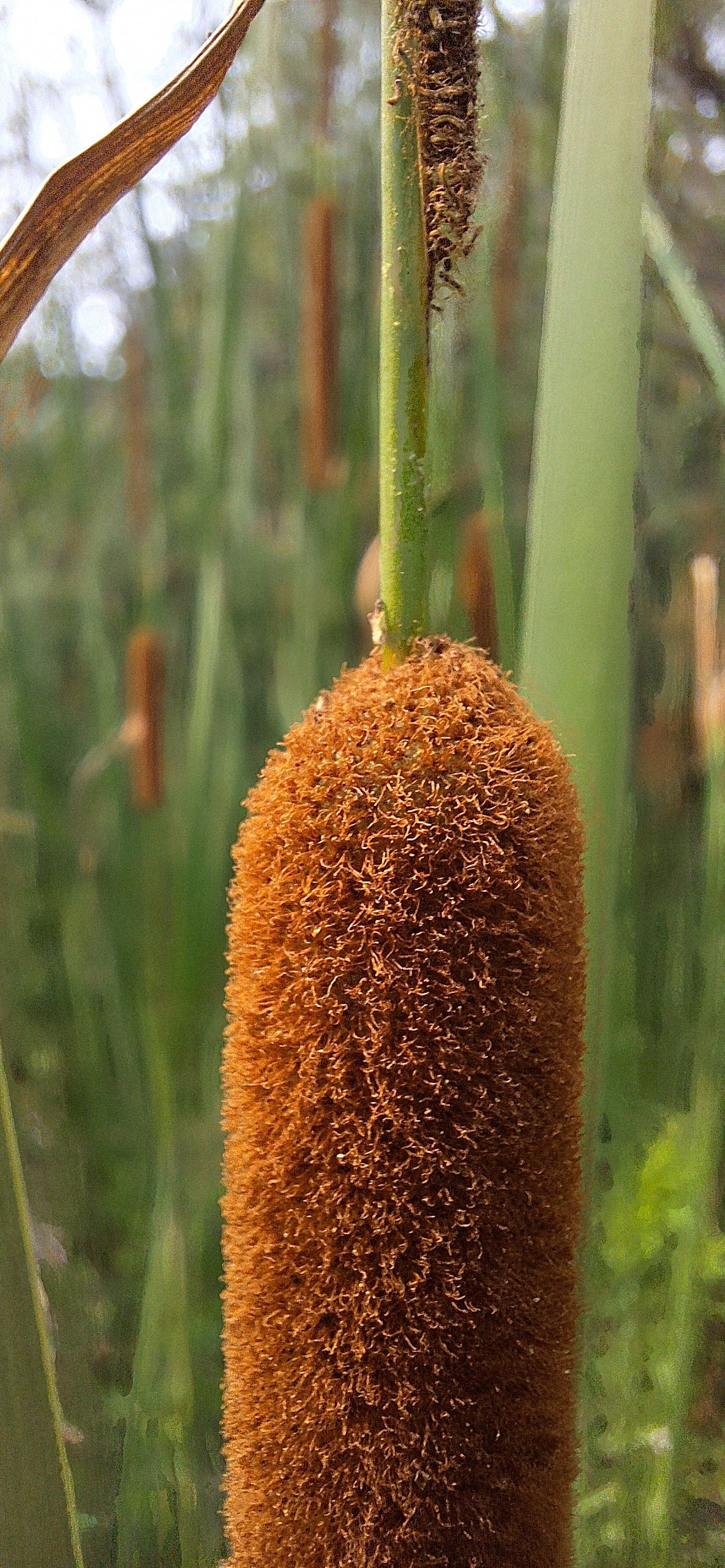
Visual AidThe plant a forager learns first
A cattail in a marsh, its thick brown spike below and the thinner one above. The Knowledge Bank explains that foragers rely on identification rather than resemblance, and that cattail is the classic teaching plant because its roots hold starch, its young shoots can be eaten, and it grows in wetlands where it is hard to mistake for anything else. That last point is the whole lesson. The first rule is to learn a small number of species completely, and a plant with no dangerous look-alike is where a beginner is allowed to start.
Typha latifolia, female and male spikes. Source: Wikimedia Commons, CC0.
foragev.Ch.5
To search the wild for food
“Sam learned to forage for roots and nuts.”
edibleadj.Ch.5
Safe and fit to eat
“He tested which plants were edible.”
nutritionn.Ch.6
The nourishment food provides
“Acorns offered real nutrition.”
abundantadj.Ch.6
Present in great amounts
“Food proved abundant to those who knew.”
resourcefuladj.Ch.5
Clever at solving problems
“Sam grew resourceful with wild food.”
leachv.Ch.6
To wash a substance out with water
“He would leach the bitterness from acorns.”
barrenadj.Ch.5
Bare and producing little
“The land seemed barren at first.”
locatev.Ch.4
To find the exact place of
“The librarian helped him locate the farm.”
patientadj.Ch.5
Calm and willing to wait
“Foraging rewards the patient.”
thrivev.Ch.6
To grow strong and do well
“Slowly, Sam began to thrive.”
ⓘ The vocabulary words in this list are selected to help you understand and complete this workbook. Some may not appear verbatim in the original novel.
🧠Knowledge Bank question
1According to the Knowledge Bank, what is a forager's first rule?Ch.5
2Something ‘edible’ is safe and fit to eat.Ch.5
3‘Nutrition’ is the ___ that food provides.Ch.6
4‘Abundant’ means present in very small amounts.Ch.6
5Fill in each blank with the correct word.Ch.5
Word choices:forageresourcefulediblesneer- some words will not be used
Sam learned to for wild food.
He grew clever and on the mountain.
6To ‘leach’ acorns is to wash out their ___ with water.Ch.6
7‘Barren’ land is bare and produces little.Ch.5
8To ‘locate’ the farm is to ___ it.Ch.4
9Fill in each blank with the correct word.Ch.6
Word choices:thrivenutritionpatientbarren- some words will not be used
Foraging rewards those who are .
Slowly, Sam began to .
10To ‘thrive’ is to ___.Ch.6
Part 2
Comprehension
Show you understood what happens in Chapters 4–6.
🧠Knowledge Bank · Why People Go Back to the Land
Human Geography · Leaving the City
Americans have repeatedly tried to leave cities for the countryside, and the pattern has a history. Nineteenth-century writers made a philosophy of it, most famously in a two-year experiment beside a Massachusetts pond that argued a person should reduce life to its essentials. Utopian communities took it further, farming collectively and mostly failing within a decade. The largest wave came in the 1960s and 1970s, when hundreds of thousands of young Americans moved to rural land, an episode historians call the back-to-the-land movement. Studies of who stayed found that the successful ones had learned practical skills before arriving and kept some outside income. The romance breaks on the same rock every time. Self-sufficiency is not a rejection of work but an enormous increase in it, and the people who last are the ones who wanted the work rather than the escape.
🧠Knowledge Bank question
1The Knowledge Bank explains that American back-to-the-land movements have usually ___.Ch.4
2At first, the land seems to offer Sam ___.Ch.5
3Sam quickly learns that the forest is full of food.Ch.5
4To make acorns edible, Sam must ___ them.Ch.6
5Write the numbers 1–5 in the boxes to show the correct order of events. Number 1 = what happens first.Chapters 4–6
He claims the abandoned land as his home.
Hunger becomes a daily task he can meet.
The librarian helps him locate the Gribley farm.
Sam masters making fire.
He learns to forage cattails, greens, and acorns.
6Sam eats any plant he finds without testing it.Ch.5
7Foods Sam gathers include cattail roots, wild greens, and ___.Ch.6
8As Sam’s skill grows, hunger changes from an emergency into ___.Ch.6
9The mountain is truly barren and cannot feed anyone.Ch.6
10By the end of Part 2, Sam is becoming a ___.Ch.6
Part 3
Literary Elements
Understanding HOW and WHY Jean Craighead George tells the story across Chapters 4–6.
🧠Knowledge Bank · Telling Two Times at Once
Literary Craft · Flashback Structure
A story that opens in the middle and then reaches back is using a technique the Romans named in medias res, into the middle of things. The opening scene supplies a question, and the flashback supplies the answer while the reader waits to return. Writers manage the jump with clear signals — a change of tense, a section break, a repeated phrase — because a reader who is unsure which time they are in stops trusting the narrator. The structure earns its complication when the two timelines comment on each other, so that knowing the later scene changes how an earlier one reads. Watch for the moment the earlier thread catches up with the opening. That junction is usually placed to make the reader realize how far the character has come, using nothing but the contrast between two versions of the same person.
Visual AidOpening in the middle
Diagram for the Knowledge Bank on flashback structure. Card 1 is the opening scene, card 2 is the question it plants, card 3 is the flashback that answers it, and card 4 is the rule that keeps the whole arrangement working. The Knowledge Bank gives the Roman name for the technique. Notice that the opening scene is not the beginning of the story at all. It is chosen because of the question it raises, and the book spends its first stretch catching up to it.
How a story that opens in the middle works, as described in the Knowledge Bank. Drawn for Garden Heights Academy.
Setting as character
The mountain — first an enemy, then a generous companion Sam must know and love.
Character arc
Sam’s growth from helpless boy to capable woodsman, skill by learned skill.
Verisimilitude
George’s real, correct plant and animal lore, which makes the survival feel true.
🧠Knowledge Bank question
1According to the Knowledge Bank, why must a writer signal a jump backward in time clearly?Ch.5
2Fill in each blank with the correct literary term.Ch.5
Word choices:setting as charactercharacter arcrhymeindex- some words will not be used
The mountain treated like a living presence is .
Sam’s growth from helpless to capable is his .
3A character arc is a character’s change and growth across a story.Ch.6
4George’s real, correct plant lore gives the book ___.Ch.6
5Sam’s growing love for the mountain measures his change from ___ to inhabitant.Ch.6
6Verisimilitude means a story feels true to real life.Ch.6
7The book lingers on how-to details because the details ARE Sam’s ___.Ch.6
8Fill in each blank with the correct literary term.Ch.6
Word choices:verisimilitudesetting as characternarratormotif- some words will not be used
George’s accurate plant lore gives the book .
The mountain as a living presence is .
9The land’s shift from enemy to companion reflects Sam’s growing skill.Ch.6
10Sam’s quiet new confidence comes mainly from ___.Ch.6
Part 4
Think Deeper
Four deeper challenges — no single-word recall. Read, weigh the evidence, and reason it out.
🧠Knowledge Bank · What Is Owed to the People You Left
Ethics · Independence and Family
Philosophers describe family duties as associative obligations: they arise from a relationship rather than from a promise or a contract, which is why they are hard to argue about and hard to escape. A young person seeking independence is not doing something wrong; developmental research treats separation as a necessary task of adolescence. The difficulty is that a departure is never only about the person leaving. Ethicists point out that duties run in both directions, and that the strongest claim a family has is usually not obedience but information — being told, being able to help, not being left to fear the worst. That distinction is useful in practice. Wanting to live differently from your parents is a legitimate exercise of judgment; disappearing without a word is a decision about somebody else’s peace of mind, made without consulting.
Think back over these chapters. A boy who has finally learned to make fire faces a new fear: starving. The mountain looks empty, a green desert with nothing to eat — until, with a kind librarian’s help finding his family’s old land, he starts to look closely. And the closer he looks, the more the ‘empty’ forest fills: cattail roots to boil, wild onions and dandelions to dig, acorns to grind and rinse sweet, fish and mussels in the stream. Meal by patient meal, the mountain stops being a threat and becomes a table set for anyone who has learned its language — and the frightened city boy, his hands busy and sure, quietly becomes someone who belongs to the woods.
Original passage written for Garden Heights — not a quotation from the novel.
1Claim: “Part 2 shows that the mountain is generous, but only to someone who learns its secrets.” — choose the two details that best prove it.Claim & Evidence
2The mountain to a beginner, or The mountain to a skilled forager? Tap each detail to sort it — tap again to switch sides. You can keep tapping to change your answer.Sort into two
◄ The mountain to a beginnerThe mountain to a skilled forager ►
3Match each cause to its result. For each cause, pick its result.Cause & Effect
The librarian finds the old farm→
Sam learns to boil cattails→
He leaches the acorns→
Hunger becomes a daily task→
🧠Knowledge Bank question
4Fill both blanks to complete the reasoning.Build the Argument
The Knowledge Bank argues that family duties are hard to escape because , which shows that .
Part 5
Standardized Test
Reading passage · Eating from the Wild: Foraging · SAT & TOEFL-style practice
Read the passage — the highlighted words are tested — then answer. Tap an answer, then tap it again to confirm.
SATCentral Ideas — the passage's main point
SATDetail — a fact stated in the passage
TOEFLFactual Information — a fact stated in the passage
TOEFLProse Summary — the three sentences that sum it up
TOEFLRhetorical Purpose — why the author included a detail
The Ancient Skill of Foraging
Sam’s discovery that the forest is full of food is really a lesson in foraging — the age-old human skill of gathering wild plants and animals to eat. For almost the entire span of human history, long before farming, people fed themselves this way. They carried in memory a vast library of knowledge: which plants nourished, which cured, and which killed. When Sam learns to eat from his mountain, he is re-learning a small piece of that ancient wisdom.
Some of his foods show how rich the wild can be; cattails, which Sam boils, are so useful that they have been nicknamed a wild supermarket, providing edible roots, shoots, and a flour-like pollen. Acorns are packed with nutrition but also full of bitter, mildly poisonous chemicals called tannins, so Sam cannot simply eat them; he must leach them — soaking or boiling the ground nuts in water to wash the bitterness away — exactly as Native peoples did for thousands of years. And this points to the forager’s single most important rule, and greatest danger: knowledge is everything. The same woods hold nourishing plants and their deadly look-alikes side by side, and telling them apart can be the difference between a meal and a poisoning. This is why Jean Craighead George, a trained naturalist, took such care to put real, correct plant lore into the book. Sam survives because he learns to read a landscape that is a feast for the knowledgeable and a trap for the careless.
Original passage written for Garden Heights — not a quotation from the novel.
1What does the passage mainly explain?SAT · Central Ideas
2For most of human history, people fed themselves by ___.TOEFL · Factual Information
3Cattails are nicknamed a wild ___.SAT · Detail
4Acorns are full of bitter, mildly poisonous ___.TOEFL · Factual Information
5To make acorns safe, Sam must ___ them.SAT · Detail
6Native peoples leached acorns for ___.TOEFL · Factual Information
7The forager’s single most important rule is that ___.SAT · Central Ideas
8The great danger is that nourishing plants grow beside their ___.SAT · Detail
9Prose Summary (TOEFL).The passage explains what foraging is and why knowledge is essential to it. This TOEFL task lists six sentences; choose the THREE that best capture the passage’s main ideas. The other three do not belong — they state minor details or ideas the passage does not present.TOEFL · Prose Summary
10Why did George put real plant lore in the book?TOEFL · Rhetorical Purpose
Part 6 · Optional
Creative Writing
A bonus challenge to practice your English. Take your time and have fun with it.
About This Section
This writing task is optional and is not part of your auto-graded score. The feedback below checks only the basics — length, spelling, and grammar — not whether your ideas are right or wrong. It is meant for classroom discussion and creative practice, so feel free to use your imagination!
Writing Task — Part 2 “Reading What Others Miss”
Sam learns to see a whole pantry where others see a barren forest, simply by gaining knowledge. Write about something you learned to ‘read’ or notice that most people miss — in nature, a skill, a subject, or daily life. What did you learn to see, and how did it change your view? 6–10 sentences. End with why knowledge can reveal a hidden world.
You can start with: “Most people walked right past it, but once I learned to look...”
0 / 40 words minimum
🗣 Teach It · Just for Fun (optional)
No right or wrong — close the screen and tell someone nearby what happened in this part. Can’t find anyone? Tell yourself out loud. The moment you teach it, you truly understand it.
Part 2 Complete!
You finished Chapters 4–6 of My Side of the Mountain.
Here are your auto-graded results:
-
points out of 100
Teach it to someone
The best last step is to teach it. In your own words, explain what happened — retell a favorite scene, teach a character’s big choice, or sum up the main idea for a parent, friend, or classmate. When you can teach it clearly, you truly own it.
Independent study guide by Garden Heights. Not affiliated with or endorsed by Jean Craighead George. Contains original analysis only; no text from the novel is reproduced. Reference text: This workbook follows Jean Craighead George’s classic text (the standard Puffin edition sold worldwide). Revised 2023 UK editions change some wording and may not match the vocabulary studied here.
SAT® is a registered trademark of College Board, which is not affiliated with, and does not endorse, these materials. TOEFL® is a registered trademark of ETS. These materials are not endorsed or approved by ETS. Garden Heights is an independent provider of test-style reading practice.