New here? Just sign up with Google — your account includes Matilda, our gift book, forever.
My Side of the Mountain · Garden Heights
Part 3
for My Side of the Mountain · Part 3 · Chapters 7–9
8 Parts40 min
What Happens in Part 3
One day, watching the sky, Sam sees a peregrine falcon slicing through the air, and an idea seizes him: if he could raise a falcon, he could train it to hunt game and help feed him through the coming winter. It is a bold, difficult plan. To get a young bird he must climb to a falcon’s nest high on a sheer cliff face — a genuinely terrifying climb, with the parent falcons diving and screaming at the intruder. Heart pounding, Sam reaches the ledge and carefully takes one nestling. The experience is so frightening that he names the little bird ‘Frightful.’ Then begins the patient, ancient art of training a bird of prey. Sam learns falconry mostly on his own, from library books and trial and error: he feeds Frightful by hand, keeps her close, teaches her to sit on his fist and to return to him, and slowly wins her trust. As the weeks pass, Frightful grows into a swift, deadly hunter who catches rabbits and pheasants and brings them back — and, just as importantly, into Sam’s dearest companion. In a life of solitude, the falcon becomes his partner, his friend, and a living answer to the loneliness of the wild. Sam is no longer entirely alone on his mountain.
The bold plan, a bond formed, and loneliness answered
Cross-Curricular
The peregrine falcon and the ancient art of falconry
Chapter Summary
Ch.
What happens
Chapters 7–8
The Cliff Climb — Sam decides to raise a falcon to help him hunt; he makes a terrifying climb to a cliff nest and takes a nestling he names Frightful.
Chapter 9
Training Frightful — through patient falconry, Sam teaches the young peregrine to hunt and return to him; she becomes a deadly hunter and his dearest companion.
Part 1
Vocabulary
Study 10 key words from Chapters 7–9, then answer each question.
🧠Knowledge Bank · The Fastest Animal Alive
Ornithology · The Peregrine Falcon
The peregrine falcon is the fastest animal on Earth, reaching over 380 kilometers (236.1 miles) an hour in a hunting dive called a stoop. Everything about the bird serves that dive. It folds into a teardrop shape, and small bony cones inside each nostril slow the incoming air so it can still breathe at speed. A third eyelid, the nictitating membrane, sweeps across the eye to clean and protect it without blinding the bird. Peregrines strike prey in mid-air with clenched feet. Their recent history is also a landmark in conservation: the pesticide DDT thinned their eggshells so badly that they vanished from the eastern United States by the 1960s, and after the chemical was banned, captive breeding restored them so completely that they now nest on city skyscrapers, which suit them because tall ledges and abundant pigeons are exactly what a peregrine wants.
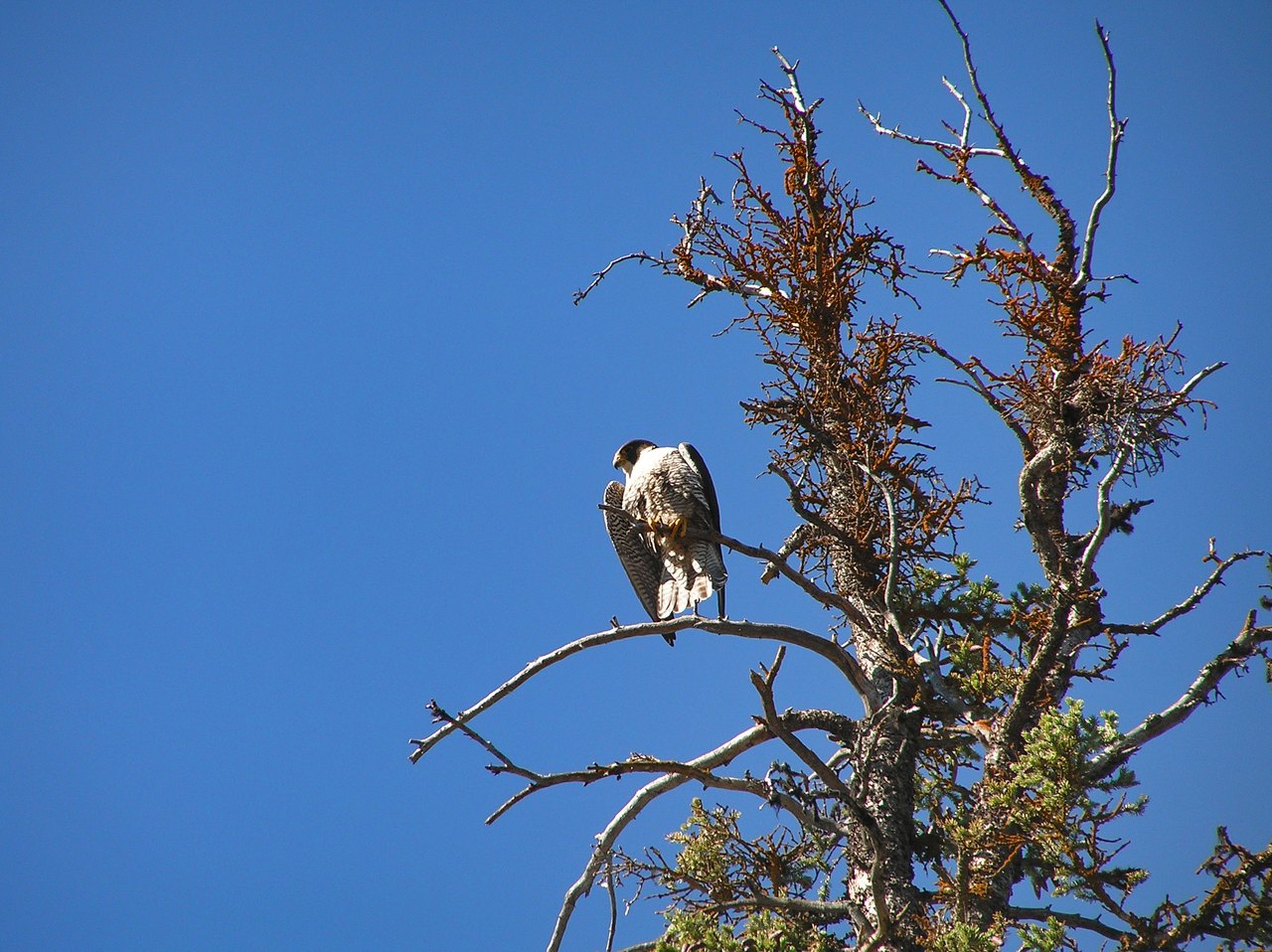
Visual AidBuilt entirely for one dive
A peregrine falcon at rest on a bare branch. The Knowledge Bank explains that this is the fastest animal on Earth, reaching over 380 kilometers (236.1 miles) an hour in the hunting dive called a stoop, and that everything about the bird serves that dive: it folds into a teardrop, small bony cones inside each nostril slow the incoming air so it can still breathe, and a third eyelid sweeps the eye clean without blinding it. Look at how compact it is even sitting still. Nothing on that body is loose.
Peregrine falcon perched. Source: Wikimedia Commons, public domain.
falconn.Ch.7
A swift bird of prey
“Sam spotted a falcon slicing the sky.”
talonn.Ch.8
A sharp claw of a bird of prey
“Frightful gripped his glove with her talons.”
tamev.Ch.9
To make a wild animal trusting
“It took patience to tame the young bird.”
companionn.Ch.9
A creature or person you share life with
“Frightful became his closest companion.”
perilousadj.Ch.8
Full of danger
“The climb to the nest was perilous.”
nestlingn.Ch.8
A young bird still in the nest
“He took one nestling from the ledge.”
stoopn.Ch.9
A falcon’s fast hunting dive
“In a stoop a falcon dives at great speed.”
patiencen.Ch.9
Calm, steady waiting
“Falconry demands enormous patience.”
trustn.Ch.9
Confidence in someone’s reliability
“The bird returned out of trust.”
fierceadj.Ch.9
Powerful and intense
“Frightful was a fierce little hunter.”
ⓘ The vocabulary words in this list are selected to help you understand and complete this workbook. Some may not appear verbatim in the original novel.
🧠Knowledge Bank question
1According to the Knowledge Bank, what lets a peregrine keep breathing during its dive?Ch.7
2A ‘talon’ is a sharp claw of a bird of prey.Ch.8
3To ‘tame’ a wild animal is to make it ___.Ch.9
4‘Perilous’ means safe and easy.Ch.8
5Fill in each blank with the correct word.Ch.8
Word choices:nestlingperilousfalconsneer- some words will not be used
The climb to the nest was .
Sam carefully took one from the ledge.
6A ‘companion’ is one you ___ life with.Ch.9
7A ‘stoop’ is a falcon’s fast hunting dive.Ch.9
8‘Patience’ is calm, steady ___.Ch.9
9Fill in each blank with the correct word.Ch.9
Word choices:trustfiercetametalon- some words will not be used
The bird returned out of .
Frightful was a little hunter.
10Something ‘fierce’ is powerful and ___.Ch.9
Part 2
Comprehension
Show you understood what happens in Chapters 7–9.
🧠Knowledge Bank · A Partnership Thousands of Years Old
Cultural History · Falconry
Falconry is the practice of hunting with a trained bird of prey, and it is at least three thousand years old, with roots across Central Asia and the Middle East. Its central insight is that a hawk is never tamed in the way a dog is. It stays because it is fed, so the whole craft turns on weight: a falconer weighs the bird daily and flies it at a precise hunting weight, heavy enough to be strong and light enough to be interested in returning. The vocabulary is old enough to have entered English — a bird taken from the wild is a haggard, one raised from the nest an eyas, and to fly free without a tether is to be at hack. Modern falconry is tightly regulated because the birds are protected, so nearly everywhere it requires a license, an inspected facility and an experienced sponsor before anyone may keep a hawk.
Visual AidWhy a hawk comes back
Diagram for the Knowledge Bank on falconry. Card 1 is a bird too heavy to be interested, card 3 is a bird too light to be safe, and card 2 is the narrow flying weight between them. Card 4 is why the scales come out daily. The Knowledge Bank puts it plainly: a hawk is never tamed the way a dog is, and the whole craft turns on that one number. Notice that both dashed arrows point inward. The falconer is always correcting toward the middle, never holding a bird at either end.
Why a falconer weighs the bird every day, as described in the Knowledge Bank. Drawn for Garden Heights Academy.
🧠Knowledge Bank question
1The Knowledge Bank explains that the whole craft of falconry turns on ___.Ch.7
2To get a young bird, Sam must ___.Ch.8
3The climb to the falcon nest is easy and safe.Ch.8
4Sam names the bird ‘Frightful’ because of ___.Ch.8
5Write the numbers 1–5 in the boxes to show the correct order of events. Number 1 = what happens first.Chapters 7–9
He takes a nestling and names her Frightful.
Frightful becomes a hunter and his closest companion.
Sam spots a peregrine falcon and forms a plan.
He climbs the dangerous cliff to the nest.
He patiently trains her through falconry.
6Sam learns falconry mostly from library books and trial and error.Ch.9
7Trained, Frightful catches ___ and brings them back.Ch.9
8Beyond hunting, Frightful becomes Sam’s ___.Ch.9
9After getting Frightful, Sam is completely alone as before.Ch.9
10Sam’s love for Frightful hints that even a boy seeking solitude longs for ___.Ch.9
Part 3
Literary Elements
Understanding HOW and WHY Jean Craighead George tells the story across Chapters 7–9.
🧠Knowledge Bank · Giving a Wild Thing a Character
Literary Craft · Personification
Personification gives human qualities to an animal, object or force, and nature writing depends on it while also distrusting it. The critic John Ruskin coined pathetic fallacy for the habit of projecting a narrator’s mood onto the landscape, so a storm becomes angry and a valley becomes calm. Used carelessly it is sentimental and, in a book about real animals, misleading. Used well it does something else: it records how a solitary person actually experiences company, because someone alone with an animal genuinely begins reading intention into behavior. Modern naturalists handle this by describing what an animal does in precise physical terms and letting the reader supply the feeling. Notice how a good nature writer moves between the two registers, using exact observation when accuracy matters and warmth when the subject is the human’s own attachment.
Character growth
Sam risking a deadly climb — the timid city boy is now bold enough to face real terror.
Relationship
The bond between Sam and Frightful — a fierce, loyal partnership at the story’s heart.
Foreshadowing
Sam’s longing for a companion hints at the human friendships and family still to come.
🧠Knowledge Bank question
1According to the Knowledge Bank, what did the critic John Ruskin call the pathetic fallacy?Ch.8
2Fill in each blank with the correct literary term.Ch.8
Word choices:character growthforeshadowingsettingrhyme- some words will not be used
Sam braving the deadly climb shows his .
His longing for a companion is of friendships to come.
3Foreshadowing hints at events still to come in a story.Ch.9
4The bond between Sam and Frightful is the story’s central ___.Ch.9
5That Sam seeks a companion the moment he can hints he cannot bear total ___.Ch.9
6Character growth is a character becoming braver or wiser across a story.Ch.8
7The difficulty of getting Frightful mainly measures ___.Ch.8
8Fill in each blank with the correct literary term.Ch.9
Word choices:relationshipforeshadowingnarratorrhyme- some words will not be used
The bond between Sam and Frightful is the story’s central .
His need for a companion is of company to come.
9The falcon is only a hunting tool with no deeper meaning.Ch.9
10The name ‘Frightful’ is a small monument to Sam’s ___.Ch.8
Part 4
Think Deeper
Four deeper challenges — no single-word recall. Read, weigh the evidence, and reason it out.
🧠Knowledge Bank · Why You Cannot Simply Take a Bird
Conservation Law · Protecting Wildlife
Taking a wild animal is a legal act with a long history behind it. In the United States the Migratory Bird Treaty Act of 1918 made it an offense to take, possess or sell most native birds, their nests or even their feathers, and it grew out of a trade that had nearly wiped out several species for the millinery market. Birds of prey received further protection, and the Endangered Species Act of 1973 added recovery duties for species at risk. The reasoning is that a wild animal is not property waiting to be claimed; it is part of a population, and removing individuals affects everyone. Modern permits therefore exist for falconry, research and rehabilitation, each requiring training and inspection. The rule that follows is the same one wildlife officers repeat every spring about apparently abandoned young animals: admiration is not a reason to take.
Think back over these chapters. A boy watches a falcon cut the sky like a thrown knife and thinks: I could raise one of those. So he does the un-thinkable — scaling a sheer cliff while the parent birds shriek and dive at his head, a fall waiting below — and comes down with one small, furious nestling, and names her for the terror it took to get her. Then, week by patient week, he teaches her to sit his fist, to fly, to hunt, to come home — and somewhere in the training a hunting tool becomes something more: a friend. And the boy who ran to the mountain to be gloriously alone discovers, in the fierce eyes of a bird, how much he needed someone to share it with.
Original passage written for Garden Heights — not a quotation from the novel.
1Claim: “Part 3 reveals that even Sam, who fled to the wild for solitude, deeply longs for companionship.” — choose the two details that best prove it.Claim & Evidence
2Sam’s dream of solitude, or Sam’s real need for company? Tap each detail to sort it — tap again to switch sides. You can keep tapping to change your answer.Sort into two
◄ Sam’s dream of solitudeSam’s real need for company ►
3Match each cause to its result. For each cause, pick its result.Cause & Effect
Sam climbs the deadly cliff→
He names the bird Frightful→
He trains her with patience→
Frightful becomes his friend→
🧠Knowledge Bank question
4Fill both blanks to complete the reasoning.Build the Argument
The Knowledge Bank argues that taking a wild bird is a legal act because , which shows that .
Part 5
Standardized Test
Reading passage · The Peregrine Falcon · SAT & TOEFL-style practice
Read the passage — the highlighted words are tested — then answer. Tap an answer, then tap it again to confirm.
SATCentral Ideas — the passage's main point
SATDetail — a fact stated in the passage
SATWords in Context — a word's meaning in this passage
SATText Connections — how two parts of the text relate
TOEFLFactual Information — a fact stated in the passage
The Peregrine Falcon and Falconry
Of all the creatures Sam might have chosen, the peregrine falcon is one of the most extraordinary on Earth. The peregrine is the fastest animal alive. When it hunts, it climbs high, then folds its wings and drops into a plunging dive called a stoop, reaching speeds that can top 240 miles (386.2 km) per hour — faster than a race car — before striking a bird in midair. Peregrines are found on every continent except Antarctica, and their vision is so keen that they can spot prey from more than a mile away. To share your life with such a bird is to keep company with a feathered marvel.
The art Sam teaches himself — training a bird of prey to hunt in partnership with a human — is called falconry, and it is astonishingly old, practiced for more than three thousand years. Falconry demands deep patience and knowledge, because a falconer does not truly own the bird, and no amount of handling will ever tame it the way a dog can be. A trained falcon is always free to fly away and never return; it comes back to the falconer’s fist because of careful feeding, conditioning, and trust, not because it is forced. The partnership must be re-earned every single day. Jean Craighead George knew these birds intimately, and she drew Frightful with such accuracy that generations of readers have learned real falconry lore from the book.
Original passage written for Garden Heights — not a quotation from the novel.
1What does the passage mainly describe?SAT · Central Ideas
2The peregrine falcon is the fastest ___ alive.TOEFL · Factual Information
3A falcon’s plunging hunting dive is called a ___.SAT · Detail
4Peregrines live on every continent except ___.TOEFL · Factual Information
5A peregrine can spot prey from more than ___ away.SAT · Detail
6In the passage, falconry is training a bird of prey to ___.TOEFL · Factual Information
7Falconry has been practiced for more than ___ years.SAT · Detail
8A trained falcon returns to the falconer because of ___.TOEFL · Factual Information
9In the passage, tame most nearly means ___.SAT · Words in Context
10Which detail from Part 3 does this passage BEST help explain?SAT · Text Connections
Part 6 · Optional
Creative Writing
A bonus challenge to practice your English. Take your time and have fun with it.
About This Section
This writing task is optional and is not part of your auto-graded score. The feedback below checks only the basics — length, spelling, and grammar — not whether your ideas are right or wrong. It is meant for classroom discussion and creative practice, so feel free to use your imagination!
Writing Task — Part 3 “A Companion”
Frightful becomes Sam’s partner and friend, answering the loneliness of his solitary life. Write about an animal companion or a close friend who has been important to you. How did the bond form, and what does that companionship give you? 6–10 sentences. End with why companionship matters, even to independent people.
You can start with: “I thought I could do it all on my own, until...”
0 / 40 words minimum
🗣 Teach It · Just for Fun (optional)
No right or wrong — close the screen and tell someone nearby what happened in this part. Can’t find anyone? Tell yourself out loud. The moment you teach it, you truly understand it.
Part 3 Complete!
You finished Chapters 7–9 of My Side of the Mountain.
Here are your auto-graded results:
-
points out of 100
Teach it to someone
The best last step is to teach it. In your own words, explain what happened — retell a favorite scene, teach a character’s big choice, or sum up the main idea for a parent, friend, or classmate. When you can teach it clearly, you truly own it.
Independent study guide by Garden Heights. Not affiliated with or endorsed by Jean Craighead George. Contains original analysis only; no text from the novel is reproduced. Reference text: This workbook follows Jean Craighead George’s classic text (the standard Puffin edition sold worldwide). Revised 2023 UK editions change some wording and may not match the vocabulary studied here.
SAT® is a registered trademark of College Board, which is not affiliated with, and does not endorse, these materials. TOEFL® is a registered trademark of ETS. These materials are not endorsed or approved by ETS. Garden Heights is an independent provider of test-style reading practice.