New here? Just sign up with Google — your account includes Matilda, our gift book, forever.
My Side of the Mountain · Garden Heights
Part 5
for My Side of the Mountain · Part 5 · Chapters 13–15
8 Parts40 min
What Happens in Part 5
One day Sam comes upon something he has not seen in months: another human being. A man is asleep near his camp — a wandering college English teacher who has lost his way. Sam is wary at first, guarding the secret of his hidden life, but the stranger turns out to be gentle, curious, and delighted by Sam’s wilderness skills. Sam nicknames him ‘Bando,’ and the two become fast friends. Bando stays for a spell, and together they do the happy work of the woods: they fish, gather food, make music on willow whistles, and talk long into the nights. Bando brings something Sam did not know he was missing — conversation, ideas, news of the wider world, the simple pleasure of another mind. He even gives Sam’s way of life a kind of dignity, treating the boy not as a runaway but as a genuine woodsman and friend. When Bando finally must leave, he promises to come back, and he keeps his word, returning at Christmas and again in the spring. For Sam, Bando becomes almost a second father and a bridge to the human world he left behind. And Sam, who set out to prove he could live entirely alone, discovers how deeply he treasures a friend — and how a life of pure solitude, however grand, has a hollow place in it that only other people can fill.
The visitor, a friendship formed, and solitude questioned
Cross-Curricular
Solitude — the value, and the limits, of being alone in nature
Chapter Summary
Ch.
What happens
Chapters 13–14
Meeting Bando — Sam finds a lost English teacher asleep near camp; wary at first, he befriends the man he nicknames Bando, and they share the happy work of the woods.
Chapter 15
A Second Father — Bando brings conversation, news, and dignity to Sam’s life; when he leaves he promises to return, and does — at Christmas and in spring.
Part 1
Vocabulary
Study 10 key words from Chapters 13–15, then answer each question.
🧠Knowledge Bank · Making Rope From a Plant
Wilderness Skills · Tools and Cordage
Rope is one of the oldest manufactured goods, and it can be made from plants growing almost anywhere. The technique is reverse wrap: split a bundle of fibers in two, twist each strand in one direction, and wind the two around each other in the other direction so that the twist locks itself. Nettle, dogbane and the inner bark of basswood all yield long fibers once the outer material is stripped and the stems have been left to rot slightly, a controlled decay called retting. Fibers are added by overlapping their ends, so a cord can be extended indefinitely. Cordage matters more than it sounds. Without it there are no snares, no bindings for a shelter, no fishing line and no way to attach a stone to a handle, which is why archaeologists treat evidence of rope as a marker of real technical skill.
Visual AidWhy a two-strand cord does not unwind
Diagram for the Knowledge Bank on making rope from a plant. Cards 1 to 4 are the steps in order, and the two curved arrows are the part a reader cannot get from words: the strands are twisted one way and then wrapped the other way. Card 5 is what happens if both turns go the same way. Nothing here is knotted and nothing is glued; the cord holds because the two twists are pulling against each other.
The reverse wrap that locks a plant cord, as described in the Knowledge Bank. Drawn for Garden Heights Academy.
solituden.Ch.13
The state of being alone
“Sam had chosen a life of solitude.”
strangern.Ch.13
A person one does not know
“A sleeping stranger lay near his camp.”
companionshipn.Ch.14
The comfort of having company
“Bando brought welcome companionship.”
waryadj.Ch.13
Cautious and watchful
“Sam was wary of the newcomer at first.”
treasurev.Ch.15
To value greatly
“Sam came to treasure the friendship.”
conversationn.Ch.14
A talk between people
“He had missed simple conversation.”
dignityn.Ch.15
Worthiness of respect
“Bando gave Sam’s life a quiet dignity.”
genuineadj.Ch.14
Real and sincere
“It was a genuine friendship.”
isolationn.Ch.13
The state of being far from others
“Long isolation had its hollow places.”
welcomeadj.Ch.14
Gladly received
“Bando’s company was welcome.”
ⓘ The vocabulary words in this list are selected to help you understand and complete this workbook. Some may not appear verbatim in the original novel.
🧠Knowledge Bank question
1According to the Knowledge Bank, what makes the reverse wrap hold together?Ch.13
2A ‘stranger’ is a person one does not know.Ch.13
3‘Companionship’ is the comfort of having ___.Ch.14
4To be ‘wary’ is to trust instantly.Ch.13
5Fill in each blank with the correct word.Ch.15
Word choices:treasuresolitudestrangersneer- some words will not be used
Sam came to the new friendship.
He had chosen a life of .
6‘Conversation’ is a ___ between people.Ch.14
7‘Dignity’ means worthiness of respect.Ch.15
8A ‘genuine’ friendship is ___.Ch.14
9Fill in each blank with the correct word.Ch.13
Word choices:isolationwarywelcometreasure- some words will not be used
Sam was of the newcomer at first.
Long had its hollow places.
10Something ‘welcome’ is ___.Ch.14
Part 2
Comprehension
Show you understood what happens in Chapters 13–15.
🧠Knowledge Bank · Reading Signs Left by Animals
Zoology · Deer and Their Neighbors
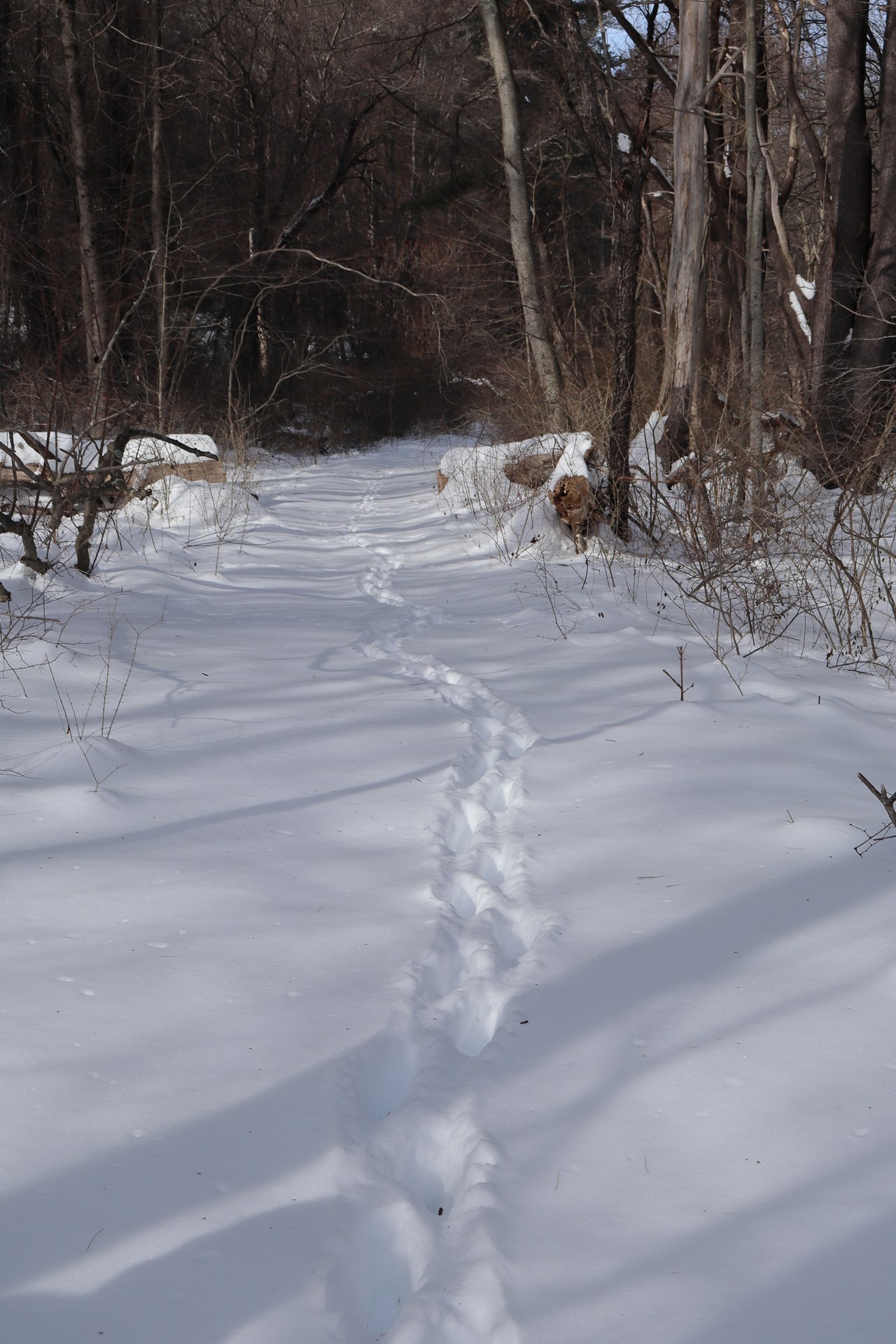
Trackers read a forest through the marks animals leave. Deer are the easiest teachers: their split hoof leaves a heart-shaped print pointing in the direction of travel, and their habit of using the same routes creates faint runs that are visible once you know to look low. In autumn, bucks scrape bark with their antlers, leaving rubs on saplings at a consistent height. Trackers also read scat, the droppings that identify a species and reveal its recent diet, and they note browse lines where every branch has been eaten to the same height. The skill is less about the individual sign than about the pattern. A trail, a water source, a feeding area and a bedding area form a daily circuit, and someone who maps that circuit can predict where an animal will be at dawn instead of hoping to meet one by luck.
Visual AidWhat an animal writes on the ground
Deer tracks along a snowy trail. The Knowledge Bank explains that trackers read a forest through the marks animals leave, and that deer are the easiest teachers: the split hoof leaves a heart-shaped print that points the way the animal was going, and the habit of using the same routes wears faint runs that become visible once you know to look low. Follow the line of prints with your eye. It is not a scattering; it is a decision, made by an animal that has walked this way before.
1The Knowledge Bank explains that a deer's print points ___.Ch.13
2Sam nicknames the man ___.Ch.14
3Sam trusts the stranger instantly and completely.Ch.13
4Bando is a ___ who lost his way.Ch.13
5Write the numbers 1–5 in the boxes to show the correct order of events. Number 1 = what happens first.Chapters 13–15
He nicknames him Bando.
They fish, make music, and talk together.
Wary at first, Sam befriends the man.
Sam finds a stranger asleep near his camp.
Bando leaves but promises to return — and does.
6Bando tries to force Sam to go back home.Ch.14
7Bando brings Sam things he did not know he missed, like ___.Ch.14
8For Sam, Bando becomes almost a ___.Ch.15
9Bando visits only once and never returns.Ch.15
10Meeting Bando shows Sam that a life of pure solitude has ___.Ch.15
Part 3
Literary Elements
Understanding HOW and WHY Jean Craighead George tells the story across Chapters 13–15.
🧠Knowledge Bank · What a Conversation Reveals
Literary Craft · Dialogue After Silence
Dialogue in a book with almost no people in it does disproportionate work. Novelists exploit the contrast: after many pages of a single interior voice, the first sustained conversation changes the texture of the prose entirely, and readers feel the shift as relief or intrusion depending on how it is staged. Writers also use a visitor to solve an information problem, since a stranger asks the questions a reader has been asking, allowing explanation without the narrator lecturing. Craft manuals warn against the crude version, sometimes called an expository exchange, in which characters tell each other things they both already know. The better technique keeps each speaker pursuing their own purpose, so information surfaces as a by-product of a real conversation. Watch what a solitary character reveals to a stranger that they never wrote down when alone, because that gap is genuine characterization.
Bridge character
Bando — who links Sam’s wild life to human society, honoring both.
Theme
Solitude’s value and its limits — the wild is wonderful, but a person longs for company.
Complexity
George holds two truths at once: the solitary life is grand AND a friend brings unmatched joy.
🧠Knowledge Bank question
1According to the Knowledge Bank, why does dialogue do extra work in this novel?Ch.14
2Fill in each blank with the correct literary term.Ch.14
Word choices:bridge characterthemesettingrhyme- some words will not be used
Bando, who links Sam’s two worlds, is a .
Solitude’s value and limits form a key .
3A theme is a big idea a story explores.Ch.15
4George holds two truths at once — solitude is grand AND a friend brings joy — giving the book ___.Ch.15
5Bando differs from the people Sam fled because he ___ Sam’s way of life.Ch.15
6A bridge character connects two different worlds in a story.Ch.14
7By refusing to choose between solitude and society, George keeps the book from being ___.Ch.15
8Fill in each blank with the correct literary term.Ch.15
Word choices:complexitybridge characternarratorrhyme- some words will not be used
Holding two opposite truths at once gives the book .
Bando, who links two worlds, is a .
9Bando’s arrival reveals a loneliness Sam had been quietly carrying.Ch.15
10Bando’s friendship mainly prepares the reader for the book’s final question about ___.Ch.15
Part 4
Think Deeper
Four deeper challenges — no single-word recall. Read, weigh the evidence, and reason it out.
🧠Knowledge Bank · How Cooperation Gets Started
Social Psychology · Trusting a Stranger
Researchers study trust with simple games. In the trust game one player may send money to a stranger, the amount is multiplied, and the stranger decides how much to return; classic experiments find most people send a substantial share and most recipients return enough to make it worthwhile. Repeated interaction strengthens this sharply, because both sides now face a future. Political scientist Robert Axelrod ran tournaments of strategies for repeated cooperation and found the winner was a simple rule called tit for tat — cooperate first, then copy whatever the other player did last. Its virtues were being nice, being provokable, and forgiving quickly. The finding maps onto ordinary life. A first meeting between strangers usually opens with a small, cheap act of generosity, and what happens next depends far less on character than on whether either expects to meet again.
Visual AidHow cooperation starts
Diagram for the Knowledge Bank on trust. Cards 1 to 3 are the trust game researchers use: one person sends something and risks losing it, the amount grows, and the other decides how much to send back. Card 4 is what the experiments actually find, and card 5 is what changes when the two will meet again. Notice that step 1 is a real risk, not a formality. Nothing forces the second player to return anything, which is exactly why the result is worth knowing.
What the trust game shows about cooperation, as described in the Knowledge Bank. Drawn for Garden Heights Academy.
Think back over these chapters. A boy who has not spoken to another human in months rounds a bend and finds a man asleep in his woods — and his first instinct is to hide, to protect the secret life he has built. But the stranger wakes gentle and curious, charmed rather than alarmed by a boy who lives in a tree, and something in Sam that had gone quiet comes roaring back to life: the pleasure of talk, of ideas, of another mind beside his own. They fish and whittle whistles and stay up late, and when the man must go he promises to return — and does, at Christmas, in spring. And the boy who set out to prove he needed no one discovers, with a warmth that surprises him, how much he had been missing a friend.
Original passage written for Garden Heights — not a quotation from the novel.
1Claim: “Part 5 reveals that Sam’s solitary life, however wonderful, has a loneliness in it that only a friend can fill.” — choose the two details that best prove it.Claim & Evidence
2What solitude gives Sam, or What Bando gives Sam? Tap each detail to sort it — tap again to switch sides. You can keep tapping to change your answer.Sort into two
◄ What solitude gives SamWhat Bando gives Sam ►
3Match each cause to its result. For each cause, pick its result.Cause & Effect
Sam finds the sleeping stranger→
He befriends and names Bando→
Bando respects Sam’s way of life→
Bando promises to return→
🧠Knowledge Bank question
4Fill both blanks to complete the reasoning.Build the Argument
The Knowledge Bank argues that repeated meetings make cooperation stronger because , which shows that .
Part 5
Standardized Test
Reading passage · Solitude: Being Alone in Nature · SAT & TOEFL-style practice
Read the passage — the highlighted words are tested — then answer. Tap an answer, then tap it again to confirm.
SATCentral Ideas — the passage's main point
SATDetail — a fact stated in the passage
SATWords in Context — a word's meaning in this passage
SATText Connections — how two parts of the text relate
TOEFLFactual Information — a fact stated in the passage
TOEFLVocabulary — a tested word's meaning here
Thoreau and the Limits of Solitude
Sam’s joy at meeting Bando quietly raises one of the book’s biggest questions: how much time alone does a person really want? Sam’s adventure belongs to a long tradition of people who go alone into nature to find themselves. The most famous is Henry David Thoreau, who in the 1840s left ordinary society to live by himself in a small cabin at Walden Pond, and then wrote a beloved book about the peace, clarity, and self-reliance he discovered there. Thoreau was not wrong. Real solitude in nature can calm a restless mind, sharpen the senses, build independence, and teach a person who they truly are when no one is watching.
But solitude has a limit, and Bando’s arrival reveals it: human beings are deeply social creatures. Long stretches of isolation, even in a beautiful place, tend to bring loneliness, and most people who seek time alone end up craving connection again. After months with nobody to answer him, a single long conversation is worth more to Sam than any meal. Even Thoreau regularly walked into town and welcomed visitors; he was alone, but never entirely cut off. Jean Craighead George is honest about both halves of this truth, and Sam’s delight in company is genuine rather than polite. The lesson is not that solitude is bad; it is that solitude is one ingredient of a good life, not the whole recipe.
Original passage written for Garden Heights — not a quotation from the novel.
1What question does the passage mainly explore?SAT · Central Ideas
2The most famous person who lived alone in nature was ___.TOEFL · Factual Information
3Thoreau wrote about the peace and ___ he found alone.SAT · Detail
4Real solitude in nature can ___ a restless mind.TOEFL · Factual Information
5The passage says human beings are deeply ___ creatures.SAT · Detail
6Long isolation, even in a beautiful place, tends to bring ___.TOEFL · Factual Information
7In the passage, conversation most nearly means ___.SAT · Words in Context
8Even Thoreau ___ visitors to his cabin.TOEFL · Factual Information
9In the passage, genuine most nearly means ___.TOEFL · Vocabulary
10Which part of the book does this passage BEST help explain?SAT · Text Connections
Part 6 · Optional
Creative Writing
A bonus challenge to practice your English. Take your time and have fun with it.
About This Section
This writing task is optional and is not part of your auto-graded score. The feedback below checks only the basics — length, spelling, and grammar — not whether your ideas are right or wrong. It is meant for classroom discussion and creative practice, so feel free to use your imagination!
Writing Task — Part 5 “Alone and Together”
Sam loves his solitude but lights up at a friend’s company — both are true. Write about how you feel about time alone versus time with others. When do you crave solitude, and when do you most need people? 6–10 sentences. End with the balance that feels right for you.
You can start with: “I love being on my own, and yet there are moments when...”
0 / 40 words minimum
🗣 Teach It · Just for Fun (optional)
No right or wrong — close the screen and tell someone nearby what happened in this part. Can’t find anyone? Tell yourself out loud. The moment you teach it, you truly understand it.
Part 5 Complete!
You finished Chapters 13–15 of My Side of the Mountain.
Here are your auto-graded results:
-
points out of 100
Teach it to someone
The best last step is to teach it. In your own words, explain what happened — retell a favorite scene, teach a character’s big choice, or sum up the main idea for a parent, friend, or classmate. When you can teach it clearly, you truly own it.
Independent study guide by Garden Heights. Not affiliated with or endorsed by Jean Craighead George. Contains original analysis only; no text from the novel is reproduced. Reference text: This workbook follows Jean Craighead George’s classic text (the standard Puffin edition sold worldwide). Revised 2023 UK editions change some wording and may not match the vocabulary studied here.
SAT® is a registered trademark of College Board, which is not affiliated with, and does not endorse, these materials. TOEFL® is a registered trademark of ETS. These materials are not endorsed or approved by ETS. Garden Heights is an independent provider of test-style reading practice.