New here? Just sign up with Google — your account includes Matilda, our gift book, forever.
Narnia: The Lion, the Witch and the Wardrobe · Garden Heights
Part 1
for Narnia: The Lion, the Witch and the Wardrobe · Part 1 · Chapters 1–2
a novel by C.S. Lewis
30 min6 Parts
This workbook is built on a solid pedagogical foundation, effectively integrating content and language learning based on the CLIL framework (Content and Language Integrated Learning), elevated by our unique 5th C — Connection — and an integrated Standardized Test section that weaves every SAT & TOEFL question type right into the novel, so learners build real test skills easily, naturally, and with fun.
💭 Before You Read · Just for Fun
No right or wrong answers — just think or chat about it: Have you ever found a hidden or secret place? If a plain old cupboard suddenly led somewhere magical, what would you do — step in, or run for your family?
What Happens in Part 1
Four children — Peter, Susan, Edmund, and Lucy Pevensie — are sent away from war-time London to the huge country house of an old Professor. Exploring on a rainy day, Lucy hides inside a tall wardrobe and walks backwards through the fur coats into a snowy wood lit by a single lamp-post. There she meets Mr. Tumnus, a Faun carrying parcels and an umbrella. He takes her home for tea, but then admits, in tears, that he is in the pay of the White Witch — who keeps Narnia in endless winter — and was supposed to hand any human child over to her. Unable to do such an unkind thing, he guides Lucy safely back to the lamp-post.
What We Will Learn
Literary Element
What It Means
Setting
The time and place of a story — a war-time house and a snowy magic wood
Character
The people or creatures a story is about — the four children and Mr. Tumnus
Conflict
The main problem — Tumnus must choose between the Witch’s orders and being kind
Chapter Summary
Chapter
Key Events
Ch.1
Lucy Looks into a Wardrobe — the four children arrive at the Professor’s house; while exploring, Lucy steps into a wardrobe and finds a snowy wood with a lamp-post
Ch.2
What Lucy Found There — Lucy meets Mr. Tumnus the Faun, has tea in his cave, and learns he was meant to betray her to the White Witch, but he sets her free instead
Copyright Notice
Independent study guide by Garden Heights. Not affiliated with or endorsed by C.S. Lewis or HarperCollins. No text from the novel is reproduced. Students should read the original book.
Part 1
Vocabulary
Study 10 key words from Chapters 1–2, then answer each question.
🧠Knowledge Bank · What Is a Faun
Lexicology · What Is a Faun
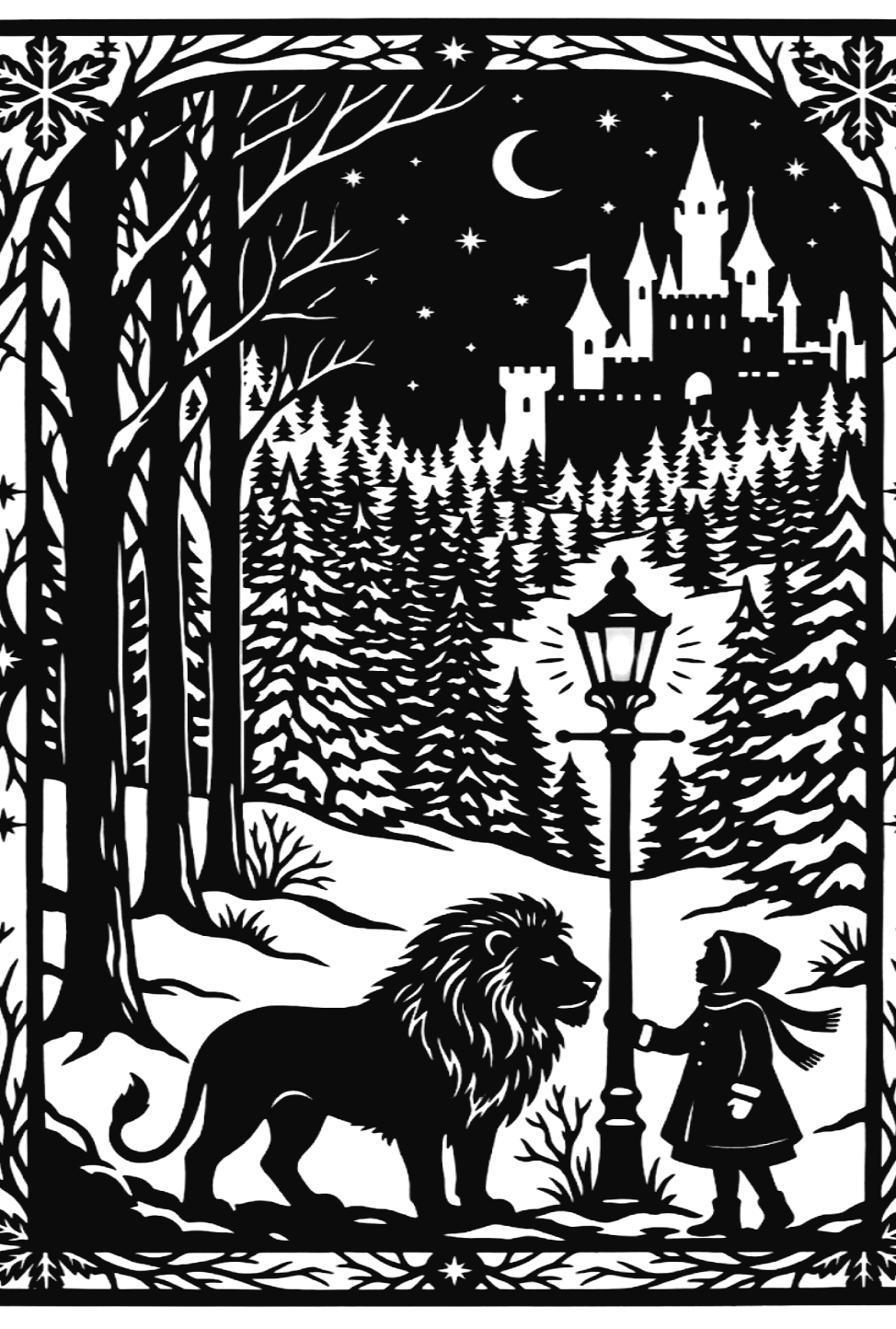
Mr. Tumnus is a faun — a creature from ancient Roman and Greekmythology that is half man and half goat. Lewis said the whole of Narnia grew from a single picture in his mind: “a Faun carrying an umbrella and parcels in a snowy wood.” He had carried that image since he was about sixteen, and years later it became this very scene. The half-goat, half-human faun Lucy meets steps straight out of Greek and Roman myth, where fauns and satyrs were woodland spirits. Lewis blends such old myths freely — a Roman faun, a Victorian lamp-post and English children together — so Narnia feels like every story at once. Notice what Lewis never does: nobody tells Lucy what a faun is, and the book does not pause to explain. The picture carries it — hooves, umbrella, parcels, a scarf in the snow — and that is enough to make the wood feel unmistakably not England.
ⓘ Vocabulary words are selected to help you understand and complete this workbook. Some may not appear verbatim in the novel.
wardroben.Ch.1
A tall cupboard for hanging clothes
“Lucy stepped inside the great wooden wardrobe and pushed past the coats.”
faunn.Ch.2
A mythical creature, half man and half goat
“The faun had a man’s body but the legs and horns of a goat.”
inquisitiveadj.Ch.1
Eager to learn or know; curious
“Inquisitive Lucy could not resist opening the wardrobe door.”
parceln.Ch.2
Something wrapped in paper to be carried
“Mr. Tumnus dropped his parcels in surprise when he saw Lucy.”
gloomyadj.Ch.1
Dark and rather sad
“It was a gloomy, rainy day with nothing to do outside.”
peculiaradj.Ch.1
Strange or unusual
“It felt peculiar to push through coats and touch cold branches.”
muffledadj.Ch.1
Made quieter or softer
“The deep snow muffled every sound in the wood.”
melancholyadj.Ch.2
Sad and thoughtful
“The faun played a strange, melancholy tune on his flute.”
spareadj.Ch.1
Extra; kept for use when needed
“They were given a spare room at the top of the house.”
scramblev.Ch.1
To climb or move quickly using your hands and feet
“Lucy had to scramble over coats to reach the back of the wardrobe.”
🧠Knowledge Bank question
1According to the Knowledge Bank, what did Lewis say the whole of Narnia grew from?Ch.1
2A “faun” is a creature that is half man and half goat.Ch.2
3Lucy is “inquisitive.” This means she is —Ch.1
4Fill in each blank with the correct word.Ch.1–2
Word choices:parcelswardrobefaungloomy- some words will not be used
Mr. Tumnus dropped his
A creature half man and half goat is a
5If a day is “gloomy,” it is bright and cheerful.Ch.1
6Something “peculiar” is —Ch.1
7The deep snow “muffled” every sound. This means the sound was —Ch.1
8A “melancholy” tune is a happy, lively one.Ch.2
9Fill in each blank with the correct word.Ch.1
Word choices:sparescramblemuffledpeculiar- some words will not be used
The children were given a
Lucy had to climb and
10To “scramble” over the coats means to —Ch.1
Part 2
Comprehension
How well do you understand Chapters 1–2?
🧠Knowledge Bank · Reading a New World
Narrative Logic · Reading a New World
When a story opens a doorway into a strange place, strong readers slow down and notice the sensorydetails — the crunch of snow, the cold air, the glow of the lamp-post. These details tell us Lucy has truly crossed into another world. Chapter 1 covers Lucy Looks into a Wardrobe — the four children arrive at the Professor’s house; while exploring, Lucy steps into a wardrobe and finds a snowy wood with a lamp-post. Chapter 2 covers What Lucy Found There — Lucy meets Mr. Tumnus the Faun, has tea in his cave, and learns he was meant to betray her to the White Witch, but he sets her free instead. Four children — Peter, Susan, Edmund, and Lucy Pevensie — are sent away from war-time London to the huge country house of an old Professor. Read the two chapters as one movement: an evacuation that empties a child’s world, then a wardrobe that hands her a whole new one. The book’s first real subject is displacement.
Visual AidHow a reader knows she has really crossed
Diagram for the Knowledge Bank on reading a new world. It draws the three places Lucy passes through as three boxes, then sets the proof underneath: the three sense-details the Knowledge Bank names, snow, cold and the lamp-post. It does not add details the chapter does not give. Notice that the proof is all physical — a cupboard can be imagined, but cold on the skin is the sign that a story has moved somewhere real.
Sense-details named in the Knowledge Bank. Drawn for Garden Heights Academy.
🧠Knowledge Bank question
1The Knowledge Bank explains what strong readers do when a story opens a doorway into a strange place. What is it?Ch.1
2Who is the first child to enter the wardrobe and reach Narnia?Ch.1
3Lucy steps out of the wardrobe into a hot, sandy desert.Ch.1
4What is standing in the middle of the wood where Lucy arrives?Ch.1
5What does Mr. Tumnus do for Lucy when they first meet?Ch.2
6Put these events from Part 1 in the correct order. Write 1–4 (1 = first).Ch.1–2
Lucy hides in the wardrobe and walks into a snowy wood.
Lucy meets Mr. Tumnus the Faun by the lamp-post.
Mr. Tumnus tearfully confesses and leads Lucy safely back.
The children arrive at the Professor’s big country house.
7Mr. Tumnus had been ordered to hand over any human child to the White Witch.Ch.2
8What has the White Witch done to Narnia?Ch.2
9Why does Mr. Tumnus cry while Lucy is in his cave?Ch.2
10In the end, Mr. Tumnus helps Lucy get back safely to the lamp-post.Ch.2
Part 3
Literary Elements
Understanding HOW and WHY C.S. Lewis writes Chapters 1–2 the way he does.
🧠Knowledge Bank · Setting, Character, and Conflict
Literary Technique · Setting, Character, and Conflict
Lewis builds his opening from three blocks: setting (a war-time house, then a snowy wood), character (curious Lucy and the kindly Faun), and conflict (Mr. Tumnus must choose between obeying the cruel Witch and doing what is right). History — the Blitz & evacuation: in 1939–41, bombing of British cities moved about 3 million people (mostly children) to the countryside under Operation Pied Piper; C.S. Lewis hosted real evacuees. Science — snow & the senses: snow muffles sound because air trapped between the flakes absorbs sound waves — one reason the wood feels so real. Exploring on a rainy day, Lucy hides inside a tall wardrobe and walks backwards through the fur coats into a snowy wood lit by a single lamp-post. There she meets Mr. Tumnus, a Faun carrying parcels and an umbrella.
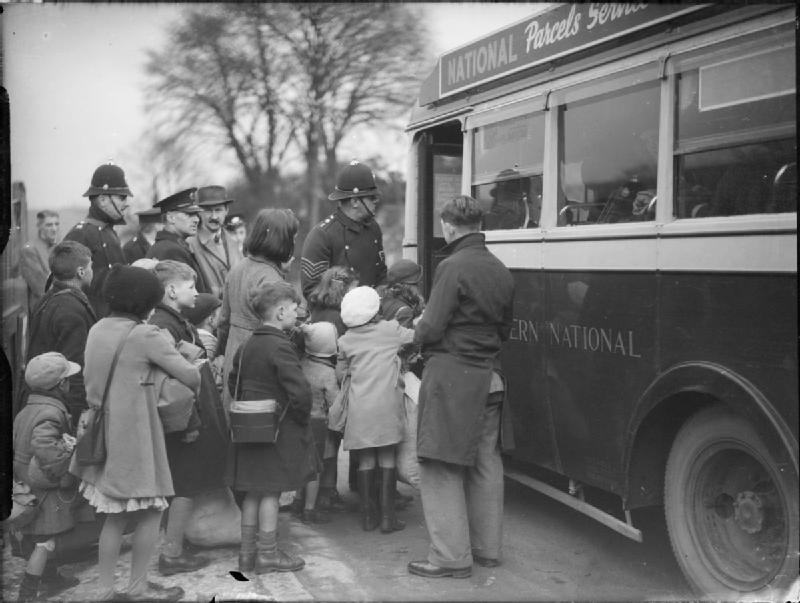
Visual AidThe evacuation the opening line means
Photograph of children evacuated from Bristol boarding a bus at Kingsbridge in Devon in 1940. The Knowledge Bank explains that the four children are sent to the Professor’s house because of the air raids on British cities, and that about three million people, most of them children, were moved to the country. This is what that sentence looked like: coats, a box each, and strangers in charge. None of these children is a Pevensie and the house is not in the picture. Notice how young the smallest are, and that no parent stands with them.
Evacuees from Bristol at Kingsbridge, Devon, 1940; Ministry of Information photograph D 2590, Imperial War Museums. Source: Wikimedia Commons, public domain.
📚 Literary Devices in This Part · definitions & examples
Setting is the time and place of a story. Part 1 has two settings: a country house during the war, and the snowy wood of Narnia.Character means a person or creature in a story. Lucy and Mr. Tumnus are the main characters of Part 1.Conflict is the main problem a character faces. Mr. Tumnus’s conflict is the struggle between obeying the Witch and being kind to Lucy.
The questions below are mixed — not grouped by device. Decide which device each one is about.
🧠Knowledge Bank question
1According to the Knowledge Bank, what was Operation Pied Piper?Ch.1
2A character can be a creature, not only a human being.Ch.2
3Fill in the blanks with the correct words.Ch.2
Word choices:conflictstruggleteasnow- some words will not be used
The main problem in a story is the
A conflict is a kind of
4Lucy and Mr. Tumnus are the story’s —Ch.2
5Go beyond the definition: what does Mr. Tumnus’s conflict mainly help the reader understand?Ch.2
6Fill in the blanks with the correct words.Ch.1
Word choices:settingtimeplacefaun- some words will not be used
The time and place of a story is its
Setting tells the reader the place and the
7What is Mr. Tumnus’s conflict in Part 1?Ch.2
8Setting tells us when and where a story happens.Ch.1
9Fill in the blanks with the correct words.Ch.2
Word choices:charactercreaturesettingsnow- some words will not be used
A person or creature in a story is a
Mr. Tumnus is a magical
10Which sentence best combines the setting, character, and conflict of Part 1?Ch.1–2
Part 4
Think Deeper
Four deeper challenges — no single-word recall. Read, weigh the evidence, and reason it through.
🧠Knowledge Bank · Doing the Right Thing
Ethical Reasoning · Doing the Right Thing
The heart of Part 1 is conscience — the inner voice that tells us right from wrong. Mr. Tumnus is paid to betray Lucy, yet he cannot bring himself to harm a kind, trusting child. The story opens during the Second World War. To keep children safe from German bombing raids on London (the Blitz ), the British government moved hundreds of thousands of city children to the countryside — a plan nicknamed Operation Pied Piper. Lewis really did host evacuated schoolchildren at his own home, which helped give him the idea for four children staying in a big country house. This book contains many allusions (references) to Christianity, because its author, C.S. Lewis, was a well-known Christian writer. In Narnia, humans are called “Sons of Adam” and “Daughters of Eve,” after Adam and Eve, the first people in the Bible’s book of Genesis. Lewis hides none of it. A Christian frame, a Roman faun and a London evacuation share one wood, and each reader takes what they recognize.
1Claim: “Mr. Tumnus chooses his conscience over the White Witch’s orders.” — choose the two details that best prove it.Claim & Evidence
2Where does each detail belong? Tap each item to sort it — tap again to switch sides. You can keep tapping to change your answer.Sort into two
◄ Our worldNarnia ►
3Match each cause to its result. For each cause, pick its result.Cause & Effect
Lucy steps in among the fur coats→
Tumnus invites Lucy home for tea→
Tumnus took the Witch’s pay to catch humans→
Tumnus cannot bring himself to betray her→
🧠Knowledge Bank question
4Fill both blanks to complete the reasoning.Build the Argument
The Knowledge Bank argues that Part 1 turns on conscience because , which shows that .
Part 5
Standardized Test · Vocabulary in Context & Main Idea
Part 1 builds four exam reading skills — Vocabulary in Context, Main Idea, Inference, and Author’s Purpose — in the styles the SAT and TOEFL use. Read the passage (the highlighted words are tested below), then choose the answer best supported by the text.
Read the passage — the highlighted words are tested — then answer. Tap an answer, then tap it again to confirm.
SATWords in Context — a word's meaning in this passage
SATInference — a conclusion the passage implies
SATCentral Ideas — the passage's main point
SATText Structure & Purpose — how the passage is built, and why
TOEFLFactual Information — a fact stated in the passage
TOEFLVocabulary — a tested word's meaning here
TOEFLInference — what the passage implies
Lucy Finds the Wardrobe
The four Pevensie children — Peter, Susan, Edmund, and little Lucy — had been evacuated from London to a huge, rambling country house, far from the bombing of the war. The move was abrupt, and at first the immense old house felt strange and remote. Their first day was gloomy and wet, with nothing to do but explore its long passages and empty rooms. Inquisitive Lucy wandered ahead of the others until she came to a bare spare room that held nothing except one tall wardrobe. Something about it felt peculiar, and she could not resist opening the door. She stepped in among the soft fur coats and scrambled further and further back, reluctant to turn around — until her fingers touched something cold and rough, and snow crunched beneath her shoes.
Without quite knowing how, she had crossed into a vast, snow-covered wood, where a faun stood beneath a single lamp-post holding an umbrella and an armful of brown-paper parcels. The creature, whose name was Mr. Tumnus, gave such a violent start that he dropped every parcel, yet he kindly invited her to tea in his snug little cave. He played a low, melancholy tune on his flute while the deep snow outside muffled every other sound. At last, in tears, he confessed a troubling secret: the White Witch, who holds Narnia in endless winter, had ordered him to betray any human child and hand it over to her. Tumnus could not bring himself to commit so cruel an act. Instead he guided Lucy safely back to the lamp-post.
Original passage written for Garden Heights — not a quotation from the novel.
1According to the passage, what had the White Witch ordered Tumnus to do?TOEFL · Factual Information
2In the passage, “melancholy” most nearly means —TOEFL · Vocabulary
3As used in the passage, “peculiar” most nearly means —SAT · Words in Context
4In the passage, “muffled” most nearly means —SAT · Words in Context
5The passage most strongly suggests that Tumnus is —SAT · Inference
6Which choice best states the central idea of the passage?SAT · Central Ideas
7According to the passage, why had the children been sent to the country house?TOEFL · Factual Information
8It can reasonably be inferred from the passage that Mr. Tumnus —SAT · Inference
9The passage most strongly suggests that the wardrobe —TOEFL · Inference
10The detail that the snow “muffled every other sound” mainly helps the reader to —SAT · Text Structure & Purpose
Part 6 · Optional
Creative Writing
A bonus challenge to practice your English.
About This Section
This writing task is optional and not part of your auto-graded score. Feedback checks length, spelling, and grammar only.
Writing Task — Part 1 “Through the Wardrobe”
Use setting to describe the moment Lucy first steps out of the wardrobe into Narnia. What does she see, hear, feel, and smell as the coats turn into snowy branches? Write at least 40 words.
You can start with: “At first Lucy felt soft fur coats around her, but then her fingers touched something cold and rough, and she realized…”
0 / 40 words minimum
🗣 Teach It · Just for Fun (optional)
No right or wrong — close the screen and tell someone nearby what happened in this part. Can’t find anyone? Tell yourself out loud. The moment you teach it, you truly understand it.
Part 1 Complete!
You finished Chapters 1–2 of Narnia: The Lion, the Witch and the Wardrobe.
Here are your auto-graded results:
-
points out of 100
Teach it to someone
The best last step is to teach it. In your own words, explain what happened — retell a favorite scene, teach a character’s big choice, or sum up the main idea for a parent, friend, or classmate. When you can teach it clearly, you truly own it.
SAT® is a registered trademark of College Board, which is not affiliated with, and does not endorse, these materials. TOEFL® is a registered trademark of ETS. These materials are not endorsed or approved by ETS. Garden Heights is an independent provider of test-style reading practice.