New here? Just sign up with Google — your account includes Matilda, our gift book, forever.
📚
Garden Heights
Members sign in to continue.
Narnia: The Lion, the Witch and the Wardrobe · Garden Heights
Part 2
for Narnia: The Lion, the Witch and the Wardrobe · Part 2 · Chapters 3–4
a novel by C.S. Lewis
30 min6 Parts
This workbook is built on a solid pedagogical foundation, effectively integrating content and language learning based on the CLIL framework (Content and Language Integrated Learning), elevated by our unique 5th C — Connection — and an integrated Standardized Test section that weaves every SAT & TOEFL question type right into the novel, so learners build real test skills easily, naturally, and with fun.
💭 Before You Read · Just for Fun
No right or wrong answers — just think or chat about it: Has anyone ever offered you a treat or gift to get you to do what they wanted? How do you decide whether you can trust someone who is suddenly very nice to you?
What Happens in Part 2
Back home, Lucy tells the others about Narnia, but no time has passed and nobody believes her. A few days later, during a game of hide-and-seek, Lucy slips into the wardrobe again — and this time Edmund follows her in. They become separated, and Edmund meets the White Witch riding a sledge pulled by white reindeer. At first she is fierce, but then she turns sweet, wraps him in her warm mantle, and gives him a hot drink and enchanted Turkish Delight. The magic sweet makes him crave more and more. The Witch learns there are four children and tells Edmund to bring his brother and sisters to her house, promising to make him a Prince. When Edmund and Lucy return, Edmund spitefully tells Peter and Susan that Narnia was only make-believe.
What We Will Learn
Literary Element
What It Means
Characterization
How an author reveals what a character is really like
Foreshadowing
Hints an author drops about what will happen later
Mood
The feeling a scene gives the reader, such as cozy or sinister
Chapter Summary
Chapter
Key Events
Ch.3
Edmund and the Wardrobe — Lucy enters Narnia again and Edmund follows; they are separated, and Edmund meets the White Witch on her sledge
Ch.4
Turkish Delight — the Witch feeds Edmund enchanted Turkish Delight, learns about the four children, and asks him to bring the others to her
Copyright Notice
Independent study guide by Garden Heights. Not affiliated with or endorsed by C.S. Lewis or HarperCollins. No text from the novel is reproduced. Students should read the original book.
Part 1
Vocabulary
Study 10 key words from Chapters 3–4, then answer each question.
🧠Knowledge Bank · The Truth About Turkish Delight
Lexicology · The Truth About Turkish Delight
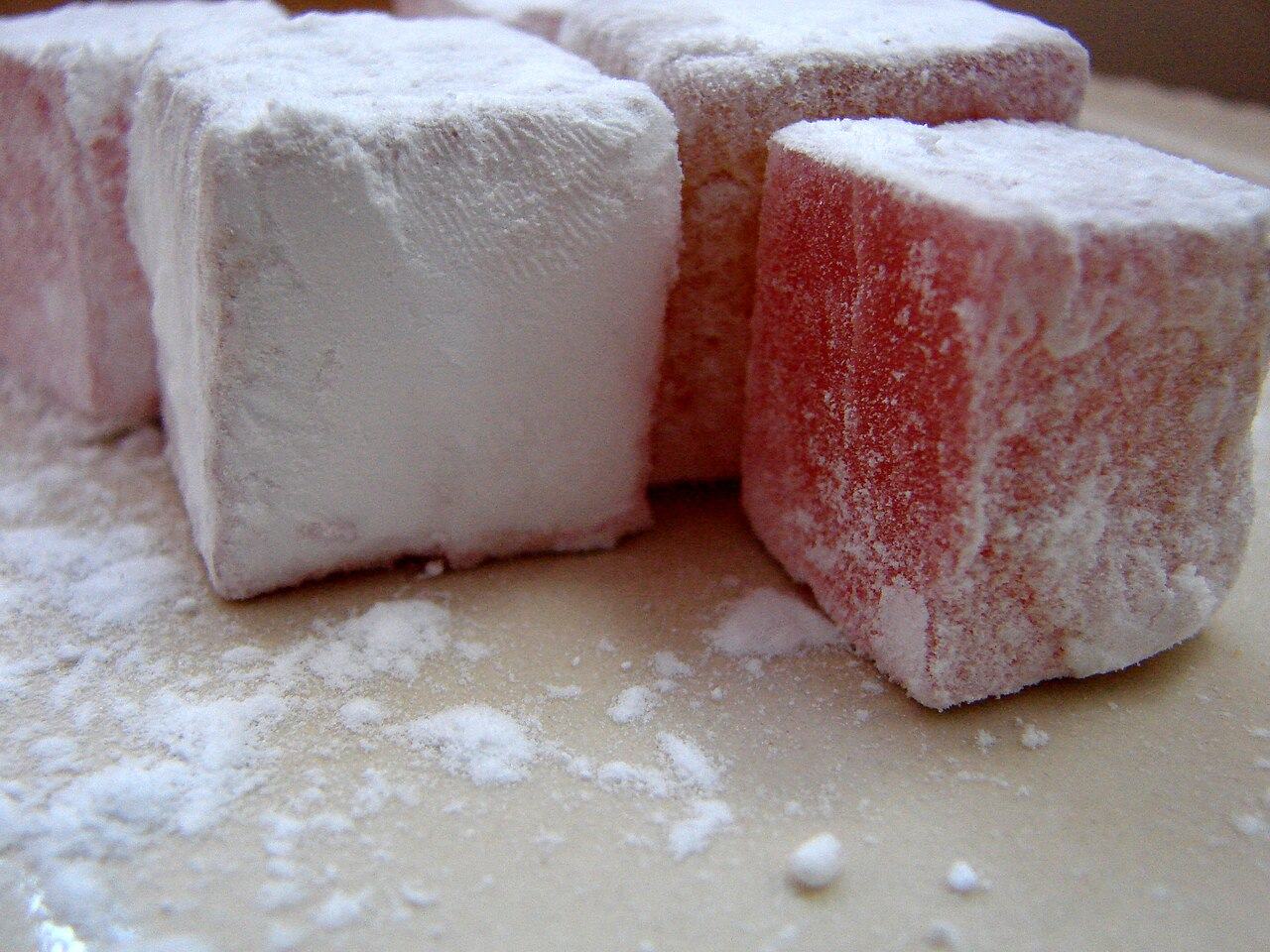
TurkishDelight (called lokum ) is a real sweet that comes from Turkey and the old Ottoman Empire. It is a soft, jelly-like cube flavored with rose-water or lemon and dusted with powdered sugar. When Lewis wrote this book, Britain was just after the war and sweets were rationed — children could only buy a tiny amount. A whole box of Turkish Delight would have seemed almost magical, which is why it tempts Edmund so strongly. The White Witch echoes the cold queens of Norse and fairy legend who freeze the world in endless winter. Her weapon is chosen with care. Sugar was the one luxury a British child in 1950 could not simply ask for, so the Witch does not open with treasure or power — she offers the thing rationing had put out of reach, and calls it a temptation.
Visual AidThe sweet itself
Photograph of Turkish delight, the sweet the Knowledge Bank calls by its Turkish name, lokum. The Knowledge Bank explains that it is a soft, jelly-like cube dusted with powdered sugar, and that in rationed post-war Britain a whole box would have seemed almost magical. This is the ordinary, unenchanted kind, bought and photographed like any other sweet. Notice how much sugar there is and how soft the cubes look — then remember that Edmund was offered pounds of it when a child could legally buy a few ounces a week.
Turkish delight (lokum), dusted with powdered sugar. Source: Wikimedia Commons, public domain.
ⓘ Vocabulary words are selected to help you understand and complete this workbook. Some may not appear verbatim in the novel.
sledgen.Ch.3
A vehicle on runners for sliding over snow
“The Witch’s sledge was pulled by two white reindeer.”
dwarfn.Ch.3
A small, human-like creature of legend
“A fat dwarf drove the Witch’s sledge.”
enchantedadj.Ch.4
Placed under a magic spell
“The enchanted Turkish Delight made Edmund want more and more.”
reindeern.Ch.3
A large deer of cold northern lands
“Two snow-white reindeer pulled the sledge swiftly.”
spitefuladj.Ch.4
Wanting to hurt or upset others
“Edmund made a spiteful remark to upset his sister.”
greedyadj.Ch.4
Wanting much more than you need
“The greedy boy could not stop eating the sweet.”
betrayv.Ch.4
To be disloyal to someone who trusts you
“The Witch hoped Edmund would betray his brother and sisters.”
sneerv.Ch.4
To smile or speak in a scornful way
“Edmund began to sneer at Lucy in front of the others.”
cravev.Ch.4
To want something very strongly
“He came to crave the magic Turkish Delight.”
mantlen.Ch.4
A loose cloak worn over the shoulders
“The Witch wrapped Edmund in a fold of her warm mantle.”
🧠Knowledge Bank question
1According to the Knowledge Bank, why would Lewis's first readers have understood exactly why Edmund craves the Turkish Delight?Ch.3
2A “dwarf” in this story is a small, human-like creature.Ch.3
3Food that is “enchanted” has been —Ch.4
4Fill in each blank with the correct word.Ch.3–4
Word choices:reindeerenchantedsledgegreedy- some words will not be used
The sledge was pulled by white
The magic sweet was
5A “spiteful” remark is meant to be kind and helpful.Ch.4
6Edmund could not stop eating the sweet. He was being —Ch.4
7To “betray” your family means to —Ch.4
8When you “sneer” at someone, you speak in a scornful, mocking way.Ch.4
9Fill in each blank with the correct word.Ch.4
Word choices:cravemantlebetraysneer- some words will not be used
To want something very strongly is to
The Witch wrapped him in her warm
10A “mantle” is a —Ch.4
Part 2
Comprehension
How well do you understand Chapters 3–4?
🧠Knowledge Bank · Reading a Character’s True Nature
Narrative Logic · Reading a Character’s True Nature
A clever villain often hides behind a friendly mask. The central question is this: does she care about Edmund, or is she using him? Chapter 3 covers Edmund and the Wardrobe — Lucy enters Narnia again and Edmund follows; they are separated, and Edmund meets the White Witch on her sledge. Chapter 4 covers Turkish Delight — the Witch feeds Edmund enchanted Turkish Delight, learns about the four children, and asks him to bring the others to her. Back home, Lucy tells the others about Narnia, but no time has passed and nobody believes her. A few days later, during a game of hide-and-seek, Lucy slips into the wardrobe again — and this time Edmund follows her in. They become separated, and Edmund meets the White Witch riding a sledge pulled by white reindeer.
🧠Knowledge Bank question
1The Knowledge Bank gives one central question to ask about the White Witch. What is it?Ch.3
2Which child follows Lucy into the wardrobe the second time?Ch.3
3Edmund meets the White Witch riding a sledge pulled by reindeer.Ch.3
4What does the Witch give Edmund to eat?Ch.4
5Why does the enchanted sweet make Edmund behave foolishly?Ch.4
6Put these events from Part 2 in the correct order. Write 1–4 (1 = first).Ch.3–4
The Witch feeds Edmund Turkish Delight and asks him to bring the others.
Back home, Edmund spitefully says Narnia was only pretend.
Edmund follows Lucy into the wardrobe during hide-and-seek.
Lucy tells the others about Narnia, but no one believes her.
7The Witch asks Edmund to bring his brother and sisters to her house.Ch.4
8What does the Witch promise Edmund to win him over?Ch.4
9How does Edmund treat Lucy after they return home together?Ch.4
10Edmund tells Peter and Susan the truth about Narnia at once.Ch.4
Part 3
Literary Elements
Understanding HOW and WHY C.S. Lewis writes Chapters 3–4 the way he does.
🧠Knowledge Bank · Characterization and Mood
Literary Technique · Characterization and Mood
Lewis shows the Witch’s nature through characterization — her icy looks, her sudden sweetness, her hunger for power. He also builds a mood of danger: the cold sledge, the silent snow, and the too-good-to-be-true sweet all warn us that something is wrong. Edmund’s temptation connects to the real world. History — sweets were rationed: just after WWII, British children could buy only a tiny amount of sweets, so a whole box of Turkish Delight would seem almost magical — which is why it tempts Edmund. Science — why we crave sugar: the “enchanted” sweet mirrors a real truth — sugar makes the brain want more and more; reindeer’s thick coats and wide hooves suit deep snow. At first she is fierce, but then she turns sweet, wraps him in her warm mantle, and gives him a hot drink and enchanted Turkish Delight. Watch the order Lewis puts those in. The cruelty comes first and the kindness second, so the kindness reads as a tactic.
Visual AidHow the Witch is built
Diagram for the Knowledge Bank on characterization and mood. The top row splits the Witch into what she shows Edmund and what leaks through anyway; the bottom row lists the three warnings the Knowledge Bank names, the cold sledge, the silent snow and the sweet that is too good to be true. It does not decide for the reader whether Edmund should have seen through her. Notice that the warnings are all in the setting, not in her words: mood is what the scene says while a character is lying.
Traits and mood cues named in the Knowledge Bank. Drawn for Garden Heights Academy.
📚 Literary Devices in This Part · definitions & examples
Characterization is how an author shows what a character is really like — through looks, words, and actions. The Witch’s false kindness reveals her true, scheming nature.Foreshadowing is a hint about what will happen later. The Witch’s interest in the other children foreshadows danger to come.Mood is the feeling a scene gives the reader. The cold sledge and silent snow create a sinister, uneasy mood.
The questions below are mixed — not grouped by device. Decide which device each one is about.
🧠Knowledge Bank question
1According to the Knowledge Bank, which three details build the mood of danger?Ch.4
2Foreshadowing gives the reader clues about events that are still to come.Ch.4
3Fill in the blanks with the correct words.Ch.3
Word choices:moodfeelingreindeerparcel- some words will not be used
The atmosphere or feeling of a scene is its
Mood is the overall
4The Witch asking Edmund to bring his siblings is a hint of future danger. This hint is called —Ch.4
5Go beyond the definition: why does Lewis give the sledge scene such a cold, sinister mood?Ch.3
6Fill in the blanks with the correct words.Ch.4
Word choices:characterizationactionssnowsledge- some words will not be used
Showing what a character is like is called
We learn about characters from their words and
7The chilly, silent, slightly frightening feeling of the sledge scene is its —Ch.3
8When the Witch suddenly turns sweet, it is a clue to her cunning character.Ch.4
9Fill in the blanks with the correct words.Ch.4
Word choices:foreshadowinghintfeastdwarf- some words will not be used
A clue about what will happen later is called
Foreshadowing is a kind of
10Which sentence best combines characterization, foreshadowing, and mood from Part 2?Ch.3–4
Part 4
Think Deeper
Four deeper challenges — no single-word recall. Read, weigh the evidence, and reason it through.
🧠Knowledge Bank · Temptation and Greed
Ethical Reasoning · Temptation and Greed
The enchanted Turkish Delight stands for temptation — being offered something you want so badly that you stop thinking clearly. Edmund’s greed for the sweet, and for the Witch’s promises, leads him to betray the people who love him. The episode demonstrates how one selfish choice grows into a bigger one. Lewis taught literature at Oxford University and belonged to a group of writer friends called the Inklings, who met to read their stories aloud — among them J.R.R. Tolkien, author of The Lord of the Rings. Lewis wrote The Lion, the Witch and the Wardrobe in 1949; it was published in 1950 with pictures by the artist Pauline Baynes. Characterization: How an author reveals what a character is really like. Foreshadowing: Hints an author drops about what will happen later.
1Claim: “The White Witch controls Edmund by feeding his desires.” — choose the two details that best prove it.Claim & Evidence
2Sort what the Witch says and does. Tap each item to sort it — tap again to switch sides. You can keep tapping to change your answer.Sort into two
◄ Kind on the surfaceCruel underneath ►
3Match each cause to its result. For each cause, pick its result.Cause & Effect
Edmund tastes the enchanted Turkish Delight→
The Witch learns four children have come→
Edmund returns from Narnia with Lucy→
Edmund chooses to deny it all→
🧠Knowledge Bank question
4Fill both blanks to complete the reasoning.Build the Argument
The Knowledge Bank argues that the enchanted sweet stands for temptation because , which shows that .
Part 5
Standardized Test · Main Idea & Detail
Part 2 practices Main Idea, Detail, Inference, and Author’s Purpose — with a quick vocabulary review — in friendly SAT– and TOEFL–style questions. No pressure: you already met these skills in the lessons above!
Read the passage — the highlighted words are tested — then answer. Tap an answer, then tap it again to confirm.
SATInference — a conclusion the passage implies
SATWords in Context — a word's meaning in this passage
SATText Structure & Purpose — how the passage is built, and why
TOEFLVocabulary — a tested word's meaning here
TOEFLFactual Information — a fact stated in the passage
TOEFLProse Summary — the three sentences that sum it up
TOEFLInference — what the passage implies
The Brain's Craving for Sugar
Almost everyone enjoys something sweet, but scientists have discovered that our love of sugar is not simply a matter of taste — it is built into the brain. When a person eats a sugary food, sensors on the tongue send a rapid signal to the brain, which then releases a chemical called dopamine. Dopamine produces a feeling of pleasure and reward, and the brain quickly learns to associate that good feeling with the food that caused it. This reward system once helped humans survive. Thousands of years ago, sweet foods such as ripe fruit and honey were abundant sources of energy, so a brain that urged people to seek them out was a real advantage.
The difficulty is that the same system can betray us today, when sugar is cheap and found almost everywhere. Because each sweet bite renews the pleasant signal, a person may begin to crave more and more, and resisting a greedy second helping becomes a genuine test of self-control. Understanding this process gives people power over it. Doctors suggest that eating a variety of foods, drinking water, and pausing before reaching for a second helping can weaken the pull of a craving. Some researchers even compare certain sweets — carefully engineered to be irresistible — to a kind of gentle trap. Knowing how the brain responds does not mean a person must give up treats altogether; it simply means choosing them deliberately rather than being controlled by them.
Original passage written for Garden Heights — not a quotation from the novel.
1The passage most strongly suggests that pausing before a second treat helps a person —SAT · Inference
2In the passage, the word “crave” is closest in meaning to —TOEFL · Vocabulary
3In the passage, “greedy” most nearly means —SAT · Words in Context
4In the passage, “betray” most nearly means —SAT · Words in Context
5According to the passage, what does the brain release when a person eats something sweet?TOEFL · Factual Information
6Prose Summary (TOEFL).The passage explains why humans crave sugar and how to manage that craving. This TOEFL task lists six sentences; choose the THREE that best capture the passage’s main ideas. The other three do not belong — they state minor details or ideas the passage does not present.TOEFL · Prose Summary
7According to the passage, why did a love of sweet foods once help early humans survive?TOEFL · Factual Information
8It can reasonably be inferred that a person who understands how cravings work is —SAT · Inference
9The passage most strongly suggests that some modern sweets are —TOEFL · Inference
10The author compares certain engineered sweets to ‘a kind of gentle trap’ mainly to —SAT · Text Structure & Purpose
Part 6 · Optional
Creative Writing
A bonus challenge to practice your English.
About This Section
This writing task is optional and not part of your auto-graded score. Feedback checks length, spelling, and grammar only.
Writing Task — Part 2 “The Witch’s Sledge”
Use mood to describe Edmund’s first meeting with the White Witch. Show how the cold, the silence, and her strange kindness make the scene feel uneasy. Write at least 40 words.
You can start with: “Edmund heard the jingle of bells, and out of the snow came a great sledge, and the lady upon it looked down at him and…”
0 / 40 words minimum
🗣 Teach It · Just for Fun (optional)
No right or wrong — close the screen and tell someone nearby what happened in this part. Can’t find anyone? Tell yourself out loud. The moment you teach it, you truly understand it.
Part 2 Complete!
You finished Chapters 3–4 of Narnia: The Lion, the Witch and the Wardrobe.
Here are your auto-graded results:
-
points out of 100
Teach it to someone
The best last step is to teach it. In your own words, explain what happened — retell a favorite scene, teach a character’s big choice, or sum up the main idea for a parent, friend, or classmate. When you can teach it clearly, you truly own it.
SAT® is a registered trademark of College Board, which is not affiliated with, and does not endorse, these materials. TOEFL® is a registered trademark of ETS. These materials are not endorsed or approved by ETS. Garden Heights is an independent provider of test-style reading practice.