New here? Just sign up with Google — your account includes Matilda, our gift book, forever.
📚
Garden Heights
Members sign in to continue.
Narnia: The Lion, the Witch and the Wardrobe · Garden Heights
Part 5
for Narnia: The Lion, the Witch and the Wardrobe · Part 5 · Chapters 9–10
a novel by C.S. Lewis
30 min6 Parts
This workbook is built on a solid pedagogical foundation, effectively integrating content and language learning based on the CLIL framework (Content and Language Integrated Learning), elevated by our unique 5th C — Connection — and an integrated Standardized Test section that weaves every SAT & TOEFL question type right into the novel, so learners build real test skills easily, naturally, and with fun.
💭 Before You Read · Just for Fun
No right or wrong answers — just think or chat about it: Has someone ever promised you something wonderful and then not kept their word? And what is the best gift you could be given to help you face something hard?
What Happens in Part 5
Edmund trudges through the snow to the Witch’s castle, a grim courtyard crowded with stone statues — creatures she has turned to stone. He expects to be made a Prince, but the Witch is cold and cruel: she gives him only dry bread and water, not the feast he was promised, and sets off in her sledge to hunt down the others. Meanwhile, the three children and the Beavers flee. They hear sledge bells and fear the Witch — but it is Father Christmas, proof that her spell of “always winter and never Christmas” is finally breaking. He gives gifts: a sword and shield for Peter, a bow, arrows, and a horn for Susan, and a healing cordial and a dagger for Lucy. Then the snow begins to thaw.
What We Will Learn
Literary Element
What It Means
Symbolism
When an object stands for a bigger idea
Contrast
Placing two opposite things side by side for effect
Imagery
Describing words that help you picture a scene
Chapter Summary
Chapter
Key Events
Ch.9
In the Witch’s House — Edmund reaches the Witch’s castle full of stone statues and is treated cruelly, not made a Prince
Ch.10
The Spell Begins to Break — Father Christmas arrives with gifts for the children, and the long winter starts to thaw
Copyright Notice
Independent study guide by Garden Heights. Not affiliated with or endorsed by C.S. Lewis or HarperCollins. No text from the novel is reproduced. Students should read the original book.
Part 1
Vocabulary
Study 10 key words from Chapters 9–10, then answer each question.
🧠Knowledge Bank · A Knight’s Gifts
Lexicology · A Knight’s Gifts
The children receive a sword and shield, a bow and arrows, a horn, and a dagger — the real tools of medieval knights and hunters. A hunting horn was genuinely used to send a signal across a forest, calling friends to your side — exactly what Susan’s horn is meant to do. These are not toys; they are working weapons for a coming war. Father Christmas belongs to a worldwide family of midwinter gift-bringers — Sinterklaas, Saint Nicholas, the Yule figures of the north. His presents are a knight’s kit from medieval legend: sword, shield, horn and healing cordial, each a tool the children will soon need. He gives gifts: a sword and shield for Peter, a bow, arrows, and a horn for Susan, and a healing cordial and a dagger for Lucy. Note who gets what. Peter is armed to fight, Susan to call for help, Lucy to heal.
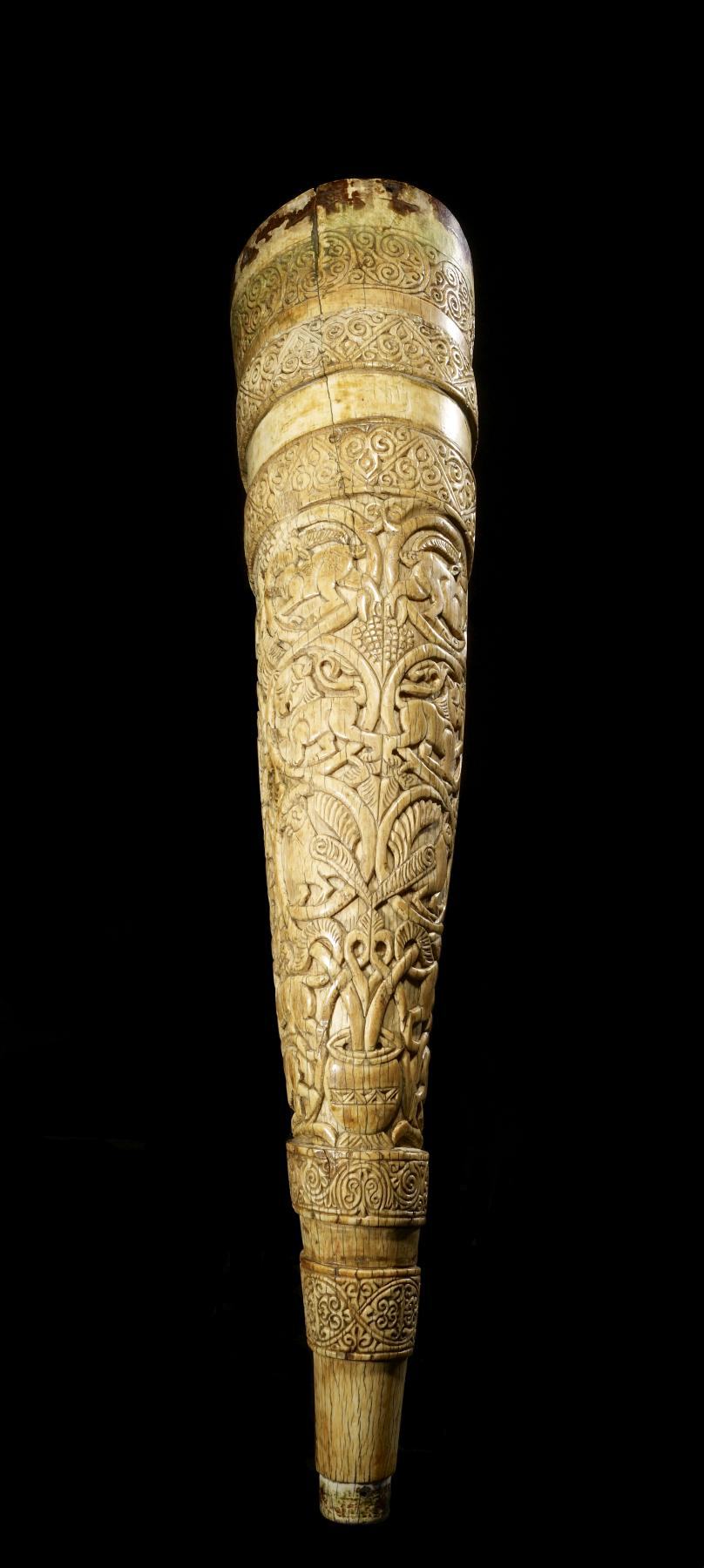
Visual AidA horn made to be heard
Photograph of a medieval ivory horn made in Italy, now in the Walters Art Museum in Baltimore. The Knowledge Bank explains that a hunting horn was a real tool for sending a signal across a forest and calling friends to your side, which is exactly what Susan’s horn is for. This one is far grander than the story needs and is not Susan’s; it is here to show the thing itself. Notice the carved animals in the vines: a horn that was made to be blown could still be made beautiful.
Horn with Animals in Vine Scrolls, Italian, ivory; Walters Art Museum 71.234. Source: Wikimedia Commons, public domain.
ⓘ Vocabulary words are selected to help you understand and complete this workbook. Some may not appear verbatim in the novel.
statuen.Ch.9
A carved or molded figure of a person or animal
“The courtyard was full of stone statues that had once been living creatures.”
courtyardn.Ch.9
An open space surrounded by walls or buildings
“Edmund crept across the silent, snowy courtyard.”
dungeonn.Ch.9
A dark underground prison
“He feared he might be thrown into a cold dungeon.”
feastn.Ch.9
A large, special meal
“Instead of the promised feast, Edmund got dry bread.”
generousadj.Ch.10
Willing to give freely
“Father Christmas was generous with his gifts.”
cordialn.Ch.10
A sweet drink; here, a healing potion
“Lucy’s cordial could heal almost any wound.”
daggern.Ch.10
A short, pointed knife used as a weapon
“Lucy was given a small dagger for her own defense.”
quivern.Ch.10
A case for carrying arrows
“Susan’s quiver was full of well-made arrows.”
famishedadj.Ch.9
Extremely hungry
“Edmund was famished after his long, cold walk.”
thawv.Ch.10
To melt after being frozen
“The snow began to thaw and drip from the branches.”
🧠Knowledge Bank question
1According to the Knowledge Bank, what was a hunting horn genuinely used for?Ch.9
2A “courtyard” is an open space surrounded by walls or buildings.Ch.9
3A “dungeon” is —Ch.9
4Fill in each blank with the correct word.Ch.9
Word choices:feaststatuefamisheddungeon- some words will not be used
A large, special meal is a
Extremely hungry means
5A “generous” person likes to keep everything and share nothing.Ch.10
6Lucy’s “cordial” is —Ch.10
7A “dagger” is —Ch.10
8A “quiver” is a case for carrying arrows.Ch.10
9Fill in each blank with the correct word.Ch.9–10
Word choices:thawgenerousquivercordial- some words will not be used
To melt after being frozen is to
Willing to give freely means
10When the snow begins to “thaw,” it —Ch.10
Part 2
Comprehension
How well do you understand Chapters 9–10?
🧠Knowledge Bank · Comparing Two Scenes
Narrative Logic · Comparing Two Scenes
Part 5 cuts between two very different scenes: Edmund’s cold, mean welcome at the Witch’s castle, and the warm joy of Father Christmas. Chapter 9 covers In the Witch’s House — Edmund reaches the Witch’s castle full of stone statues and is treated cruelly, not made a Prince. Chapter 10 covers The Spell Begins to Break — Father Christmas arrives with gifts for the children, and the long winter starts to thaw. Edmund trudges through the snow to the Witch’s castle, a grim courtyard crowded with stone statues — creatures she has turned to stone. He expects to be made a Prince, but the Witch is cold and cruel: she gives him only dry bread and water, not the feast he was promised, and sets off in her sledge to hunt down the others.
Visual AidTwo sledges in the snow
Venn diagram for the Knowledge Bank on comparing two scenes. Each circle holds what belongs to one sledge only; the overlap holds what both scenes share — a sledge, bells in the snow, a gift for a child. It does not rank the two scenes or say which the children should have expected. Notice that the overlap is the danger: the Beavers hear bells and fear the Witch, and Edmund once followed exactly those bells. The reader who can tell the two apart has learned what Edmund had not.
Contrast set out in the Knowledge Bank. Drawn for Garden Heights Academy.
🧠Knowledge Bank question
1The Knowledge Bank says Part 5 cuts between two very different scenes. Which two?Ch.9
2The Witch welcomes Edmund warmly and makes him a Prince at once.Ch.9
3What does the Witch actually give Edmund to eat at her castle?Ch.9
4When the children hear sledge bells, who turns out to be coming?Ch.10
5Why is the arrival of Father Christmas such important news?Ch.10
6Put these events from Part 5 in the correct order. Write 1–4 (1 = first).Ch.9–10
The Witch treats Edmund cruelly and sets off in her sledge.
Edmund reaches the Witch’s castle full of statues.
The snow begins to thaw and melt.
Father Christmas gives the children their gifts.
7Father Christmas gives the children gifts to help them in the days ahead.Ch.10
8What gift does Peter receive?Ch.10
9What is Susan’s horn meant to do?Ch.10
10Lucy is given a cordial that can heal the injured.Ch.10
Part 3
Literary Elements
Understanding HOW and WHY C.S. Lewis writes Chapters 9–10 the way he does.
🧠Knowledge Bank · Symbolism and Contrast
Literary Technique · Symbolism and Contrast
Lewis fills Part 5 with symbolism: the melting snow stands for hope returning, and the gifts stand for the courage the children will need. He also uses contrast — the stone-cold castle against the glow of Father Christmas — to show, without explaining, the difference between the Witch and the goodness rising against her. This part connects to the real world. Science — the thaw: melting is a change of state, solid ice → liquid water, as warmth returns. The thaw signals spring. History — arms & armor: the gifts are a knight’s kit — sword, shield, bow, quiver, dagger — the real tools of the medieval world. Symbolism: When an object stands for a bigger idea. Meanwhile, the three children and the Beavers flee. They hear sledge bells and fear the Witch — but it is Father Christmas, proof that her spell of “always winter and never Christmas” is finally breaking.
📚 Literary Devices in This Part · definitions & examples
Symbolism is when an object stands for a bigger idea. The thawing snow is a symbol of hope returning to Narnia.Contrast places two opposite things side by side. Lewis contrasts the cold castle with the warmth of Father Christmas.Imagery is describing words that help you picture, hear, or feel a scene — like dripping, melting snow and singing birds.
The questions below are mixed — not grouped by device. Decide which device each one is about.
🧠Knowledge Bank question
1According to the Knowledge Bank, what does the melting snow stand for?Ch.10
2Contrast means placing two opposite things side by side for effect.Ch.10
3Fill in the blanks with the correct words.Ch.10
Word choices:imagerypicturesworddagger- some words will not be used
Describing words that appeal to the senses are called
Imagery helps the reader form a
4Setting Edmund’s cruel welcome next to the joy of Father Christmas is an example of —Ch.9–10
5Go beyond the definition: why does Lewis fill the thaw scene with vivid imagery of dripping snow and singing birds?Ch.10
6Fill in the blanks with the correct words.Ch.10
Word choices:symbolismideasnowhorn- some words will not be used
When an object stands for a bigger idea, that is
A symbol stands for a larger
7Words that help you picture the dripping snow and budding trees are called —Ch.10
8In symbolism, something real stands for a larger idea.Ch.10
9Fill in the blanks with the correct words.Ch.10
Word choices:contrastoppositefeastthaw- some words will not be used
Placing two unlike things side by side is
A contrast shows things that are
10Which sentence best combines symbolism, contrast, and imagery from Part 5?Ch.9–10
Part 4
Think Deeper
Four deeper challenges — no single-word recall. Read, weigh the evidence, and reason it through.
🧠Knowledge Bank · Broken Promises
Ethical Reasoning · Broken Promises
Edmund gave up his family for the Witch’s promises — and she breaks every one, offering him dry bread instead of a throne. Part 5 explores how a liar treats others: appearances were not reality, and the boy who betrayed for sweets now gets nothing but cold cruelty. Father Christmas is the old English name for the cheerful gift-bringer of midwinter. His roots reach back to ancient midwinter festivals and to the legend of St Nicholas, a kind bishop famous for secret giving. When he appears in Narnia, it proves the Witch’s curse — “always winter and never Christmas” — is breaking at last. (Lewis’s friend Tolkien thought it odd to mix Father Christmas with fauns and a witch, but Lewis kept him in.) Contrast: Placing two opposite things side by side for effect.
1Claim: “The Witch’s promises to Edmund were lies.” — choose the two details that best prove it.Claim & Evidence
2What does each detail show? Tap each item to sort it — tap again to switch sides. You can keep tapping to change your answer.Sort into two
◄ The Witch is losing powerThe Witch is cruel ►
3Match each cause to its result. For each cause, pick its result.Cause & Effect
Edmund arrives expecting a royal feast→
Father Christmas appears at all→
Each child is given a gift→
The deep snow turns to running water→
🧠Knowledge Bank question
4Fill both blanks to complete the reasoning.Build the Argument
The Knowledge Bank argues that Part 5 shows how a liar treats others because , which shows that .
Part 5
Standardized Test · Vocabulary & Author’s Purpose
Part 5 practices Vocabulary in Context and Author’s Purpose — plus key details and inference — in friendly SAT– and TOEFL–style questions. No pressure: you have already met these skills above!
Read the passage — the highlighted words are tested — then answer. Tap an answer, then tap it again to confirm.
SATWords in Context — a word's meaning in this passage
SATInference — a conclusion the passage implies
SATCentral Ideas — the passage's main point
SATText Structure & Purpose — how the passage is built, and why
TOEFLFactual Information — a fact stated in the passage
TOEFLInference — what the passage implies
TOEFLRhetorical Purpose — why the author included a detail
The Real History of Saint Nicholas
Long before he became the cheerful gift-giver we picture today, Saint Nicholas was a real person. He lived roughly 1,700 years ago in a town in what is now Turkey, where he served as a bishop, a senior leader in the early Christian church. Even during his own lifetime he earned a reputation for quiet kindness and for giving gifts in secret. One famous story tells how Nicholas helped a poor, famished family by dropping bags of gold through their window at night, asking for nothing in return.
Over the following centuries, tales of his generous deeds spread across Europe, and different cultures gradually transformed him: he became Father Christmas in Britain and Sinterklaas in the Netherlands. Each version kept the same core — a mysterious figure who rewards goodness — while changing his name, his dress, and his customs. Today Saint Nicholas endures as a worldwide symbol of generosity and hope. His story shows how a single real person can, over hundreds of years, be preserved and reshaped by many traditions until he seems to belong to everyone. Understanding that history helps us see why his arrival, in stories and in life, so often signals that kindness is breaking through hard times.
Original passage written for Garden Heights — not a quotation from the novel.
1In the passage, “famished” most nearly means —SAT · Words in Context
2The passage most strongly suggests that St Nicholas ‘belongs to everyone’ because —SAT · Inference
3As used in the passage, “endures” most nearly means —SAT · Words in Context
4In the passage, “generous” most nearly means —SAT · Words in Context
5According to the passage, what position did Nicholas hold?TOEFL · Factual Information
6Which choice best states the central idea of the passage?SAT · Central Ideas
7The author tells the story of the gold dropped through the window mainly to —SAT · Text Structure & Purpose
8The passage most strongly suggests that Father Christmas and Sinterklaas —TOEFL · Inference
9The author traces how the figure changed from country to country mainly to —SAT · Text Structure & Purpose
10The author ends by linking Nicholas to ‘kindness breaking through hard times’ mainly to —TOEFL · Rhetorical Purpose
Part 6 · Optional
Creative Writing
A bonus challenge to practice your English.
About This Section
This writing task is optional and not part of your auto-graded score. Feedback checks length, spelling, and grammar only.
Writing Task — Part 5 “The Gift”
Choose one of the children and describe the moment Father Christmas hands over their gift. Use imagery to show what the gift looks and feels like, and why it matters. Write at least 40 words.
You can start with: “Father Christmas reached into his great sack, drew out the gift, and as it was placed in my hands I felt…”
0 / 40 words minimum
🗣 Teach It · Just for Fun (optional)
No right or wrong — close the screen and tell someone nearby what happened in this part. Can’t find anyone? Tell yourself out loud. The moment you teach it, you truly understand it.
Part 5 Complete!
You finished Chapters 9–10 of Narnia: The Lion, the Witch and the Wardrobe.
Here are your auto-graded results:
-
points out of 100
Teach it to someone
The best last step is to teach it. In your own words, explain what happened — retell a favorite scene, teach a character’s big choice, or sum up the main idea for a parent, friend, or classmate. When you can teach it clearly, you truly own it.
SAT® is a registered trademark of College Board, which is not affiliated with, and does not endorse, these materials. TOEFL® is a registered trademark of ETS. These materials are not endorsed or approved by ETS. Garden Heights is an independent provider of test-style reading practice.