New here? Just sign up with Google — your account includes Matilda, our gift book, forever.
Number the Stars · Garden Heights
Part 5
for Number the Stars · Part 5 · Chapters 9–10
8 Parts40 min
What Happens in Part 5
Unable to bear the lying, Annemarie follows Henrik to the barn and asks him straight: why are you lying to me? Milking in the lantern light, Henrik gives her the book’s deepest answer: he asks how brave she is, and explains that it is easier to be brave when you do not know everything — so the grown-ups are telling less, not because children are weak, but to make courage possible for everyone. And he confirms it: there is no Great-aunt Birte. That evening the farmhouse fills with silent ‘mourners’ — among them the Rosens, reunited with Ellen, and Peter Neilsen — seated around a closed casket. Late in the night, boots: German officers, drawn by the gathering of so many people. Why is the casket closed? Mama, steady as stone, invents on the spot: Great-aunt Birte died of typhus, and the doctor warned the germs may linger — open it if you wish. The officer’s answer is a slap across her face — and then the soldiers go. Peter opens an old book and reads a psalm about the God who counts the stars one by one and calls each by name — and Annemarie, listening to the sea in the dark, thinks the stars are too many to number, and the world too cold — yet the old words hold the room together until the boots have gone.
The barn catechism, the tested lie, and the title verse
Cross-Curricular
The Øresund — the water between two shores
Chapter Summary
Ch.
What happens
9–10
Brave Without Knowing — in the barn Henrik explains: bravery is easier when you know less, and Great-aunt Birte does not exist; mourners (the Rosens and Peter among them) circle a closed casket; officers demand it be opened, Mama’s typhus lie holds through a slap; and Peter reads the psalm of the One who numbers the stars.
Part 1
Vocabulary
Study 10 key words from Chapters 9–10, then answer each question.
🕮Knowledge Bank · Why Typhus Frightened Soldiers
Medicine & History · Epidemic DiseaseTyphus is not the same disease as typhoid fever. Epidemic typhus is caused by the bacterium Rickettsia prowazekii and spreads mainly through infected body lice. It has flourished where war, displacement, crowding, and limited washing make lice difficult to control. Symptoms can include sudden high fever, severe headache, weakness, and a spreading rash. Before modern antibiotics were widely available, outbreaks could kill many people, so wartime officials treated a suspected case as a serious threat. A casket said to hold someone who died of typhus would therefore trigger fear of contaminated clothing and lice even though the disease does not simply leap from a closed box. The lie works because it uses genuine medical history to manipulate the soldiers’ risk calculation. Words such as mourners, linger, and steady gain extra force when everyone must perform grief while discouraging inspection. Fear becomes an invisible barrier against inspection.
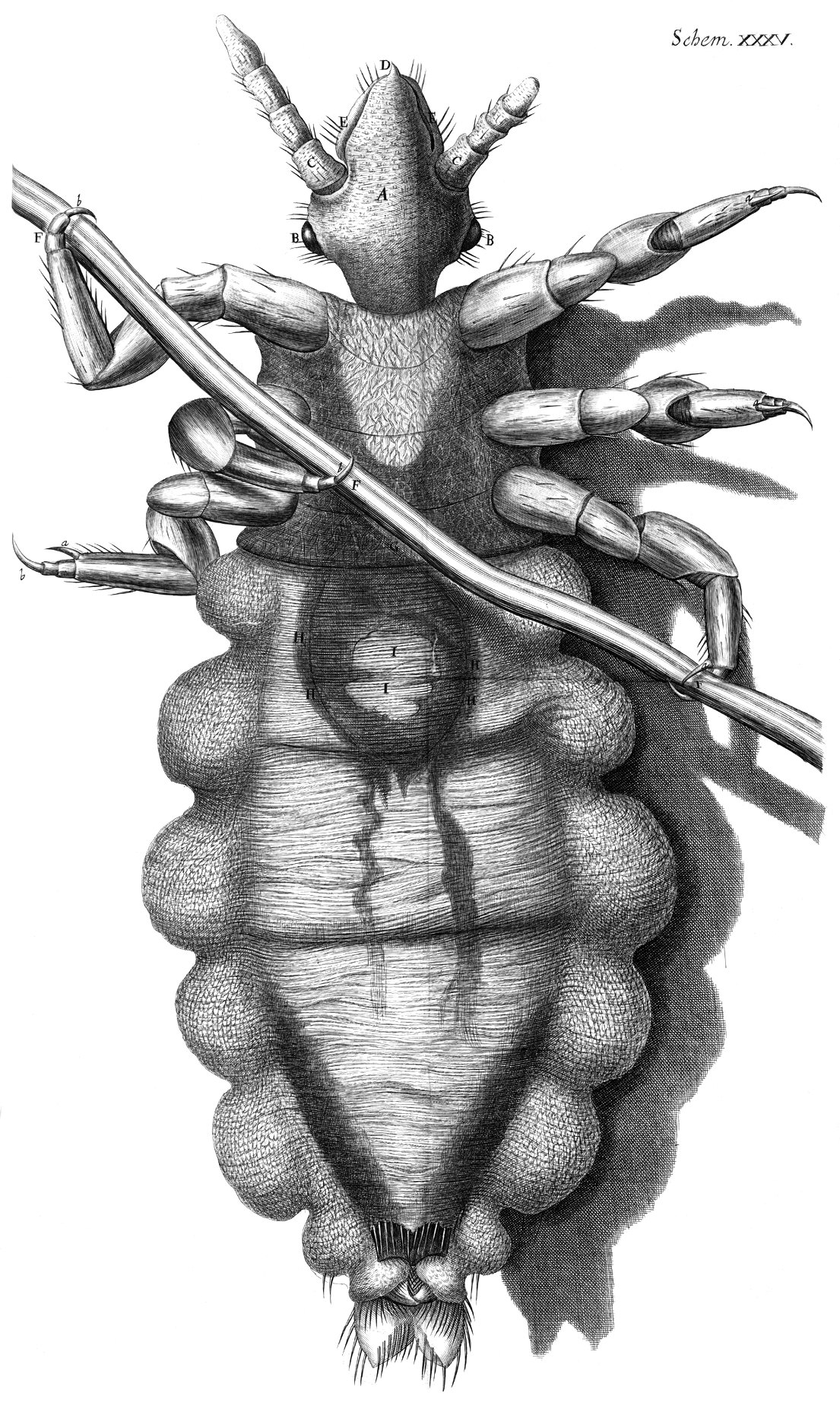
Visual AidThe insect behind the word typhus
Engraving of a human louse from Robert Hooke’s Micrographia, printed in London in 1665, the first book of drawings made through a microscope; the long diagonal line is one human hair the insect is gripping. The Knowledge Bank explains that epidemic typhus is carried mainly by infected body lice, which flourish where war, crowding and limited washing make them hard to control — and that a suspected case could therefore frighten a wartime official. Hooke could not know any of that; germs were discovered two centuries later. This insect is only a few millimeters long in life. Notice how small and ordinary the carrier is; the fear it caused was out of all proportion to its size, and that is exactly what Mama’s lie relies on.
Louse gripping a human hair, Scheme XXXV of Robert Hooke, Micrographia (London, 1665), engraving; scan from the National Library of Wales. Source: Wikimedia Commons, File:Louse diagram, Micrographia, Robert Hooke, 1667.jpg, public domain.
braveadj.Ch.9–10
Acting rightly even while afraid
“How brave are you, Henrik asked quietly.”
catechismn.Ch.9–10
Teaching done by question and answer
“The barn talk was a catechism of courage.”
mournern.Ch.9–10
A person grieving at a funeral
“Silent mourners filled the farmhouse room.”
typhusn.Ch.9–10
A deadly infectious wartime disease
“Great-aunt Birte died of typhus, Mama said.”
lingerv.Ch.9–10
To remain longer than expected
“The doctor warned the germs might linger.”
steadyadj.Ch.9–10
Calm, firm, and unshaking
“Mama’s voice stayed steady before the officer.”
psalmn.Ch.9–10
A sacred song or poem
“Peter read a psalm about numbering the stars.”
lanternn.Ch.9–10
A portable covered light
“The lantern swung shadows across the barn.”
concealv.Ch.9–10
To hide from sight or knowledge
“The closed casket helped conceal the plan.”
defiancen.Ch.9–10
Bold refusal to obey or submit
“Offering to open the casket was quiet defiance.”
ⓘ The vocabulary words in this list are selected to help you understand and complete this workbook. Some may not appear verbatim in the original novel.
🧠Knowledge Bank question
1According to the Knowledge Bank, epidemic typhus spreads mainly through ___.Ch.9–10
2‘Typhus’ was a deadly infectious wartime disease.Ch.9–10
3To remain longer than expected is to ___.Ch.9–10
4A ‘psalm’ is a sacred song or poem.Ch.9–10
5Fill in each blank with the correct word.Ch.9–10
Word choices:steadylanternmournerdefiance- some words will not be used
Mama’s voice stayed before the officer.
The swung shadows across the barn.
6To hide from sight or knowledge is to ___.Ch.9–10
7A ‘mourner’ is a person celebrating at a wedding.Ch.9–10
8Bold refusal to obey or submit is ___.Ch.9–10
9Fill in the blanks with the correct words.Ch.9–10
Word choices:typhuslingerpsalmbrave- some words will not be used
Great-aunt Birte died of , Mama said.
Peter read a about numbering the stars.
10Teaching done by question and answer is a ___.Ch.9–10
Part 2
Comprehension
Show you understood what happens in Chapters 9–10.
📋Knowledge Bank · The Need-to-Know Principle
History & Security · Underground CellsSecret networks protect people by limiting who knows the whole plan. This principle is called need-to-know: each participant receives only the information required for a specific task. A host knows where people will gather; a guide knows one path; a captain knows when to leave; a courier knows where a packet must go. If someone is questioned, frightened, or arrested, there is less information to reveal. Resistance groups often organized themselves into small cells for the same reason. The method can feel unfair to a child or newcomer because secrecy resembles distrust, but its purpose is protection. It also changes how readers follow the chapters. Instead of asking only what happens, track the distribution of knowledge: Henrik understands the route, Peter understands the gathering, Mama understands the cover story, and Annemarie receives only what helps her remain natural. The rescue depends on coordinated partial knowledge, a security practice known as compartmentalization.
Visual AidWho knows what
Diagram for the Knowledge Bank on underground cells. It gives each of the four people the one piece the Knowledge Bank assigns them and joins all four to a single line: no one holds the whole plan. It does not claim the characters distrust one another. Notice that Annemarie’s box is the only one shaded differently — she is inside the system, and the system is working exactly as designed when it tells her nothing.
Distribution of knowledge described in the Knowledge Bank. Drawn for Garden Heights Academy.
🧠Knowledge Bank question
1The Knowledge Bank explains that in a need-to-know network, Annemarie receives only ___.Ch.9–10
2What is Henrik’s answer about bravery?Ch.9–10
3Henrik admits that Great-aunt Birte never existed.Ch.9–10
4Who is among the ‘mourners’ that evening?Ch.9–10
5Write the numbers 1–5 in the boxes to show the correct order of events in Chapters 9–10. Number 1 = what happens first.Ch.9–10
Officers arrive and demand the casket be opened.
Annemarie confronts Henrik in the lantern-lit barn.
Peter reads the psalm after the soldiers leave.
Mourners gather around the closed casket.
Henrik explains bravery and admits the funeral is staged.
6The officers accept the closed casket without any challenge.Ch.9–10
7How does Mama answer the demand to open the casket?Ch.9–10
8What does the officer do before leaving?Ch.9–10
9The psalm Peter reads describes God counting and naming the stars.Ch.9–10
10What does Annemarie think as she listens to the psalm?Ch.9–10
Part 3
Literary Elements
Understanding HOW and WHY Lois Lowry tells the story across Chapters 9–10.
🧠Knowledge Bank · Psalm, Stars, and Allusion
Biblical Literature · Psalm 147A literary allusion points to another text so that its associations deepen the new story. The novel’s title comes from Psalm 147, one of the ancient Hebrew poems in the Book of Psalms, a collection sacred in Judaism and also read in Christianity. The psalm imagines the stars as countable and individually known. In a historical setting where people are threatened by official lists, that image creates a moral reversal: numbering can be used to control, but naming can also express care and individual worth. Lowry places the psalm inside a gathering that must look like mourning while secretly preparing life-saving movement. This gives the words dramatic irony: hostile listeners could hear an ordinary religious reading, while the gathered families hear courage and recognition. The title does not turn the Jewish characters into symbols; it insists that every endangered person remains particular. The allusion links vast night skies to individual human worth.
Thematic center
Henrik’s barn answer: courage = your task + a bearable portion of truth.
Tested theory
Mama (knows all) endures the slap; Annemarie (knows little) stays steady — the theory proves itself both ways.
Two countings
Lists that hunt vs. a psalm that cherishes — the title sets one counting against the other.
🧠Knowledge Bank question
1According to the Knowledge Bank, the psalm's image of countable stars creates a 'moral reversal' because ___.Ch.9–10
2Fill in the blank with the correct literary term.Ch.9–10
Word choices:centermarginprologueepilogue- some words will not be used
The barn scene is the book’s thematic .
3The chapter tests Henrik’s theory by showing ___.Ch.9–10
4The soldiers understand the psalm’s hidden meaning for the gathering.Ch.9–10
5The two ‘countings’ the title sets against each other are ___.Ch.9–10
6Mama’s ‘open it if you wish’ works because it ___.Ch.9–10
7Lowry corrects Annemarie’s doubt about the cold, uncountable stars.Ch.9–10
8Fill in the blank with the correct literary term.Ch.9–10
Word choices:testedignoredinventedquoted- some words will not be used
The courage theory is immediately by the soldiers’ visit.
9The slap Mama absorbs functions as ___.Ch.9–10
10After Part 5, the reader understands the funeral gathering is really ___.Ch.9–10
Part 4
Think Deeper
Four deeper challenges — no single-word recall. Read, weigh the evidence, and reason it out.
💡Knowledge Bank · The Five-Part Test for Proportional Risk
Ethics & Decision Science · Proportional RiskCalling an action courageous does not settle whether it is responsible. A proportional-risk test asks five questions. First, is the purpose worthy—protecting life rather than seeking praise or excitement? Second, is the danger necessary, or is a safer effective path available? Third, has the person completed enough preparation: chosen timing, rehearsed what matters, and planned what to do if conditions change? Fourth, does the action limit avoidable harm to helpers, bystanders, and the people being protected? Finally, can the person show restraint by stopping, delaying, or changing course when the original plan becomes too dangerous? These questions separate courage from recklessness without pretending that rescue can ever be risk-free. In Chapters 9–10, the false funeral and typhus warning serve a life-saving goal, use a setting already in place, and discourage inspection without initiating violence. Mama’s willingness to endure the officer’s cruelty is brave, but the ethical center is disciplined judgment: accept only the danger the rescue truly requires, and refuse needless harm.
Think back over these chapters. A lantern swings in a barn that smells of hay and warm milk, and an uncle answers the hardest question a child has ever asked him — with another question: how brave are you? Hours later, a farmhouse parlor: candles, silence, a closed box, and rows of grieving faces — some of them grieving nothing, guarding everything. Boots on the step. A demand. A mother’s calm invitation to open a casket full of ‘typhus.’ The crack of a glove across her face. And afterward, in the loosened dark, an old psalm about Someone who counts the stars — read aloud to people the occupiers are trying to count a very different way.
Original passage written for Garden Heights — not a quotation from the novel.
1Claim: “Part 5 proves Henrik’s theory: courage scales to what a person must carry.” — choose the two details that best prove it.Claim & Evidence
2What the soldiers see at the wake, or What is actually true? Tap each detail to sort it — tap again to switch sides. You can keep tapping to change your answer.Sort into two
◄ What the soldiers see at the wakeWhat is actually true ►
3Match each cause to its result. For each cause, pick its result.Cause & Effect
Annemarie demands the truth in the barn→
Mourners circle a casket with no aunt in it→
An officer demands the lid be raised→
The glove cracks across Mama’s face→
🧠Knowledge Bank question
4Fill both blanks to complete the reasoning.Build the Argument
The Knowledge Bank concludes that the false funeral passes the proportional-risk test because , which shows that .
Part 5
Standardized Test
Reading passage · Why Typhus Warnings Changed Behavior · Author’s Purpose & Vocabulary · SAT & TOEFL-style practice
Read the passage — the highlighted words are tested — then answer. Tap an answer, then tap it again to confirm.
SATCentral Ideas — the passage's main point
SATWords in Context — a word's meaning in this passage
SATInference — a conclusion the passage implies
SATText Structure & Purpose — how the passage is built, and why
SATAuthor’s Purpose — what the author wants to achieve
TOEFLVocabulary — a tested word's meaning here
TOEFLFactual Information — a fact stated in the passage
Typhus and the Body Louse
Typhus is a bacterial disease spread mainly by body lice, not by an ordinary brief conversation. A louse can act as a vector — an organism that carries a pathogen — when infected material enters scratched skin. Crowding, unwashed clothing where lice linger, and disrupted sanitation let them move rapidly through prisons, camps, and armies. High fever, severe headache, weakness, and a spreading rash can follow, and before antibiotics and modern insect control, wartime outbreaks killed many people. Military leaders therefore treated even a suspected case seriously because one sick person could threaten an entire unit.
That history explains why a disease warning can control a tense encounter. A credible claim combines a believable speaker, specific symptoms, and a setting where infection seems possible. Faced with uncertainty, an officer may choose quarantine — separating people or avoiding contact — because the cost of stepping back is smaller than the cost of catching a deadly illness. The claim can be medically false while the cautious response remains logical from the listener’s limited information. In Chapters 9–10, Lowry uses that imbalance to create suspense: the officer must decide whether pride is worth possible exposure, while Mama’s steady performance makes an invisible danger feel immediate.
Original passage written for Garden Heights — not a quotation from the novel.
1What is the main idea of the passage?SAT · Central Ideas
2In the passage, a vector is ___.TOEFL · Vocabulary
3How can infected material from a louse enter the body?TOEFL · Factual Information
4Which conditions helped lice spread during wartime?TOEFL · Factual Information
5In the passage, lice that linger in clothing ___.TOEFL · Vocabulary
6In the passage, a steady performance is one that is ___.SAT · Words in Context
7Why were military leaders especially alert to suspected typhus?TOEFL · Factual Information
8What can be inferred about an officer who steps back from a claim that may be false?SAT · Inference
9Why does the author explain typhus biology before discussing the tense encounter?SAT · Text Structure & Purpose
10How does the final sentence bridge the nonfiction topic back to Chapters 9–10?SAT · Author’s Purpose
Part 6 · Optional
Creative Writing
A bonus challenge to practice your English. Take your time and have fun with it.
About This Section
This writing task is optional and is not part of your auto-graded score. The feedback below checks only the basics — length, spelling, and grammar — not whether your ideas are right or wrong. It is meant for classroom discussion and creative practice, so feel free to use your imagination!
Writing Task — Part 5 “Easier Not to Know”
Henrik says bravery is easier when you don’t know everything. Do you agree? Write about a time an adult told you only part of the truth — or a time you protected someone by not telling them everything. Was it right? 6–10 sentences. End by saying whether you would want the whole truth next time, and why.
You can start with: “At the time, I only knew my small piece of what was happening...”
0 / 40 words minimum
🗣 Teach It · Just for Fun (optional)
No right or wrong — close the screen and tell someone nearby what happened in this part. Can’t find anyone? Tell yourself out loud. The moment you teach it, you truly understand it.
Part 5 Complete!
You finished Chapters 9–10 of Number the Stars.
Here are your auto-graded results:
-
points out of 100
Teach it to someone
The best last step is to teach it. In your own words, explain what happened — retell a favorite scene, teach a character’s big choice, or sum up the main idea for a parent, friend, or classmate. When you can teach it clearly, you truly own it.
Independent study guide by Garden Heights. Not affiliated with or endorsed by Lois Lowry. Contains original analysis only; no text from the novel is reproduced. Reference text: This workbook follows Lois Lowry’s classic text (the standard Puffin edition sold worldwide). Revised 2023 UK editions change some wording and may not match the vocabulary studied here.
SAT® is a registered trademark of College Board, which is not affiliated with, and does not endorse, these materials. TOEFL® is a registered trademark of ETS. These materials are not endorsed or approved by ETS. Garden Heights is an independent provider of test-style reading practice.