New here? Just sign up with Google — your account includes Matilda, our gift book, forever.
Number the Stars · Garden Heights
Part 6
for Number the Stars · Part 6 · Chapters 11–12
8 Parts40 min
What Happens in Part 6
The soldiers’ footsteps fade, and Peter opens the casket at last. Inside: no aunt, of course — but blankets and warm clothing, supplies for a sea crossing on an October night. The mourners become travelers: coats are fitted onto the Rosens and the other hidden guests; a baby is given drops so it cannot cry at the wrong moment. Peter leads the first group down the dark path to the harbor; before he goes, he presses a small paper packet into Mr. Rosen’s hands: it must reach Henrik at the boat — it matters more than Mr. Rosen can know. Then Mama takes the Rosens into the dark for the twenty-minute walk to the harbor. Annemarie sleeps — and wakes at dawn to a silent house: Mama, due back within the hour, never returned. From the window Annemarie sees a dark shape in the grass: her mother, crawling toward the house on a broken ankle, hurt on the path home. And beside the path where Mr. Rosen stumbled in the dark lies something that stops both their hearts: the packet — never delivered, with the boat due to sail at sunrise.
The revealed prop, the relay of burdens, and the dropped packet
Cross-Curricular
The rescue of the Danish Jews, October 1943
Chapter Summary
Ch.
What happens
11–12
The Casket, and the Missing Mother — the casket yields blankets and coats for the crossing; Peter entrusts a vital packet to Mr. Rosen and leads the first group; Mama guides the Rosens to the harbor — and by dawn she lies in the grass with a broken ankle, beside the packet Mr. Rosen dropped, as the boat waits to sail.
Part 1
Vocabulary
Study 10 key words from Chapters 11–12, then answer each question.
📦Knowledge Bank · The Logistics of a Night Escape
History & Logistics · Routes and RolesA rescue route requires more than a destination. It needs logistics: the planning of people, supplies, timing, transport, and communication. During October 1943, Jewish families moved from Copenhagen to temporary hiding places and then toward coastal departure points by train, car, bicycle, and on foot. Guides timed small groups to reduce attention. Warm coats and blankets mattered because an open or unheated boat on the Øresund could become dangerously cold. Historical accounts describe some infants and young children being given sedating medicine so that a cry would not reveal hidden passengers. Such medication required professional medical supervision and is not a method to imitate. Boats used storage spaces, holds, or coverings to conceal people during inspection. In these chapters, words such as guide and deliver name links in a chain rather than isolated actions. When one link fails, another person must take over. Successful escape depends on prepared routes and reliable handoffs.
contentsn.Ch.11–12
What is held inside a container
“The casket’s contents were blankets and coats.”
dosen.Ch.11–12
A measured amount of medicine
“A careful dose kept the baby silently asleep.”
guidev.Ch.11–12
To lead someone along a way
“Mama would guide the Rosens to the harbor.”
stumblev.Ch.11–12
To trip while walking
“Mr. Rosen seemed to stumble on the dark path.”
errandn.Ch.11–12
A short trip made to do a task
“The packet’s errand was left unfinished.”
anklen.Ch.11–12
The joint between foot and leg
“Mama’s ankle had snapped near the path.”
crawlv.Ch.11–12
To move along on hands and knees
“She had to crawl through the wet grass home.”
deliverv.Ch.11–12
To bring something to its destination
“Someone still had to deliver the packet.”
urgentadj.Ch.11–12
Needing action right away
“The sunrise sailing made everything urgent.”
concealv.Ch.11–12
To hide from sight
“Coats helped conceal the travelers’ bundles.”
ⓘ The vocabulary words in this list are selected to help you understand and complete this workbook. Some may not appear verbatim in the original novel.
🧠Knowledge Bank question
1According to the Knowledge Bank, warm coats and blankets mattered on the rescue route because ___.Ch.11–12
2A ‘dose’ is a measured amount of medicine.Ch.11–12
3To trip while walking is to ___.Ch.11–12
4Something ‘urgent’ can safely wait a week.Ch.11–12
5Fill in each blank with the correct word.Ch.11–12
Word choices:anklecrawldoseerrand- some words will not be used
Mama’s had snapped near the path.
She had to through the wet grass home.
6To bring something to its destination is to ___ it.Ch.11–12
7To ‘guide’ someone is to lead them along a way.Ch.11–12
8A short trip made to do a task is an ___.Ch.11–12
9Fill in the blanks with the correct words.Ch.11–12
Word choices:contentsdeliverurgentstumble- some words will not be used
The casket’s were blankets and coats.
Someone still had to the packet.
10To hide from sight is to ___.Ch.11–12
Part 2
Comprehension
Show you understood what happens in Chapters 11–12.
📋Knowledge Bank · The Rescue by Sea
History & Maritime Denmark · October 1943Over several weeks in October 1943, about 7,200 Danish Jews and roughly 700 non-Jewish relatives reached neutral Sweden. Many first hid in homes, hospitals, churches, inns, or farm buildings. Resistance members and other civilians guided them to coastal towns, where fishermen and other boat owners carried small groups across the Øresund and nearby waters. Some boats were ordinary fishing craft; passengers might crouch below deck, among gear, or inside holds while patrols searched above. The operation was partly coordinated and partly spontaneous, growing rapidly after the warning spread. It was remarkably successful, but not complete: German authorities captured about 470 Danish Jews and deported them to Theresienstadt. This fuller history prevents the rescue from becoming a simple victory tale. The chapters’ coats, sleeping baby, dark path, and dropped packet reveal how a famous event depended on vulnerable bodies, exact timing, and repeated acts of cooperation.
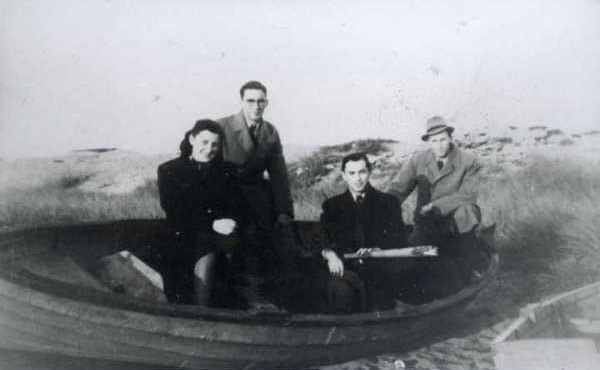
Visual AidA boat that reached the other side
Photograph of Danish Jews on the Swedish shore on October 6, 1943, in the rowboat that carried them across; the archive note says one of the oars had broken near the end of the crossing. The Knowledge Bank explains that fishermen and other boat owners carried small groups over the Øresund in ordinary craft, some no bigger than this. These are real refugees, not the Rosens, and the picture is small and worn because it is old. Notice how few people one boat took, and what they crossed in — the rescue of seven thousand was made of trips like this one.
Danish Jews arriving in Sweden by rowboat, 6 October 1943. Source: Wikimedia Commons, public domain.
🧠Knowledge Bank question
1The Knowledge Bank explains that the rescue was 'remarkably successful, but not complete' because ___.Ch.11–12
2Why is the baby given drops?Ch.11–12
3Peter gives the packet directly to Henrik before leaving.Ch.11–12
4What does Peter say about the packet?Ch.11–12
5Write the numbers 1–5 in the boxes to show the correct order of events in Chapters 11–12. Number 1 = what happens first.Ch.11–12
The packet is entrusted to Mr. Rosen.
Dawn reveals Mama in the grass — and the dropped packet.
Peter leads the first group into the dark.
Peter opens the casket of blankets and coats.
Mama guides the Rosens toward the harbor.
6Mama returns from the harbor exactly when expected.Ch.11–12
7What has happened to Mama?Ch.11–12
8What lies beside the path where Mr. Rosen stumbled?Ch.11–12
9The Rosens and Ellen are reunited before the crossing.Ch.11–12
10What situation closes Part 6?Ch.11–12
Part 3
Literary Elements
Understanding HOW and WHY Lois Lowry tells the story across Chapters 11–12.
🧠Knowledge Bank · A Relay Built from Objects
Literary Craft · Causality and Prop PayoffNarrative causality means that one event creates the conditions for the next instead of scenes merely following one another. Lowry builds these chapters as a relay. Clothing moves from the casket to the travelers; responsibility moves from Peter to Mr. Rosen to Mama; the packet falls from the route and becomes Annemarie’s task. Each transfer is a handoff, linking household objects to the historical machinery of rescue. The casket also demonstrates payoff: an object introduced earlier as a dangerous mystery later reveals a practical purpose. The packet works differently. Its contents remain unknown, so it becomes an unresolved promise that pulls the reader forward. Writers sometimes call such a planted object a narrative trigger; its importance is clear before its function is explained. The relay structure mirrors a real underground network, where no participant completes the rescue alone. Form and history therefore reinforce the same idea: survival depends on connected responsibility.
Visual AidTwo handoff chains
Diagram for the Knowledge Bank on causality and prop payoff. It draws the two objects the Knowledge Bank follows as two chains of handoffs: the casket, which is introduced as a threat and pays off as coats and blankets, and the packet, which passes from hand to hand and is still unexplained when Part 6 ends. It does not say what the packet holds. Notice that both chains move through people; in this book an object never travels alone.
The two chains traced in the Knowledge Bank. Drawn for Garden Heights Academy.
Architecture of delegation
Five parts of adults absorbing danger — then accident delivers the vital task to the child.
Prop payoff
The casket the soldiers nearly opened now opens on the story’s terms — blankets, not a body.
Chekhov’s packet
Unexplained contents + absolute importance = a promise the ending is now bound to keep.
🧠Knowledge Bank question
1According to the Knowledge Bank, the casket demonstrates 'payoff' because it ___.Ch.11–12
2Fill in the blank with the correct literary term.Ch.11–12
Word choices:accidentvillainprophecystorm- some words will not be used
No enemy plans the crisis — an does.
3The packet works as a ‘Chekhov’s gun’ because ___.Ch.11–12
4Lowry has a German patrol cause Mama’s injury.Ch.11–12
5Keeping the packet’s contents secret from Annemarie preserves ___.Ch.11–12
6The sedated baby, given one quiet sentence, shows Lowry’s method of ___.Ch.11–12
7The relay structure (Peter → Mr. Rosen → the grass) is designed to reach Annemarie.Ch.11–12
8Fill in the blank with the correct literary term.Ch.11–12
Word choices:payoffsetuprefrainmoral- some words will not be used
The casket’s reveal is the prop’s .
9Dawn revealing Mama in the grass uses the window as ___.Ch.11–12
10Part 6’s ending converts the novel into ___.Ch.11–12
Part 4
Think Deeper
Four deeper challenges — no single-word recall. Read, weigh the evidence, and reason it out.
💡Knowledge Bank · Rescue Is a System, Not One Hero
History & Civics · Collective ResponsibilityLarge rescues are often remembered through one brave figure because a single hero is easy to picture. The Danish operation worked more like a system. Jewish organizers and families made urgent decisions; political contacts and rabbis spread warnings; households offered temporary shelter; doctors, students, clergy, police, resistance workers, drivers, guides, and boat crews supplied specialized help. Swedish authorities granted asylum to the refugees, giving the route a safe endpoint. No role was sufficient by itself. Historical honesty also requires limits: some Danes collaborated with Nazi Germany, some refugees were betrayed or arrested, and some boat operators demanded high payments. Acknowledging this complexity does not weaken the rescue. It reveals why each choice mattered. The night journey in these chapters shows both the strength and fragility of a system: one injury and one dropped object can threaten the chain, yet another person can repair it. Collective courage is the practice of making one’s small role dependable to others—a form of shared responsibility.
Think back over these chapters. Candlelight on a raised lid: not a face inside, but folded wool — blankets, coats, mittens, the warmth a cold sea demands. Whispered fittings; a baby’s eyes closing under the doctor’s drops; a young man pressing a small paper packet into trembling hands with three words of instruction. Then the door, the dark, the waiting. And at first light: a silent kitchen, an empty bed, a shape dragging itself through silver grass — and near it, small and terrible on the path, a dropped square of paper on which, somehow, everything now depends.
Original passage written for Garden Heights — not a quotation from the novel.
1Claim: “Part 6 argues that the rescue’s margin between success and disaster is accident-thin.” — choose the two details that best prove it.Claim & Evidence
2The plan as designed, or The night as it happened? Tap each detail to sort it — tap again to switch sides. You can keep tapping to change your answer.Sort into two
◄ The plan as designedThe night as it happened ►
3Match each cause to its result. For each cause, pick its result.Cause & Effect
The soldiers’ footsteps fade from the farmhouse→
A baby receives its measured drops→
Peter presses the packet on Mr. Rosen→
A root catches a shoe in the darkness→
🧠Knowledge Bank question
4Fill both blanks to complete the reasoning.Build the Argument
The Knowledge Bank argues that the Danish rescue is better understood as a system than as one hero's act because , which shows that .
Part 5
Standardized Test
Reading passage · The Rescue of the Danish Jews · Reference & Inference · SAT & TOEFL-style practice
Read the passage — the highlighted words are tested — then answer. Tap an answer, then tap it again to confirm.
SATWords in Context — a word's meaning in this passage
SATInference — a conclusion the passage implies
TOEFLMain Idea — the passage's central point
TOEFLFactual Information — a fact stated in the passage
TOEFLVocabulary — a tested word's meaning here
TOEFLSentence Simplification — the shorter sentence that keeps the meaning
TOEFLReference — what a pronoun refers to
TOEFLProse Summary — the three sentences that sum it up
Denmark's Rescue of Its Jews
In the last days of September 1943, word leaked from inside the German administration itself: the roundup of Denmark’s Jews was scheduled for the night of October 1st. What followed had no parallel in occupied Europe. Warned by urgent word through synagogues, workplaces, and door-to-door whispers, nearly the entire Jewish population — about eight thousand people — vanished into hiding within days, sheltered by neighbors, strangers, hospitals that admitted them under false names, and churches that would conceal families in lofts. Then, over roughly two weeks, the coastal villages finished the work: fishing boats, rowboats, and even kayaks carried group after group across the Øresund to Sweden, which had publicly promised to receive them. About 7,200 Jews and about 680 non-Jewish family members reached safety.
The rescue succeeded because it was improvised — assembled on the spot, from what was at hand — by thousands of ordinary people rather than commanded by any single leader: doctors, pastors, taxi drivers, housewives, teenagers. It had its prices and its griefs: fishermen often charged fees that strained poor families; 470 Jews were caught and deported to the Theresienstadt camp, though all but 51 survived, largely because Danish officials kept pressing for their protection. Historians still cite the Danish rescue as a striking exception — the case that proved an occupied society, acting almost as one, could refuse. Nearly all of Denmark’s Jewish population survived the Holocaust — an outcome almost unmatched, written by rowboats, fishing smacks, and unlocked doors.
Original passage written for Garden Heights — not a quotation from the novel.
1What is the main idea of the passage?TOEFL · Main Idea
2How did Danes first learn of the planned roundup?TOEFL · Factual Information
3In the passage, an urgent warning is one that ___.TOEFL · Vocabulary
4How did hospitals help?TOEFL · Factual Information
5Which sentence best expresses the essential information in the sentence about the coastal villages finishing the rescue?TOEFL · Sentence Simplification
6In the passage, improvised means ___.SAT · Words in Context
7Why does the author mention Danish officials’ pressure after the deportations?SAT · Inference
8In paragraph 2, the pronoun It in ‘It had its prices and its griefs’ refers to ___.TOEFL · Reference
9In the passage, churches that would conceal families ___.TOEFL · Vocabulary
10Prose Summary (TOEFL).The passage describes the October 1943 rescue of Denmark’s Jews. This TOEFL task lists six sentences; choose the THREE that best capture the passage’s main ideas. The other three do not belong — they state minor details or ideas the passage does not present.TOEFL · Prose Summary
Part 6 · Optional
Creative Writing
A bonus challenge to practice your English. Take your time and have fun with it.
About This Section
This writing task is optional and is not part of your auto-graded score. The feedback below checks only the basics — length, spelling, and grammar — not whether your ideas are right or wrong. It is meant for classroom discussion and creative practice, so feel free to use your imagination!
Writing Task — Part 6 “The Packet in the Grass”
Write the moment of dawn from Annemarie’s point of view — the silent house, the shape in the grass, the packet on the path — ending at the instant she understands what must happen next. Use short sentences for the fear and longer ones for the thinking, the way Lowry does. 6–10 sentences. End with the decision, not the run.
You can start with: “The house was too quiet, the way a held breath is quiet...”
0 / 40 words minimum
🗣 Teach It · Just for Fun (optional)
No right or wrong — close the screen and tell someone nearby what happened in this part. Can’t find anyone? Tell yourself out loud. The moment you teach it, you truly understand it.
Part 6 Complete!
You finished Chapters 11–12 of Number the Stars.
Here are your auto-graded results:
-
points out of 100
Teach it to someone
The best last step is to teach it. In your own words, explain what happened — retell a favorite scene, teach a character’s big choice, or sum up the main idea for a parent, friend, or classmate. When you can teach it clearly, you truly own it.
Independent study guide by Garden Heights. Not affiliated with or endorsed by Lois Lowry. Contains original analysis only; no text from the novel is reproduced. Reference text: This workbook follows Lois Lowry’s classic text (the standard Puffin edition sold worldwide). Revised 2023 UK editions change some wording and may not match the vocabulary studied here.
SAT® is a registered trademark of College Board, which is not affiliated with, and does not endorse, these materials. TOEFL® is a registered trademark of ETS. These materials are not endorsed or approved by ETS. Garden Heights is an independent provider of test-style reading practice.