New here? Just sign up with Google — your account includes Matilda, our gift book, forever.
The Lightning Thief · Garden Heights
Part 1
for The Lightning Thief · Part 1 · Chapters 1–3
a novel by Rick Riordan
40 min6 Parts
This workbook is built on a solid pedagogical foundation, effectively integrating content and language learning based on the CLIL framework (Content and Language Integrated Learning), elevated by our unique 5th C — Connection — and an integrated Standardized Test section that weaves every SAT & TOEFL question type right into the novel, so learners build real test skills easily, naturally, and with fun.
💭 Before You Read · Just for Fun
No right or wrong answers — just think or chat about it: Have you ever had a completely ordinary day suddenly turn strange? If a grumpy teacher you knew turned out to be something they were only pretending to be, would you fight, freeze, or run — and who would you trust to tell?
What Happens in Part 1
A museum field trip turns deadly when Percy's math teacher becomes a monster no one else remembers.
Attack at the MuseumOn a Yancy Academy trip to the Metropolitan Museum of Art in New York City, cranky math teacher Mrs. Dodds turns into a winged monster and attacks twelve-year-old Percy Jackson.
The Pen-SwordLatin teacher Mr. Brunner tosses Percy a pen that becomes a sword; Percy destroys her, but afterward everyone insists Mrs. Dodds never existed.
Omens and MontaukPercy passes three old ladies knitting who silently snip a thread, an eerie omen. His best friend Grover acts strangely protective, and Percy's mother whisks him to a seaside cabin at Montauk on Long Island, sensing something dangerous coming.
What We Will Learn
Focus
What It Means
Greek Mythology
How real Greek myths hide inside a modern story
Setting (New York)
Why the story begins in New York City
Foreshadowing
Early clues that hint at danger to come
Chapter Summary
Chapter
Key Events
Ch.1
On a museum trip in NYC, Mrs. Dodds becomes a Fury and attacks Percy; Mr. Brunner’s pen-sword saves him, then everyone forgets she existed
Ch.2
Percy passes three old ladies who snip a thread of yarn — a dark omen; school ends and Grover seems oddly worried
Ch.3
Grover behaves strangely; Percy’s mother takes him to a cabin at Montauk as a storm builds
Copyright Notice
This is an independent study guide created by Garden Heights to support reading comprehension and literary analysis. It contains original analysis questions and does not reproduce any text from the novel. The Lightning Thief is a work by Rick Riordan. This guide is not affiliated with, authorized by, or endorsed by Rick Riordan or any associated rights holders. Students should read the original book, available from libraries and booksellers.
Part 1
Vocabulary
Study 10 key words from Chapters 1–3, then answer each question.
🧠Knowledge Bank · Greek Names Hiding in English
Classical Studies · Words From Myth
English carries Greek mythology inside its everyday vocabulary. A task that seems endless is Herculean, after the twelve labors; a weak point is an Achilles heel; a confusing building is a labyrinth, from the maze built for the Minotaur. The pattern is not decoration. When Renaissance scholars rebuilt European education around Greek and Latin texts, they handed later writers a shared set of stories to point at, and those pointers hardened into ordinary words. Psychology did the same much later, borrowing narcissism from Narcissus, who could not stop looking at his reflection, and echo from the nymph who could only repeat what others said. Knowing the story behind such a word gives you its exact shade of meaning rather than a rough synonym, which is why classicists argue that mythology is not a subject you finish. It is a key to a language you already speak.
mythologyn.Ch.1
The old stories of a people’s gods and heroes
“Percy did not know mythology was real.”
omenn.Ch.2
A sign that something is about to happen
“The snipped thread felt like a bad omen.”
disintegratev.Ch.1
To break apart into tiny pieces and vanish
“Mrs. Dodds seemed to disintegrate into dust.”
dyslexian.Ch.1
A difficulty with reading and letters
“Percy’s dyslexia made school hard for him.”
expelv.Ch.1
To force someone to leave a school
“Percy was afraid he would be expelled again.”
fountain penn.Ch.1
A pen that holds liquid ink
“Mr. Brunner handed Percy an ordinary fountain pen.”
protectiveadj.Ch.3
Wanting to keep someone safe
“Grover became very protective of Percy.”
talonn.Ch.1
A sharp claw of a bird or monster
“The creature reached out with cruel talons.”
sulfurn.Ch.1
A yellow element that smells of rotten eggs
“The monster vanished in a smell of sulfur.”
uneasyadj.Ch.2
Worried and not comfortable
“Percy felt uneasy about the old ladies.”
ⓘ The vocabulary words in this list are selected to help you understand and complete this workbook. Some may not appear verbatim in the original novel.
🧠Knowledge Bank question
1According to the Knowledge Bank, why is mythology called a key to a language you already speak?Ch.1
2True or False: An “omen” is a sign that something is about to happen.Ch.2
3When Mrs. Dodds breaks apart into dust and vanishes, she seems to ___.Ch.1
4True or False: To “expel” a student means to reward them with a prize.Ch.1
5Fill in each blank with the correct word.Ch.1–2
Word choices:omenmythologytalondisintegrate- some words will not be used
The monster slashed with a sharp , then seemed to . The snipped thread was a bad .
6True or False: Someone “protective” wants to keep another person safe.Ch.3
7Percy struggles with reading because he has ___.Ch.1
8True or False: “Uneasy” means calm and relaxed.Ch.2
9Fill in the blanks with the correct words.Ch.1
Word choices:sulfurprotectivemythologyexpel- some words will not be used
The monster vanished in a smell of , and Percy began to wonder if was real.
10A sharp claw of a bird or monster is a ___.Ch.1
Part 2
Comprehension
How well do you understand Chapters 1–3?
🧠Knowledge Bank · Brains Wired for a Different Job
Learning Science · Dyslexia and ADHD
Dyslexia is a difficulty in connecting written symbols to the sounds of speech, and it has nothing to do with intelligence or effort. Brain imaging shows less activation in the left-hemisphere regions that most readers use for rapid word recognition, and often more activity elsewhere, which may be why many dyslexic people report unusual strength in spatial reasoning and pattern-spotting. Attention deficit hyperactivity disorder involves the brain’s systems for regulating attention rather than a shortage of it; people with ADHD frequently describe hyperfocus on things they find compelling and great difficulty with things they do not. Neither condition is rare, and neither is fixed. Explicit phonics instruction reliably improves reading, and structure, movement and interest all improve focus. Researchers now describe both as neurodivergence, a difference in wiring rather than a defect, and stress that the disadvantage often lies in a classroom designed for one kind of brain.
Visual AidTwo routes from print to meaning
Structure diagram of the reading system the Knowledge Bank describes: a fast lane that recognizes whole words at once — the left-hemisphere circuitry brain scans watch — and a slow lane that assembles words letter by letter. In dyslexia the fast lane underactivates, so reading runs on the slow one. The two lanes are a simplification of many interacting regions, and the drawing claims nothing about any one person’s brain, least of all a fictional narrator’s. Notice what the Knowledge Bank insists on: the slow lane is effortful, not unintelligent.
Reading pathways and dyslexia as summarized in standard cognitive-neuroscience overviews (e.g., the International Dyslexia Association’s fact sheets). Drawn for Garden Heights Academy.
🧠Knowledge Bank question
1The Knowledge Bank explains that ADHD involves ___.Ch.1
2What does Mrs. Dodds turn into?Ch.1
3What does Mr. Brunner give Percy that becomes a sword?Ch.1
4True or False: After the fight, everyone insists Mrs. Dodds never existed.Ch.1
5Write the numbers 1–5 in the boxes to show the correct order across Part 1. Number 1 = what happens first.Ch.1–3
Percy passes three old ladies who snip a thread of yarn.
Percy’s mother takes him to a cabin at Montauk as a storm builds.
Mr. Brunner’s pen turns into a sword and Percy destroys Mrs. Dodds.
Grover acts strangely worried as school ends.
On the museum trip, Mrs. Dodds turns into a winged monster.
6True or False: Percy passes three old ladies who snip a thread, which feels like an omen.Ch.2
7How does Grover behave toward Percy?Ch.3
8Where does Percy’s mother take him to get away?Ch.3
9True or False: Percy has been expelled from schools before Yancy Academy.Ch.1
10Fill in the blanks to complete the sentence.Ch.1–3
Word choices:penmuseumstormfountain- some words will not be used
At the , a teacher became a monster, and Mr. Brunner’s became a sword.
Part 3
Literary Elements
Understanding HOW and WHY Rick Riordan creates certain feelings across Chapters 1–3.
🧠Knowledge Bank · A Narrator Who Warns You
Literary Craft · The Unreliable Opening
Some novels open with the narrator addressing the reader directly, a technique older than the novel itself and known as apostrophe when a speaker turns aside to an audience. First-person narration of this kind buys immediacy and voice, and it costs certainty: everything reaches the reader through one person’s judgment. Writers exploit that limit deliberately. A narrator who insists he is ordinary, or who advises the reader to stop reading, creates suspense without revealing plot, because the reader now wonders what would make someone say that. The device also establishes register. A wisecracking, self-deprecating voice signals that the coming mythology will be handled with comedy rather than reverence. Notice how much characterization arrives in the first page purely through word choice, before a single event has occurred — the narrator has already told you what kind of person he is by choosing which details he thinks are worth mentioning.
📚 Literary Devices in This Part · definitions & examples
Foreshadowing gives early clues about the future. The snipped thread hints at danger ahead.The story is told by Percy himself (“I”), so we see everything through his eyes and humor.An allusion is a reference to something famous — here, to real Greek myths like the Furies and the Fates.
The questions below are mixed — not grouped by device. Decide which device each one is about.
🧠Knowledge Bank question
1According to the Knowledge Bank, why does a narrator who advises the reader to stop reading create suspense?Ch.1–4
2A first-person narrator tells the story using ‘I’ and ‘me’.Ch.1–4
3Fill in each blank with the correct word.Ch.1–4
Word choices:first-personallusionforeshadowingsetting- some words will not be used
Percy narrating with ‘I’ is
A nod to the Greek Furies is an .
4A reference to something famous — like the real Greek Furies or Fates — is an —Ch.1–4
5An allusion explains a myth in full so the reader needs no outside knowledge.Ch.1–4
6Fill in each blank with the correct word.Ch.1–4
Word choices:foreshadowingallusionfirst-personmood- some words will not be used
The three old ladies snipping a thread is
Borrowing the Greek Fates is an .
7The old woman snipping the yarn hints at coming death. This clue is —Ch.1–4
8Percy’s funny, sarcastic voice mostly comes through because the story is —Ch.1–4
9Fill in each blank with the correct word.Ch.1–4
Word choices:first-personforeshadowingallusionplot- some words will not be used
Seeing events only through Percy’s eyes is the
The Fates scene is .
10Why does Riordan weave real Greek myths into a modern setting?Ch.1–4
Part 4
Think Deeper
Four deeper challenges — no single-word recall. Read, weigh the evidence, and reason it through.
🧠Knowledge Bank · What Museums Keep From Greece
Art History · Reading Greek Vases
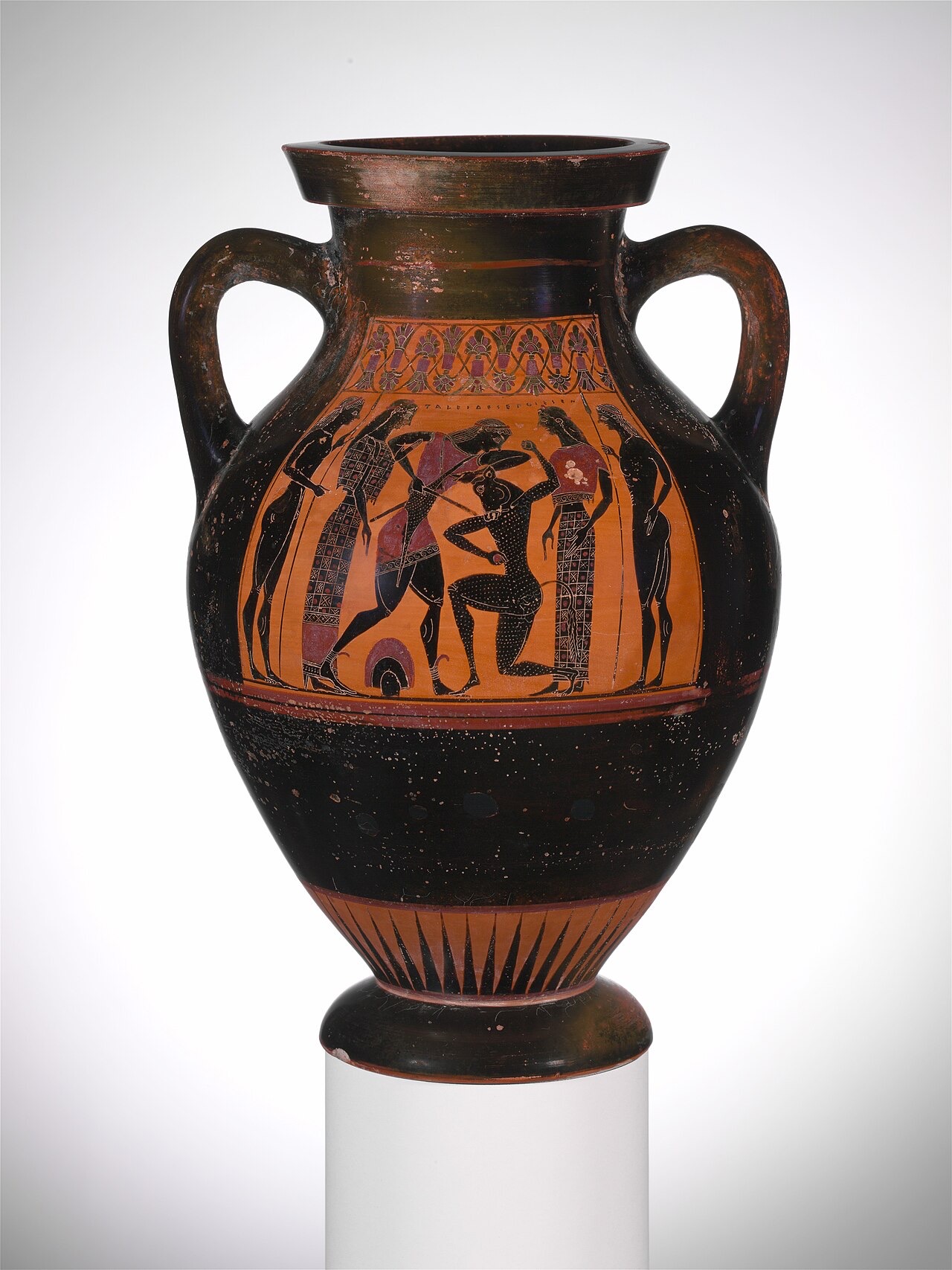
Most surviving Greek mythology reaches us through objects rather than books. Painted pottery is the richest source: black-figure vases, made mainly in the sixth century BCE, show figures as dark silhouettes scratched with detail, while the later red-figure technique reversed the scheme and let painters draw muscles and folds with a brush. Because these pots were exported all around the Mediterranean, archaeologists use them to date sites and map trade. They also preserve versions of myths that no text records, and sometimes contradict the versions that survive in writing. That is why museum curators treat a vase as evidence rather than illustration, cataloguing the painter’s hand, the shape’s function and the findspot. A student who learns to read the images can recover stories the ancient world told itself long before anyone wrote them down, and can see which heroes a particular city actually cared to display.
Visual AidThe evidence a museum reads
Photograph of an Attic black-figure amphora made in Athens in the sixth century BCE, attributed to the Taleides Painter and now in the Metropolitan Museum of Art. The panel shows Theseus driving his sword into the kneeling Minotaur while onlookers watch — exactly the kind of object the Knowledge Bank describes: figures as dark silhouettes, detail scratched into the glaze. It does not illustrate the novel; the Minotaur Percy meets is Rick Riordan (author)’s modern retelling, while this pot preserves an ancient version, painted before most surviving texts of the story were written. Notice that a picture like this is evidence: exported pots let archaeologists date sites and map trade.
Attic black-figure amphora attributed to the Taleides Painter, obverse: Theseus slaying the Minotaur; Metropolitan Museum of Art, New York. Source: Wikimedia Commons, File:Terracotta amphora (jar) MET DP116930.jpg, CC0.
1Claim: “Percy’s ‘problems’ are really signs that he is a demigod.” — choose the two details that best prove it.Claim & Evidence
2A sign Percy is a demigod, or an ordinary detail? Tap each item to sort it — tap again to switch sides. You can keep tapping to change your answer.Sort into two
◄ A demigod signAn ordinary detail ►
3Match each cause to its result. For each cause, pick its result.Cause & Effect
Mrs. Dodds corners Percy alone→
Mr. Brunner tosses Percy a pen→
Percy defeats Mrs. Dodds→
Percy can’t read or sit still in class→
🧠Knowledge Bank question
4Fill both blanks to complete the reasoning.Build the Argument
Museum curators treat a painted Greek vase as evidence rather than illustration because , which shows that .
Part 5
Standardized Test · Vocabulary in Context & Main Idea
Part 1 builds four exam reading skills — Vocabulary in Context, Main Idea, Inference, and Author’s Purpose — in the styles the SAT and TOEFL use. Read the passage (the highlighted words are tested below), then choose the answer best supported by the text.
Read the passage — the highlighted words are tested — then answer. Tap an answer, then tap it again to confirm.
SATWords in Context — a word's meaning in this passage
SATInference — a conclusion the passage implies
SATCentral Ideas — the passage's main point
SATText Structure & Purpose — how the passage is built, and why
TOEFLFactual Information — a fact stated in the passage
TOEFLInference — what the passage implies
Why Greek Myths Still Endure
The Metropolitan Museum of Art in New York City holds an immense collection of ancient Greek art. Visitors who walk its vast marble halls confront gods, heroes, and monsters that were carved thousands of years ago. Although ancient Greece can feel remote from modern life, its myths have proved remarkably durable, and they still endure in books, films, and museums today.
One reason these stories resist being forgotten is that they explain feelings people still recognize. The Greeks imagined the three Fates, who spin, measure, and cut the thread of each human life. This was not an abrupt or careless idea; it was a deliberate way to picture how a life can end suddenly. Before a voyage or a battle, many Greeks also searched the sky for an omen, reading the flight of birds as a sign of the good or bad luck ahead. Everyday English even hides Greek myth — the word panic comes from the god Pan, who was said to cause sudden fear.
Old stories can disintegrate — crumble away piece by piece until nothing remains — yet over the centuries Greek mythology has instead transitioned smoothly into modern storytelling. Writers now place ancient monsters in busy city streets so that readers can meet them in a familiar world. Publishers have found that young readers embrace these updated tales eagerly, and such books often lead them back to the original legends. Museums like the Metropolitan encourage that curiosity by displaying the very vases and statues that first pictured the heroes. By blending the old and the new, such stories keep the myths alive for each new generation.
Original passage written for Garden Heights — not a quotation from the novel.
1In the passage, omen most nearly means ___.SAT · Words in Context
2The passage most strongly suggests that writers set ancient monsters in city streets so readers can —SAT · Inference
3According to the passage, the Metropolitan Museum of Art holds an immense collection of —TOEFL · Factual Information
4As used in the passage, the word “confront” most nearly means —SAT · Words in Context
5According to the passage, the English word “panic” comes from —TOEFL · Factual Information
6According to the passage, what has happened to Greek mythology over the centuries?TOEFL · Factual Information
7Which statement best expresses the central idea of the passage?SAT · Central Ideas
8In the passage, disintegrate most nearly means ___.SAT · Words in Context
9The example of the word “panic” most strongly suggests that —TOEFL · Inference
10Why does the author mention writers who place ancient monsters in modern city streets?SAT · Text Structure & Purpose
Part 6 · Optional
Creative Writing
A bonus challenge to practice your English. Take your time and have fun with it.
About This Section
This writing task is optional and is not part of your auto-graded score. The feedback below checks only the basics — length, spelling, and grammar — not whether your ideas are right or wrong. It is meant for classroom discussion and creative practice, so feel free to use your imagination!
Writing Task — Part 1 “A Strange Day”
Percy’s ordinary school trip turns strange and scary. Write about a time something normal suddenly felt strange or surprising. What happened, and how did you feel? Write at least 40 words.
You can start with: “It started as a completely normal day, until…”
0 / 40 words minimum
🗣 Teach It · Just for Fun (optional)
No right or wrong — close the screen and tell someone nearby what happened in this part. Can’t find anyone? Tell yourself out loud. The moment you teach it, you truly understand it.
Part 1 Complete!
You finished Chapters 1–3 of The Lightning Thief.
Here are your auto-graded results:
-
points out of 100
Teach it to someone
The best last step is to teach it. In your own words, explain what happened — retell a favorite scene, teach a character’s big choice, or sum up the main idea for a parent, friend, or classmate. When you can teach it clearly, you truly own it.
Independent study guide by Garden Heights. Not affiliated with or endorsed by Rick Riordan. Contains original analysis only; no text from the novel is reproduced.
SAT® is a registered trademark of College Board, which is not affiliated with, and does not endorse, these materials. TOEFL® is a registered trademark of ETS. These materials are not endorsed or approved by ETS. Garden Heights is an independent provider of test-style reading practice.