New here? Just sign up with Google — your account includes Matilda, our gift book, forever.
Pippi Longstocking · Garden Heights
Part 3
for Pippi Longstocking · Part 3 · Chapters 3–4
8 Parts40 min
What Happens in Part 3
Word spreads that a nine-year-old lives alone at Villa Villekulla, and the town decides she belongs in a children’s home. Two police officers arrive to collect her — and Pippi, delighted to have visitors, turns the arrest into a game of tag, leading the puffing officers across the roof and finally setting them gently outside the gate. The town gives up: Pippi may stay. Then Tommy and Annika persuade her to try school — mostly by mentioning Christmas vacation. At the schoolhouse Pippi answers arithmetic with nonsense, draws a life-size horse on the floor, and cheerfully talks back until she suddenly understands: school has rules she never learned. She apologizes in her own way, the teacher forgives her, and Pippi gallops home — deciding school, like arithmetic, can manage without her.
What We Will Learn
Section
What you will practice
Vocabulary
Words of rules and lessons: officer, orphanage, arithmetic, persuade, vacation, mischief…
Literary Elements
Situational irony, satire, and setting
Cross-Curricular
Why towns have police and schools at all — and what school was like in 1945 Sweden
Chapter Summary
Ch.
What happens
3
Tag with the Police — two officers come to take Pippi to a children’s home; she beats them at roof-tag and the town lets her stay.
4a
Off to School — tempted by the idea of Christmas vacation, Pippi rides to the schoolhouse.
4b
A Very Odd Pupil — nonsense answers to arithmetic, a life-size horse drawn on the floor, and honest confusion about the rules.
4c
Home Again — Pippi makes peace with the kind teacher and gallops home, done with school for now.
Part 1
Vocabulary
Study 10 key words from Chapters 3–4, then answer each question.
🧠Knowledge Bank · Sailors’ Yarns and Faraway Lands
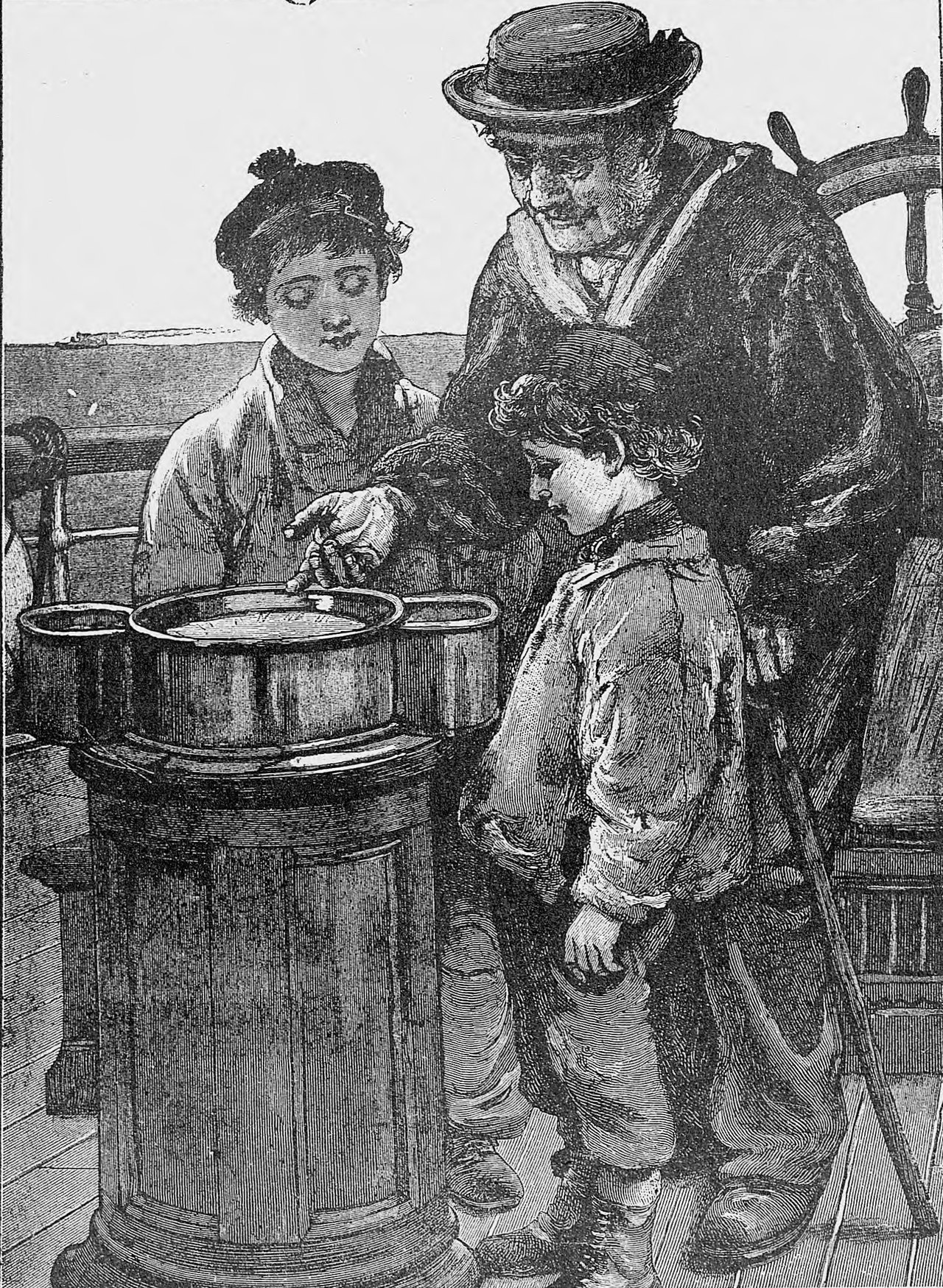
Content · Tall Tales & the Wider WorldAt school Pippi answers every question with a wild story — of Egypt, of far-off seas, of people who walk on their hands. She is spinning what sailors call a yarn: a tall tale swapped between ships to pass long nights at sea. Her father is a sea captain, so Pippi grew up on voyages and harbor talk, where each teller stretches the truth a little farther than the last. Real explorers did bring home astonishing facts from distant countries, and those true wonders are what made the exaggerated versions so easy to believe. That is the root of the whole tall-tale tradition: a grain of real geography, watered into something marvelous. When Pippi trades book-facts for a good story, she is carrying on an art far older than any classroom.
Visual AidA sailor spinning a yarn
Engraving from a children’s book published in Chicago around 1897, showing an old sailor on deck with two children at the ship’s compass, both of them listening. The Knowledge Bank explains that a yarn is a tall tale swapped between ships to pass long nights at sea, and that Pippi grew up on voyages and harbor talk, where each teller stretches the truth a little farther than the last. This is a picture of that art being handed down. The artist is unknown, the sailor is not Pippi’s father, and we cannot hear what he is saying. Notice the children’s faces — a yarn works only when somebody leans in to listen.
Sailor with two children at a ship's compass, engraving from Happy Children, Chicago, about 1897; artist unknown. Source: Wikimedia Commons, public domain.
officern.Ch.3
A member of the police
“Two officers knocked at the gate.”
orphanagen.Ch.3
A home for children without parents
“The town planned to send her to an orphanage.”
persuadev.Ch.4
To talk someone into doing something
“The children persuade Pippi to try school.”
arithmeticn.Ch.4
The number work of adding and subtracting
“The class was busy with arithmetic.”
vacationn.Ch.4
A break from school or work
“Christmas vacation sounded wonderful.”
refusev.Ch.4
To say no to something
“Pippi would refuse to sit still.”
mischiefn.Ch.3–4
Playful trouble-making
“Her eyes sparkled with mischief.”
gallopv.Ch.4
To run at a horse’s fastest pace
“She galloped home on her horse.”
educationn.Ch.4
Teaching and learning
“School, said the town, meant a proper education.”
behavev.Ch.4
To act in a proper way
“Pupils were expected to behave quietly.”
ⓘ The vocabulary words in this list are selected to help you understand and complete this workbook. Some may not appear verbatim in the original novel.
🧠Knowledge Bank question
1According to the Knowledge Bank, a yarn is ___.Ch.3
2An ‘orphanage’ is a home for children without parents.Ch.3
3To talk someone into doing something is to ___ them.Ch.4
4‘Arithmetic’ is the school subject about drawing horses.Ch.4
5Fill in each blank with the correct word.Ch.3–4
Word choices:vacationmischiefofficerbehave- some words will not be used
Only the promise of Christmas tempts Pippi to school.
Her roof-tag game was pure .
6To say no to something is to ___ it.Ch.4
7A horse that ‘gallops’ is moving as slowly as possible.Ch.4
8Teaching and learning together are called ___.Ch.4
9Fill in the blanks with the correct words.Ch.3–4
Word choices:refusebehavegalloppersuade- some words will not be used
Pupils must quietly at their desks.
Pippi would rather home than sit still.
10Playful trouble-making is called ___.Ch.3–4
Part 2
Comprehension
Show you understood what happens in Chapters 3–4.
🧠Knowledge Bank · Tracing Cause and Effect
Comprehension · Chapters 3–4These two chapters follow the same clear chain, and naming it helps you read. A cause is what makes something happen; an effect is the result. The town sends police to fetch Pippi (cause), so a rooftop game of tag breaks out and the officers go home empty-handed (effect). The school tries to teach her by the rules (cause), so she answers with tall tales and cheerful chaos (effect). Underneath every scene sits her impossible strength — the force that lets her carry two grown men to the gate like parcels — which is the deeper cause of each comic result. When you can point to what triggers each event and what follows from it, you understand a story instead of just watching it, reading the way a good detective works — by tracing.
Visual AidCause, effect, and the cause under both
Diagram for the Knowledge Bank on cause and effect. The two rows are the two chains the Knowledge Bank names, the police visit and the school day, each as a cause on the left and its effect on the right; the red band beneath is the deeper cause the Knowledge Bank says sits under every scene. It does not add events of its own. Notice that both rows rest on the same band — one strength, two comedies.
Chains and deeper cause as given in the Knowledge Bank. Drawn for Garden Heights Academy.
🧠Knowledge Bank question
1The Knowledge Bank says the deeper cause of each comic result is ___.Ch.3
2How does Pippi treat the officers’ visit?Ch.3
3The chase with the officers ends up on the roof of Villa Villekulla.Ch.3
4How does the police visit finally end?Ch.3
5Write the numbers 1–5 in the boxes to show the correct order of events in Chapters 3–4. Number 1 = what happens first.Ch.3–4
Tempted by talk of vacation, Pippi rides to school.
Pippi answers arithmetic with nonsense and draws on the floor.
Pippi makes peace with the teacher and gallops home.
Two officers arrive with orders about Pippi.
Pippi leads the officers on a chase across the roof.
6Pippi goes to school mainly because she loves arithmetic.Ch.4
7What does Pippi draw during the drawing lesson?Ch.4
8When the teacher explains the rules, Pippi realizes she ___.Ch.4
9The teacher and Pippi part as enemies, and Pippi is expelled forever.Ch.4
10After the roof-tag game, what does the town decide about Pippi?Ch.3
Part 3
Literary Elements
Understanding HOW and WHY Astrid Lindgren tells the story across Chapters 3–4.
🧠Knowledge Bank · Laughing at the Rulebook
Narrative Craft · Laughing at the RulebookBoth chapters run on situational irony — when the opposite of what we expect actually happens. Police arrive to capture a small girl, yet she captures them, lifting each officer over a fence with ease. A school means to tame a wild child, yet the child cheerfully upends the room. The engine under every reversal is her physical strength, the tall-tale power that flips who is really in charge. Lindgren sets up an ordinary expectation — grown-ups control children — and then lets Pippi’s impossible body turn it upside down, which is exactly why we laugh. Irony makes comedy because our minds lean one way and the story leaps the other. Learning to feel that little jolt of the unexpected is how a reader hears a book’s humor.
Situational Irony
When events turn out the opposite of what is expected — the arresting officers end up the ones being played with.
Satire
Humor that gently makes fun of rules or systems — school and police both look a little silly beside Pippi.
Setting
Where a scene happens shapes its feeling — rooftop and open road mean freedom; the schoolhouse means rules.
🧠Knowledge Bank question
1According to the Knowledge Bank, situational irony is when ___.Ch.3
2Fill in the blank with the correct literary term.Ch.3–4
Word choices:satiresettingdialoguesimile- some words will not be used
Gently mocking the school system through humor is .
The cramped schoolhouse and the open road are contrasts of .
3Lindgren makes the officers puff and stumble during the chase to ___.Ch.3
4Satire uses humor to point at something silly in rules or systems.Ch.3–4
5Pippi attending school only for the vacations is ironic because ___.Ch.4
6The kindly teacher is important to the satire because she shows ___.Ch.4
7In these chapters, the rooftop setting is linked with freedom and play.Ch.3
8Fill in the blank with the correct literary term.Ch.3
Word choices:situational ironysatirethemeflashback- some words will not be used
An outcome that is the opposite of what is expected is called .
9Pippi’s nonsense answers in arithmetic serve the story by ___.Ch.4
10By ending both chapters with nobody punished and nobody angry, Lindgren keeps the story’s tone ___.Ch.3–4
Part 4
Think Deeper
Four deeper challenges — no single-word recall. Read, weigh the evidence, and reason it out.
🧠Knowledge Bank · Systems, Rules, and One Free Girl
Child Psychology · Systems, Rules, and One Free GirlThe police chapter and the school chapter tell one story twice: a system built for ordinary children meets a girl who is not ordinary at all. Rules exist for good reasons — to keep people safe and help everyone learn together — so Pippi’s cheerful defiance can make us cheer and worry at the same time. Her strength means no rule can force her, which lets the book ask a real question: is a person who breaks every rule truly free, or simply alone? Lindgren does not scold and does not fully approve; she lets you weigh it. Being different is a gift and a difficulty at once, and honest thinking holds both truths without rushing to a tidy answer. Sitting with that tension, instead of escaping it, is what makes a reader truly wise.
Think back over the two visits. The officers climb ladders and chase across roof tiles, only to be set gently outside their own case. The teacher offers numbers and letters, and receives nonsense, a floor-sized horse — and, at last, an honest apology from a girl who never knew the rules. Both times the town’s system arrives certain, and leaves smiling and empty-handed.
Original passage written for Garden Heights — not a quotation from the novel.
1Claim: “Pippi means no harm — she simply does not know the town’s rules.” — choose the two details that best prove it.Claim & Evidence
2What the town’s systems want, or What Pippi wants? Tap each detail to sort it — tap again to switch sides. You can keep tapping to change your answer.Sort into two
◄ What the town’s systems wantWhat Pippi wants ►
3Match each cause to its result. For each cause, pick its result.Cause & Effect
The town learns a child lives alone→
Pippi wins the game of roof-tag→
Tommy and Annika describe Christmas vacation→
The teacher kindly explains the rules→
🧠Knowledge Bank question
4Fill both blanks to complete the reasoning.Build the Argument
The Knowledge Bank says the police and school chapters ask whether , and the author .
Part 5
Standardized Test
Why Every Child Went to School · SAT & TOEFL-style practice
Read the passage — the highlighted words are tested — then answer. Tap an answer, then tap it again to confirm.
SATWords in Context — a word's meaning in this passage
SATDetail — a fact stated in the passage
SATCentral Ideas — the passage's main point
SATText Connections — how two parts of the text relate
TOEFLFactual Information — a fact stated in the passage
TOEFLVocabulary — a tested word's meaning here
TOEFLRhetorical Purpose — why the author included a detail
Sweden's Compulsory School Laws
A hundred years ago, most countries in Europe passed laws making school compulsory — every child had to attend, whether their family was rich or poor. Sweden was among the earliest: from 1842, each parish had to open a school, and by the 1940s a Swedish child spent seven years at a desk learning reading, writing, and arithmetic. The law had a serious purpose. Before compulsory school, many children worked instead of learning, and whether you got any education at all depended on luck. School laws also gave towns a new duty: finding the children who did not come. Teachers kept careful attendance lists, and a missing pupil meant a visit — sometimes from a police officer — to make sure the child was safe and cared for. That is why a girl living alone, with no school and no parents, would draw the town's worried attention at once. The system could be stiff, but its heart was simple: no child should be forgotten.
Original passage written for Garden Heights — not a quotation from the novel.
1In the passage, a child's education is ___.SAT · Words in Context
2According to the passage, when did Swedish parishes have to open schools?TOEFL · Factual Information
3By the 1940s, how long did a Swedish child spend at school?SAT · Detail
4In the passage, “arithmetic” is ___.TOEFL · Vocabulary
5Before compulsory school, many children ___.TOEFL · Factual Information
6In the passage, a police officer is ___.SAT · Words in Context
7What happened when a pupil was missing from school?SAT · Detail
8What is the passage mainly about?SAT · Central Ideas
9How does the passage connect to Chapters 3–4?SAT · Text Connections
10The author’s attitude toward the old school system is best described as ___.TOEFL · Rhetorical Purpose
Part 6 · Optional
Creative Writing
A bonus challenge to practice your English. Take your time and have fun with it.
About This Section
This writing task is optional and is not part of your auto-graded score. The feedback below checks only the basics — length, spelling, and grammar — not whether your ideas are right or wrong. It is meant for classroom discussion and creative practice, so feel free to use your imagination!
Writing Task — Part 3 “The School I Would Build”
Pippi lasts one single day at school. Imagine you could build a school she would love to attend. Describe a day there: what would be taught, what rules would exist, and what would make even Pippi come back tomorrow? Write at least 40 words.
You can start with: “At my school, the first lesson of the day is…”
0 / 40 words minimum
🗣 Teach It · Just for Fun (optional)
No right or wrong — close the screen and tell someone nearby what happened in this part. Can’t find anyone? Tell yourself out loud. The moment you teach it, you truly understand it.
Part 3 Complete!
You finished Chapters 3–4 of Pippi Longstocking.
Here are your auto-graded results:
-
points out of 100
Teach it to someone
The best last step is to teach it. In your own words, explain what happened — retell a favorite scene, teach a character’s big choice, or sum up the main idea for a parent, friend, or classmate. When you can teach it clearly, you truly own it.
Independent study guide by Garden Heights. Not affiliated with or endorsed by Astrid Lindgren. Contains original analysis only; no text from the novel is reproduced. Reference text: This workbook follows Astrid Lindgren’s classic text (the standard Puffin edition sold worldwide). Revised 2023 UK editions change some wording and may not match the vocabulary studied here.
SAT® is a registered trademark of College Board, which is not affiliated with, and does not endorse, these materials. TOEFL® is a registered trademark of ETS. These materials are not endorsed or approved by ETS. Garden Heights is an independent provider of test-style reading practice.