New here? Just sign up with Google — your account includes Matilda, our gift book, forever.
Ramona the Pest · Garden Heights
Part 3
for Ramona the Pest · Part 3 · Chapter 3
8 Parts40 min
What Happens in Part 3
Kindergarten gets serious: it is time for seat work — sitting still and practicing letters — and Ramona discovers the glory of writing her own name. R-A-M-O-N-A is splendid, but the real prize is her last name: Quimby begins with Q, and Miss Binney teaches that a Q is a nice round O with a little tail, like a cat. A cat! Ramona’s imagination takes the wheel: if a Q is a cat, her Qs shall be the finest cats in kindergarten — complete with ears pricked up and whiskers spreading wide. Miss Binney praises Ramona’s interesting drawings and her nice fat Qs, and Ramona glows: pleasing this teacher is now the great mission of her life. Around her, classmates wrestle their own pencils, and Ramona learns that seat work is where school stops being all play — and that even so, there is always room, at the top of a Q, for a pair of ears.
Imagination as a character trait, and small conflicts to come
Cross-Curricular
How hands learn letters, and why children turn letters into pictures
Chapter Summary
Ch.
What happens
3
Seat Work — Ramona learns to write her name, meets the letter Q — a round O with a cat’s tail — and improves it with ears and whiskers, to Miss Binney’s delight.
Part 1
Vocabulary
Study 10 key words from Chapter 3, then answer each question.
🧠Knowledge Bank · How a Hand Learns Its Letters
Lexicology · How a Hand Learns Its Letters
To an adult, writing a letter feels automatic, but to a five-year-old it is real, sweaty labor. The tiny muscles of the hand are still developing, and the link between eye and fingers — called coordination — is only beginning to form. Shaping a curvy letter like Q takes enormous effort and concentration. Because the work is so hard and the child’s imagination so lively, Ramona does not just draw the letter — she gives her Q ears and whiskers and turns it into a cat. This is not disobedience; it is a young mind making a dull, difficult task her own. Every wobbly, decorated letter on the page is proof of a small hand slowly, patiently winning its control.
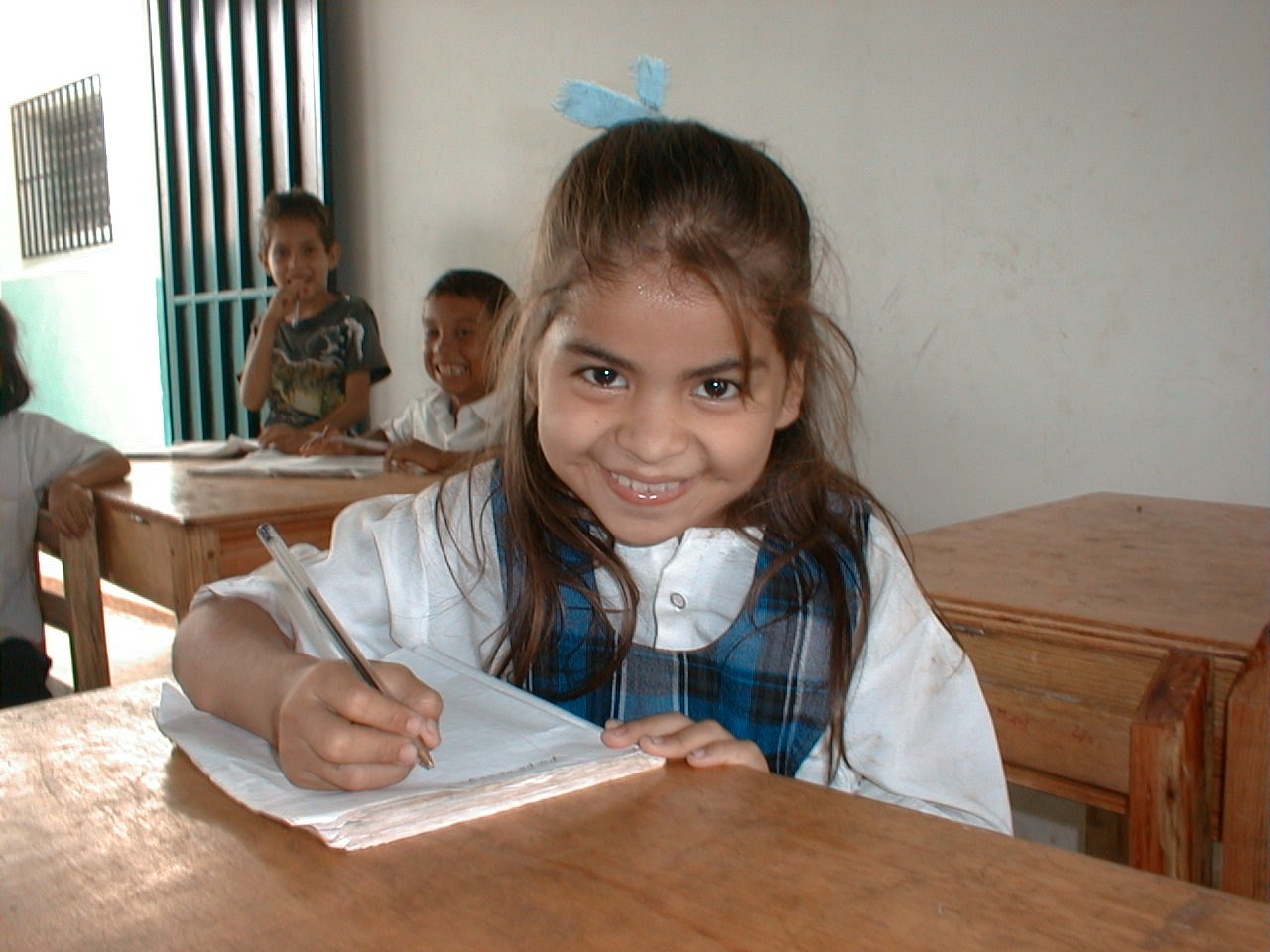
Visual AidA young hand steering a pencil
Photograph taken in 1999 of a girl writing in an exercise book at a school desk. The Knowledge Bank explains that writing feels automatic to an adult but is real, sweaty labor for a five-year-old, because the tiny muscles of the hand are still developing and the link between eye and fingers, called coordination, is only beginning to form. Look at the grip and the angle of the wrist: that is the whole hand working, not just the fingers. She is a pupil at a school in Honduras, not a character in the book, and the letters she is forming are her own.
Girl writing at a school desk, San Ramon, Choluteca, Honduras, 1999; photograph by Zack Clark. Source: Wikimedia Commons, public domain.
practicev.Ch.3
To do something again and again to get better
“Kindergartners practice their letters row after row.”
imaginationn.Ch.3
The mind’s power to picture new things
“Ramona’s imagination turned a letter into a cat.”
whiskersn.Ch.3
The long thin hairs on an animal’s face
“Her Qs grew whiskers, naturally.”
praisen.Ch.3
Kind words about something done well
“Miss Binney’s praise made Ramona glow.”
splendidadj.Ch.3
Wonderful; excellent
“Writing her own name felt absolutely splendid.”
capitaladj.Ch.3
An uppercase letter, like the Q in Quimby
“Quimby begins with a capital Q.”
wobblyadj.Ch.3
Shaky and unsteady
“New writers make wobbly letters at first.”
improvev.Ch.3
To make something better
“Ramona decided to improve the plain Q with ears.”
missionn.Ch.3
An important job you give yourself
“Pleasing Miss Binney became Ramona’s mission.”
glowv.Ch.3
To shine with happiness
“One kind word, and Ramona would glow all morning.”
ⓘ The vocabulary words in this list are selected to help you understand and complete this workbook. Some may not appear verbatim in the original novel.
🧠Knowledge Bank question
1According to the Knowledge Bank, shaping a letter is hard work for a five-year-old because ___.Ch.3
2Your ‘imagination’ is the mind’s power to picture new things.Ch.3
3Kind words about something done well are ___.Ch.3
4Something ‘wobbly’ is perfectly steady and straight.Ch.3
5Fill in each blank with the correct word.Ch.3
Word choices:missionwhiskerscapitalglow- some words will not be used
Quimby begins with a Q.
Ramona’s cat-Qs had ears and .
6Wonderful or excellent is ___.Ch.3
7To ‘improve’ something is to make it worse.Ch.3
8An important job you give yourself is a ___.Ch.3
9Fill in the blanks with the correct words.Ch.3
Word choices:praisepracticesplendidimagination- some words will not be used
Ramona’s saw a cat inside the letter Q.
Warm from Miss Binney made the work worthwhile.
10To shine with happiness is to ___.Ch.3
Part 2
Comprehension
Show you understood what happens in Chapter 3.
🧠Knowledge Bank · Naming What Ramona Feels
Narrative Logic · Naming What Ramona Feels
One of the best things a reader can do is keep a finger on a character’s feelings as they change through a scene. A book seldom stops to announce that now she felt bored; instead it shows the signs, and we read them. When Ramona wiggles, sighs, and lets her mind wander during quiet seat work, those small actions are clues to a feeling she never names aloud. Because you watch what her body does, you can tell her first-day eagerness has cooled into restlessness. Feelings in a story are like weather, always shifting. Track how Ramona’s mood rises and dips, and you will understand her better than her own words could ever show.
🧠Knowledge Bank question
1The Knowledge Bank says a book seldom announces a feeling, so a reader should watch for ___.Ch.3
2What thrills Ramona about learning to write?Ch.3
3Miss Binney says a Q is a nice round O with a little tail, like a cat.Ch.3
4How does Ramona improve her letter Q?Ch.3
5Write the numbers 1–5 in the boxes to show the correct order of events in Chapter 3. Number 1 = what happens first.Ch.3
Miss Binney describes the Q as an O with a cat’s tail.
Ramona learns to write her own name.
Miss Binney praises Ramona’s interesting work.
Seat work begins, and the class practices letters.
Ramona’s Qs grow ears and whiskers.
6Miss Binney scolds Ramona for ruining the letter Q with decorations.Ch.3
7Why does Quimby matter so much to Ramona’s writing?Ch.3
8What has become Ramona’s great mission at school?Ch.3
9Ramona finds sitting still for seat work the easiest part of school.Ch.3
10What does the cat-Q show about how Ramona meets the world?Ch.3
Part 3
Literary Elements
Understanding HOW and WHY Beverly Cleary tells the story across Chapter 3.
🧠Knowledge Bank · Comparing with ‘Like’ and ‘As’
Literary Technique · Comparing with ‘Like’ and ‘As’
A simile is a comparison that uses the little words like or as to hold two things side by side — quiet as a mouse, busy like a bee. Writers reach for similes because our minds think in pictures: when you compare something new to something familiar, the reader suddenly sees it clearly and feels it too. In this chapter, watch for the moments when Ramona’s world is described by comparing it to something you already know well. Each time, the comparison does double duty — it paints a sharp image and often makes you smile at how exactly right it feels. The author’s arrangement intensifies the moment Ramona’s imagination takes the wheel.
Visual AidTwo things held side by side
Diagram for the Knowledge Bank on similes. Card 1 is the new thing a reader cannot yet picture, card 2 is the pair of little words the Knowledge Bank names, and card 3 is the familiar thing they reach for. The two examples underneath are the Knowledge Bank’s own. Notice that the smallest card is the one doing the joining — like and as are what make a simile a simile.
How a simile joins two things, as set out in the Knowledge Bank. Drawn for Garden Heights Academy.
Simile
A comparison using like or as — a Q is like a cat with a tail — and Ramona takes it literally.
Characterization
Small actions revealing character — one whiskered Q says: this girl makes things her own.
Foreshadowing
A hint of what is coming — a rule-improver is headed for trouble with rules that can’t bend.
🧠Knowledge Bank question
1According to the Knowledge Bank, a simile holds two things side by side using ___.Ch.3
2Fill in the blank with the correct literary term.Ch.3
Word choices:simileforeshadowingdialoguechorus- some words will not be used
A comparison using like or as is a .
A hint of trouble to come is .
3Ramona’s cat-Q takes the teacher’s simile and ___.Ch.3
4The whiskered Q works as characterization because a small action reveals who Ramona is.Ch.3
5As foreshadowing, the cat-Q quietly warns readers that Ramona ___.Ch.3
6Cleary shows Ramona’s love for Miss Binney growing through ___.Ch.3
7A simile is a comparison that never uses the words like or as.Ch.3
8Fill in the blank with the correct literary term.Ch.3
Word choices:characterizationsettingclimaxmoral- some words will not be used
Revealing who a character is through small actions is .
9By letting Miss Binney PRAISE the cat-Q, Cleary shows this teacher ___.Ch.3
10This quiet chapter matters to the whole book because it ___.Ch.3
Part 4
Think Deeper
Four deeper challenges — no single-word recall. Read, weigh the evidence, and reason it out.
🧠Knowledge Bank · The Hard Work of Sitting Still
Ethical Reasoning · The Hard Work of Sitting Still
Adults sometimes forget how genuinely hard it is for a five-year-old to sit still and do quiet work. A young body is built to move, and a young mind can hold its attention for only a short stretch before it drifts. So when Ramona grows restless during seat work, she is not being naughty — her attention span has reached its natural edge. Learning to stay with a boring but necessary task is one of the quietest lessons of childhood. Nobody masters it at once; like a muscle, patience strengthens only with use. Every restless morning at a small desk is secretly teaching her the slow, valuable art of patience.
Think back over the chapter. A classroom of five-year-olds bends over papers, tongues out, pencils wobbling through rows of letters. At one desk, a girl writes her name for the very first time and feels the floor of the world shift a little. Then her teacher says the magic words — a Q is a round O with a little tail, like a cat — and at that desk, and that desk only, the alphabet quietly grows ears, whiskers, and a personality.
Original passage written for Garden Heights — not a quotation from the novel.
1Claim: “Ramona’s cat-Q came from listening closely, not from ignoring the lesson.” — choose the two details that best prove it.Claim & Evidence
2What the lesson asked for, or What Ramona added? Tap each detail to sort it — tap again to switch sides. You can keep tapping to change your answer.Sort into two
◄ What the lesson asked forWhat Ramona added ►
3Match each cause to its result. For each cause, pick its result.Cause & Effect
Ramona writes her own name for the first time→
Miss Binney compares the Q to a cat→
The Qs grow ears and whiskers→
The praise lands on Ramona→
🧠Knowledge Bank question
4Fill both blanks to complete the reasoning.Build the Argument
The Knowledge Bank says Ramona is not being naughty during seat work because , since a young body is .
Part 5
Standardized Test
Reading passage · How Hands Learn Letters · SAT & TOEFL-style practice
Read the passage — the highlighted words are tested — then answer. Tap an answer, then tap it again to confirm.
SATCentral Ideas — the passage's main point
SATWords in Context — a word's meaning in this passage
SATInference — a conclusion the passage implies
SATText Connections — how two parts of the text relate
TOEFLFactual Information — a fact stated in the passage
TOEFLRhetorical Purpose — why the author included a detail
Learning to Write by Hand
Ask a kindergartner to write her name, and you are really asking her hand to run a tiny obstacle course. Writing uses fine motor skills — the small, exact finger movements that steer a pencil — and young hands are still building them. That is why beginner letters come out fat, wobbly, and sometimes backwards, and why teachers are not worried when they do: wobble is what practice looks like. Researchers add a surprise: writing letters by hand helps children read, because forming a shape stroke by stroke plants it deep in the memory. Many children also pass through a picture stage, where letters look like little drawings — an S is a snake, an O is a ball, a Q is a cat with a tail. Far from being a problem, this stage shows a young mind doing exactly what young minds do best: hooking something new onto something it already loves. So when a certain kindergartner sends home a row of Qs with ears and whiskers, her paper is not messy. It is a milestone — a hand, a memory, and an imagination, all learning to write at once.
Original passage written for Garden Heights — not a quotation from the novel.
1What is the main idea of the passage?SAT · Central Ideas
2In the passage, wobbly letters are ___.SAT · Words in Context
3According to the passage, why are wobbly letters nothing to worry about?TOEFL · Factual Information
4What surprise do reading researchers add?TOEFL · Factual Information
5In the passage, practice is ___.SAT · Words in Context
6In the picture stage, children see letters as ___.TOEFL · Factual Information
7The passage says the picture stage shows a young mind ___.SAT · Inference
8In the passage, imagination is ___.SAT · Words in Context
9Why does the passage say tapping a key plants letter shapes less deeply?TOEFL · Rhetorical Purpose
10Which Chapter 3 moment does this passage BEST help explain?SAT · Text Connections
Part 6 · Optional
Creative Writing
A bonus challenge to practice your English. Take your time and have fun with it.
About This Section
This writing task is optional and is not part of your auto-graded score. The feedback below checks only the basics — length, spelling, and grammar — not whether your ideas are right or wrong. It is meant for classroom discussion and creative practice, so feel free to use your imagination!
Writing Task — Part 3 “My Letter, My Way”
Ramona turned the letter Q into a cat. Choose any letter of the alphabet and imagine what it could become — an animal, an object, a tiny machine. Describe your letter-creature in 6–10 sentences: what it looks like, how it behaves on the page, and what happens when the teacher sees a whole row of them. End with the reason your letter is secretly the best one in the alphabet.
You can start with: “Everyone thinks it is just an ordinary letter, but I know what it really is...”
0 / 40 words minimum
🗣 Teach It · Just for Fun (optional)
No right or wrong — close the screen and tell someone nearby what happened in this part. Can’t find anyone? Tell yourself out loud. The moment you teach it, you truly understand it.
Part 3 Complete!
You finished Chapter 3 of Ramona the Pest.
Here are your auto-graded results:
-
points out of 100
Teach it to someone
The best last step is to teach it. In your own words, explain what happened — retell a favorite scene, teach a character’s big choice, or sum up the main idea for a parent, friend, or classmate. When you can teach it clearly, you truly own it.
Independent study guide by Garden Heights. Not affiliated with or endorsed by Beverly Cleary. Contains original analysis only; no text from the novel is reproduced. Reference text: This workbook follows Beverly Cleary’s classic text (the standard Puffin edition sold worldwide). Revised 2023 UK editions change some wording and may not match the vocabulary studied here.
SAT® is a registered trademark of College Board, which is not affiliated with, and does not endorse, these materials. TOEFL® is a registered trademark of ETS. These materials are not endorsed or approved by ETS. Garden Heights is an independent provider of test-style reading practice.