New here? Just sign up with Google — your account includes Matilda, our gift book, forever.
Refugee · Garden Heights
Part 1
for Refugee · Part 1 · Chapters 1–7
8 Parts40 min
What Happens in Part 1
Three children in three eras — Berlin 1938, Havana 1994, Aleppo 2015 — each lose their homes in a single stroke.
Kristallnacht in BerlinBerlin, November 1938: twelve-year-old Josef Landau wakes to the crash of his own front door. Brownshirts — Nazi storm troopers — wreck the apartment on Kristallnacht, the Night of Broken Glass, and drag his father Aaron away to the Dachau concentration camp while Josef, his mother Rachel, and his little sister Ruthie can do nothing.
Hunger in HavanaHavana, 1994: eleven-year-old Isabel Fernandez lives with Papi, her pregnant Mami, and her grandfather Lito in a seaside village outside the city. The Soviet Union's collapse has left Cuba desperately short of food; Isabel feeds a scrawny kitten from her own scraps anyway, and plays her trumpet while worrying that she cannot hear the clave — the offbeat heartbeat rhythm of Cuban music.
Invisible in AleppoAleppo, 2015: twelve-year-old Mahmoud Bishara steers his younger brother Waleed home from school through a city gutted by four years of civil war, obeying his one rule — be invisible. Then a missile blows the front wall off the family's apartment building, and Mahmoud's father decides they will make for Turkey and then for Germany.
Home is overThe Landaus learn Papa will be freed from Dachau only because the family has sworn to leave Germany within fourteen days; at the Hamburg dock a shaved, skeletal stranger steps out — Papa, frantic to board the ship Mama booked for Cuba. After a hunger riot on Havana's seafront, where Papi throws a bottle at police, the government announces anyone may leave, so Isabel trades her trumpet for gasoline for the boat the Castillos built. Home, all three realize, is over.
What We Will Learn
Section
What you will practice
Vocabulary
Words from three collapsing homes: ransack, ration, shrapnel, rubble, emaciated…
Literary Elements
Parallel plots in strict rotation, dramatic irony powered by real history, and a trumpet that becomes a symbol of what escape costs
Cross-Curricular
Kristallnacht and 1938 Germany — a staged pogrom, the Dachau arrests, and the visa walls that left Jewish families almost nowhere to go
Chapter Summary
Ch.
What happens
Chapter 1
Josef — Berlin, Germany, 1938 — On Kristallnacht, brownshirts smash into the Landaus’ apartment in the middle of the night. They wreck the rooms and drag Josef’s father, Aaron, away to a concentration camp while Josef, his mother Rachel, and his little sister Ruthie watch helplessly.
Chapter 2
Isabel — Just Outside Havana, Cuba, 1994 — Cuba is starving through its worst shortage in years. Isabel, eleven, slips food from her own plate to a scrawny kitten, plays her trumpet, and worries that she cannot hear the clave — the heartbeat rhythm underneath all Cuban music.
Chapter 3
Mahmoud — Aleppo, Syria, 2015 — Mahmoud walks his younger brother Waleed home from school through a city hollowed out by four years of war. His rules are simple: head down, hood up, stay unnoticed. In Aleppo, attention of any kind is dangerous.
Chapter 4
Josef — Berlin, Germany, 1939 — Months after the arrest, word finally comes: Papa will be released from Dachau — but only because the family has promised to leave Germany within fourteen days. Mama books passage on a ship sailing for Cuba, half a world away.
Chapter 5
Isabel — Just Outside Havana, Cuba, 1994 — A hunger riot boils over on Havana’s seafront, and Papi hurls a bottle at the police. That night the government announces that anyone who wishes to leave Cuba may go. The Castillos next door have a boat, and Isabel trades her trumpet for the gasoline to run it.
Chapter 6
Mahmoud — Aleppo, Syria, 2015 — A missile strike tears the front wall off the Bisharas’ apartment while Mahmoud and Waleed are inside. The family climbs out of the wreckage with what it can carry, and Mahmoud’s father decides: they will head for Turkey, and then for Germany.
Chapter 7
Josef — On the Train to Hamburg, Germany, 1939 — With their fourteen days nearly spent, the Landaus ride the train to the port of Hamburg. At the dock, a gaunt stranger with a shaved head steps out from behind the luggage: Papa — freed from Dachau, certain he is being watched, and frantic to board the ship at once.
Part 1
Vocabulary
Study 10 key words from Chapters 1–7, then answer each question.
📜Knowledge Bank · Stripped by Law
History · The Nuremberg LawsKristallnacht did not come out of nowhere. For five years the Nazi state had been removing Jewish Germans from national life one decree at a time, and it did the work with paperwork before it did it with bricks. The Nuremberg Laws of 1935 stripped Jews of German citizenship, reclassifying them as mere subjects of the state, and outlawed marriages between Jews and other Germans. Then the spiral tightened. Jewish doctors and lawyers lost the right to serve non-Jewish clients, Jewish children were pushed out of public schools, and thousands of Jewish businesses were Aryanized — a polite word for being sold off, far below their value, to non-Jewish owners. In 1938 came the branding: Jews were ordered to carry passports stamped with a red letter J, and to add the middle names Israel or Sara so any official could identify them instantly. Josef’s father practiced law under exactly these decrees. By November 1938, persecution was not a mob’s mood. It was the law.
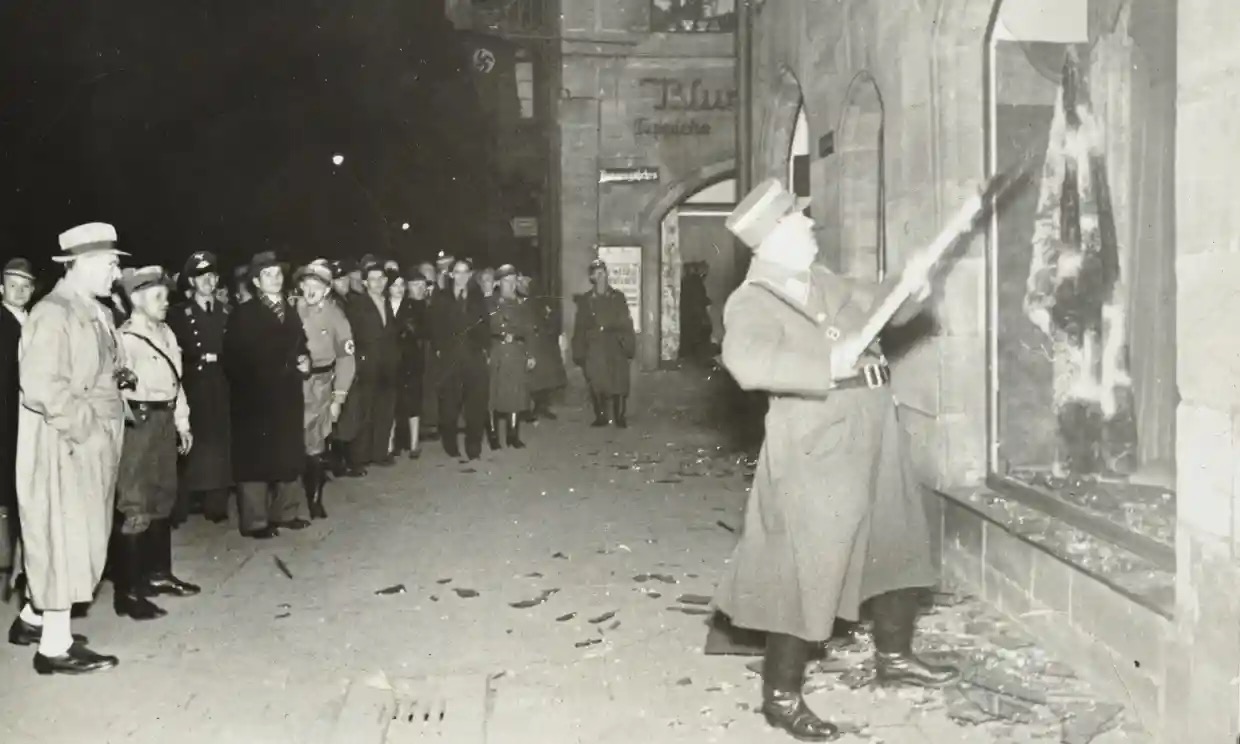
Visual AidThe night the paperwork turned to bricks
Photograph from Kristallnacht, November 1938 — most likely Fürth, near Nuremberg — kept in an unpublished album now held by the Yad Vashem memorial in Israel. A Nazi officer swings at the window of a Jewish-owned carpet shop while a crowd, including uniformed stormtroopers, simply watches; the pavement is already covered in glass. This is the very night the Knowledge Bank builds up to: five years of decrees first, and then the bricks. The photographer is unknown, and the picture shows one street in one town — not Josef’s Berlin, which Alan Gratz (author) furnishes from many such records.
A Nazi officer vandalizes a Jewish-owned shop as a crowd watches, most likely Fürth, November 1938; unpublished album donated to Yad Vashem. Source: Wikimedia Commons, File:Kristallnacht - 4974.webp, public domain.
ransackv.Ch.1
To search a place wildly, wrecking it as you go
“The brownshirts ransacked the apartment, tipping shelves and shattering dishes.”
persecutionn.Ch.1
Cruel, repeated mistreatment of a group because of who they are
“Years of persecution had already stripped the family of most of its rights.”
scrawnyadj.Ch.2
So thin that the bones show; badly underfed
“Isabel slipped her last beans to the scrawny kitten.”
rationn.Ch.2
A fixed, limited share of food or supplies in hard times
“The monthly ration was gone long before the month was.”
shrapneln.Ch.3
Flying metal fragments thrown out by an exploding shell
“The shop walls of Aleppo were pocked with shrapnel scars.”
desperateadj.Ch.4
Ready to try anything because hope is nearly gone
“Fourteen days to leave the country made every hour feel desperate.”
defiancen.Ch.5
Open refusal to obey a power or authority
“Hurling the bottle was an act of defiance Papi could not take back.”
riotn.Ch.5
A violent public disturbance by an angry crowd
“The riot spread along the seafront faster than the police could contain it.”
rubblen.Ch.6
Broken stone, brick, and concrete left where buildings fall
“Mahmoud dug through the rubble for anything worth carrying.”
emaciatedadj.Ch.7
Dangerously thin from starvation or illness
“The emaciated man at the dock barely resembled Papa.”
ⓘ The vocabulary words in this list are selected to help you understand and complete this workbook. Some may not appear verbatim in the original novel.
🧠Knowledge Bank question
1According to the Knowledge Bank, the persecution of Jewish Germans in the 1930s began with paperwork — the Nuremberg Laws of 1935 ___.Ch.1
2‘Persecution’ means cruel, repeated mistreatment of a group because of who they are.Ch.1
3A ‘scrawny’ animal is ___.Ch.2
4A ‘ration’ is ___.Ch.2
5Fill in each blank with the correct word.Ch.2
Word choices:rationscrawnyshrapnelriot- some words will not be used
The family’s monthly ran out in two weeks.
Isabel fed the kitten anyway.
6‘Shrapnel’ is ___.Ch.3
7‘Emaciated’ describes someone who has grown strong and healthy.Ch.7
8Throwing a bottle at the police was an act of ‘defiance,’ meaning ___.Ch.5
9‘Rubble’ is the broken stone and concrete left after a building falls.Ch.6
10Fill in each blank with the correct word.Ch.7
Word choices:emaciateddesperatedefiancerubble- some words will not be used
Papa returned from Dachau and afraid.
With fourteen days to leave, the packing grew .
Part 2
Comprehension
Show you understood what happens in Chapters 1–7.
🔒Knowledge Bank · Thirty Thousand Fathers
History · The Dachau ArrestsWhen the brownshirts drag Aaron Landau away, he joins a real crowd. In the days around November 9, 1938, German police arrested about thirty thousand Jewish men and boys — not for anything they had done, but as hostages whose absence would terrify their families into leaving. They were shipped to three concentration camps: Dachau, Buchenwald, and Sachsenhausen. Dachau, near Munich, was the oldest, opened back in 1933 for the regime’s political enemies; the November prisoners arrived to shaved heads, hours of freezing roll call, beatings, and starvation rations. Hundreds died within weeks. Yet most were eventually released, because in 1938 the Nazi goal was still expulsion, not murder. A man could walk out of the gates if his family proved he would emigrate immediately — and if he signed a promise never to describe what he had seen inside. That is the bargain behind Papa’s fourteen days, and it explains why the man who meets the family at the Hamburg dock cannot bring himself to speak about the camp.
🧠Knowledge Bank question
1The Knowledge Bank explains that a man arrested in the November 1938 roundups could walk out of Dachau if, along with signing a promise of silence, ___.Ch.1
2Why is Isabel’s family hungry in 1994?Ch.2
3Mahmoud’s rule for surviving in Aleppo is to draw as little attention as possible.Ch.3
4What does Isabel trade away, and for what?Ch.5
5Write the numbers 1–5 in the boxes to show the order in which Part 1 tells these events. Number 1 = what the book tells first.Chapters 1–7
Word comes that Papa will go free only if the family leaves Germany.
Mahmoud and Waleed pick their careful way home through Aleppo.
At the Hamburg dock, an emaciated, shaved stranger appears: Papa.
A missile shears the front wall off Mahmoud’s apartment building.
Brownshirts storm the Landaus’ apartment and seize Josef’s father.
6During the Havana riot, what does Papi do?Ch.5
7The missile strike kills members of Mahmoud’s family.Ch.6
8What condition is attached to Aaron Landau’s release from Dachau?Ch.4
9After the riot, the government announces that Cubans who want to leave will be allowed to go.Ch.5
10How has Papa changed when Josef sees him again?Ch.7
Part 3
Literary Elements
Understanding HOW and WHY Alan Gratz tells the story across Chapters 1–7.
🎭Knowledge Bank · Three Strands, One Rope
Authorial Craft · Braided NarrativeAlan Gratz (author) tells three stories at once, and the machinery is strict: Josef, then Isabel, then Mahmoud, in perfect rotation, every chapter stamped with a name, a place, and a year. This braided structure asks the reader to do the connecting work — nobody in the book ever announces that the stories rhyme; you notice it yourself when a second door splinters, a second father is put in danger, a second family starts packing. Each chapter also tends to stop at its worst possible moment, a cliffhanger technique borrowed from serial fiction, so the rotation constantly interrupts you mid-crisis and makes you read on to get back to the strand you left. The deepest effect, though, is comparison. Because Berlin 1938, Havana 1994, and Aleppo 2015 arrive interleaved, the reader cannot treat any one catastrophe as unique; the same beats repeat across eras — home attacked, father endangered, family deciding to run — until the repeating pattern itself becomes the novel’s argument.
Parallel Plots
Three stories — Berlin 1938, Havana 1994, Aleppo 2015 — run side by side in strict rotation, inviting the reader to compare them at every turn.
Dramatic Irony
The reader often knows the history the characters cannot — how much worse 1938 Germany will get — and that gap between hope and knowledge creates dread.
Symbol
Objects carry meaning beyond themselves: Isabel’s trumpet is her childhood, and trading it away prices exactly what escape costs.
🧠Knowledge Bank question
1According to the Knowledge Bank, the deepest effect of the braided structure is that ___.Ch.1
2Dramatic irony happens when readers know something the characters do not.Ch.4
3Readers knowing how bad Nazi Germany will become — while the Landaus still hope — creates ___.Ch.1
4In Part 1, Isabel’s trumpet comes to stand for ___.Ch.5
5A symbol is an object that stands only for itself and nothing more.Ch.5
6Fill in each blank with the correct literary term.Ch.5
Word choices:symbolironysettingrhyme- some words will not be used
Isabel’s trumpet is a of her childhood.
Readers knowing what 1939 will bring is dramatic .
7Each chapter heading names a character, a city, and a year, pinning down the story’s ___.Ch.1
8The three storylines are set in the same country and the same year.Ch.3
9Ending chapters at moments of sudden danger — a missile, an arrest, a knock — is a use of ___.Ch.6
10Fill in each blank with the correct literary term.Ch.6
Word choices:parallelcliffhangersettingsymbol- some words will not be used
The three storylines run in , never touching yet echoing.
A chapter that stops as the missile strikes ends on a .
Part 4
Think Deeper
Four deeper challenges — no single-word recall. Read, weigh the evidence, and reason it out.
🌎Knowledge Bank · Thirty-Two Nations Say No
Diplomacy · The Évian ConferenceIn July 1938, four months before Kristallnacht, delegates from thirty-two countries gathered at the French resort town of Évian to discuss the Jewish refugees already streaming out of Germany and Austria. President Franklin Roosevelt had proposed the meeting, which sounded like hope itself — except that the invitation promised in advance that no nation would be asked to loosen its immigration quotas. So one delegate after another rose, offered warm sympathy, and explained why his country could admit almost no one: unemployment was high, times were hard, there was simply no room. Only the small Dominican Republic offered to take refugees in real numbers. Nazi newspapers celebrated openly: the world scolds Germany for its treatment of the Jews, they wrote, yet nobody else wants them either. This is the wall standing silently behind everything the Landaus attempt in Part 1. A family could be ordered out of Germany in fourteen days — and still find that almost no border on Earth was willing to let them in.
Visual AidThe Évian Conference, counted
Measure diagram of the arithmetic the Knowledge Bank reports from Évian in July 1938: thirty-two squares for thirty-two delegations, thirty-one of which offered sympathy and almost no visas, and one — the Dominican Republic — that offered to take refugees in real numbers. The squares are identical on purpose; the countries were not, and their speeches, quotas, and excuses all differed in ways a grid cannot show. The diagram claims nothing about any delegate’s private feelings. What to notice is the proportion itself: thirty-one to one.
Delegations and outcomes of the Évian Conference, July 1938, as documented by the United States Holocaust Memorial Museum. Drawn for Garden Heights Academy.
Picture three front doors in three different decades. Behind the first, in Berlin in 1938, a boy wakes to the sound of his own door splintering; the men pouring in wear uniforms, and they have come for his father. Behind the second, outside Havana in 1994, a girl divides a plate that was already too small and slips a share to a starving kitten, because someone in the house should get enough to eat. Behind the third, in Aleppo in 2015, two brothers walk home past bombed-out buildings, hoods up and heads down, practicing the art of not being seen. Alan Gratz (author) opens all three doors in turn — seven chapters, strict rotation — and then he knocks all three houses down. A concentration camp, a hunger riot, a missile. By the end of Part 1, each family has understood the same impossible sentence: we cannot stay here. What none of them yet knows is what leaving will cost.
Original passage written for Garden Heights — not a quotation from the novel.
1Claim: “Part 1 argues that none of the three families chooses to leave home — leaving is forced on each of them.” — choose the two details that best prove it.Claim & Evidence
2Pushes a family toward leaving, or Shows daily life holding on? Tap each detail to send it left or right.Sort into two
◄ Pushes a family toward leavingShows daily life holding on ►
3Match each cause to its result. For each cause, pick its result.Cause & Effect
Brownshirts storm the apartment on Kristallnacht→
Papi hurls a bottle during the seafront riot→
A missile levels the apartment building→
Isabel hands over her beloved trumpet→
🧠Knowledge Bank question
4Fill both blanks to complete the reasoning.Build the Argument
The Knowledge Bank argues that the Évian Conference offered refugees little real help because , which shows that .
Part 5
Standardized Test
The Night of Broken Glass · Reading & Vocabulary · SAT & TOEFL-style practice
Read the passage — the highlighted words are tested — then answer. Tap an answer, then tap it again to confirm.
SATCentral Ideas — the passage's main point
SATInference — a conclusion the passage implies
SATAuthor’s Purpose — what the author wants to achieve
SATWords in Context — a word's meaning in this passage
TOEFLFactual Information — a fact stated in the passage
TOEFLVocabulary — a tested word's meaning here
The Night of Broken Glass
On November 7, 1938, a seventeen-year-old Polish Jewish student named Herschel Grynszpan, desperate over the deportation of his family from Germany, shot a German diplomat in Paris. When the diplomat died two days later, the Nazi leadership had the excuse it had been waiting for. Propaganda minister Joseph Goebbels signaled that demonstrations against Jews would not be stopped, and instructions raced through party channels that same evening. What followed was presented to the world as spontaneous public fury, but the crowds were seeded with storm troopers in plain clothes, working from prepared lists of Jewish homes and businesses.
Through the night of November 9 and into the next day, the violence rolled across Germany and annexed Austria. More than 250 synagogues were burned while fire brigades stood by, under orders to protect only the buildings next door. About 7,500 Jewish-owned shops were ransacked — windows smashed, shelves stripped of goods — and at least 91 Jews were killed. Roughly 30,000 Jewish men and boys were arrested and shipped to concentration camps such as Dachau. So much shattered glass carpeted the streets that the night earned a bitter nickname: Kristallnacht, the Night of Broken Glass.
Then the government blamed the victims. It fined the Jewish community one billion reichsmarks — Germany’s currency at the time — for the destruction, and it confiscated the insurance money owed to Jewish shop owners. The shooting in Paris had been only a pretext; the real purpose of this campaign of persecution was to make Jewish life in Germany impossible and to drive Jewish families out. The terror worked exactly as designed: within months, hundreds of thousands of people were searching for any country that would take them. Very few countries would.
Original passage written for Garden Heights — not a quotation from the novel.
1Which sentence best states the passage’s central idea?SAT · Central Ideas
2According to the passage, what event did Nazi leaders use as their excuse?TOEFL · Factual Information
3Fire brigades at the burning synagogues were ordered to ___.TOEFL · Factual Information
4The passage implies the violence was labeled ‘spontaneous’ because ___.SAT · Inference
5What does the passage say happened to roughly 30,000 Jewish men and boys?TOEFL · Factual Information
6It can be inferred that the billion-reichsmark fine was designed to ___.SAT · Inference
7Why does the author include the detail about glass carpeting the streets?SAT · Author’s Purpose
8In the passage, ransacked most nearly means ___.SAT · Words in Context
9In the passage, spontaneous most nearly means ___.TOEFL · Vocabulary
10In the passage, persecution most nearly means ___.TOEFL · Vocabulary
Part 6 · Optional
Creative Writing
A bonus challenge to practice your English. Take your time and have fun with it.
About This Section
This writing task is optional and is not part of your auto-graded score. The feedback below checks only the basics — length, spelling, and grammar — not whether your ideas are right or wrong. It is meant for classroom discussion and creative practice, so feel free to use your imagination!
Writing Task — Part 1 “The Hardest Thing to Trade”
Isabel gives up the thing she loves most so that her family can escape. Write about the possession that would be hardest for you to give up. Describe it, explain what it means to you, and tell what it would take — what emergency, what person in danger — before you would trade it away. 6–10 sentences. End by saying whether you think Isabel’s trade was worth it.
You can start with: “The hardest thing for me to give up would be...”
0 / 40 words minimum
🗣 Teach It · Just for Fun (optional)
No right or wrong — close the screen and tell someone nearby what happened in this part. Can’t find anyone? Tell yourself out loud. The moment you teach it, you truly understand it.
Independent study guide by Garden Heights. Not affiliated with or endorsed by Alan Gratz. Contains original analysis only; no text from the novel is reproduced. Reference text: This workbook follows Alan Gratz’s classic text (the standard Puffin edition sold worldwide). Revised 2023 UK editions change some wording and may not match the vocabulary studied here.