New here? Just sign up with Google — your account includes Matilda, our gift book, forever.
Refugee · Garden Heights
Part 2
for Refugee · Part 2 · Chapters 8–14
8 Parts40 min
What Happens in Part 2
Each family pays a first price: a traded trumpet, a bar mitzvah over Papa's terror, and a bullet-riddled car abandoned.
Trumpet for gasolinePapi was seen throwing a bottle at police, so when Fidel Castro announces that anyone leaving by sea will not be stopped, leaving becomes a deadline. To fuel the Castillos' boat, Isabel hands a fisherman her trumpet — her tie to her grandfather Lito and to Cuba's music — for two jugs of gasoline, her little kitten left in the bargain. That night both families carry the boat down to the water, Mami nearly nine months pregnant beside them.
Shots on the sandHeadlights sweep the sand and shots crack out; two police officers — Iván's brother Luis and his girlfriend Amara — leap aboard at the last second, deserting their posts to escape with them. A police bullet punches a hole low in the hull, and by the time Cuba is a smear of light behind them, Isabel is already bailing.
Bar mitzvah at seaAboard the MS St. Louis, the crew's politeness feels miraculous; Josef and Ruthie befriend sisters traveling alone, Renata and Evelyne Aber, and a soaped-door-handle prank brings the first laughter in months — while Papa, hollowed by the camp, bolts the cabin and sees spies everywhere. In the social hall turned synagogue — Hitler's portrait down, the captain permitting — Josef stands for his bar mitzvah, the ceremony making a Jewish boy a man, while his father hides below, certain it is a trap.
Abandoning the carIn Syria, Mahmoud's family drives through the ruins of Aleppo toward the Turkish border, dodging checkpoints held by armed men, until gunfire finds the car itself — a tire gone, bullets in the metal — and the family must leave it, and nearly everything in it, to go on by foot. Three departures, three prices already being paid.
What We Will Learn
Section
What you will practice
Vocabulary
Departure and danger: steward, visa, rubble, barter, hull…
Literary Elements
Parallel plots braided in strict rotation, cliffhanger chapter breaks, and the dramatic irony of hope the reader cannot fully share
Cross-Curricular
Castro’s Cuba in 1994 — the Special Period after the Soviet collapse, the Malecón riot, and the summer the rafts set sail
Chapter Summary
Ch.
What happens
Chapter 8
Isabel — Outside Havana, 1994 — With Castro’s announcement hanging in the air and the police sure to remember what Papi did on the Malecón, Isabel buys her family’s way onto the Castillos’ boat: she trades her beloved trumpet to a fisherman for two jugs of gasoline — and leaves him the stray kitten she has been feeding, hoping he will keep it fed.
Chapter 9
Mahmoud — Aleppo, 2015 — The family drives out through a city ground down to rubble, past buildings opened up like dollhouses. Dad steers around the checkpoints, where armed men of any side might take the car — or worse. Waleed watches it all without any expression, and that frightens Mahmoud more than the ruins do.
Chapter 10
Josef — On the Atlantic, 1939 (6 days from home) — Aboard the St. Louis, the crew treats the Jewish passengers with respect, and Josef feels something he has almost forgotten: hope. He and Ruthie befriend two sisters traveling alone to their father in Cuba, Renata and Evelyne Aber, and a prank — soaping the cabin door handles until a steward fumbles his loaded tray — leaves all four of them helpless with laughter.
Chapter 11
Isabel — Outside Havana, 1994 — At night the two families carry the boat down to the water, Mami walking beside them nearly nine months pregnant. Then headlights, shouts, gunshots — and two figures in police uniform sprinting down the sand: Luis, Iván’s brother, and his girlfriend Amara, deserting to join the escape. A bullet punches through the hull as the overloaded boat pulls away, and water starts coming in.
Chapter 12
Mahmoud — Outside Aleppo, 2015 (1 day from home) — Near the highway, the war catches up with the family: gunfire erupts, bullets slam into the car, and a tire blows out. The car is finished. Leaving almost everything they packed behind, they slip away from the fighting and set out on foot toward the Turkish border, refugees now in every sense.
Chapter 13
Josef — On the Atlantic, 1939 (8 days from home) — The social hall is made over into a synagogue, and at the rabbi’s request Captain Schroeder has the portrait of Hitler taken down. Josef stumbles through his Hebrew blessing but finishes it: his bar mitzvah — the ceremony in which a Jewish boy becomes a man. Papa does not attend, and Josef begins to understand that he may have to be the family’s adult.
Chapter 14
Isabel — Straits of Florida, 1994 (1 day from home) — The first stretch of open water. Nine people ride a boat built for far fewer, so low in the sea that every swell threatens to slop over the side, while water seeps steadily through the bullet hole. The lights of Cuba shrink behind them, and the bailing that will fill the days ahead begins.
Part 1
Vocabulary
Study 10 key words from Chapters 8–14, then answer each question.
🎺Knowledge Bank · When Money Stops Working
Economics · BarterMoney only works while everyone agrees it will buy something tomorrow. In Cuba’s Special Period, that agreement broke down: a worker’s monthly wages might be paid on time and still buy almost nothing, because the state stores had empty shelves and the currency could not summon goods that did not exist. When cash fails, people fall back on the oldest system there is — barter, trading one real thing directly for another. Barter has a famous weakness that economists call the double coincidence of wants: a deal only happens if each side wants exactly what the other one has. That is the cold machinery underneath Isabel’s hardest choice. Gasoline was among the scarcest things on the island, so whoever held it could name any price, and the only possession Isabel owned that another person truly wanted was her trumpet. In a barter economy, value is not a number printed on a bill; it is measured in what you love and are still willing to trade.
Visual AidBarter: the double coincidence of wants
Structure diagram of the machinery the Knowledge Bank calls the double coincidence of wants: no deal happens unless each side wants exactly what the other has. The two parties shown are the trade at the heart of Isabel’s hardest choice — gasoline on one side, her trumpet on the other — but the diagram simplifies the whole Special Period economy down to one exchange and leaves out every failed bargain that never found its match. It does not claim the trumpet and the gasoline were worth the same; barter has no price tags. Notice the last line: in a broken economy, value is measured in what you love and will still trade.
The double coincidence of wants, a standard concept in introductory economics, applied as in the Knowledge Bank. Drawn for Garden Heights Academy.
salvagev.Ch.8
To save usable parts or materials from being lost or thrown away
“The Castillos’ boat was built from metal other people had thrown out, salvaged piece by piece.”
barterv.Ch.8
To trade goods or services directly, without using money
“With pesos nearly worthless, Cubans learned to barter for what they needed.”
rubblen.Ch.9
Broken pieces of stone, brick, and concrete from destroyed buildings
“Whole streets of Aleppo had collapsed into mountains of rubble.”
checkpointn.Ch.9
A guarded barrier where travelers are stopped and questioned
“Dad steered wide around every checkpoint on the road north.”
listlessadj.Ch.9
Without energy, interest, or feeling
“Waleed sat listless in the back seat, watching the ruins slide past.”
stewardn.Ch.10
A crew member who serves and looks after a ship’s passengers
“A steward with a loaded tray fumbled at the soaped-up door handle.”
visan.Ch.10
An official document that permits a person to enter a country
“The family’s papers promised them permission to land in Cuba, like a visa stamped with hope.”
haggardadj.Ch.10
Looking exhausted, thin, and worn out
“Six months in the camp had left Papa haggard and hollow-eyed.”
hulln.Ch.11
The body or outer shell of a boat or ship
“Every extra passenger pressed the little hull deeper into the water.”
desertv.Ch.11
To leave a post or duty without permission and without meaning to return
“Luis and Amara chose to desert the police rather than stay behind.”
ⓘ The vocabulary words in this list are selected to help you understand and complete this workbook. Some may not appear verbatim in the original novel.
🧠Knowledge Bank question
1According to the Knowledge Bank, barter’s famous weakness — the double coincidence of wants — means a trade happens only when ___.Ch.10
2A ‘haggard’ person looks exhausted, thin, and worn out.Ch.10
3‘Rubble’ is ___.Ch.9
4A ‘checkpoint’ is a guarded place where travelers are stopped and questioned.Ch.9
5Fill in each blank with the correct word.Ch.8
Word choices:bartersalvagevisahull- some words will not be used
To get gasoline, Isabel had to away something she loved.
The Castillos worked to metal that others had thrown away.
6A ‘visa’ is ___.Ch.10
7A ‘listless’ child is full of energy and excitement.Ch.9
8To ‘barter’ is to ___.Ch.8
9Fill in each blank with the correct word.Ch.11
Word choices:hulldesertlistlesscheckpoint- some words will not be used
A bullet can pierce a boat’s below the waterline.
Luis chose to the police and board the boat.
10To ‘salvage’ something is to ___.Ch.8
Part 2
Comprehension
Show you understood what happens in Chapters 8–14.
🌊Knowledge Bank · The Seawall That Boiled Over
History · The MalecónThe Malecón is Havana’s front porch: a broad seawall and roadway that runs about five miles along the city’s edge, begun in 1901 to hold back the ocean. Generations have used it as a free living room — a place to fish, play music, and escape hot apartments. That is why what happened there on August 5, 1994 shocked the country. After years of hunger and blackouts, and a string of desperate boat hijackings, thousands of Cubans poured onto the seawall shouting against the government, smashing windows, and throwing stones at police. It was the largest street protest Cuba had seen since the revolution of 1959, and it even drew Fidel Castro himself to the scene. The uprising was put down within hours, but it forced a choice. Rather than jail a furious city, Castro announced days later that anyone who wished to leave by sea would not be stopped — and the island’s anger turned toward the harbor.
🧠Knowledge Bank question
1The Knowledge Bank explains that after the Malecón uprising was put down, Castro responded by ___.Ch.8
2Castro announces that Cubans who want to leave by sea will not be stopped.Ch.8
3What does Isabel trade to the fisherman for two jugs of gasoline?Ch.8
4How does the crew of the St. Louis treat Josef’s family on board?Ch.10
5Write the numbers 1–5 in the boxes to show the correct order of events. Number 1 = what happens first.Chapters 8–14
Mahmoud’s family drives out of Aleppo through streets of rubble.
Luis and Amara leap aboard as the boat launches under gunfire.
Bullets wreck the car, and Mahmoud’s family goes on by foot.
Isabel trades her trumpet for the gasoline the boat needs.
Josef and Ruthie soap door handles with the Aber sisters.
6Papa proudly attends Josef’s bar mitzvah in the ship’s social hall.Ch.13
7Why does Mahmoud’s father steer around the checkpoints on the road north?Ch.9
8During the drive, what worries Mahmoud most about his brother Waleed?Ch.9
9Isabel’s mother is pregnant when the family leaves Cuba.Ch.11
10Who leaps into the boat at the last moment as it launches?Ch.11
Part 3
Literary Elements
Understanding HOW and WHY Alan Gratz tells the story across Chapters 8–14.
🧵Knowledge Bank · Why the Story Keeps Switching
Literature · Braided NarrativeAlan Gratz (author) never lets one story run for long. Josef, Isabel, and Mahmoud take the stage in strict rotation, a design often called a braided narrative, and the braid does three jobs at once. First, it manufactures suspense: because every chapter ends just as danger peaks, and the next chapter belongs to someone else, the reader is always two chapters away from an answer. Second, it forces comparison. When a boy in 1939, a girl in 1994, and a boy in 2015 each pack what they can carry, say goodbye to home, and face men in uniform, the reader cannot help laying the journeys side by side and noticing that the machinery of flight barely changes. Third, the braid makes an argument no single strand could make alone: refugees are not one moment in history but a pattern that returns in every generation. Watch what each chapter break hides from you — the waiting is part of the design.
Parallel Plots
Three protagonists, three decades, one rotation: Alan Gratz (author) braids the storylines so tightly that each one comments on the other two.
Cliffhanger
Chapters break at the worst possible moment — shots on a beach, bullets on a highway — and the rotation makes readers wait two chapters to return.
Dramatic Irony
Readers know what 1939 becomes and what a homemade boat faces at sea; the characters cannot — and that gap turns their hope into our dread.
🧠Knowledge Bank question
1According to the Knowledge Bank, the braided structure manufactures suspense because ___.Ch.8
2Ending a chapter at gunfire and switching to another decade creates ___.Ch.11
3Dramatic irony happens when readers know something the characters do not.Ch.10
4Josef’s hope aboard the St. Louis feels heavy to readers mainly because of ___.Ch.10
5A cliffhanger resolves every question before the chapter ends.Ch.12
6Fill in each blank with the correct literary term.Ch.9
Word choices:parallelcliffhangerrhymeindex- some words will not be used
Three stories told side by side are plots.
A chapter that stops mid-danger ends on a .
7All three families packing to leave home, decades apart, is an example of ___.Ch.11
8A reader of Refugee knows more about 1939 Europe than Josef possibly can.Ch.13
9Alan Gratz (author) switches away from Isabel just as shots ring out mainly to make readers ___.Ch.11
10Fill in each blank with the correct literary term.Ch.13
Word choices:ironymotifcliffhangerglossary- some words will not be used
Readers knowing history the characters cannot know is dramatic .
A repeated image, like leaving home with one bag, is a .
Part 4
Think Deeper
Four deeper challenges — no single-word recall. Read, weigh the evidence, and reason it out.
💡Knowledge Bank · The Pressure Valve
Civics · Emigration ControlMost countries police who may enter; Cuba’s government also policed who could leave, and departing without permission was a crime. Yet three times, Fidel Castro suddenly threw the coast open. In 1965 he opened the port of Camarioca; in 1980 the Mariel boatlift carried roughly 125,000 Cubans to Florida in six months; and in August 1994 he announced that rafters would not be stopped. Political scientists read the pattern as a pressure valve: when hunger and anger build toward an explosion, letting the most discontented citizens sail away releases the pressure, removes the loudest critics, and dumps a sudden crisis on the United States, which then has reason to negotiate. It worked again in 1994 — within weeks, Washington agreed to admit at least twenty thousand Cubans a year through legal channels. As you weigh the challenges ahead, ask who actually pays the price of such a policy. The state releases pressure; the people in the water absorb the risk.
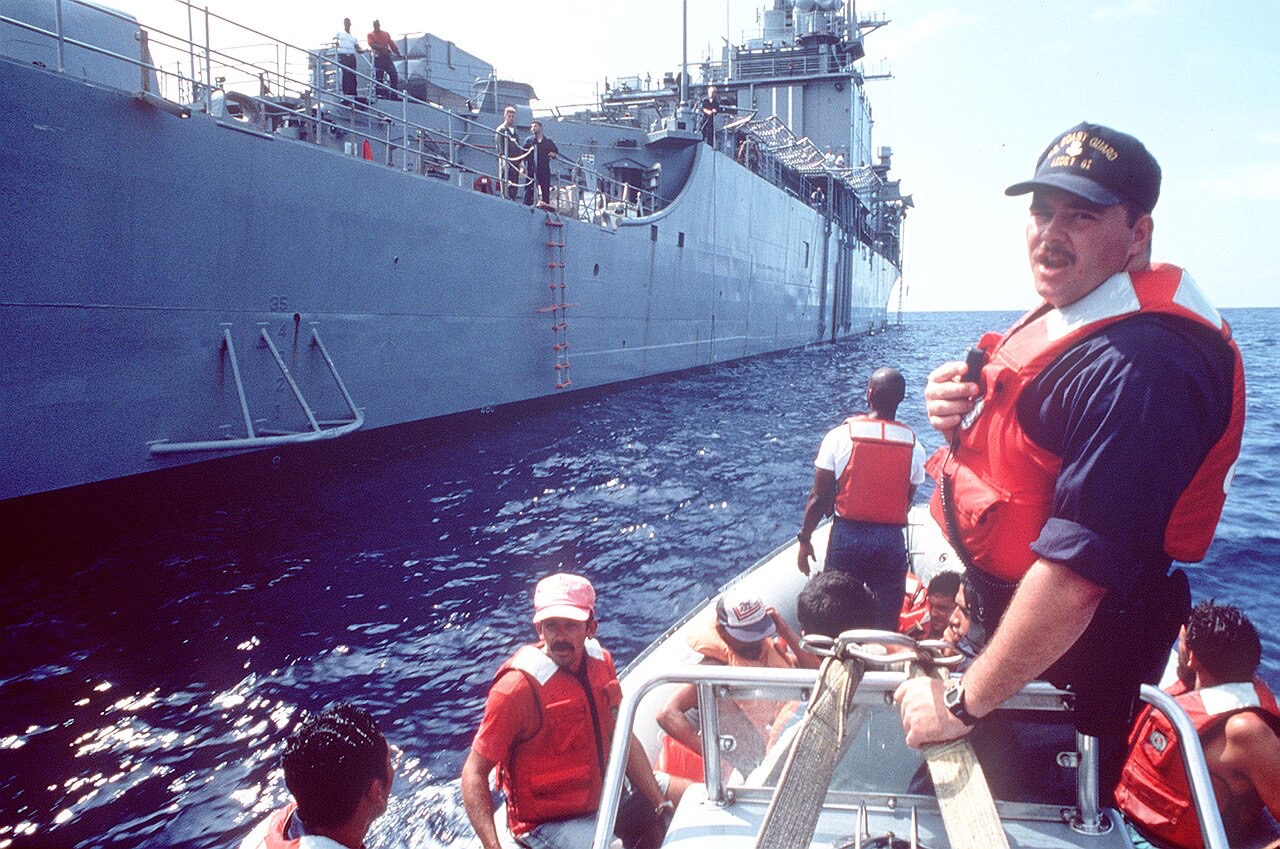
Visual AidWho absorbs the risk
United States Coast Guard photograph, September 19, 1994, between Cuba and the Florida Keys: a Coast Guardsman ferries rescued Cuban rafters — balseros — to a waiting Navy ship during Operation Able Vigil. Every person here survived to be photographed; the many who did not are exactly what no rescue picture can show. The photo records one boatload on one afternoon, weeks after the door the Knowledge Bank describes was thrown open. It is the Knowledge Bank’s final sentence made visible: the state releases pressure, and the people in the water absorb the risk.
Coast Guardsman transports Cuban migrants to a Navy ship during Operation Able Vigil, September 19, 1994; U.S. Coast Guard photograph by PA1 Don Wagner. Source: Wikimedia Commons, File:US Coast Guard LEDET 1 Operation Able Vigil.jpg, public domain.
Three families are in motion at once now. Somewhere on the Atlantic, a boy pads down the carpeted corridor of a liner where, for the first time in years, the people in uniform smile at his family — and he is finally free to be twelve, soaping doorknobs with brand-new friends. Outside Havana, a boat built from scrap metal sits in a shed with no fuel in its tank, and a girl stands in front of it doing a terrible piece of arithmetic: the one thing she owns that anyone wants is the one thing she loves most. And on the road out of Aleppo, a car noses between mountains of rubble where apartment buildings used to stand, steering wide around every checkpoint, because the men who hold them answer to no one. Hope, a bargain, and a gauntlet — Part 2 is the moment each escape stops being a plan and becomes a journey.
Original passage written for Garden Heights — not a quotation from the novel.
1Claim: “Part 2 shows that every family’s escape depends on other people choosing to take risks or show kindness.” — choose the two details that best prove it.Claim & Evidence
2Reasons to hope, or Dangers still ahead? Tap each detail to send it left or right.Sort into two
◄ Reasons to hopeDangers still ahead ►
3Match each cause to its result. For each cause, pick its result.Cause & Effect
The Soviet Union collapses and its aid to Cuba ends→
Papi is seen throwing a bottle during the riot→
A police bullet punches through the hull at the launch→
Gunfire wrecks the car on the road out of Aleppo→
🧠Knowledge Bank question
4Fill both blanks to complete the reasoning.Build the Argument
Political scientists read Castro’s sudden openings of the coast as a pressure valve because , which shows that .
Part 5
Standardized Test
The Summer of the Rafts · Reading & Vocabulary · SAT & TOEFL-style practice
Read the passage — the highlighted words are tested — then answer. Tap an answer, then tap it again to confirm.
SATCentral Ideas — the passage's main point
SATInference — a conclusion the passage implies
SATAuthor’s Purpose — what the author wants to achieve
SATWords in Context — a word's meaning in this passage
TOEFLFactual Information — a fact stated in the passage
TOEFLVocabulary — a tested word's meaning here
TOEFLProse Summary — the three sentences that sum it up
The Summer of the Rafts
For thirty years, Cuba’s economy floated on Soviet support. The Soviet Union bought Cuban sugar at generous prices, sold Cuba oil at cheap ones, and covered the gap with subsidies worth billions each year. When the Soviet Union dissolved in 1991, that support vanished almost overnight. Fidel Castro named what followed the Special Period in Time of Peace — wartime scarcity without a war. Blackouts swallowed whole evenings, food rations shrank month after month, and with gasoline nearly gone, farmers hitched oxen to plows while workers pedaled to work on imported bicycles.
By the summer of 1994, desperation had reached the water’s edge. Cubans began hijacking ferries and fishing boats to attempt the ninety miles to Florida, and on August 5 the anger boiled over when thousands rioted along Havana’s seawall — the largest protest the government had faced since 1959. Days later, Castro announced that anyone who wished to leave by sea would not be stopped. Families began building rafts improvised from inner tubes, foam blocks, oil drums, and wooden doors salvaged from junk heaps — anything that might float.
Over about five weeks, roughly thirty-five thousand people pushed off from Cuban beaches. They were called balseros — rafters. United States Coast Guard ships pulled thousands of haggard, sunburned survivors from the water, but delivered them to the American naval base at Guantánamo Bay to wait instead of carrying them to Miami. In September the two governments struck a deal: the United States would admit at least twenty thousand Cubans each year through legal channels, and Cuba would again discourage departures. The great exodus ended almost as suddenly as it began, but the summer of the rafts had shown the world what Cubans would risk to leave.
Original passage written for Garden Heights — not a quotation from the novel.
1What is the main idea of the passage?SAT · Central Ideas
2According to the passage, how did the Soviet Union support Cuba’s economy?TOEFL · Factual Information
3What does the passage say happened on August 5, 1994?TOEFL · Factual Information
4The passage suggests the rafts were dangerous mainly because they ___.SAT · Inference
5Why does the author mention oxen pulling plows and workers on bicycles?SAT · Author’s Purpose
6Where did the United States Coast Guard take the rafters it picked up?TOEFL · Factual Information
7In the passage, salvaged most nearly means ___.SAT · Words in Context
8In the passage, improvised most nearly means ___.TOEFL · Vocabulary
9In the passage, haggard most nearly means ___.SAT · Words in Context
10Prose Summary (TOEFL).The passage explains how Cuba’s Special Period ended in the balsero summer of 1994. This TOEFL task lists six sentences; choose the THREE that best capture the passage’s main ideas. The other three do not belong — they state minor details or ideas the passage does not present.TOEFL · Prose Summary
Part 6 · Optional
Creative Writing
A bonus challenge to practice your English. Take your time and have fun with it.
About This Section
This writing task is optional and is not part of your auto-graded score. The feedback below checks only the basics — length, spelling, and grammar — not whether your ideas are right or wrong. It is meant for classroom discussion and creative practice, so feel free to use your imagination!
Writing Task — Part 2 “The Price of a Seat”
Isabel hands over the trumpet she loves to buy something her family needs more. Write about a time you gave up something precious for something necessary — or imagine the moment Isabel makes the trade, in her own voice. Describe what the treasured thing meant, what it bought, and how the trade felt. 6–10 sentences. End with whether it was worth the price.
You can start with: “The hardest part was not handing it over — it was the moment just before, when it was still mine...”
0 / 40 words minimum
🗣 Teach It · Just for Fun (optional)
No right or wrong — close the screen and tell someone nearby what happened in this part. Can’t find anyone? Tell yourself out loud. The moment you teach it, you truly understand it.
Independent study guide by Garden Heights. Not affiliated with or endorsed by Alan Gratz. Contains original analysis only; no text from the novel is reproduced. Reference text: This workbook follows Alan Gratz’s classic text (the standard Puffin edition sold worldwide). Revised 2023 UK editions change some wording and may not match the vocabulary studied here.