
Refugee cover
Garden Heights

Refugee

This workbook is for Garden Heights members. Sign in to continue.

Sign in with Google →
New here? Just sign up with Google — your account includes Matilda, our gift book, forever.
Refugee · Garden Heights

Part 3

for Refugee · Part 3 · Chapters 15–21
8 Parts40 min
What Happens in Part 3

Alan Gratz (author) cuts among the three escapes as every family meets its first real test.

Into TurkeyAfter two days among Syrian crowds, a border agent hands Mahmoud's family temporary visas into Turkey; in the Kilis tent camp his father finds a smuggler selling passage to the Greek islands, and the family drives west to Izmir, Mahmoud buying a Ninja Turtle toy for silent brother Waleed. With hotels stuffed three families to a room, a Syrian boy — two thousand pounds, about ten dollars — leads them to an abandoned mall of squatters, warning them to buy life vests.

Rot below decksA tour below decks, where off-duty crewmen drink and sing, shows Josef the polite ship's rot: the steward Schiendick spits the words Jewish rats and belts hateful songs. Then come a funeral at sea and word of a medical inspection before Cuba — and Papa, who survived six months in Dachau, unravels, whispering of a man shot beside him at roll call. To stop his terrified outburst, Josef slaps him — the boy becomes the parent, the father a broken old man.

Tanker in the darkIsabel's boat lies dead — the motor refusing to start, the bullet-hole sock soaked through — and she and Iván bail in the dark until a tanker seven stories high slides from the night; Luis coaxes the engine alive seconds before the wake buries the boat in water. That wake throws Señor Castillo overboard; remembering her grandmother Lita lost to the waves two years before, Isabel dives after him, and once he is hauled aboard the motor coughs alive — hope with it.

The cruelest wordA full week past the promised departure, the smuggler in Izmir offers a new excuse and the same word — tomorrow. Mahmoud, who knows he is almost a man, hears himself scream that he wants to go back to Syria. Tomorrow, the word that once meant hope, has become the cruelest word in the language.

What We Will Learn
SectionWhat you will practice
VocabularyWords for a watched voyage and a price argued down: dignity, steward, makeshift, smuggler, counterfeit
Literary ElementsCliffhangers that cut away at the worst possible moment, a symbol that promises safety it cannot give, and the internal conflict of a boy forced to parent his own father
Cross-CurricularModern history — how Syria’s 2011 protests became a war that split Aleppo in two, and why 2015 became the year so many families set out for Europe
Chapter Summary
Ch.What happens
Chapter 15 · Mahmoud · Kilis, TurkeyPast the Camp — after two days of walking, a border agent hands the Bisharas temporary visas; in the huge tent camp near Kilis, Dad finds a smuggler selling passage to Greece, Mahmoud buys Waleed a Ninja Turtle toy, and the family sets out at once on the long drive to Izmir.
Chapter 16 · Josef · On the AtlanticBelow the Waterline — an officer leads the children on a tour down to the engine rooms, where drinking crewmen sing hateful songs and the steward Schiendick sneers at Jewish rats; Josef learns the polite ship carries the old hatred everywhere it sails.
Chapter 17 · Isabel · The Straits of FloridaThe Wall of Steel — the motor is dead, the sock plugging the bullet hole has soaked through, and Isabel and Iván bail in the dark — then a tanker seven stories tall bears down on them, and Luis starts the engine with seconds to spare before its wake swamps the boat.
Chapter 18 · Mahmoud · IzmirTomorrow, Tomorrow — the smuggler says the boat leaves tomorrow, and keeps saying it; with every hotel jammed, a small Syrian boy takes ten American dollars’ worth of pounds to lead the family to an abandoned mall full of squatters — and warns them to buy life vests.
Chapter 19 · Josef · On the AtlanticThe Man Dachau Sent Back — the ship slows for a burial at sea, then a medical inspection looms; Josef’s father, sure the lineup will end like a Dachau roll call, spirals into terror, and Josef must slap him quiet — the moment the son becomes the parent.
Chapter 20 · Isabel · The Straits of FloridaOverboard — the tanker’s wake has thrown Señor Castillo into the sea; remembering her grandmother Lita slipping under the waves, Isabel dives into the black water after him, and once he is hauled back aboard, the motor — and hope — come back to life.
Chapter 21 · Mahmoud · IzmirA Week of Tomorrows — seven days past the promised departure, the smuggler offers a new excuse and the same old word; Mahmoud, almost a man, hears himself scream like a toddler that he wants to go home to Syria, and his mother cries while his father stands in shock.
Part 1
Vocabulary
Study 10 key words from Chapters 15–21, then answer each question.
📚Knowledge Bank · Where These Words Sailed From
Etymology · The History Inside Five WordsThe vocabulary of Part 3 is older than any of its boats. Steward comes from Old English stigweard, the guardian of the hall — the servant trusted to run a great house — and when great houses took to the sea, the word boarded with them, which is why a ship’s attendant still carries a title from a thousand years ago. Counterfeit is built from Latin pieces meaning made in imitation: a thing manufactured against the original, on purpose, to deceive. Smuggle slipped into English in the 1600s from Low German smuggeln, to sneak goods past the watchers — a crime so tied to coastlines that the word still smells of salt. Haggle once meant to hack or chop, and bargaining hard is still chopping at a price. And dignity descends from Latin dignus, worthy — so when the crew is ordered to serve every passenger properly, the old meaning surfaces exactly: the ship is insisting that each of them is worthy.
dignityn.Ch.16
The state of being treated as worthy of respect
“On deck the passengers were still served with dignity.”
stewardn.Ch.16
A crew member who looks after a ship’s passengers
“One steward muttered insults where the officers could not hear.”
solemnadj.Ch.19
Serious, dignified, and formal
“The burial at sea was quiet and solemn.”
makeshiftadj.Ch.17
Put together quickly from whatever is available
“The makeshift boat was built of scrap metal and hope.”
distraughtadj.Ch.19
So upset that clear thinking becomes difficult
“His distraught father paced the tiny cabin for hours.”
cowerv.Ch.19
To crouch or shrink away in fear
“He would cower at a knock on the cabin door.”
smugglern.Ch.18
A person paid to move people or goods secretly and illegally
“The smuggler took their money and told them to wait.”
lurchv.Ch.20
To make a sudden, unsteady movement
“The overloaded boat began to lurch in the swells.”
hagglev.Ch.18
To argue back and forth over a price
“Shoppers stopped to haggle over the orange vests.”
counterfeitadj.Ch.18
Made as a fake copy of something real
“A counterfeit life jacket looks right until it touches water.”

ⓘ The vocabulary words in this list are selected to help you understand and complete this workbook. Some may not appear verbatim in the original novel.
🧠Knowledge Bank question
1According to the Knowledge Bank, the word steward descends from Old English stigweard, meaning ___.Ch.16
2A ‘makeshift’ shelter is put together from whatever is at hand.Ch.17
3A ‘steward’ is ___.Ch.16
4A ‘distraught’ person is calm and thinking clearly.Ch.19
5Fill in each blank with the correct word.Ch.18–19
Word choices:smugglersolemncounterfeitharvest- some words will not be used
The family paid a to arrange the crossing.
The burial at sea was quiet and .
6To ‘cower’ is to ___.Ch.19
7To ‘haggle’ is to argue back and forth over a price.Ch.18
8A ‘counterfeit’ life jacket is ___.Ch.18
9Fill in each blank with the correct word.Ch.16–20
Word choices:lurchcowerdignityanchor- some words will not be used
The little boat began to in the open swells.
The captain treated every passenger with .
10To ‘lurch’ is to make ___.Ch.20
Part 2
Comprehension
Show you understood what happens in Chapters 15–21.
🚌Knowledge Bank · The Long Road to the Coast
Geography · From Aleppo to IzmirThe distance Mahmoud’s family covers in these chapters is easy to underestimate. From Aleppo, the Turkish border lies only about sixty kilometers north — roughly forty miles — at the crossing near the small Turkish city of Kilis. That closeness is why southern Turkey filled with camps: by the war’s later years, Kilis was sheltering roughly as many Syrians as it had Turkish citizens. But the border is not the destination; it is barely the beginning. Izmir, the port where smugglers sell the crossing, sits on Turkey’s Aegean coast, and reaching it means traveling some eleven hundred kilometers — about seven hundred miles — across the whole width of the country by bus. Izmir is Turkey’s third-largest city, and in 2015 the blocks around its Basmane railway station became an open-air market of the exodus: hotels full of waiting families, money changers, phone-card sellers, and shop windows stacked with orange vests. For thousands of families that summer, it was the last address before the sea.
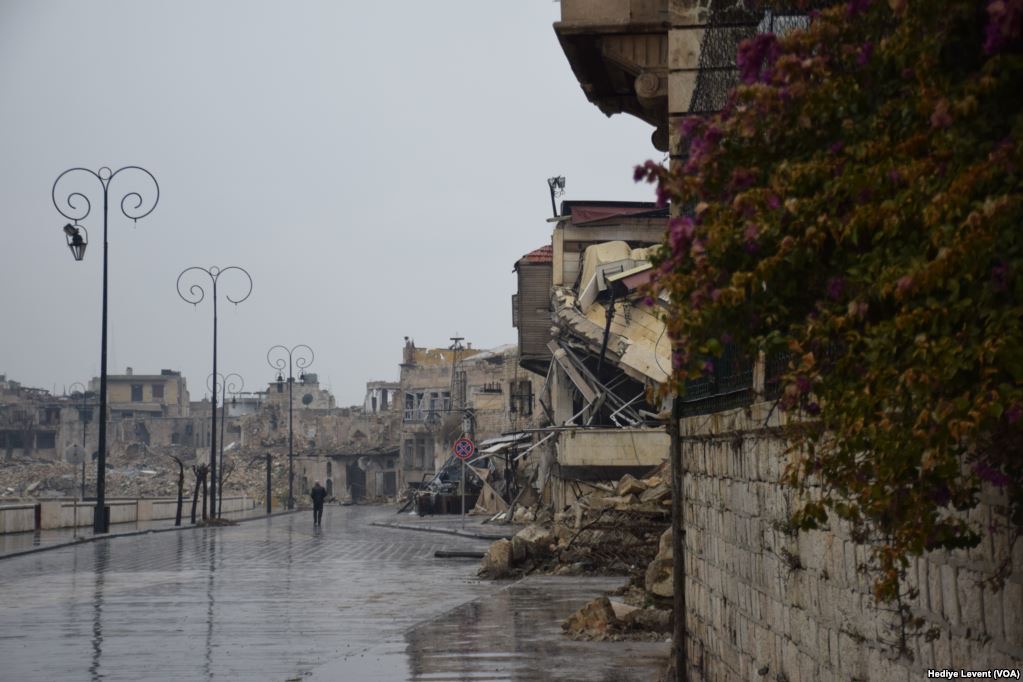
Visual AidKilometer zero of the road
A wet, empty street in Aleppo's Old City under a gray sky: whole blocks collapsed into rubble on the left, a sagging ruined building at right, and a single person walking in the distance
Photograph of the Old City of Aleppo on January 13, 2017, taken for Voice of America a few weeks after the battle for the city ended. Whole blocks along this street have collapsed into rubble; one person walks through the rain. The Knowledge Bank measures the road out — sixty kilometers to the border at Kilis, eleven hundred more to Izmir — and this is kilometer zero, the place worth leaving. The picture was taken about a year and a half after Mahmoud’s family departs in 2015, so it shows what the bombardment they fled went on to finish, not the day they left.
Old City of Aleppo, Syria, January 13, 2017; photograph by Hediye Levent, Voice of America. Source: Wikimedia Commons, File:Aleppo 2017 (10).jpg, public domain.
🧠Knowledge Bank question
1The Knowledge Bank explains that for Mahmoud’s family, crossing the Turkish border is barely the beginning, because Izmir lies ___.Ch.15
2On the tour below decks, Josef discovers that ___.Ch.16
3Josef’s father spends the voyage relaxed and enjoying the ship.Ch.19
4During the medical inspection scare, Josef quiets his father by ___.Ch.19
5Write the numbers 1–5 in the boxes to show the correct order of events. Number 1 = what happens first.Chapters 15–21
  • A Syrian boy leads the family to an abandoned mall.
  • Josef hears crewmen singing hateful songs below decks.
  • Mahmoud’s family crosses the border into Turkey.
  • Isabel dives into the sea after Señor Castillo.
  • A tanker nearly runs down the little boat in the dark.
6What nearly destroys Isabel’s boat on the first night at sea?Ch.17
7The bullet hole in the hull is plugged with a sock that keeps soaking through.Ch.17
8In Izmir, the smuggler answers the family’s questions by saying ___.Ch.18
9Some life vests sold to refugees in Izmir are fakes that will not keep a person afloat.Ch.18–21
10Why does the coming medical inspection terrify Josef’s father?Ch.19
Part 3
Literary Elements
Understanding HOW and WHY Alan Gratz tells the story across Chapters 15–21.
🎬Knowledge Bank · The Rotating Cliffhanger
Authorial Craft · How This Novel Generates SuspenseAlan Gratz (author) builds this novel like a machine with three gears. The chapters rotate in a strict order — Josef, Isabel, Mahmoud — and almost every one ends on a cliffhanger: a tanker filling the horizon, a man gone overboard, a promise that slides to tomorrow. The trick is what the rotation does to that old device. When a single-hero novel cuts away at the worst moment, the reader waits one page for relief; here the reader must cross two whole chapters — two other emergencies — before returning, so the worry is not interrupted but compounded, three anxieties carried at once. The structure also forces comparison. Because the stories alternate, a boat sinking low off Cuba lands beside a boat promised in Izmir and a liner crossing the Atlantic, and the reader starts seeing one journey in three costumes — an effect critics call parallel plotting. The suspense, in other words, is not decoration on the novel’s argument. The structure is the argument: three eras, one journey.
Visual AidThe rotating cliffhanger
The rotating cliffhangerSix boxes in a row show one full turn of the rotation and the start of the next: Josef 1939, Isabel 1994, Mahmoud 2015, then Josef, Isabel, Mahmoud again, joined by arrows. Under each box a small label reads ends on a cliff. A bracket runs from the first Josef box to the second with the note that the reader leaves Josef mid-crisis and must cross two other emergencies to return. Notes underneath say the rotation of fifty-three short chapters never breaks, and that carrying three anxieties at once is the machine that makes you read on.ONE TURN OF THE BRAID — AND THE WAIT BUILT INTO ITJOSEF1939ends on a cliffISABEL1994ends on a cliffMAHMOUD2015ends on a cliffJOSEF1939ends on a cliffISABEL1994ends on a cliffMAHMOUD2015ends on a cliffthe reader leaves Josef mid-crisis and must cross TWO other emergencies to returnfifty-three short chapters, each stamped with a name, a place, and a year — the rotation never breaksthree anxieties carried at once: the machine that makes you read on
Sequence diagram of the machine the Knowledge Bank takes apart: one full turn of Alan Gratz (author)’s rotation and the start of the next, every chapter ending on a cliff. The bracket is the point — leaving Josef mid-crisis, the reader must cross two other emergencies to get back, so the worry is compounded, not interrupted. Real chapters vary in length and a few skip the cliff; the diagram evens them out to show the pattern. It maps the reader’s waiting, not any journey on the map.
Chapter rotation and cliffhanger structure of Refugee (2017), as described in the Knowledge Bank. Drawn for Garden Heights Academy.
Cliffhanger
A chapter that stops at its moment of highest danger or doubt — a wall of steel out of the dark, a man overboard — forcing the reader onward for the answer.
Symbolism
An object that stands for a larger idea: the counterfeit life jackets are safety that only looks like safety — the whole refugee bargain in orange fabric.
Internal Conflict
A struggle inside one character: Josef wants to enjoy being thirteen at sea, yet feels he must become the family’s man because his father no longer can be.
🧠Knowledge Bank question
1According to the Knowledge Bank, the rotating chapters change the old cliffhanger device by ___.Ch.17
2The life jackets that only look protective are best read as ___.Ch.18
3A cliffhanger resolves every question before the chapter ends.Ch.15–21
4Fill in each blank with the correct literary term.Ch.17–21
Word choices:cliffhangersymbolismdialoguerhyme- some words will not be used
A chapter that stops at the moment of danger ends on a .
An object standing for a larger idea is .
5Josef wanting to enjoy the voyage while feeling he must guard his family shows ___.Ch.16–19
6A symbol is an object that stands for something beyond itself.Ch.18
7Internal conflict takes place inside a character’s own mind.Ch.16–19
8Rotating among three narrators chapter by chapter mainly lets the author ___.Ch.15–21
9Fill in each blank with the correct literary term.Ch.16–21
Word choices:internal conflictsymbolcliffhangerstanza- some words will not be used
Josef’s private struggle over growing up is an .
The fake life jacket works as a .
10A cliffhanger at the end of each chapter mainly makes readers feel ___.Ch.15–21
Part 4
Think Deeper
Four deeper challenges — no single-word recall. Read, weigh the evidence, and reason it out.
🧠Knowledge Bank · What Fear Leaves Behind
Psychology · Trauma’s Two FacesPart 3 shows the same injury in two very different disguises. Josef’s father cannot stop being afraid: aboard a comfortable ship he checks the door, distrusts every kindness, and reads menace into a steward’s smile. Psychologists call this hypervigilance — a brain’s alarm system stuck in the on position after months when the alarm was correct. Waleed shows the opposite face: the boy who once cared about cartoons and soccer now registers bombings with a shrug. That flatness is emotional numbing, the mind dialing every feeling down because feeling had become unbearable. Doctors began studying these reactions seriously in soldiers of the First World War, when it was called shell shock; in 1980 the modern name arrived — post-traumatic stress disorder, or PTSD. Two findings matter for these chapters. The injury is real, not weakness or cowardice. And recovery rarely begins with courage or scolding — it begins when the danger actually ends, which is why every character here is chasing the same medicine: safety.

Picture three boats that do not exist in the same year. One is an ocean liner with white tablecloths and polite stewards, where a boy taken on a tour below decks hears the crew singing songs that call his people vermin. One is a homemade hull of scrap metal riding low in the dark Straits of Florida, a sock stuffed into a bullet hole, while something the size of a building comes out of the night without seeing it. And one is not a boat at all yet — only a promise, sold in a Turkish port city where shop windows glow orange with life jackets and a man keeps saying tomorrow. Three families, three shores, one word underneath all of it: out. Part 3 is where each escape stops being a plan and becomes a gamble.

Original passage written for Garden Heights — not a quotation from the novel.
1Claim: “In Part 3, promises of safety keep turning out to be hollow.” — choose the two details that best prove it.Claim & Evidence
2Aboard the St. Louis, 1939, or On the road through Turkey, 2015? Tap each detail to send it left or right.Sort into two
◄ Aboard the St. Louis, 1939On the road through Turkey, 2015 ►
3Match each cause to its result. For each cause, pick its result.Cause & Effect
A bullet hole from the launch is plugged with a sock
Crewmen drink and sing hateful songs below decks
Six months in Dachau
Cheap vests are stuffed with padding instead of buoyant foam
🧠Knowledge Bank question
4Fill both blanks to complete the reasoning.Build the Argument
The Knowledge Bank pairs Josef’s father with Waleed because , which shows that .
Part 5
Standardized Test
A City Split in Two · Reading & Vocabulary · SAT & TOEFL-style practice
A City Split in Two

For centuries Aleppo was Syria’s largest city, a trading hub so old that merchants on the Silk Road rested their camels in its covered market. When protests against the government broke out across Syria in 2011, Aleppo stayed quiet at first, and many residents believed the trouble would pass them by. It did not. In July 2012, rebel fighters pushed into its eastern neighborhoods, the army held the west, and the city froze into two armed halves.

A front line now ran through the heart of the Old City. On one side stood government soldiers, on the other rebel brigades, and between them lay streets no one could safely walk. Families cowered in cellars as government helicopters dropped barrel bombs — oil drums packed with explosives and scrap metal, improvised weapons too crude to aim at anything smaller than a neighborhood — onto the rebel-held east. Crossing between the halves meant running past sniper positions, and the Castello Road, the last artery into the east, was watched by gunners on both sides. Power lines failed, water plants shut down, and the city’s hospitals came under attack again and again.

By 2015 the war was in its fifth year, and more than four million Syrians had already left the country, most of them for Turkey, Lebanon, and Jordan. Savings ran out, legal work was scarce, and a generation of children had missed years of school. Waiting no longer looked safer than moving, and that year hundreds of thousands of families joined an exodus toward Europe, many paying smugglers to ferry them illegally across the sea to Greece. Aleppo, once Syria’s most crowded city, was emptying one family at a time.

Original passage written for Garden Heights — not a quotation from the novel.
1What is the passage mainly about?SAT · Central Ideas
2According to the passage, the city split in two when ___.TOEFL · Factual Information
3The passage describes barrel bombs as ___.TOEFL · Factual Information
4As used in the passage, artery most nearly means ___.SAT · Words in Context
5Which detail about daily life in wartime Aleppo does the passage mention?TOEFL · Factual Information
6The passage suggests that many families finally left because ___.SAT · Inference
7In the passage, cowered most nearly means ___.TOEFL · Vocabulary
8By 2015, roughly how many Syrians had left the country?TOEFL · Factual Information
9In the passage, smugglers most nearly means ___.SAT · Words in Context
10The author includes the final paragraph mainly to ___.SAT · Author’s Purpose
Part 6 · Optional
Creative Writing
A bonus challenge to practice your English. Take your time and have fun with it.
About This Section

This writing task is optional and is not part of your auto-graded score. The feedback below checks only the basics — length, spelling, and grammar — not whether your ideas are right or wrong. It is meant for classroom discussion and creative practice, so feel free to use your imagination!

Writing Task — Part 3 “Safety You Could Not Test”

In Izmir, Mahmoud’s family must buy life jackets with no way to know whether they are real or counterfeit until the moment they matter most. Write about a time you had to trust something — a promise, a plan, a person, a piece of equipment — without being able to test it first. What made you decide to trust it or not? What happened, and what would you check first the next time?

You can start with: “Everyone said it would be fine, but...”
0 / 40 words minimum
🗣 Teach It · Just for Fun (optional)

No right or wrong — close the screen and tell someone nearby what happened in this part. Can’t find anyone? Tell yourself out loud. The moment you teach it, you truly understand it.

Garden Heights

Part 3 Complete!

You finished Chapters 15–21 of Refugee.

Here are your auto-graded results:

-
points out of 100
🗣 Teach It · Just for Fun (optional)
Move on to Part 4 →

Independent study guide by Garden Heights. Not affiliated with or endorsed by Alan Gratz. Contains original analysis only; no text from the novel is reproduced. Reference text: This workbook follows Alan Gratz’s classic text (the standard Puffin edition sold worldwide). Revised 2023 UK editions change some wording and may not match the vocabulary studied here.