New here? Just sign up with Google — your account includes Matilda, our gift book, forever.
Refugee · Garden Heights
Part 4
for Refugee · Part 4 · Chapters 22–28
8 Parts40 min
What Happens in Part 4
Havana keeps the St. Louis at anchor, a shark takes Iván, and Mahmoud's overloaded dinghy flips in a storm.
Anchored off HavanaAfter twenty-one days as Josef's whole world, the St. Louis reaches Havana — and is ordered to anchor out in the harbor, not at the dock. Cuban police and doctors board, papers are collected and studied, and a courteous officer named Mariano Padron answers every anxious question the same way: mañana — tomorrow. Small boats circle, some selling fruit, some carrying relatives shouting names up at the rail; days pass, and almost no one is allowed off.
Papa goes overboardJosef's father, never recovered from the concentration camp, becomes certain the waiting is a trap, and one evening he goes over the rail into the dark harbor. Officer Padron dives in after him and keeps him afloat until a launch arrives; Papa is carried away to a Havana hospital, the only Landau to reach Cuban soil, while Josef stands at the rail watching his family come apart.
The sea takes IvánIsabel's night at sea stretches into days, seawater weeping through the patched bullet holes faster than the bailing. Then a tanker rears, blotting out the stars; its wake sweeps the supplies overboard and throws Iván's father into the sea — Isabel dives in and helps drag him back. Later, as swimmers take turns beside the low-riding boat, a shark strikes; Iván's bleeding cannot be stopped, and the two families must give him to the sea. Nobody speaks for a long time.
The dinghy flipsMahmoud's family finally gets the call. On a dark beach the smugglers pack too many people into a cheap rubber dinghy — a small inflatable boat — and send it into weather it was never built for. The storm wins: the dinghy flips far from shore, the bargain-priced life vests prove nearly useless, and the family clings together among the waves while full boats pass, the longest night of Mahmoud's life becoming one long wait — for another boat, for light, for anything.
What We Will Learn
Section
What you will practice
Vocabulary
Harbors, hulls, and hard waiting: visa, bail, capsize, wake, despair…
Literary Elements
Parallel plots that echo one another across eighty years, a motif of tomorrow that turns from promise to threat, and a mood that darkens from hope to dread
Cross-Curricular
The real MS St. Louis — the 1939 voyage of 937 refugees that reached Havana, found every door closed, and was forced back across the Atlantic
Chapter Summary
Ch.
What happens
Chapter 22
Josef — Havana Harbor, 1939 — After three weeks at sea the St. Louis anchors within sight of Havana, but no gangway is lowered. A Cuban doctor inspects the passengers — Josef must shock his panicking father into looking calm — and Officer Padron answers every question with mañana — tomorrow.
Chapter 23
Isabel — At Sea, 1994 — The boat rides low, seawater seeping through the plugged bullet holes, when a tanker rears out of the night. They slip past its hull, but the wake sweeps supplies overboard and hurls Iván’s father into the sea; Isabel dives in to help save him.
Chapter 24
Mahmoud — The Mediterranean, 2015 — The call finally comes, and in the dark the smugglers cram far too many people into a cheap rubber dinghy and send it into rising weather. Far from shore the storm flips the boat, and Mahmoud is suddenly in the sea, grabbing for his family in the dark.
Chapter 25
Josef — Havana Harbor, 1939 — The waiting stretches on. A handful of passengers with different papers are allowed ashore while hundreds are not, negotiations stall somewhere beyond the rail, and Josef watches his father shrink deeper into fear with every mañana.
Chapter 26
Isabel — At Sea, 1994 — With the leaking boat riding low, people take turns in the water beside it — and a shark strikes without warning. Iván’s leg is torn, the bleeding cannot be stopped, and the two families must give him to the sea. Grief settles over the boat like weather.
Chapter 27
Mahmoud — The Mediterranean, 2015 — The waiting moves into the water. The cheap life vests barely float, the waves keep coming, and the boats that pass are already full. All the family can do is cling together in the dark and wait for another boat.
Chapter 28
Josef — Havana Harbor, 1939 — Broken by the endless waiting, Josef’s father goes over the rail into the harbor. Officer Padron dives in and holds him up until a launch arrives, and Papa is taken to a hospital ashore — on Cuban soil at last, but without his family.
Part 1
Vocabulary
Study 10 key words from Chapters 22–28, then answer each question.
⚓Knowledge Bank · What a Harbor Is For
Maritime History · Ports and AnchorageA harbor holds two kinds of ship. One is tied up at a pier, connected to land by a gangway, its passengers already standing in the country they came to reach. The other rides at anchor out in the open water of the port — sailors call that waiting area a roadstead — and such a ship has arrived and yet arrived nowhere: no stamp, no gangway, no ground underfoot. Port authorities have always used the anchorage as a waiting room they control completely. It is where vessels once sat out quarantine — a holding period meant to keep disease off the docks — and it is where a government can hold a thousand people in place without a single soldier, simply by sending no boats. That is exactly what Havana does to the St. Louis in these chapters. The ship crosses an entire ocean and is defeated by the last few hundred yards, because the end of every voyage is decided not on the water but by the people ashore.
Visual AidPier and roadstead
Structure diagram, in plan view, of the two ways to be in a harbor that the Knowledge Bank separates: tied up at a pier with a gangway to land, or riding at anchor in the roadstead — arrived, and yet nowhere. Distances and sizes are not to scale, and a real port holds far more than two ships. The drawing shows the geometry of any harbor; it is not a chart of Havana in 1939, and the gap labeled the last few hundred yards stands for whatever width the shore chooses to enforce. Notice who decides: the end of every voyage is settled by the people ashore.
Piers, anchorages and roadsteads as described in standard maritime references. Drawn for Garden Heights Academy.
visan.Ch.22
An official paper or stamp that gives a person permission to enter a country
“Without a valid visa or landing paper, no passenger could step off onto the dock.”
bailv.Ch.23
To scoop water out of a boat
“Isabel bailed with a metal cup until her arms ached.”
capsizev.Ch.24
To overturn in the water
“One breaking swell was enough to capsize the crowded dinghy.”
smugglern.Ch.24
A person paid to sneak people or goods across a border illegally
“The smuggler pocketed the money and pointed at the overloaded rubber boat.”
despairn.Ch.25
The complete loss of hope
“Each new mañana pushed the passengers deeper into despair.”
waken.Ch.23
The trail of churned waves a moving ship leaves behind it
“The tanker’s wake lifted the little boat like a toy.”
griefn.Ch.26
Deep sorrow after a loss
“Grief settled over the boat, and for a long while no one could speak.”
adriftadj.Ch.27
Floating without power or control, carried by wind and current
“The family hung adrift in the swells, watching for any light.”
franticadj.Ch.28
Wild with fear or worry
“Josef’s mother grew frantic the moment she saw the empty rail.”
overboardadv.Ch.28
Over the side of a ship and into the water
“A shout went up the instant Papa went overboard.”
ⓘ The vocabulary words in this list are selected to help you understand and complete this workbook. Some may not appear verbatim in the original novel.
🧠Knowledge Bank question
1The Knowledge Bank explains that a ship anchored in the roadstead — held in place, though not adrift — could be controlled by a government simply ___.Ch.22
2To ‘bail’ a boat is to scoop water out of it.Ch.23
3If a boat ‘capsizes,’ it ___.Ch.24
4A ‘smuggler’ is someone who ___.Ch.24
5Fill in each blank with the correct word.Ch.23–28
Word choices:wakefranticdespairvisa- some words will not be used
The tanker’s nearly rolled the little boat over.
Mama grew when Papa disappeared over the rail.
6A ship’s ‘wake’ is ___.Ch.23
7A boat that is ‘adrift’ is being steered safely toward shore.Ch.27
8‘Despair’ is ___.Ch.25
9‘Overboard’ means over the side of a ship and into the water.Ch.28
10Fill in each blank with the correct word.Ch.26–27
Word choices:griefadriftsmugglercapsize- some words will not be used
After the capsize, the family hung in the dark water.
A silent settled over Isabel’s boat.
Part 2
Comprehension
Show you understood what happens in Chapters 22–28.
📜Knowledge Bank · The Decree That Closed Havana
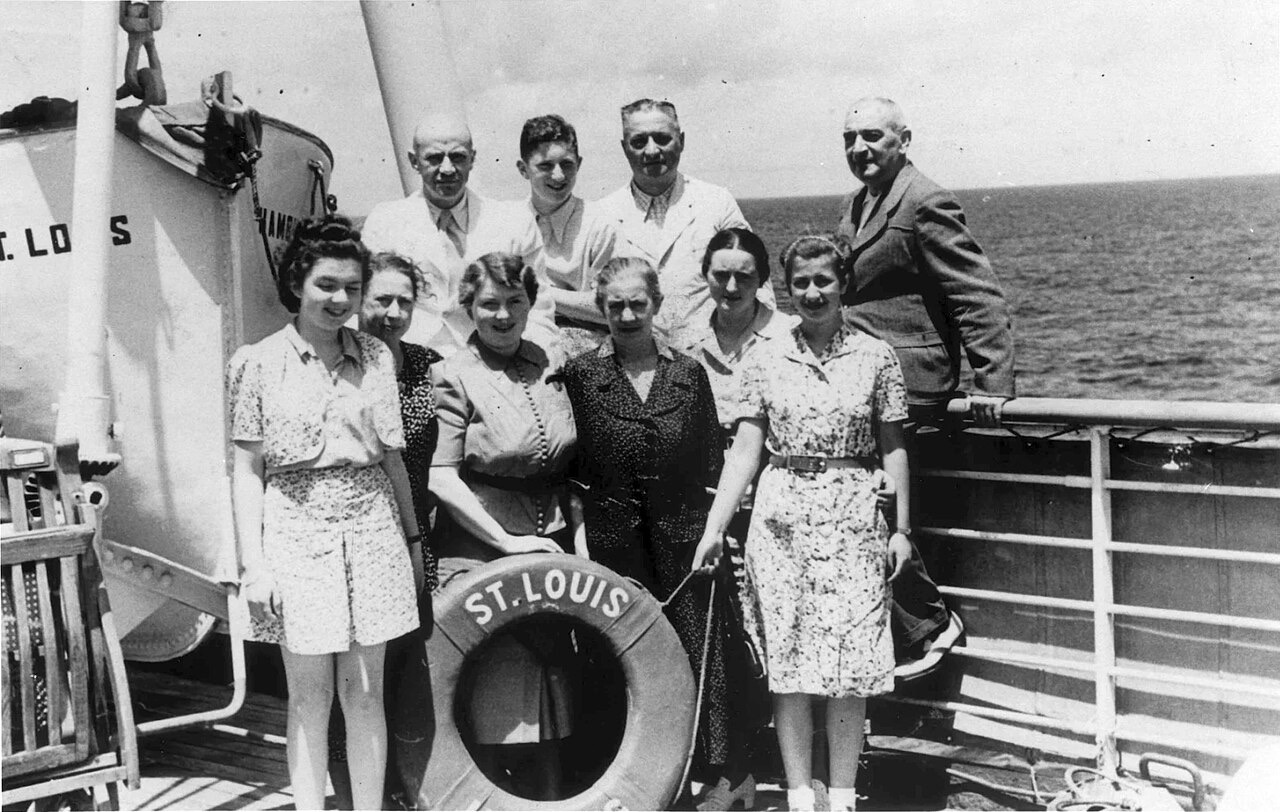
History · Cuba, 1939Cuba did not refuse the St. Louis on a whim; it refused by paperwork. Through the late 1930s, Cuba’s director-general of immigration, Manuel Benítez, had grown rich selling landing certificates to desperate European Jews for about 150 dollars apiece — papers that promised the holder could come ashore in Havana. His corruption embarrassed the government, jobs were scarce after years of economic depression, and newspapers stirred up fear of newcomers. So on May 5, 1939 — about a week before the St. Louis sailed — President Federico Laredo Brú signed Decree 937, which declared those certificates worthless and demanded instead a 500-dollar bond — a cash guarantee — for each newcomer. By grim coincidence, the decree’s number matched the 937 passengers who would soon drop anchor in the harbor it had sealed. Negotiators offered money; the government raised its price and then stopped answering. The passengers had bought a door in good faith, and while they crossed the ocean it was quietly closed.
Visual AidThe ship that was refused
Photograph of passengers aboard the MS St. Louis during its 1939 Atlantic crossing, posed at the rail around a life ring bearing the ship’s name; the lifeboat behind them is marked with its home port, Hamburg. These are real people on the real ship the Knowledge Bank describes — more than 900 refugees who crossed the ocean and were then held at anchor by Decree 937. The photographer is unknown and the passengers are unidentified, so the picture does not show the Landau family, who are Alan Gratz (author)’s invention. Notice the ordinary calm: when this was taken, they still believed the certificates they had bought.
Passengers on the deck of the MS St. Louis, 1939; photographer unknown. Source: Wikimedia Commons, file "На палубе лайнера Сент-Луис (2).jpg (On the deck of the liner St. Louis), public domain.
🧠Knowledge Bank question
1According to the Knowledge Bank, Cuba’s Decree 937 declared the sold landing certificates worthless and demanded instead ___.Ch.22
2Day after day, Officer Padron answers the passengers’ questions with mañana — tomorrow.Ch.22
3How does seawater keep getting into Isabel’s boat?Ch.23
4What almost destroys Isabel’s boat in the middle of the night?Ch.23
5Write the numbers 1–5 in the boxes to show the correct order of events. Number 1 = what happens first.Chapters 22–28
Mahmoud’s overloaded dinghy capsizes in a storm at sea.
The St. Louis drops anchor in Havana harbor instead of docking.
A shark takes Iván’s life after the tanker passes.
Isabel takes her turn bailing as water seeps through the hull.
Josef’s father throws himself over the ship’s rail.
6Mahmoud’s family reaches Greece safely on their first attempt.Ch.24
7After the dinghy capsizes, what does Mahmoud’s family do?Ch.27
8What happens to Iván during the voyage?Ch.26
9Officer Padron dives into the harbor and saves Josef’s father.Ch.28
10Where is Josef’s father taken after he is pulled from the water?Ch.28
Part 3
Literary Elements
Understanding HOW and WHY Alan Gratz tells the story across Chapters 22–28.
🎬Knowledge Bank · Three Clocks, One Story
Authorial Craft · Braided NarrativesRefugee is a braided novel: three storylines in three eras, told in strict rotation, each chapter handing the reader onward just as something goes wrong. Watch what Alan Gratz (author) does with the handoff in Part 4. The tanker looms over Isabel’s boat — cut. The dinghy tips Mahmoud’s family into the sea — cut. Josef’s father climbs toward the rail — cut. Each break is a cliffhanger, and each one forces the reader to wait through two other chapters for news, which is a small taste of the waiting that fills the refugees’ whole lives. The braid does a second job as well: it builds an echo. When Havana says mañana in 1939 and a smuggler says tomorrow in 2015, no narrator needs to announce that little has changed in seventy-six years. The novel never argues its point in a speech; the argument is carried entirely by the structure.
Parallel Plots
Three storylines — 1939, 1994, 2015 — run side by side in strict rotation, and in Part 4 each one strikes the same note: safety in sight, then refused.
Motif
Mañana in Havana, tomorrow in Izmir: a repeated word that gathers new meaning with every return, curdling from comfort into threat.
Mood
The emotional weather of the chapters. Part 4 opens on hope with harbor lights in it and closes in dread, grief, and salt water.
🧠Knowledge Bank question
1According to the Knowledge Bank, the wait between each cliffhanger and its answer gives the reader ___.Ch.22–28
2A motif is a repeated word, image, or idea that gains meaning each time it returns.Ch.22
3‘Mañana’ in Havana and ‘tomorrow’ in Izmir work together as ___.Ch.22–27
4The feeling a scene stirs in the reader — hope, dread, grief — is its ___.Ch.26
5In Part 4 the mood shifts from hope toward dread as the harbor stays closed.Ch.25
6Fill in each blank with the correct literary term.Ch.22–27
Word choices:motifmooddialogueparallel- some words will not be used
The promise of tomorrow, repeated in two storylines, is a .
As hope curdles, the of the chapters darkens.
7Alan Gratz (author) ends a chapter just as the tanker bears down on the little boat. Why?Ch.23
8A cliffhanger ends a chapter at a moment of calm and safety.Ch.24
9Which detail is the clearest parallel between Josef’s and Mahmoud’s journeys?Ch.22–27
10Fill in each blank with the correct literary term.Ch.24–28
Word choices:cliffhangerparallelmoodmotif- some words will not be used
Storylines told side by side are called plots.
A chapter that stops at the moment of greatest danger ends on a .
Part 4
Think Deeper
Four deeper challenges — no single-word recall. Read, weigh the evidence, and reason it out.
🚫Knowledge Bank · Within Sight of Miami
Political History · Borders and QuotasWhen Cuba closed, the passengers’ hopes swung to the United States — and ran into arithmetic. American immigration in 1939 was governed by a quota system, fixed by law in 1924, that admitted only about 27,000 people from Germany and Austria each year; the waiting list was so long that a number issued that summer might not come up for years. The St. Louis steamed close enough to Florida for its passengers to see Miami’s glow, but a Coast Guard cutter — a fast patrol ship — trailed the liner, and a telegram sent to President Franklin D. Roosevelt was never answered; the State Department’s reply said, in effect, wait your turn. A petition asking Canada to take the passengers was turned aside in Ottawa within days. No law of that era required any nation to shelter people fleeing for their lives, and none volunteered. Seen from the deck, the lesson was simple and terrible: every door on the map had swung shut.
Picture a boy at the rail of an ocean liner in the first light of morning. Behind him lie three weeks of open ocean; in front of him, close enough to count the windows, is a city the color of sugar — Havana, the place every paper in his father’s pocket points to. Small boats putter out to circle the ship. Some carry sellers with bananas and coconuts. Some carry relatives, shouting names up at the rail. None carries permission to land. Fifty-five years later, in the same warm sea, a girl bails water out of a boat her neighbors built, cup by aching cup, while something enormous pushes a wall of black water toward her in the dark. And seventy-six years after the boy, in the cold sea between Turkey and Greece, a family treads water beside an overturned rubber boat, watching other boats motor past — every one of them already full. Part 4 is the part where safety comes close enough to touch — and does not let anyone touch it.
Original passage written for Garden Heights — not a quotation from the novel.
1Claim: “Part 4 argues that the deadliest dangers refugees face are decisions made by other people.” — choose the two details that best prove it.Claim & Evidence
2Decisions made by people, or Dangers from the sea? Tap each detail to send it left or right.Sort into two
◄ Decisions made by peopleDangers from the sea ►
3Match each cause to its result. For each cause, pick its result.Cause & Effect
Cuba refuses to honor the landing certificates→
Patched bullet holes weep seawater all day→
Too many passengers crowd the little dinghy→
Day after day of mañana wears Papa down→
🧠Knowledge Bank question
4Fill both blanks to complete the reasoning.Build the Argument
The Knowledge Bank argues that in 1939 the passengers could be turned away everywhere because , which shows that .
Part 5
Standardized Test
Nowhere to Land · Reading & Vocabulary · SAT & TOEFL-style practice
Read the passage — the highlighted words are tested — then answer. Tap an answer, then tap it again to confirm.
SATCentral Ideas — the passage's main point
SATInference — a conclusion the passage implies
SATAuthor’s Purpose — what the author wants to achieve
SATWords in Context — a word's meaning in this passage
TOEFLFactual Information — a fact stated in the passage
TOEFLInsert Text — where a sentence best fits
TOEFLVocabulary — a tested word's meaning here
Nowhere to Land
On May 13, 1939, a German liner steamed out of Hamburg carrying 937 passengers, nearly all of them Jewish families fleeing Nazi Germany. Each family had paid for a landing certificate — a visa promising the holder the right to come ashore in Cuba. What almost none of them knew was that a presidential decree had invalidated those papers a week before the ship sailed. For two weeks the crossing felt like a vacation, because Captain Gustav Schröder insisted that his crew treat the refugees as honored guests.
On May 27 the ship reached Havana and was ordered to anchor out in the harbor instead of docking. Police launches circled for days while officials studied papers, and in the end only 28 passengers were allowed ashore. Ordered out of Cuban waters, Schröder steamed north until his passengers could see the glow of Miami across the dark water. But the United States sent a Coast Guard cutter to shadow the liner, and a telegram begging President Franklin Roosevelt for refuge went unanswered. A request that Canada accept the passengers was rebuffed as well, and the liner, low on food and fuel, turned back toward Europe.
Hope aboard gave way to despair. Schröder refused to accept that his passengers must return to Germany; he privately planned to run the ship aground off the English coast before he would land them in Hamburg. It never came to that. Moved by the passengers’ plight, aid organizations persuaded Belgium, the Netherlands, France, and Great Britain to divide the refugees among them, and on June 17 the liner docked safely at Antwerp. The ship had spent thirty-five days at sea, crossed the Atlantic twice, and found, in all that water, not one port that wanted her.
Original passage written for Garden Heights — not a quotation from the novel.
1What is the main idea of the passage?SAT · Central Ideas
2According to the passage, what did most passengers not know when they sailed?TOEFL · Factual Information
3How many passengers were allowed ashore at Havana?TOEFL · Factual Information
4The passage suggests Schröder sailed close to Miami because he ___.SAT · Inference
5Insert Text (TOEFL). Look at the four squares [1]–[4] in the excerpt below. They show where this sentence could be added: “Some aboard could even pick out individual hotel signs winking along the shoreline.”
On May 27 the ship reached Havana and was ordered to anchor out in the harbor instead of docking. [1] Police launches circled for days while officials studied papers, and in the end only 28 passengers were allowed ashore. [2] Ordered out of Cuban waters, Schröder steamed north until his passengers could see the glow of Miami across the dark water. [3] But the United States sent a Coast Guard cutter to shadow the liner, and a telegram begging President Franklin D. Roosevelt for refuge went unanswered. [4]
Where would the sentence fit best?TOEFL · Insert Text
6Why does the author include Schröder’s secret plan to run the ship aground?SAT · Author’s Purpose
7The final sentence — not one port that wanted her — mainly emphasizes ___.SAT · Inference
8In the passage, invalidated most nearly means ___.SAT · Words in Context
9In the passage, despair most nearly means ___.TOEFL · Vocabulary
10In the passage, visa most nearly means ___.TOEFL · Vocabulary
Part 6 · Optional
Creative Writing
A bonus challenge to practice your English. Take your time and have fun with it.
About This Section
This writing task is optional and is not part of your auto-graded score. The feedback below checks only the basics — length, spelling, and grammar — not whether your ideas are right or wrong. It is meant for classroom discussion and creative practice, so feel free to use your imagination!
Writing Task — Part 4 “Within Sight of Shore”
In Part 4, all three families can almost touch the thing they need most — and are told to wait. Write about a time you were close to something you wanted badly when someone else’s decision made you wait, or a time you had to keep hoping after a plan fell apart. Describe what you were waiting for, what the waiting felt like, and what you did to keep going. 6–10 sentences. End with what the wait taught you about hope.
You can start with: “I was so close I could almost touch it, and then I heard the word wait...”
0 / 40 words minimum
🗣 Teach It · Just for Fun (optional)
No right or wrong — close the screen and tell someone nearby what happened in this part. Can’t find anyone? Tell yourself out loud. The moment you teach it, you truly understand it.
Independent study guide by Garden Heights. Not affiliated with or endorsed by Alan Gratz. Contains original analysis only; no text from the novel is reproduced. Reference text: This workbook follows Alan Gratz’s classic text (the standard Puffin edition sold worldwide). Revised 2023 UK editions change some wording and may not match the vocabulary studied here.