New here? Just sign up with Google — your account includes Matilda, our gift book, forever.
What Happens in Part 1
On a lonely prairie farm long ago, young Anna and her little brother Caleb live with their widowed father, Papa (Jacob Witting). Their mother died the day after Caleb was born, and the house has been quiet and sad ever since; Caleb keeps asking Anna what their mother was like, and whether she used to sing. One evening Papa surprises them with news: he has placed an advertisement in the newspaper for a wife and mother. A woman named Sarah Wheaton has answered from far-off Maine, by the sea. Letters begin to travel back and forth, and Sarah agrees to come for one month to see whether they might all suit one another. Honestly and plainly, she warns them that she is ‘plain and tall,’ that she misses the sea, and that she will bring her cat, Seal.
What We Will Learn
Focus
What It Means
First-Person Narrator
Anna tells the whole story in her own voice (‘I’, ‘my’)
History (Prairie Homesteads)
Farm life on the American plains long ago
Theme (Family & Belonging)
A grieving family hoping to become whole again
Chapter Summary
Chapter
Key Events
Ch.1
Papa reveals he has advertised for a wife; a letter arrives from Sarah Wheaton of Maine, who agrees to visit for a month
Ch.2
The family and Sarah write letters back and forth; Sarah says she is ‘plain and tall,’ misses the sea, and will bring her cat, Seal
💭 Before You Read · Warm-Up (not scored)
There are no wrong answers here — just think, guess, and talk:
Papa advertises in the newspaper for a wife he has never met. Why might a lonely farmer, long ago, choose to do that?
Sarah warns the family, right away, that she is ‘plain and tall’ and misses the sea. Why might a person tell the honest, unflattering truth about themselves before they even arrive?
Predict: a stranger is coming to live with a grieving family for one month. What do you think each of them — Anna, Caleb, Papa — is secretly hoping for, and afraid of?
Copyright Notice
This is an independent study guide created by Garden Heights Academy to support reading comprehension and literary analysis. It contains original analysis questions and does not reproduce any text from the novel. Sarah, Plain and Tall is a work by Patricia MacLachlan. This guide is not affiliated with, authorized by, or endorsed by the author or any associated rights holder.
Part 1
Vocabulary
Study 10 key words from Chapters 1–2, then answer each question.
🧠Knowledge Bank · Free Land on the Great Plains
History · The Homestead ActIn 1862 the United States passed a law that changed the middle of the country. Any settler willing to farm a stretch of empty grassland could claim about 160 acres (64.8 hectares) for almost nothing, provided the family stayed and worked it for five years. Thousands of people traveled west to try. The country they reached was prairie — flat, treeless, and buried under grass that stood taller than a child. Each new claim was called a homestead, and the people who proved one up were homesteaders. Anna and Caleb’s farm exists because of that bargain: free ground traded for years of unrelenting work.
Visual AidThe Homestead bargain, 1862
Diagram for the Knowledge Bank on the Homestead Act. The two cards are the two halves of the bargain the Knowledge Bank describes, about 160 acres (64.8 hectares) of grassland from the government and five years of staying and working from the family, and the red card is what the trade produced, a homestead on flat, treeless prairie. It does not describe Anna and Caleb’s own farm. Notice that the arrows run both ways — the land was free only in money, never in work.
The Homestead Act bargain as described in the Knowledge Bank. Drawn for Garden Heights Academy.
advertisementn.Ch.1
A public notice placed to inform many people
“The shop put an advertisement in the paper to find new workers.”
prairien.Ch.1
A wide, flat stretch of grassland
“Tall grass rolled for miles across the open prairie.”
hearthn.Ch.1
The floor of a fireplace; the warm heart of a home
“The family gathered by the hearth to keep warm on cold nights.”
mournv.Ch.1
To feel deep sorrow for someone who has died
“The whole town gathered to mourn the beloved old teacher.”
correspondv.Ch.2
To write letters back and forth
“The two friends corresponded for years after they moved apart.”
plainadj.Ch.2
Simple and ordinary, not fancy or beautiful
“She wore a plain gray dress with no ribbons or lace.”
wearyadj.Ch.1
Very tired
“After the long harvest, the farmers were weary to the bone.”
homesteadn.Ch.1
A house together with the farmland around it
“They built their homestead far from the nearest town.”
yearnv.Ch.2
To long deeply for something
“Far from home, the sailor yearned for the sight of land.”
companionn.Ch.2
Someone (or an animal) who keeps you company
“The old dog was her closest companion on quiet evenings.”
🧠Knowledge Bank question
1According to the Knowledge Bank, a settler could claim about 160 acres of grassland provided the family ___.Ch.1
2A wide, flat stretch of open grassland is a ___.Ch.1
3True or False: To “mourn” means to feel deep sorrow for someone who has died.Ch.1
4Fill in each blank with the correct word.Ch.1
Word choices:hearthhomesteadprairiecompanion- some words will not be used
The family gathers by the warm , the heart of the house.
Their farmhouse and the land around it make up the .
5To “correspond” with someone is to ___.Ch.2
6True or False: Something “plain” is fancy and covered in decoration.Ch.2
7Someone who is “weary” feels ___.Ch.1
8Fill in each blank with the correct word.Ch.1
Word choices:mournplainwearyyearn- some words will not be used
The children still the mother they lost.
Sarah writes that she is and tall, not fancy.
9To “yearn” for something is to ___.Ch.2
10A “companion” is best described as ___.Ch.2
Part 2
Comprehension
How well do you understand Chapters 1–2?
🧠Knowledge Bank · Houses Cut from the Earth
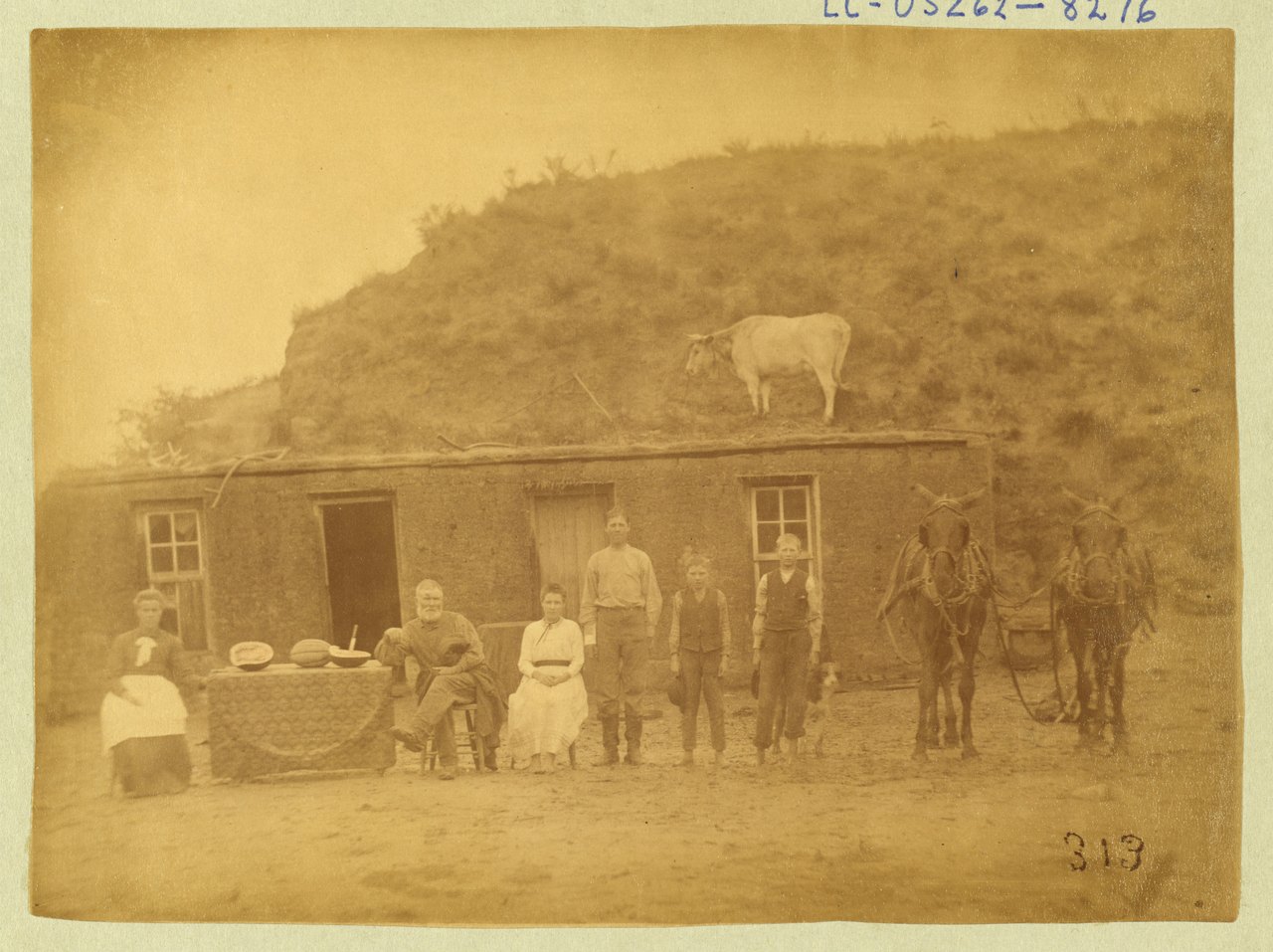
Architecture · Building Without TimberBuilding a house takes wood, and the plains had almost none. So settlers built from the one material lying everywhere beneath their boots: the ground itself. They sliced the thick, root-bound topsoil into heavy bricks of sod and stacked them into walls nearly three feet (91 cm) deep. Such a house stayed cool through scorching summers and held its heat all winter, though a hard rain turned the roof to mud and grass sometimes sprouted overhead. Anyone who could afford lumber hauled it in by wagon and raised a wooden home instead, prizing its window light and its dry, sweepable floor.
Visual AidA sod house with a cow on the roof
Photograph by Solomon Butcher, taken in 1886, of the Sylvester Rawding family in front of their sod house north of Sargent in Custer County, Nebraska, with a cow standing on the grass-covered roof. The Knowledge Bank explains that the plains had almost no wood, so settlers sliced the root-bound topsoil into heavy bricks of sod and stacked them into walls nearly three feet (91 cm) thick, and that grass sometimes sprouted overhead. Here the roof has grown enough grass to graze a cow. This is a real Nebraska family, not Anna and Caleb’s, and their house is sod rather than the wooden home the story describes. Notice the thickness of the wall at the door — earth kept the house cool in summer and warm in winter.
Sylvester Rawding family in front of their sod house, Custer County, Nebraska, 1886; photograph by Solomon D. Butcher, Library of Congress. Source: Wikimedia Commons, public domain.
🧠Knowledge Bank question
1The Knowledge Bank says settlers built with sod because ___.Ch.1
2What happened to Anna and Caleb’s mother?Ch.1
3Who answers Papa’s advertisement?Ch.1
4What does Caleb most want to know from Anna about their mother?Ch.1
5Put these events from Part 1 in the correct order. Write 1–5 (1 = first).Ch.2
Papa tells the children he has advertised for a wife.
The letters travel back and forth between the farm and Maine.
Sarah Wheaton answers the advertisement from Maine.
Sarah agrees to come for a one-month trial visit.
Caleb asks Anna to tell about their mother.
6How do the family and Sarah get to know each other before she arrives?Ch.2
7What honest thing does Sarah tell them about herself?Ch.2
8Sarah writes that she will bring her cat, Seal, along with her.Ch.2
9What place does Sarah miss and often write about?Ch.2
10True or False: The family’s house has felt cheerful and busy ever since the mother died.Ch.1
Part 3
Literary Elements
Understanding HOW and WHY Patricia MacLachlan tells the story across Chapters 1–2.
🧠Knowledge Bank · The Voice That Tells It
Literary Craft · First-Person NarrationWriters must decide who speaks. A first-person narrator is a character inside the story who reports it using the word ‘I,’ which locks the reader into one person’s head. The gain is closeness: every worry, memory, and small hope arrives without a middleman. The cost is that the perspective also limits us — whatever the narrator fails to notice, we never learn, and whatever she believes, right or wrong, is all we are handed. Patricia MacLachlan gives this story to a child, so the whole prairie reaches us through a daughter’s eyes.
📚 Literary Devices in This Part · definitions & examples
A first-person narrator tells the story using ‘I’ and ‘my’; here Anna narrates, so we see everything through her eyes and feel her feelings. Characterization is how an author reveals what a person is like — through their words and deeds. Sarah’s plain, honest letters characterize her as truthful before we ever meet her.
1Fill in each blank with the correct literary term.Ch.1
Word choices:narratorsettingrhymetitle- some words will not be used
A story told with ‘I’ and ‘my’ has a first-person .
The story’s is a prairie farmhouse long ago.
🧠Knowledge Bank question
2According to the Knowledge Bank, the cost of a first-person narrator is that ___.Ch.1
3True or False: Showing what Sarah is like through her own honest letters is an example of characterization.Ch.2
4Sarah’s plain, honest letters mainly make the reader ___.Ch.2
5Why might the author begin with the family’s grief and quiet house?Ch.1
6Caleb’s constant questions about his mother mostly show that he ___.Ch.2
7Fill in each blank with the correct literary term.Ch.2
Word choices:indirectmoodsuspensetitle- some words will not be used
Sarah’s honest letters reveal her without the author telling us — that is characterization.
The quiet, hopeful, slightly sad feeling of these chapters is the .
8True or False: A first-person narrator can tell you the private thoughts of every character in the book.Ch.2
9The mood of these opening chapters is mostly ___.Ch.1
10True or False: A story’s mood is the overall feeling it gives the reader, such as hopeful or sad.Ch.1
Part 4
Think Deeper
Four deeper challenges — no single-word recall. Read, weigh the evidence, and reason it through.
🧠Knowledge Bank · Finding a Wife by Newspaper
Social History · Marriage by AdvertisementA widowed farmer on the plains could not simply go out and meet someone; the nearest town might be a day’s drive away. So men paid for a short advertisement in newspapers printed in eastern cities, describing the farm and asking whether any woman cared to write. Historians later called the women who answered mail-order brides, although nothing was ever bought. What actually passed between them was correspondence: weeks of letters in which two strangers tested one another with plain, awkward questions. Most such arrangements allowed a visit first, because paper alone can never prove trust.
1Claim: “The family still feels the loss of the mother years later.” — choose the two details that best prove it.Claim & Evidence
2Shows the family’s loss, or just a fact about their life? Tap each item to sort it — tap again to switch sides. You can keep tapping to change your answer.Sort into two
◄ The family’s lossJust a fact ►
3Match each cause to its result. For each cause, pick its result.Cause & Effect
The mother died years ago→
The children long for a mother→
Sarah reads the advertisement→
Letters pass back and forth→
🧠Knowledge Bank question
4Fill both blanks to complete the reasoning.Build the Argument
The Knowledge Bank says the women who answered farmers' advertisements were later called mail-order brides, although , and most arrangements allowed a visit first because .
Part 5
Standardized Test
Vocabulary in Context & Main Idea — SAT & TOEFL-style practice
Read the passage — the highlighted words are tested — then answer. Tap an answer, then tap it again to confirm.
SATWords in Context — a word's meaning in this passage
SATInference — a conclusion the passage implies
SATCentral Ideas — the passage's main point
TOEFLFactual Information — a fact stated in the passage
TOEFLRhetorical Purpose — why the author included a detail
Letters Across the Lonely Prairie
More than a hundred years ago, letters were the only way most people could reach someone who lived far away. A message could not be sent in an instant; instead it was written by hand, sealed in an envelope, and carried for days or even weeks by train, wagon, and horse before it arrived. Because a reply took so long, people wrote carefully and honestly, filling the page with news, questions, and feelings they truly meant. A single letter might be read again and again, then kept in a drawer for years. On the lonely prairie, where the nearest neighbor could be miles away, the arrival of the mail was a small event. Families would gather to hear a letter read aloud, and two strangers who chose to correspond could build a whole new friendship, or even a whole new family, out of a few honest words. It is easy to forget, in a world of instant messages, how much patience a letter once required, and how precious each one became.
Original passage written for Garden Heights — not a quotation from the novel.
1In the passage, a prairie is ___.SAT · Words in Context
2About how long could a letter take to arrive, according to the passage?TOEFL · Factual Information
3Why did people write so carefully and honestly?TOEFL · Factual Information
4To correspond with someone is to ___.SAT · Words in Context
5Families would “gather” when the mail arrived because —TOEFL · Factual Information
6The passage says a few honest words from a faraway “stranger” could begin a new family; this suggests —SAT · Inference
7Why might a letter be read again and again and kept for years?SAT · Inference
8“Patience” most nearly means —SAT · Words in Context
9Which sentence best states the main idea of the passage?SAT · Central Ideas
10The author ends by mentioning “instant messages” mainly to —TOEFL · Rhetorical Purpose
Part 6 · Optional
Creative Writing
A bonus challenge to practice your English. Take your time and have fun with it.
About This Section
This writing task is optional and is not part of your auto-graded score. The feedback below checks only the basics — length, spelling, and grammar — not whether your ideas are right or wrong. It is meant for classroom discussion and creative practice, so feel free to use your imagination!
Writing Task — Part 1 “A Letter to a Stranger”
Sarah and the family learn about each other by writing honest letters. Write a short letter introducing yourself to someone you have never met. Be honest, like Sarah — tell them one true thing you love, one thing you miss, and one question you would ask them. Write at least 40 words.
You can start with: “Dear friend, I have never met you, but I would like you to know…”
0 / 40 words minimum
🗣 Teach It · Just for Fun (optional)
No right or wrong — close the screen and tell someone nearby what happened in this part. Can’t find anyone? Tell yourself out loud. The moment you teach it, you truly understand it.
Part 1 Complete!
You finished Chapters 1–2 of Sarah, Plain and Tall.
Here are your auto-graded results:
-
points out of 100
Teach it to someone
The best last step is to teach it. In your own words, explain what happened — retell a favorite scene, teach a character’s big choice, or sum up the main idea for a parent, friend, or classmate. When you can teach it clearly, you truly own it.
Independent study guide by Garden Heights Academy. Not affiliated with or endorsed by the author or any rights holders. Contains original analysis only; no text from the novel is reproduced.
SAT® is a registered trademark of College Board, which is not affiliated with, and does not endorse, these materials. TOEFL® is a registered trademark of ETS. These materials are not endorsed or approved by ETS. Garden Heights is an independent provider of test-style reading practice.