New here? Just sign up with Google — your account includes Matilda, our gift book, forever.
What Happens in Part 3
Sarah begins to make herself at home. The two farm dogs take to her at once, and she lines up her sea shells along the windowsill, showing Caleb how to hold one to his ear and hear the whisper of the ocean. She walks out with the children to gather wildflowers, and teaches them to hang the blossoms upside down so they will dry and keep their color all winter. She even cuts Caleb’s and Papa’s hair, then scatters the soft clippings on the wind so the birds can weave them into their nests. Little by little, with these small, gentle acts, Sarah is beginning to belong — and she says she would like, tomorrow, to go and see the sheep, for she has never once touched one.
What We Will Learn
Focus
What It Means
Characterization by Action
How Sarah’s small deeds show who she is
Home Science
Drying flowers; birds lining their nests
Theme (Belonging)
A stranger quietly beginning to make a home
Chapter Summary
Chapter
Key Events
Ch.4
The dogs love Sarah; she sets her shells on the windowsill and lets Caleb hear the sea in one; she dries wildflowers, cuts hair and scatters it for the birds, and asks to visit the sheep
💭 Before You Read · Warm-Up (not scored)
There are no wrong answers here — just think, guess, and talk:
How can small, everyday actions — not big speeches — show what a person is really like?
Sarah scatters hair clippings so birds can use them. Why might a kind person think about even the birds?
Predict: with every gentle thing Sarah does, does she seem more likely, or less likely, to want to stay? Why?
Copyright Notice
This is an independent study guide created by Garden Heights Academy to support reading comprehension and literary analysis. It contains original analysis questions and does not reproduce any text from the novel. Sarah, Plain and Tall is a work by Patricia MacLachlan. This guide is not affiliated with, authorized by, or endorsed by the author or any associated rights holder.
Part 1
Vocabulary
Study 10 key words from Chapter 4, then answer each question.
🧠Knowledge Bank · How a Seashell Is Built
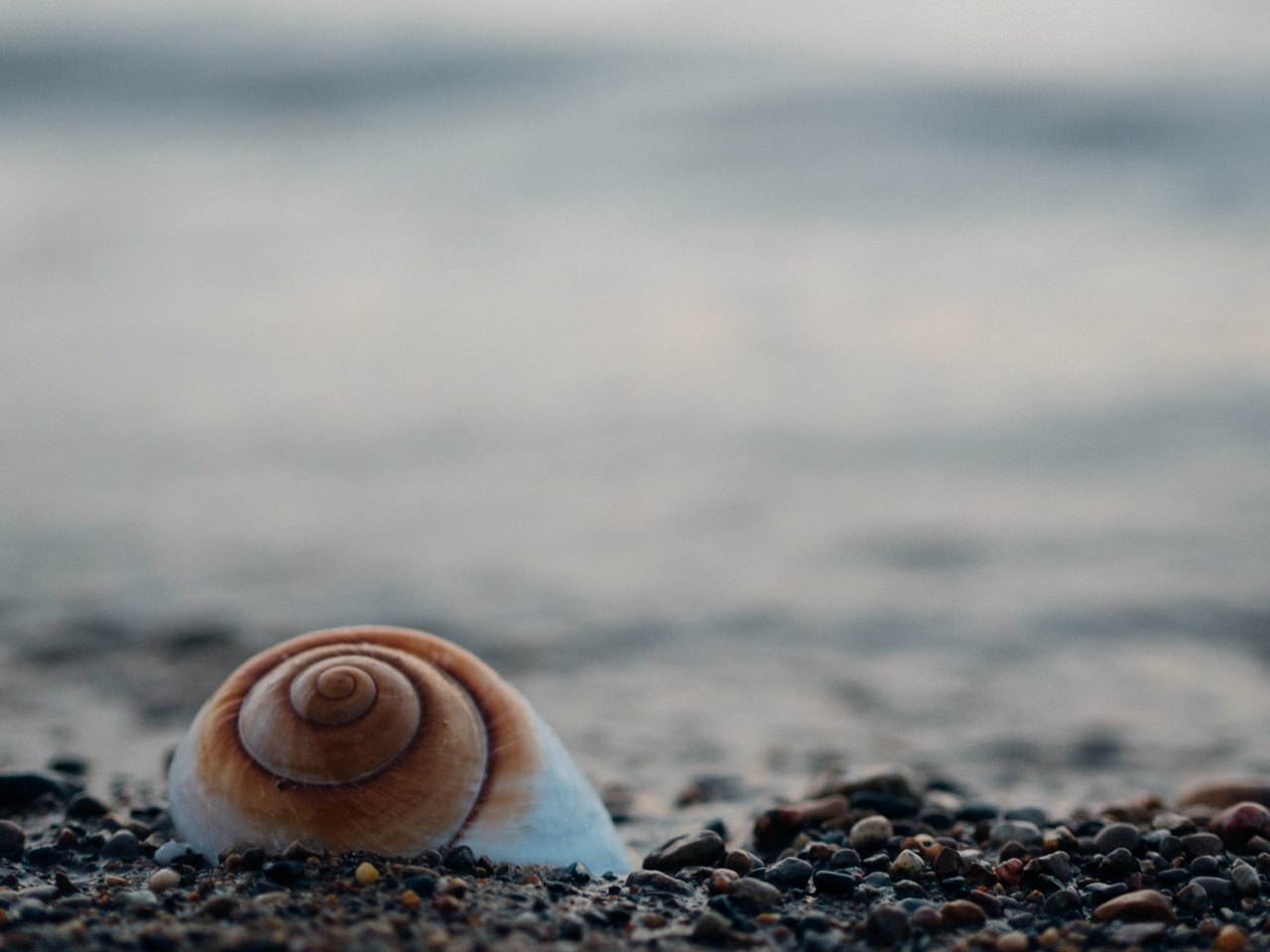
Marine Biology · Shells and SoundA seashell is not a pebble. It is a house that a soft animal — a snail, clam, or mussel — grows around itself, laying down a rim of hard mineral at the opening month after month so the whole thing widens in a spiral as its owner grows. Once the animal dies, the empty shell tumbles in the surf until it is smooth and pale. Lift a large one to your ear and a hush like the ocean swells inside. That sound is never the sea: the curved chamber traps the noise already around you and returns it as a faint roar.
Visual AidA spiral shell on the shore
Photograph by Aaron Burden, taken in July 2015, of a spiral snail shell resting on wet pebbles at the water’s edge. The Knowledge Bank explains that a seashell is not a pebble but a house a soft animal grows around itself, laying down a rim of hard mineral at the opening month after month so that the whole thing widens in a spiral as its owner grows. The spiral is plain to see here, tight at the center and widening toward the mouth. The shell is empty and has been tumbled smooth, as the Knowledge Bank describes; it is not one of Sarah’s shells from Maine, and it is too small to hold to an ear. Notice the bands of color following the spiral — each was laid down as the animal grew.
Seashell on the shore, July 2015; photograph by Aaron Burden, released under CC0 on Unsplash. Source: Wikimedia Commons, CC0.
settlev.Ch.4
To make a calm, permanent home somewhere
“After years of traveling, they were ready to settle on the farm.”
scatterv.Ch.4
To throw or drop things loosely in many directions
“She scattered the seeds across the freshly turned soil.”
arrangev.Ch.4
To place things neatly in order
“He arranged the books carefully along the shelf.”
blossomn.Ch.4
A flower, especially on a plant or tree
“The apple tree was covered in white blossom.”
witherv.Ch.4
To dry up and lose freshness
“Without water, the picked flowers began to wither.”
clippingn.Ch.4
A small piece cut off from something
“She swept the hair clippings from the floor.”
delicateadj.Ch.4
Easily broken; fine and dainty
“The delicate shell cracked at the slightest touch.”
tameadj.Ch.4
Gentle and used to people, not wild
“The tame dogs followed Sarah everywhere.”
gatherv.Ch.4
To collect things together
“The children gathered wildflowers in the meadow.”
delightn.Ch.4
Great pleasure or joy
“The shell’s sea-sound filled Caleb with delight.”
🧠Knowledge Bank question
1According to the Knowledge Bank, the hush inside a large shell held to the ear is ___.Ch.4
2To “scatter” things is to ___.Ch.4
3True or False: To “arrange” things is to place them neatly in order.Ch.4
4Fill in each blank with the correct word.Ch.4
Word choices:blossomwitherclippingdelight- some words will not be used
Each prairie opens bright in the summer sun.
Cut flowers soon unless Sarah dries them with care.
5To “wither” means to ___.Ch.4
6A “clipping” is ___.Ch.4
7True or False: Something “delicate” is strong and hard to break.Ch.4
8A “tame” animal is ___.Ch.4
9Fill in each blank with the correct word.Ch.4
Word choices:gatherclippingtamescatter- some words will not be used
The children armfuls of wildflowers from the fields.
Sarah saves each hair for the birds to take.
10“Delight” means ___.Ch.4
Part 2
Comprehension
How well do you understand Chapter 4?
🧠Knowledge Bank · Keeping Flowers Through Winter
Home Science · Preserving BloomsCut flowers wither because the stem can no longer draw water up while the petals keep losing it. Drying sidesteps that problem instead of fighting it. Tie a small bunch, hang it head-down somewhere dark and airy, and the moisture leaves slowly; gravity pulls the stems straight as they stiffen, so the blossoms keep their shape rather than drooping, and the darkness stops sunlight from bleaching them. Within a few weeks the bundle is light, papery, and permanent. Long before shops sold decorations, this was how a household kept a piece of August alive through a gray February.
Visual AidKeeping August through February
Diagram for the Knowledge Bank on preserving blooms. The four cards are the steps the Knowledge Bank describes, tying a bunch, hanging it head-down in a dark airy place, letting the moisture leave while gravity straightens the stems, and the light, papery result weeks later; the notes beneath give the Knowledge Bank’s reasons. It does not say which flowers Sarah dried. Notice that the bunch hangs upside down — that one detail is what keeps the blossoms from drooping.
The steps of drying flowers as described in the Knowledge Bank. Drawn for Garden Heights Academy.
🧠Knowledge Bank question
1The Knowledge Bank says flowers are hung head-down to dry so that ___.Ch.4
2Sarah sets her sea shells out along the windowsill.Ch.4
3What does Sarah show Caleb he can do with a shell?Ch.4
4What does Sarah teach the children to do with the wildflowers?Ch.4
5Put these events from Part 3 in the correct order. Write 1–5 (1 = first).Ch.4
Sarah teaches the children to dry wildflowers for winter.
She cuts Caleb’s and Papa’s hair.
Sarah shows Caleb how to hear the sea in a shell.
She scatters the clippings on the wind for birds’ nests.
The farm dogs take to Sarah at once.
6What does Sarah do with the hair clippings?Ch.4
7What does Sarah say she would like to do next?Ch.4
8True or False: Sarah keeps to herself and refuses to join in the family’s daily life.Ch.4
9Why does drying the flowers matter beyond just decoration?Ch.4
10What do Sarah’s small acts together suggest?Ch.4
Part 3
Literary Elements
Understanding HOW and WHY Patricia MacLachlan tells the story across Chapter 4.
🧠Knowledge Bank · Character Shown, Not Announced
Literary Craft · Indirect CharacterizationThere are two ways to tell a reader what somebody is like. Direct characterization simply states it: she was generous. Indirect characterization hands the reader the job — the writer supplies a deed and lets us draw our own conclusion. Freely chosen deeds count most, especially small ones nobody demanded: what a person saves, shares, notices, or troubles to name. Because we reach the verdict ourselves, it feels earned and it sticks. Watch which details a writer bothers to include, since in a short book no gesture reaches the page by accident.
📚 Literary Devices in This Part · definitions & examples
Characterization is how an author shows what a person is like. Here it is done through action — Sarah’s gentle deeds reveal her character without a single sentence of description. Sensory imagery is language that appeals to the senses; the shell held to the ear lets us hear the sea Caleb has never seen.
1Fill in each blank with the correct literary term.Ch.4
Word choices:characterizationmoodrhymesetting- some words will not be used
Revealing Sarah through her small, kind deeds is .
The warm, gentle, hopeful feeling here is the chapter’s .
🧠Knowledge Bank question
2According to the Knowledge Bank, the deeds that count most in indirect characterization are ___.Ch.4
3The shell held to the ear is an example of ___.Ch.4
4True or False: An author can reveal a character without ever describing them, just by showing what they do.Ch.4
5Why does MacLachlan ‘show’ Sarah’s kindness instead of just stating it?Ch.4
6Fill in each blank with the correct literary term.Ch.4
Word choices:foreshadowingsymbolnarratortitle- some words will not be used
The dried flowers quietly hint at the future — that is .
A shell that stands for Sarah’s whole sea world works as a .
7The mood of this chapter is mostly ___.Ch.4
8True or False: Sensory imagery can use sound, not only sight.Ch.4
9Caleb hearing the sea in a shell mainly lets the reader feel his ___.Ch.4
10True or False: Characterization can reveal a person through what they do, not only through what the author says about them.Ch.4
Part 4
Think Deeper
Four deeper challenges — no single-word recall. Read, weigh the evidence, and reason it through.
🧠Knowledge Bank · What Birds Build With
Ornithology · Nest BuildingMost birds gather their building material rather than making it. A robin frames a cup from grass and mud, a wren crams a hollow with twigs, and nearly all small birds finish the inside with something soft: plant down, moss, feathers, animal hair. Hair is prized because it is fine, strong, and curls into a warm lining that holds the nest in shape. On treeless plains, where such material was scarce, a scatter of clippings caught in the grass was a real gift to the birds nearby. Nesting also runs on a calendar, and the softest linings are collected in spring.
1Claim: “Sarah is settling in, yet she still misses her home by the sea.” — choose the two details that best prove it.Claim & Evidence
2Shows Sarah settling in, or that she misses the sea? Tap each item to sort it — tap again to switch sides. You can keep tapping to change your answer.Sort into two
◄ Settling inMissing the sea ►
3Match each cause to its result. For each cause, pick its result.Cause & Effect
The farm dogs take to Sarah→
Sarah misses the ocean→
Caleb holds a shell to his ear→
Sarah speaks often of Maine→
🧠Knowledge Bank question
4Fill both blanks to complete the reasoning.Build the Argument
The Knowledge Bank says birds prize hair for nest lining because it is , so on treeless plains a scatter of clippings was .
Part 5
Standardized Test
Factual Details & EXCEPT Questions — SAT & TOEFL-style practice
Read the passage — the highlighted words are tested — then answer. Tap an answer, then tap it again to confirm.
SATWords in Context — a word's meaning in this passage
SATInference — a conclusion the passage implies
SATCentral Ideas — the passage's main point
TOEFLFactual Information — a fact stated in the passage
TOEFLNegative Fact (EXCEPT) — the statement the passage does NOT support
TOEFLRhetorical Purpose — why the author included a detail
How Birds Build Their Nests
When spring comes, birds all over the world set to work building nests, and they are among nature's most resourceful builders. A nest must cradle delicate eggs and keep tiny chicks warm, so a bird gathers whatever soft and sturdy materials it can find. Many weave a strong outer cup from twigs, grass, and mud, then line the inside with the softest things they can collect: feathers, moss, plant fluff, and even bits of animal hair or fur left on fences and in fields. A snug lining keeps the eggs from growing cold. Some birds are famous for their skill: a weaver bird can knot grass into a hanging basket, and a hummingbird binds its thimble-sized nest together with spider silk so it can stretch as the chicks grow. What birds almost never use, though, is anything sharp or poisonous that might harm the young. From a scattering of hair on the wind to a strand of dry grass, a bird will turn the odds and ends of a whole field into a safe and cozy home.
Original passage written for Garden Heights — not a quotation from the novel.
1In the passage, birds are called resourceful “builders” because they —SAT · Words in Context
2What is the outer cup of many nests woven from?TOEFL · Factual Information
3A bird gathers materials, meaning it ___.SAT · Words in Context
4The passage says birds line their nests with all of these EXCEPT —TOEFL · Negative Fact (EXCEPT)
5Why does a nest need a soft, snug lining?TOEFL · Factual Information
6Delicate eggs are eggs that are ___.SAT · Words in Context
7What can the reader infer about how birds choose materials?SAT · Inference
8According to the passage, what makes the finished nest “cozy” and safe for the chicks?TOEFL · Factual Information
9Which sentence best states the main idea of the passage?SAT · Central Ideas
10This passage connects to Chapter 4 because Sarah —TOEFL · Rhetorical Purpose
Part 6 · Optional
Creative Writing
A bonus challenge to practice your English. Take your time and have fun with it.
About This Section
This writing task is optional and is not part of your auto-graded score. The feedback below checks only the basics — length, spelling, and grammar — not whether your ideas are right or wrong. It is meant for classroom discussion and creative practice, so feel free to use your imagination!
Writing Task — Part 3 “Small Acts of Kindness”
Sarah makes a home through tiny gentle acts — arranging shells, drying flowers, feeding the birds. Write about a small, quiet kindness someone has done for you, or one you could do for someone else. What was it, and why did such a little thing matter so much? Write at least 40 words.
You can start with: “The smallest kind thing I remember is…”
0 / 40 words minimum
🗣 Teach It · Just for Fun (optional)
No right or wrong — close the screen and tell someone nearby what happened in this part. Can’t find anyone? Tell yourself out loud. The moment you teach it, you truly understand it.
Part 3 Complete!
You finished Chapter 4 of Sarah, Plain and Tall.
Here are your auto-graded results:
-
points out of 100
Teach it to someone
The best last step is to teach it. In your own words, explain what happened — retell a favorite scene, teach a character’s big choice, or sum up the main idea for a parent, friend, or classmate. When you can teach it clearly, you truly own it.
Independent study guide by Garden Heights Academy. Not affiliated with or endorsed by the author or any rights holders. Contains original analysis only; no text from the novel is reproduced.
SAT® is a registered trademark of College Board, which is not affiliated with, and does not endorse, these materials. TOEFL® is a registered trademark of ETS. These materials are not endorsed or approved by ETS. Garden Heights is an independent provider of test-style reading practice.