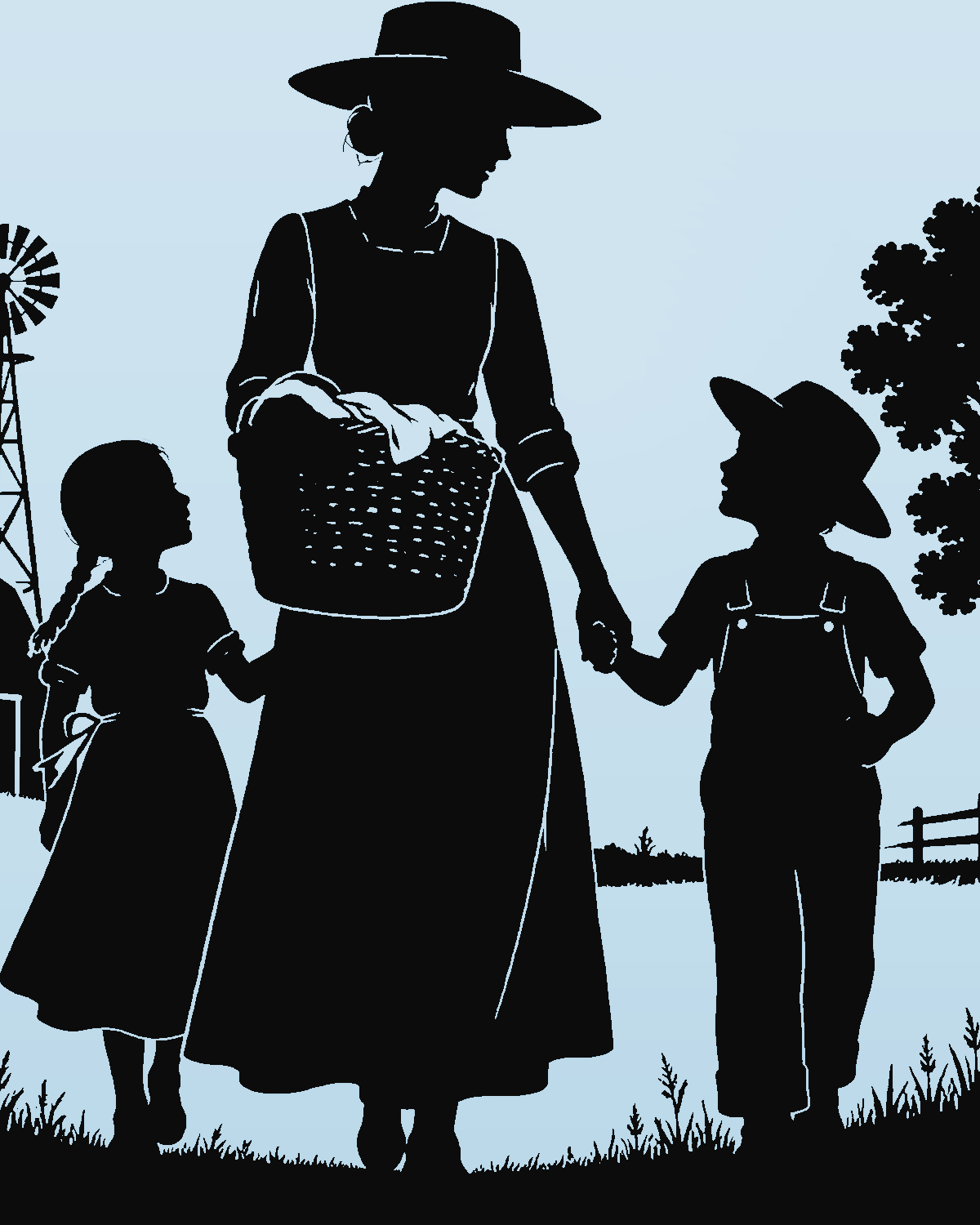
Sarah, Plain and Tall cover
Garden Heights Academy

Sarah, Plain and Tall

This workbook is for Garden Heights members. Sign in to continue.

Sign in with Google →
New here? Just sign up with Google — your account includes Matilda, our gift book, forever.
What Happens in Part 4

Today Sarah meets the sheep at last. She adores them instantly — she pets them, gives them the names of her favorite aunts, and even sings to them. Missing her old home, Sarah draws pictures to send back to her family in Maine, and tells the children more about the sea: its wide beaches and, most of all, the great rolling sand dunes she loved. Then Papa does a wonderful thing. “Come and see our dunes,” he says, and leads everyone to the barn, where the tall golden haystacks rise like hills. He leans a ladder against the highest stack, and Sarah climbs up and throws herself joyfully into the hay — sliding down a prairie ‘dune’ made just for her. For one bright afternoon, the plains give Sarah a little piece of the sea she misses.

What We Will Learn
FocusWhat It Means
MetaphorCalling the haystacks Sarah’s ‘dunes’
Farm LifeSheep, wool, and grazing on the plains
Theme (Kindness)Papa easing Sarah’s homesickness with a gift
Chapter Summary
ChapterKey Events
Ch.5Sarah meets and adores the sheep, names them after her aunts and sings to them; she draws for her Maine family and misses the sand dunes, so Papa shows her the haystacks as ‘our dunes’ and she slides joyfully into the hay
💭 Before You Read · Warm-Up (not scored)

There are no wrong answers here — just think, guess, and talk:

  • Papa turns haystacks into ‘dunes’ for Sarah. Why can naming one thing as another be a kind of gift?
  • Sarah names the sheep after her favorite aunts. What does that tell you about what she is missing?
  • Predict: does giving Sarah bits of the sea on the prairie make her more likely to stay, or does it remind her of what she has lost?
Copyright Notice

This is an independent study guide created by Garden Heights Academy to support reading comprehension and literary analysis. It contains original analysis questions and does not reproduce any text from the novel. Sarah, Plain and Tall is a work by Patricia MacLachlan. This guide is not affiliated with, authorized by, or endorsed by the author or any associated rights holder.
Part 1
Vocabulary
Study 10 key words from Chapter 5, then answer each question.
🧠Knowledge Bank · Why Farms Kept Sheep
Agriculture · Sheep and WoolA sheep turns grass into cloth. Its fleece grows all year, and once each spring the animal is sheared with hand clippers, giving several pounds of wool that can be washed, spun into yarn, and knitted into everything a prairie winter demands. Wool holds warmth even when damp, which is exactly why it beat cotton on the open plains. Sheep also thrive where crops fail, since they graze coarse grass that would feed nothing else, and one child with a steady dog can mind an entire flock. Milk, meat, and lambs every spring made them well worth their keep.
flockn.Ch.5
A group of sheep or birds together
“The shepherd led his flock across the green hill.”
grazev.Ch.5
To eat growing grass in a field
“The sheep grazed quietly on the prairie grass.”
wooln.Ch.5
The soft, curly hair of a sheep
“Her warm winter sweater was made of wool.”
sketchv.Ch.5
To draw quickly and simply
“She liked to sketch the hills at sunset.”
dunen.Ch.5
A hill of sand made by the wind
“The children rolled down the tall sand dune at the beach.”
meadown.Ch.5
A field of grass and wildflowers
“Butterflies drifted over the sunny meadow.”
tumblev.Ch.5
To fall or roll in a loose, playful way
“He tumbled laughing down the soft haystack.”
adorev.Ch.5
To love something very much
“She adored the gentle sheep from the first moment.”
distantadj.Ch.5
Far away
“She thought of her distant home across the country.”
joyn.Ch.5
A feeling of great happiness
“Sliding into the hay filled Sarah with joy.”
1A “flock” is ___.Ch.5
2To “graze” means to ___.Ch.5
3Fill in each blank with the correct word.Ch.5
Word choices:woolgrazedunemeadow- some words will not be used
The sheep’s soft, curly keeps them warm.
All day the sheep on the summer grass.
4True or False: To “sketch” is to draw quickly and simply.Ch.5
5A “dune” is ___.Ch.5
6Fill in each blank with the correct word.Ch.5
Word choices:meadowtumbleflockadore- some words will not be used
The sheep wander the , a field of grass and wildflowers.
Sarah loves to down into the soft hay.
7To “tumble” is to ___.Ch.5
8To “adore” something is to ___.Ch.5
9True or False: Something “distant” is very close by.Ch.5
10“Joy” means ___.Ch.5
Part 2
Comprehension
How well do you understand Chapter 5?
🧠Knowledge Bank · How a Sand Dune Forms
Earth Science · Dunes and WindA dune is a hill assembled by wind. Along a beach the breeze lifts dry grains off the flat sand and drops them the instant something slows the air — a stranded log, a tuft of beach grass. Grain by grain the pile climbs, steep on the sheltered face and gently sloped on the windward one, and the whole hill creeps inland over the years. Beach grass eventually roots through it and pins it down. What results is a chain of soft, rounded mounds standing between ocean and land, and to a child raised beside them that rolling shape simply means home.
1How does Sarah feel about the sheep when she meets them?Ch.5
2What does Sarah name the sheep after?Ch.5
3Sarah sings to the sheep as if they were old friends.Ch.5
4Why does Sarah draw pictures?Ch.5
5Put these events from Part 4 in the correct order. Write 1–5 (1 = first).Ch.5
  • Sarah climbs the ladder and leaps joyfully into the hay.
  • She names the sheep after her favorite aunts.
  • Papa points to the haystacks and calls them ‘our dunes.’
  • Sarah tells the family she misses the sand dunes most.
  • Sarah meets the sheep and adores them at once.
6What does Papa call the haystacks?Ch.5
7How does Sarah reach the top of the tallest haystack?Ch.5
8What does Sarah do at the top of the haystack?Ch.5
9True or False: Papa ignores Sarah’s homesickness and tells her to forget the sea.Ch.5
10Naming the sheep after her aunts shows that Sarah ___.Ch.5
Part 3
Literary Elements
Understanding HOW and WHY Patricia MacLachlan tells the story across Chapter 5.
🧠Knowledge Bank · Calling One Thing Another
Literary Craft · MetaphorA metaphor declares that one thing is another and trusts the reader to carry the meaning across. A simile keeps a safety rail — like, as — which holds the two things politely apart; a metaphor removes the rail, so the sentence lands harder and faster. The good ones are honest, too: the comparison only works if the two things genuinely share a shape, a motion, or a mood. When a character renames part of an unfamiliar landscape with a word borrowed from the place she loves, the metaphor does double duty. It describes the view and quietly reports the state of her heart.
📚 Literary Devices in This Part · definitions & examples
A metaphor says one thing is another to share a feeling — the haystacks ‘are’ dunes. Unlike a simile, it does not use like or as; it simply names one as the other. Characterization continues too: Papa’s single kind act reveals his quiet, loving heart more than any speech could.
1Fill in each blank with the correct literary term.Ch.5
Word choices:metaphormoodsimilerhyme- some words will not be used
Calling the haystacks ‘dunes’ — one thing named as another — is a .
The joyful, free feeling of the hay-sliding scene is the .
2A metaphor is different from a simile because it ___.Ch.5
3What feeling does Papa’s ‘our dunes’ metaphor really share?Ch.5
4True or False: A metaphor can let a character say something too tender to say plainly.Ch.5
5Papa building Sarah her ‘dunes’ mainly reveals that he is ___.Ch.5
6Fill in each blank with the correct literary term.Ch.5
Word choices:similesymbolnarratortitle- some words will not be used
A comparison that DOES use ‘like’ or ‘as’ is a .
The hay-dunes stand in for Sarah’s sea — they work as a .
7The mood as Sarah slides into the hay is ___.Ch.5
8True or False: The word ‘our’ in ‘our dunes’ helps join Sarah and the family together.Ch.5
9Why does the author give Sarah this happy afternoon now?Ch.5
10True or False: A metaphor calls one thing another — haystacks are ‘dunes’ — to share a feeling, without using ‘like’ or ‘as.’Ch.5
Part 4
Think Deeper
Four deeper challenges — no single-word recall. Read, weigh the evidence, and reason it through.
🧠Knowledge Bank · The Power of Naming Things
Cultural Anthropology · NamingPeople name whatever they mean to keep. Farmers everywhere name the working animals and leave unnamed the ones they cannot afford to grow fond of — a habit shepherds and dairy families still follow. A name performs two jobs at once: it turns a creature into an individual you can notice and miss, and it fastens that creature to you, which is the beginning of attachment. Settlers did the same with country, hauling old place names west and pinning them onto new hills and creeks. Naming a strange thing after a beloved one is how a person starts making an unknown world familiar.
1Claim: “Sarah is torn between loving the prairie and missing the sea.” — choose the two details that best prove it.Claim & Evidence
2Sarah embracing the prairie, or missing the sea? Tap each item to send it left or right.Sort into two
◄ Embracing the prairieMissing the sea ►
3Match each cause to its result. For each cause, pick its result.Cause & Effect
Sarah meets the sheep
She grows fond of the farm animals
Sarah misses her old home
The prairie has no ocean
4Fill both blanks to complete the reasoning.Build the Argument
Sarah draws pictures of the sea because , which shows that .
Part 5
Standardized Test
Main Idea & Inference — SAT & TOEFL-style practice
🎯 You already have the skills from the sections above — this is just a fun way to meet real SAT & TOEFL-style questions. Read the passage (the highlighted words are tested below), then answer the questions below. Tap an answer to select it, then tap it again to confirm — you can change your choice until you confirm.

Along many seashores and in every desert, the wind is a tireless builder, and its favorite creation is the sand dune. A dune begins wherever something small — a rock, a clump of grass, even a shell — slows the moving air. As the wind loses speed, it drops the grains of sand it was carrying, and they begin to pile up. Grain by grain, day after day, the heap grows into a hill. The wind keeps working, pushing sand up the gentle slope on one side and letting it tumble down the steeper side, so the whole dune slowly creeps forward across the land. Some desert dunes are taller than houses and travel a little further every year. Plants can anchor a dune in place: their roots hold the sand still, and the moving hill becomes a settled one. So a dune is really a story about patience — a mountain built from tiny grains by nothing but a steady, patient wind.

Original passage written for Garden Heights — not a quotation from the novel.
1A “dune” in this passage is —SAT · Words in Context
2What must happen first for a dune to begin?TOEFL · Factual Information
3The passage says grains “pile” up wherever something slows the wind because —TOEFL · Factual Information
4When the passage says a dune “creeps” forward, it means the dune —SAT · Words in Context
5How can plants “anchor” a dune?TOEFL · Factual Information
6What can the reader infer builds a dune?SAT · Inference
7To “anchor” something is to —SAT · Words in Context
8Insert Text (TOEFL). Look at the four squares [1][4] in the passage excerpt below. They show where the following sentence could be added:
“Given enough time, even a hill the size of a house can cross a road.”
The wind keeps working, pushing sand up the gentle slope on one side and letting it tumble down the steeper side, so the whole dune slowly creeps forward across the land. [1] Some desert dunes are taller than houses and travel a little further every year. [2] Plants can anchor a dune in place: their roots hold the sand still, and the moving hill becomes a settled one. [3] So a dune is really a story about patience — a mountain built from tiny grains by nothing but a steady, patient wind. [4]
Where would the sentence fit best?
TOEFL · Insert Text
9Which sentence best states the main idea?SAT · Central Ideas
10This passage connects to Chapter 5 because Sarah —TOEFL · Rhetorical Purpose
Part 6 · Optional
Creative Writing
A bonus challenge to practice your English. Take your time and have fun with it.
About This Section

This writing task is optional and is not part of your auto-graded score. The feedback below checks only the basics — length, spelling, and grammar — not whether your ideas are right or wrong. It is meant for classroom discussion and creative practice, so feel free to use your imagination!

Writing Task — Part 4 “A Gift That Says ‘Stay’”

Papa turns haystacks into ‘dunes’ to make Sarah feel at home. Write about a time someone made you feel welcome in a new or strange place — a new school, a new city, a new group. What did they do, and how did it make you feel? Or invent a kind gift one character could give another. Write at least 40 words.

You can start with: “The thing that made me feel welcome was…”
0 / 40 words minimum
🗣 Teach It · Just for Fun (optional)

No right or wrong — close the screen and tell someone nearby what happened in this part. Can’t find anyone? Tell yourself out loud. The moment you teach it, you truly understand it.


Garden Heights Academy

Part 4 Complete!

You finished Chapter 5 of Sarah, Plain and Tall.

Here are your auto-graded results:

-
points out of 100
Your Writing

Your writing was checked automatically for length, spelling, grammar, and whether you included the key parts of the scene. Scroll back to Part 5 anytime to read your feedback and improve your work.

Move on to Part 5 →

Independent study guide by Garden Heights Academy. Not affiliated with or endorsed by the author or any rights holders. Contains original analysis only; no text from the novel is reproduced.