New here? Just sign up with Google — your account includes Matilda, our gift book, forever.
Stargirl · Garden Heights
Part 1
for Stargirl · Part 1 · Chapters 1–4
8 Parts40 min
What Happens in Part 1
At conformist Mica High, watchful Leo Borlock meets Stargirl Caraway, a homeschooled newcomer who seems to come from another planet.
Leo's MicaLeo Borlock introduces Mica, a quiet Arizona desert town, and Mica Area High School, where nearly everyone works to look, dress, and act the same — standing out is the one thing no one dares to do. Careful, watchful Leo co-hosts the student TV show 'Hot Seat' with his friend Kevin, and has kept since childhood an anonymous gift, a porcupine necktie, that first taught him someone notices him.
Stargirl arrivesInto this sea of sameness walks a brand-new tenth-grader who calls herself Stargirl Caraway. Homeschooled until now, she seems to have arrived from another planet entirely: she carries a ukulele to lunch and strums it in the cafeteria, and she sings 'Happy Birthday' to startled strangers.
Real or fake?She keeps a pet rat named Cinnamon that rides on her shoulder, wears pioneer dresses and kimonos, and cheers with her whole heart for absolutely everyone. The students of Mica High cannot decide whether she is a fake, a performer, a plant, or the most real person any of them has ever seen — and they cannot stop watching her.
Leo’s first-person voice, the conformist setting, and character shown through action
Cross-Curricular
First impressions — how we judge, and misjudge, a person who stands out
Chapter Summary
Ch.
What happens
Chapters 1–2
A Town of the Same — Leo describes conformist Mica High and his own porcupine-necktie mystery; a homeschooled newcomer named Stargirl arrives and startles the cafeteria with a ukulele.
Chapters 3–4
Nobody Knows What to Think — Stargirl sings to strangers, carries a pet rat, and cheers for everyone; the students gawk, gossip, and cannot decide whether she is real or an act.
Part 1
Vocabulary
Study 10 key words from Chapters 1–4, then answer each question.
🧠Knowledge Bank · Words of a Strange Arrival
Lexical Semantics · Words of a Strange Arrival
Four words, and they split neatly in half. To conform is to behave the way everyone else does, and at Mica High that is not a suggestion but the whole curriculum. Unremarkable means ordinary, not standing out — which is what almost every student at Mica is working hard to be. Homeschooled means taught at home rather than at a school, and it is the one fact that explains Stargirl without excusing her: she arrived in tenth grade never having learned the rules everyone else absorbed in kindergarten. To serenade is to sing or play music to someone, which she does to strangers, on a ukulele, in a lunchroom. The first two words describe a school. The last two describe a girl. Spinelli sets them side by side on page one and lets the collision do the rest, because she does not yet know she is supposed to be afraid.
conformv.Ch.1
To behave the way everyone else does
“At Mica High, students worked hard to conform.”
unremarkableadj.Ch.1
Ordinary; not standing out
“Most students tried to look perfectly unremarkable.”
homeschooledadj.Ch.2
Taught at home rather than at a school
“Stargirl had been homeschooled until tenth grade.”
serenadev.Ch.2
To sing or play music to someone
“She would serenade strangers on her ukulele.”
spontaneousadj.Ch.3
Done freely on impulse, without planning
“Her spontaneous songs surprised the whole cafeteria.”
oddityn.Ch.3
A strange or unusual person or thing
“To the students, Stargirl was a complete oddity.”
gawkv.Ch.3
To stare openly and rudely
“The whole lunchroom would gawk at her.”
unnervev.Ch.4
To make someone uneasy or afraid
“Her calm strangeness began to unnerve them.”
individualityn.Ch.4
The quality of being unlike anyone else
“Stargirl’s individuality frightened and fascinated them.”
spectaclen.Ch.4
A striking or unusual public display
“Every lunch with Stargirl became a spectacle.”
ⓘ The vocabulary words in this list are selected to help you understand and complete this workbook. Some may not appear verbatim in the original novel.
🧠Knowledge Bank question
1According to the Knowledge Bank, why does being homeschooled explain Stargirl without excusing her?Ch.1
2Something ‘unremarkable’ stands out sharply from the crowd.Ch.1
3To ‘serenade’ someone is to ___ for them.Ch.2
4An ‘oddity’ is a strange or unusual person or thing.Ch.3
5Fill in each blank with the correct word.Ch.3
Word choices:gawkspontaneousconformporcupine- some words will not be used
Her songs were never planned.
The whole lunchroom would at her.
6To ‘gawk’ at someone is to ___ at them.Ch.3
7To ‘unnerve’ someone is to make them feel uneasy.Ch.4
8‘Individuality’ is the quality of being ___.Ch.4
9Fill in each blank with the correct word.Ch.4
Word choices:spectacleindividualityunremarkableserenade- some words will not be used
Every lunch with her became a .
Her bold both scared and drew them.
10Someone who was ‘homeschooled’ was taught ___.Ch.2
Part 2
Comprehension
Show you understood what happens in Chapters 1–4.
🧠Knowledge Bank · The Girl Who Would Not Blend In
Narrative Causality · The Girl Who Would Not Blend In
In Chapters 1–4, plot comprehension depends on locating the trigger, tracing mounting pressure, and recognizing the decisive turn. Leo Borlock introduces his world: Mica, a quiet desert town in Arizona, and Mica Area High School, where nearly everyone works hard to look, dress, and act the same. Standing out is the one thing no one dares to do. Leo himself is a careful, watchful boy who co-hosts a small student television program called ‘Hot Seat’ with his friend Kevin, and who has kept, since childhood, a strange anonymous gift — a porcupine necktie — that first taught him someone out there notices him. Into this sea of sameness walks a brand-new tenth-grader who calls herself Stargirl Caraway. She has been homeschooled until now, and she seems to have arrived from another planet entirely. Seen as cause and effect, “The Girl Who Would Not Blend In” becomes the opening catalyst.
Visual AidOne arrival sets the plot moving
Flow diagram of Chapters 1–4 as the Knowledge Bank on narrative causality arranges them: a settled world of practiced sameness, the arrival that works as catalyst, and the mounting stares and rumors every later event flows from. The five panels hold only what the chapters state, in order; Leo’s porcupine necktie and everything past Chapter 4 are left out, because the point is smaller and sharper — locate the trigger, and the plot becomes cause and effect. The collision is the engine Jerry Spinelli (author) builds the novel on.
Sequence as described in the Knowledge Bank, from Stargirl, Chapters 1–4. Drawn for Garden Heights Academy.
🧠Knowledge Bank question
1The Knowledge Bank explains that, seen as cause and effect, Stargirl's arrival at Mica High works as ___.Ch.1
2Who narrates the story?Ch.1
3Leo and Kevin run a student television show called ‘Hot Seat.’Ch.1
4The strange anonymous gift Leo received as a boy was a ___.Ch.2
5Write the numbers 1–5 in the boxes to show the correct order of events. Number 1 = what happens first.Chapters 1–4
She strums her ukulele in the crowded cafeteria.
The students gossip, unsure whether she is real or an act.
Leo describes conformist Mica High and its sameness.
Stargirl, a homeschooled newcomer, arrives at school.
She sings ‘Happy Birthday’ to startled strangers.
6Stargirl arrives at Mica High acting shy and trying hard to fit in.Ch.2
7What animal does Stargirl keep as a pet?Ch.3
8In the cafeteria, Stargirl surprises everyone by ___.Ch.3
9The students of Mica quickly agree on exactly who Stargirl is.Ch.4
10By the end of Part 1, the students mostly ___ Stargirl.Ch.4
Part 3
Literary Elements
Understanding HOW and WHY Jerry Spinelli (author) tells the story across Chapters 1–4.
🧠Knowledge Bank · The Ukulele and the Rat
Narrative Technique · The Ukulele and the Rat
In Chapters 1–4, Jerry Spinelli coordinates narrator, setting, and characterization to establish the novel’s opening design. Notice HOW Spinelli introduces Stargirl — not with a paragraph explaining her, but through indirect characterization, letting her actions and objects speak. The ukulele she strums in the cafeteria, the pet rat Cinnamon riding her shoulder, the pioneer dresses, the ‘Happy Birthday’ sung to strangers: each detail tells us more than any label could. Together they paint a person who lives by her own delight, entirely unbothered by whether the crowd approves. Spinelli makes us meet Stargirl the way the students do — from the outside, mystified — so that we, too, must decide what to make of her. Is she performing, or is she simply, radically real? By showing rather than telling, the author keeps that question open and pulls the reader into the same fascinated staring that grips all of Mica High. That authorial design makes “The Ukulele and the Rat” a lesson in deliberate atmosphere.
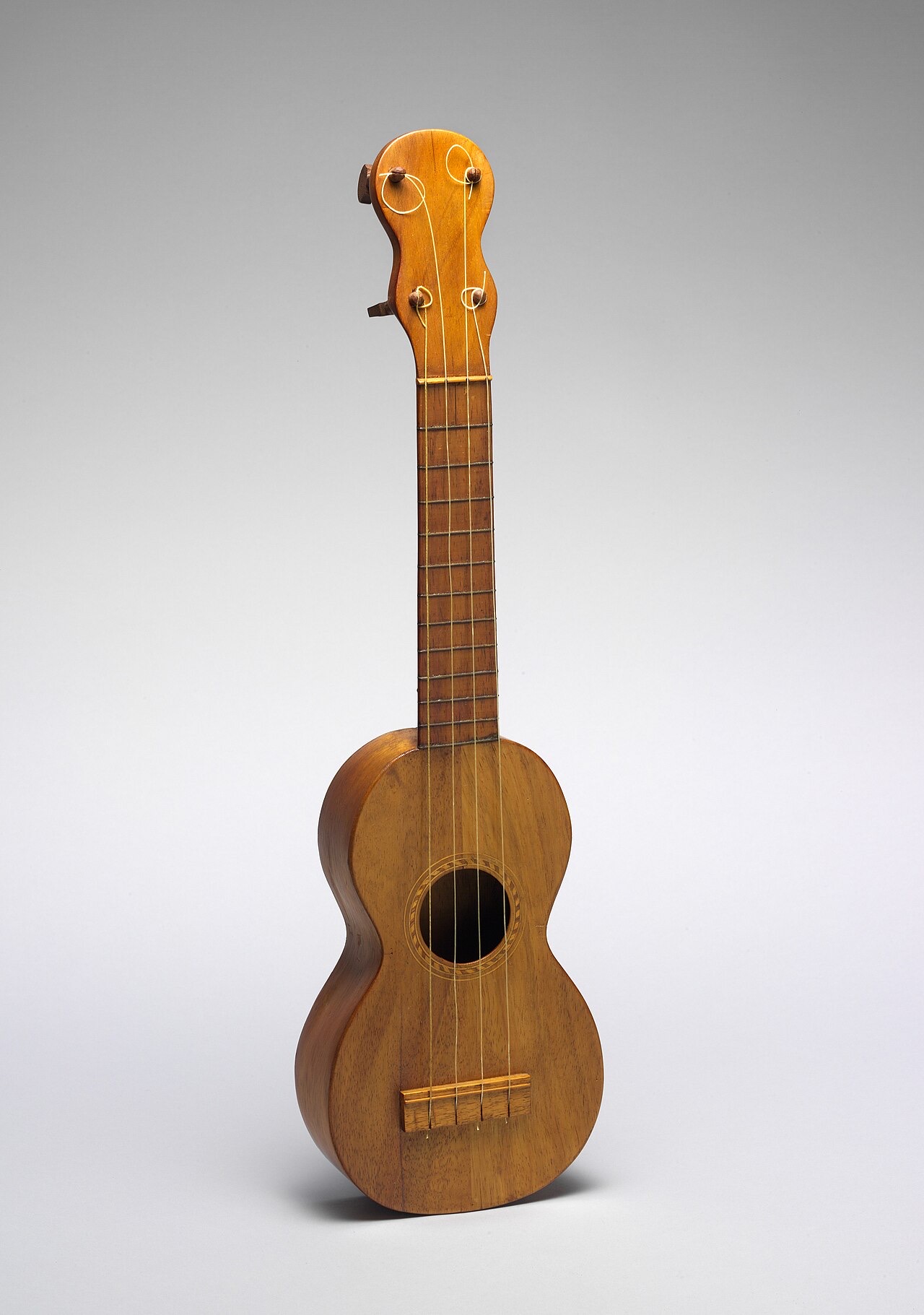
Visual AidThe instrument in the lunchroom
Photograph of a wooden ukulele made in Hawaii around 1880, in the first years after Hawaiian makers reshaped a small Portuguese guitar into a new instrument; it is now in the Metropolitan Museum of Art in New York. This is the kind of instrument — the kind, not hers — that the Knowledge Bank on indirect characterization watches Stargirl strum in the cafeteria: small, light, and impossible to play unnoticed. Notice how modest the object itself is; everything bold about it is in the choosing to play one where nobody else would.
Ukulele, Hawaii, c. 1880; Metropolitan Museum of Art, New York. Source: Wikimedia Commons, File:Ukulele MET DP218831.jpg, CC0.
First-person narrator
Leo tells the story with ‘I,’ so we watch Stargirl through his fascinated, uncertain eyes.
Setting
Mica — a conformist desert town and school — is the gray sameness against which Stargirl stands out.
Indirect characterization
Stargirl is revealed by what she does — ukulele, songs, pet rat — not by the narrator explaining her.
🧠Knowledge Bank question
1According to the Knowledge Bank, Jerry Spinelli (author) introduces Stargirl through indirect characterization, which means ___.Ch.1
2Fill in each blank with the correct literary term.Ch.1
Word choices:first-person narratorsettingrhymeindex- some words will not be used
Because Leo narrates with ‘I,’ he is the .
Conformist Mica is the story’s .
3A first-person narrator tells the story using the word ‘I.’Ch.1
4The gray, conformist town of Mica works mainly as the story’s ___.Ch.1
5Spinelli reveals Stargirl through her ukulele and songs rather than by explaining her, which is ___.Ch.3
6Indirect characterization shows a character through actions instead of direct statements.Ch.3
7Setting Stargirl against Mica’s sameness makes her difference feel ___.Ch.1
8Fill in each blank with the correct literary term.Ch.3
Word choices:indirect characterizationsettingnarratormotif- some words will not be used
Showing Stargirl through her actions is .
The conformist town is the story’s .
9Because Leo narrates, we can hear the private thoughts of every other student.Ch.1
10The strongest early clue to Stargirl’s character is ___.Ch.3
Part 4
Think Deeper
Four deeper challenges — no single-word recall. Read, weigh the evidence, and reason it out.
🧠Knowledge Bank · The Pull of the Crowd
Conformity · The Pull of the Crowd
Mica High is built on a single, unspoken rule: be like everyone else. To understand Stargirl, it helps to understand conformity — the powerful human tendency to match our behavior, dress, and even opinions to the group around us. Psychologists have shown that this pull is far stronger than most people believe. In a place like Mica, conformity feels safe: if you look and act like everyone else, you cannot be singled out, judged, or laughed at. But safety has a price. Psychologists distinguish two reasons for going along. The first is informational — you assume the group must know something you do not. The second is normative: you know perfectly well the group is wrong, and you go along anyway, because standing alone is unbearable. Mica High runs almost entirely on the second, which is why nobody there can actually explain what is wrong with Stargirl.
Picture a lunchroom full of students who have quietly agreed, without ever saying so, to wear the same clothes, laugh at the same jokes, and never, ever draw a second glance. Into that careful sameness walks a girl in a pioneer dress with a rat on her shoulder and a ukulele in her hands, and she begins to sing — not to be noticed, but because it is someone’s birthday and singing seems like the natural thing to do. Forks stop halfway to mouths. Whispers race table to table. Is she a joke, a plant, a performer, a spy for the show, or simply a person who has never learned to be afraid of being herself? Leo watches, as puzzled as everyone else, and cannot look away — and neither, it turns out, can the reader.
Original passage written for Garden Heights — not a quotation from the novel.
1Claim: “Part 1 shows that Mica High values sameness and fears anyone who stands out.” — choose the two details that best prove it.Claim & Evidence
2A sign Stargirl is different, or A sign Mica prizes sameness? Tap each detail to sort it — tap again to switch sides. You can keep tapping to change your answer.Sort into two
◄ A sign Stargirl is differentA sign Mica prizes sameness ►
3Match each cause to its result. For each cause, pick its result.Cause & Effect
Stargirl sings in the cafeteria→
She keeps a pet rat and wears odd clothes→
Mica prizes looking unremarkable→
Leo once got an anonymous gift→
🧠Knowledge Bank question
4Fill both blanks to complete the reasoning.Build the Argument
The Knowledge Bank argues that Mica High runs on normative conformity because , which shows that .
Part 5
Standardized Test
Reading passage · First Impressions and Standing Out · SAT & TOEFL-style practice
Read the passage — the highlighted words are tested — then answer. Tap an answer, then tap it again to confirm.
SATCentral Ideas — the passage's main point
SATDetail — a fact stated in the passage
SATWords in Context — a word's meaning in this passage
SATText Connections — how two parts of the text relate
TOEFLFactual Information — a fact stated in the passage
TOEFLVocabulary — a tested word's meaning here
The Speed of a First Impression
When Stargirl walks into the Mica High cafeteria, every student forms an opinion of her within seconds. This is not unusual; it is how human minds work. Researchers have found that people form a first impression of a stranger astonishingly fast — often within a fraction of a second of seeing a face — and that these snap judgments, made on almost no real information, can be stubborn. We decide, in a blink, whether someone seems friendly or threatening, one of us or one of them, and then we look for evidence that we were right.
First impressions rest heavily on whatever stands out. An unremarkable person — one who looks and behaves like everyone else — barely registers; the mind files them as ordinary and moves on. But a person who breaks the pattern — a girl in a pioneer dress with a ukulele and a pet rat — sets off a small alarm of attention. Standing out draws the eye, but it also draws suspicion, because a crowd is quietly reassured by sameness, and difference can quietly unnerve it. This is why the very qualities that make someone interesting can also make a group wary.
The trouble with first impressions is that they are fast, not fair. A snap judgment can capture something true, but it can just as easily be badly wrong, because it is built on surfaces — clothes, gestures, a single strange act — rather than on who a person really is. Psychologists warn that our earliest impressions can distort everything we notice afterward, nudging us to explain away anything that does not fit. That is exactly the trap Mica High falls into with Stargirl. The students decide what she is in the first minute, then spend weeks trying to confirm it — never pausing to wonder whether their verdict was right.
Original passage written for Garden Heights — not a quotation from the novel.
1What is the main idea of the passage?SAT · Central Ideas
2How quickly do people often form a first impression of a stranger?TOEFL · Factual Information
3Snap judgments are made on ___.SAT · Detail
4A person who looks like everyone else tends to ___.TOEFL · Factual Information
5According to the passage, a crowd is quietly reassured by ___.SAT · Detail
6The passage says standing out draws the eye but also draws ___.TOEFL · Factual Information
7The main trouble with first impressions is that they are ___.SAT · Central Ideas
8In the passage, unremarkable most nearly means ___.SAT · Words in Context
9In the passage, unnerve most nearly means ___.TOEFL · Vocabulary
10Which behavior from Part 1 does this passage BEST help explain?SAT · Text Connections
Part 6 · Optional
Creative Writing
A bonus challenge to practice your English. Take your time and have fun with it.
About This Section
This writing task is optional and is not part of your auto-graded score. The feedback below checks only the basics — length, spelling, and grammar — not whether your ideas are right or wrong. It is meant for classroom discussion and creative practice, so feel free to use your imagination!
Writing Task — Part 1 “The New Kid”
Stargirl arrives and everyone judges her at a glance. Write about a time you were the new person somewhere — or a time you watched someone new arrive. What first impression did people form, and was it fair? 6–10 sentences. End with what you wish others had taken time to see.
You can start with: “Everyone made up their minds about me before I said a word...”
0 / 40 words minimum
🗣 Teach It · Just for Fun (optional)
No right or wrong — close the screen and tell someone nearby what happened in this part. Can’t find anyone? Tell yourself out loud. The moment you teach it, you truly understand it.
Part 1 Complete!
You finished Chapters 1–4 of Stargirl.
Here are your auto-graded results:
-
points out of 100
Teach it to someone
The best last step is to teach it. In your own words, explain what happened — retell a favorite scene, teach a character’s big choice, or sum up the main idea for a parent, friend, or classmate. When you can teach it clearly, you truly own it.
Independent study guide by Garden Heights. Not affiliated with or endorsed by Jerry Spinelli. Contains original analysis only; no text from the novel is reproduced. Reference text: This workbook follows Jerry Spinelli’s classic text (the standard Puffin edition sold worldwide). Revised 2023 UK editions change some wording and may not match the vocabulary studied here.
SAT® is a registered trademark of College Board, which is not affiliated with, and does not endorse, these materials. TOEFL® is a registered trademark of ETS. These materials are not endorsed or approved by ETS. Garden Heights is an independent provider of test-style reading practice.