New here? Just sign up with Google — your account includes Matilda, our gift book, forever.
Stargirl · Garden Heights
Part 4
for Stargirl · Part 4 · Chapters 14–17
8 Parts40 min
What Happens in Part 4
Leo falls in love, and through wise old Archie he discovers Stargirl's secret life as an anonymous giver.
Archie's houseLeo falls in love; he can no longer pretend he is only curious about Stargirl, and wants to be part of her strange, luminous world. His guide is Archie — Mr. Archibald Brubaker, a warm, wise retired paleontologist who lets neighborhood kids gather in his cluttered house, teaches by telling stories, keeps a fossil rat skull called Barney, and asks a saguaro cactus named Señor Saguaro for advice.
The secret giverFrom Archie, Leo begins to grasp who Stargirl really is, and he discovers her astonishing secret: she is a giver. Anonymously and tirelessly she watches over the people of Mica — sending cards to strangers who are sick or sad, leaving small gifts on doorsteps, dropping coins for others to find, tracking the town's joys and sorrows in a private scrapbook, and quietly showing up. She has done this her whole life, wanting nothing back, unseen.
The enchanted placeThen Stargirl takes Leo to her enchanted place, a hidden clearing out in the desert where she goes to be alone and still, and shows him her happy wagon, a little box of stones she shifts to weigh her moods. Out there, away from the crowd, Leo begins to understand that her strangeness is really a deep and radical kindness — a way of loving the world.
Archie as the wise mentor, the happy wagon as symbol, and the enchanted place as setting
Cross-Curricular
The Sonoran Desert and the saguaro cactus — life and solitude in the drylands
Chapter Summary
Ch.
What happens
Chapters 14–15
Archie’s Wisdom — Leo falls in love and learns from Archie, a retired paleontologist; he discovers Stargirl’s secret life of anonymous cards, gifts, and quiet kindness.
Chapters 16–17
The Enchanted Place — Stargirl takes Leo to a hidden desert clearing and shows him her ‘happy wagon’ of stones; Leo sees her strangeness as deep kindness.
Part 1
Vocabulary
Study 10 key words from Chapters 14–17, then answer each question.
🧠Knowledge Bank · Words of Kindness and the Desert
Lexical Semantics · Words of Kindness and the Desert
Two of these words describe a person and two describe a way of giving. A paleontologist is a scientist who studies ancient fossils, which is what Archie was before he retired to a porch full of bones. A mentor is a wise, trusted teacher or guide, which is what he is now, without ever once calling himself one. Anonymous means done or given without a known name — the condition Stargirl attaches to almost everything she does, from the doorstep gifts to the cards. Benevolent means kind and wishing to do good, and it is the word that separates her from everyone else in the book, because her kindness asks for nothing back. Notice what the pair of pairs implies. The one adult who teaches Leo anything does it by never announcing that he is teaching, and the girl gives by not signing.
paleontologistn.Ch.14
A scientist who studies ancient fossils
“Archie, a retired paleontologist, loved old bones.”
mentorn.Ch.14
A wise, trusted teacher or guide
“Archie became a mentor to the neighborhood kids.”
anonymousadj.Ch.15
Done or given without a known name
“Stargirl left anonymous gifts on doorsteps.”
benevolentadj.Ch.15
Kind and wishing to do good
“Her benevolent deeds asked for nothing back.”
fossiln.Ch.14
The preserved remains of ancient life
“Archie kept a fossil rat skull named Barney.”
solituden.Ch.16
The state of being peacefully alone
“The desert offered Stargirl deep solitude.”
empathyn.Ch.16
The ability to share another’s feelings
“Her empathy let her feel a stranger’s sorrow.”
enchantv.Ch.17
To fill with wonder and delight
“The hidden clearing seemed to enchant Leo.”
devotionn.Ch.17
Deep, loyal love and care
“She watched over the town with quiet devotion.”
wondrousadj.Ch.17
Remarkable; full of wonder
“Her secret kindness was a wondrous thing to Leo.”
ⓘ The vocabulary words in this list are selected to help you understand and complete this workbook. Some may not appear verbatim in the original novel.
🧠Knowledge Bank question
1The Knowledge Bank explains that paleontologist and mentor differ from anonymous and benevolent because they ___.Ch.14
2An ‘anonymous’ gift is given with the giver’s name proudly attached.Ch.15
3Someone ‘benevolent’ is ___.Ch.15
4‘Empathy’ is the ability to share another person’s feelings.Ch.16
5Fill in each blank with the correct word.Ch.16
Word choices:solitudeempathybenevolentcafeteria- some words will not be used
The desert offered Stargirl deep .
Her let her feel a stranger’s pain.
6‘Solitude’ means the state of being ___.Ch.16
7A ‘mentor’ is a wise, trusted teacher or guide.Ch.14
8To ‘enchant’ someone is to fill them with ___.Ch.17
9Fill in each blank with the correct word.Ch.14
Word choices:fossildevotionanonymouswondrous- some words will not be used
Archie kept a rat skull named Barney.
She watched over the town with quiet .
10Something ‘wondrous’ is ___.Ch.17
Part 2
Comprehension
Show you understood what happens in Chapters 14–17.
🧠Knowledge Bank · The Giver in the Desert
Narrative Causality · The Giver in the Desert
The Giver in the Desert is organized around a difficult decision, the risk it creates, and the eventual result. Leo falls in love. He can no longer pretend he is only curious about Stargirl; he wants to be near her, to understand her, to be part of her strange, luminous world. His guide into that world is Archie — Mr. Archibald Brubaker, a warm, wise retired paleontologist who lets the neighborhood kids gather in his cluttered house, teaches them by telling stories, keeps a fossil rat skull he calls Barney, and asks a saguaro cactus named Señor Saguaro for advice. From Archie, Leo begins to grasp who Stargirl really is, and he discovers her astonishing secret life: she is a giver. Anonymously, tirelessly, she watches over the people of Mica — sending cards to strangers who are sick or sad, leaving small gifts on doorsteps, dropping coins for others to find, following the town’s joys and sorrows in a private scrapbook and quietly showing up for them. Once decision and result are joined, “The Giver in the Desert” supplies narrative momentum.
Visual AidA kindness machine with no name on it
Sequence diagram of the secret routine the Knowledge Bank on the giver in the desert uncovers: Stargirl reads the town’s news, tracks it in a private scrapbook, chooses a card or gift or coin, and delivers it unsigned. Each step exists so the next can happen, and the drawing’s real subject is the last one, where the maker’s name is removed and thanks becomes impossible. What no diagram can show is the scale — the novel implies years of this, one porcupine necktie included.
Steps as described in the Knowledge Bank, from Stargirl, Chapters 14–17. Drawn for Garden Heights Academy.
🧠Knowledge Bank question
1According to the Knowledge Bank, Leo discovers Stargirl's astonishing secret: she ___.Ch.14
2Who is Archie?Ch.14
3Archie keeps a fossil rat skull that he calls Barney.Ch.14
4Leo discovers that Stargirl secretly ___.Ch.15
5Write the numbers 1–5 in the boxes to show the correct order of events. Number 1 = what happens first.Chapters 14–17
He discovers her secret life of anonymous kindness.
She shows him her happy wagon of stones.
He learns about her from wise old Archie.
Stargirl takes Leo to her hidden enchanted place.
Leo admits to himself that he loves Stargirl.
6Stargirl performs her kind deeds loudly, so everyone will praise her.Ch.15
7Where does Stargirl take Leo to be alone and still?Ch.16
8The ‘happy wagon’ is a little box of ___ that Stargirl shifts to mark her moods.Ch.16
9Out in the desert, Leo begins to see Stargirl’s strangeness as a kind of deep kindness.Ch.17
10Archie mainly helps Leo by ___.Ch.15
Part 3
Literary Elements
Understanding HOW and WHY Jerry Spinelli (author) tells the story across Chapters 14–17.
🧠Knowledge Bank · Archie, the Wise Mentor
Narrative Technique · Archie, the Wise Mentor
Jerry Spinelli makes the midpoint turn through archetype, symbol, and setting rather than through explanation alone. Archie fills one of the oldest and most important roles in storytelling: the mentor — the wise, older guide who helps the young hero understand the world. Think of the gray-bearded teachers in countless tales; Archie is that figure in a rumpled cardigan, a retired scientist who has traded fossils for the harder study of people. He does not lecture Leo so much as tell stories, ask questions, and let understanding arrive on its own. It is Archie who helps Leo see what Stargirl truly is, and Archie who quietly defends her way of living when the town cannot understand it. Watch how Spinelli uses him: a mentor gives the hero not answers but eyes. That authorial design makes “Archie, the Wise Mentor” a lesson in deliberate symbolism.
Mentor archetype
Archie — the wise, older guide who gives Leo the eyes to see Stargirl clearly.
Symbol
The happy wagon — stones Stargirl shifts to track her moods — stands for a life measured against her own heart.
Setting
The enchanted place in the desert — a space of solitude and truth, the opposite of the crowded town.
🧠Knowledge Bank question
1The Knowledge Bank explains that, as a mentor, Archie gives Leo ___.Ch.14
2Fill in each blank with the correct literary term.Ch.16
Word choices:settingsymbolrhymefootnote- some words will not be used
The enchanted desert clearing is the story’s .
The happy wagon of stones is a .
3A mentor is a wise, older character who guides the young hero.Ch.14
4The happy wagon mainly stands for a life measured against ___.Ch.16
5The hidden desert clearing where Stargirl goes to be still is an important ___.Ch.16
6Setting includes the places where a story happens, like the desert clearing.Ch.16
7A mentor, Spinelli shows, gives the hero not answers but ___.Ch.15
8Fill in each blank with the correct literary term.Ch.14
Word choices:mentorsymbolclimaxrhyme- some words will not be used
Archie is the wise who guides Leo.
Stargirl’s happy wagon is a .
9The desert setting is meant to feel just like the crowded, conformist town.Ch.16
10The clearest symbol of Stargirl’s inner life is the ___.Ch.16
Part 4
Think Deeper
Four deeper challenges — no single-word recall. Read, weigh the evidence, and reason it out.
🧠Knowledge Bank · The Sonoran Desert and the Saguaro
The Desert as a Place of Truth · The Sonoran Desert and the Saguaro
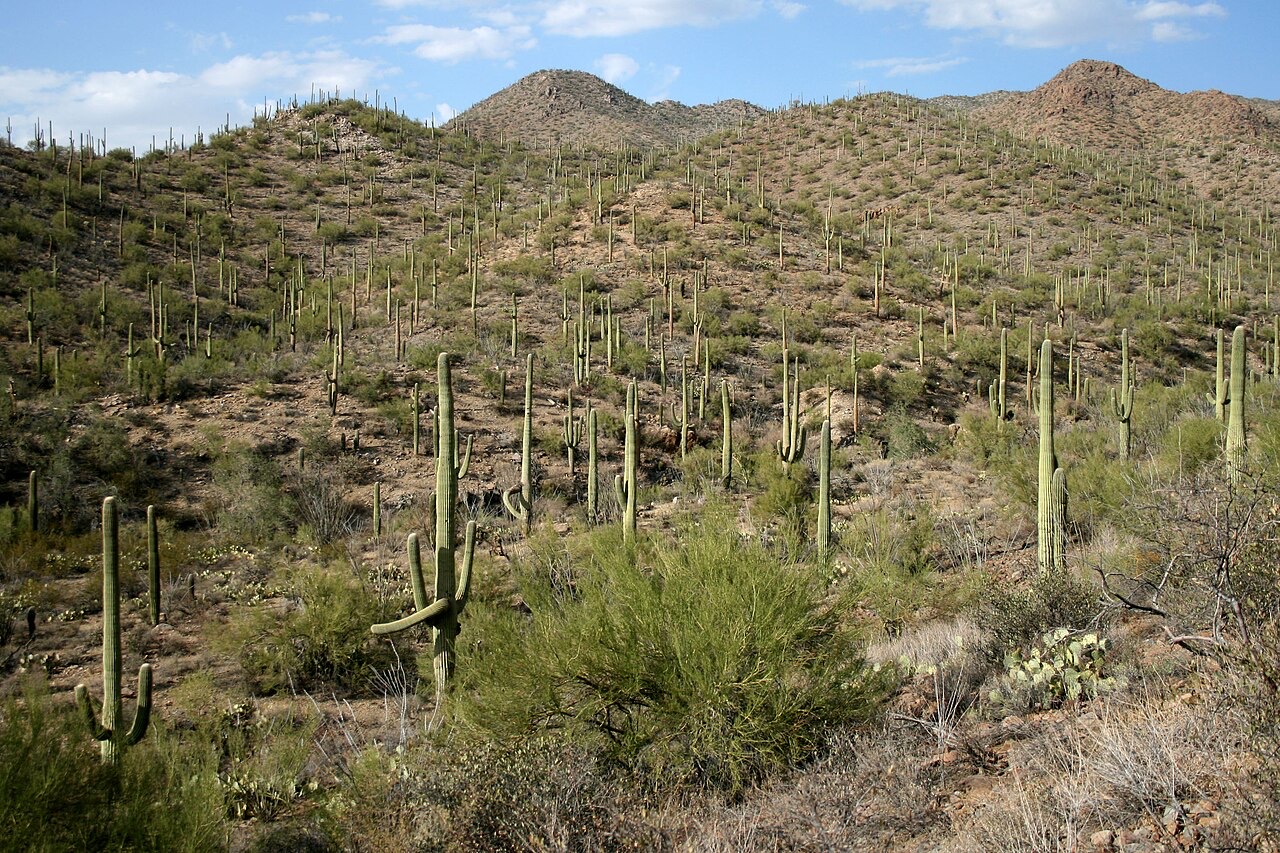
Stargirl’s ‘enchanted place’ lies out in the Sonoran Desert, and to understand her, it helps to understand that desert. The Sonoran, which spreads across Arizona and northwestern Mexico, is one of the hottest deserts in North America — and, surprisingly, one of the most alive. Far from being empty, it teems with hardy, patient creatures and plants that have learned to survive on very little. Its most famous resident is the giant saguaro cactus, the tall, many-armed silhouette that means ‘the American West.’ A saguaro grows almost unbelievably slowly — it may take fifty years to sprout its first arm and can live for a century and a half or more — and it survives by storing water deep in its pleated trunk, swelling after rain and shrinking through the long dry months. Spinelli chose that setting deliberately. A saguaro survives by being slow, by needing almost nothing, and by standing completely alone — a fair description of the girl who goes out there to sit, and an unfair one for a fifteen-year-old who would rather have a friend.
Visual AidThe giant the Knowledge Bank describes
Photograph of a saguaro forest on National Park Service land in the Sonoran Desert of Arizona, taken in 2011 — the landscape the Knowledge Bank on the desert as a place of truth describes: one of the hottest deserts in North America, and anything but empty. Every many-armed giant on this hillside grew at the pace the Knowledge Bank gives, decades before the first arm, a century and a half of life. The picture shows real country, not the enchanted place; Stargirl’s spot exists only in the novel, somewhere in land like this.
Saguaro cactus forest; National Park Service photograph by Todd M. Edgar, 2011. Source: Wikimedia Commons, File:Saguaro cactus forest.jpg, public domain.
Imagine a cluttered house where a gentle old man keeps fossils and stories, and where a boy in love comes to learn what he cannot figure out on his own. The old man does not explain the girl; he tells tales, asks questions, and lets the boy’s eyes open by themselves. And slowly Leo sees it: the strange girl he has been watching is not performing at all. She has been, in secret, watching over the whole town — a card to a lonely stranger, a gift on a doorstep, a coin left to be found — asking for nothing, signing nothing. Then she leads him out past the last houses into the desert, to a still clearing that feels enchanted, and shows him a little box of stones she uses to keep track of her own happiness. Out there, in the silence, Leo finally understands: her strangeness was kindness all along.
Original passage written for Garden Heights — not a quotation from the novel.
1Claim: “Part 4 reveals that Stargirl’s strangeness is really a life of hidden, selfless kindness.” — choose the two details that best prove it.Claim & Evidence
2Belongs to the noisy town, or Belongs to Stargirl’s quiet world? Tap each detail to sort it — tap again to switch sides. You can keep tapping to change your answer.Sort into two
◄ Belongs to the noisy townBelongs to Stargirl’s quiet world ►
3Match each cause to its result. For each cause, pick its result.Cause & Effect
Leo cannot understand Stargirl alone→
Stargirl sends cards and leaves gifts→
She leads Leo into the desert→
She shows him the happy wagon→
🧠Knowledge Bank question
4Fill both blanks to complete the reasoning.Build the Argument
The saguaro is a fitting symbol for Stargirl because , though the Knowledge Bank calls the match unfair because .
Part 5
Standardized Test
Reading passage · The Sonoran Desert and the Saguaro · SAT & TOEFL-style practice
Read the passage — the highlighted words are tested — then answer. Tap an answer, then tap it again to confirm.
SATCentral Ideas — the passage's main point
SATDetail — a fact stated in the passage
SATWords in Context — a word's meaning in this passage
SATText Connections — how two parts of the text relate
TOEFLFactual Information — a fact stated in the passage
TOEFLInsert Text — where a sentence best fits
The Patient Growth of a Saguaro
Stargirl’s enchanted place lies in the Sonoran Desert, which stretches across southern Arizona into northwestern Mexico. To a stranger it looks like wasteland, but the Sonoran is one of the wettest deserts in the world, watered by two rainy seasons, and it shelters a wondrous variety of life, a living marvel to anyone who looks closely. Coyotes, javelinas, roadrunners, tortoises, owls, and insects make their home here, along with hundreds of plants. The secret is not that they escape the harsh dryness, but that they have learned to live within it — to wait, to store, and to ask for very little.
No plant does this better than the giant saguaro, whose branching silhouette is the picture of the American desert. A saguaro grows with almost unbelievable patience. Tiny and easily overlooked at first, it may not grow an arm until it is fifty or sixty years old. A full-grown saguaro can stand forty feet (12.2 m) high and live for a hundred and fifty years or more. Its trick is water storage: the thick, pleated trunk swells like an accordion to hold rain, then shrinks through the dry months; in return it offers desert creatures flowers, fruit, and nesting holes.
This place speaks to someone like Stargirl: the desert is quiet and vast, and it does not care who is popular. Out among the saguaros a person is stripped of the crowd, the gossip, and the endless watching, and is left alone with her own thoughts. For centuries, people have gone into deserts with a quiet devotion, returning faithfully to that stillness to think clearly, away from the noise of ordinary life. When Stargirl slips away, she is doing what desert-goers have always done: trading the roar of the crowd for the honest solitude of open land.
Original passage written for Garden Heights — not a quotation from the novel.
1What is the main idea of the passage?SAT · Central Ideas
2The Sonoran Desert is described as one of the world’s ___ deserts.TOEFL · Factual Information
3How do desert creatures survive the harsh dryness?SAT · Detail
4The giant saguaro is famous for its ___.TOEFL · Factual Information
5Insert Text (TOEFL). Look at the four squares [1]–[4] in the excerpt below. They show where this sentence could be added: “This slow start is only the beginning of the saguaro’s long life.”
A saguaro grows with almost unbelievable patience. [1] In its first years it is tiny and easily overlooked. [2] A full-grown saguaro can live for a hundred and fifty years or more. [3] Its thick, pleated trunk swells to hold rain when it comes. [4]
Where would the sentence fit best?TOEFL · Insert Text
6A saguaro stores water in its ___.SAT · Detail
7The saguaro helps desert creatures by offering ___.TOEFL · Factual Information
8In the passage, wondrous most nearly means ___.SAT · Words in Context
9In the passage, devotion most nearly means ___.SAT · Words in Context
10How does this passage best help explain Part 4?SAT · Text Connections
Part 6 · Optional
Creative Writing
A bonus challenge to practice your English. Take your time and have fun with it.
About This Section
This writing task is optional and is not part of your auto-graded score. The feedback below checks only the basics — length, spelling, and grammar — not whether your ideas are right or wrong. It is meant for classroom discussion and creative practice, so feel free to use your imagination!
Writing Task — Part 4 “A Place of My Own”
Stargirl escapes the crowd to a still, enchanted place in the desert. Write about a place where you go to think, be calm, or feel like yourself. Where is it, what is it like, and why does it matter to you? 6–10 sentences. End with how you feel when you leave it and return to everyday life.
You can start with: “When everything gets too loud, there is one place I go...”
0 / 40 words minimum
🗣 Teach It · Just for Fun (optional)
No right or wrong — close the screen and tell someone nearby what happened in this part. Can’t find anyone? Tell yourself out loud. The moment you teach it, you truly understand it.
Part 4 Complete!
You finished Chapters 14–17 of Stargirl.
Here are your auto-graded results:
-
points out of 100
Teach it to someone
The best last step is to teach it. In your own words, explain what happened — retell a favorite scene, teach a character’s big choice, or sum up the main idea for a parent, friend, or classmate. When you can teach it clearly, you truly own it.
Independent study guide by Garden Heights. Not affiliated with or endorsed by Jerry Spinelli. Contains original analysis only; no text from the novel is reproduced. Reference text: This workbook follows Jerry Spinelli’s classic text (the standard Puffin edition sold worldwide). Revised 2023 UK editions change some wording and may not match the vocabulary studied here.
SAT® is a registered trademark of College Board, which is not affiliated with, and does not endorse, these materials. TOEFL® is a registered trademark of ETS. These materials are not endorsed or approved by ETS. Garden Heights is an independent provider of test-style reading practice.