New here? Just sign up with Google — your account includes Matilda, our gift book, forever.
Stargirl · Garden Heights
Part 6
for Stargirl · Part 6 · Chapters 23–26
8 Parts40 min
What Happens in Part 6
Torn between Stargirl and the crowd, Leo tells her to change — and she becomes ordinary 'Susan,' whom the school ignores anyway.
Two livesLeo is living two lives, and they are tearing him apart. Weekend hours in the desert with Stargirl are the happiest he has ever known; every Monday he walks back into a school that has turned its back on them both. The shunning bites him less than it bites her, but it bites, and Leo discovers something unwelcome about himself: he needs other people to notice him to feel that he exists.
The rat brushed offStargirl, barely registering the cold, keeps loving him in public. Then someone posts a bright red heart on the school bulletin board announcing that she loves him, dragging Leo into the spotlight he has been dreading. When she playfully sets Cinnamon on his shoulder in the hallway, he brushes the rat off and walks away, leaving her stunned; by the end of the day only Kevin will still speak to him.
You have to changeStargirl finally corners Leo and asks what is wrong, and he says the thing he cannot take back: she has to change. He tries to teach her the rules — cheer for one side, do not embarrass people, care what the crowd thinks — and she cannot understand why any of it should matter.
Becoming SusanDays later she reappears in jeans, sandals, makeup, and hoop earrings and tells Leo her name is Susan. She studies ordinariness as if for a test, invents an imaginary ordinary girl to copy, laughs less, and waits to be accepted; the school ignores her anyway. Leo watches her cry for the first time, sees her happy wagon down to two stones, then hears her announce a desert vision showed her winning the state oratorical contest — everything will be fine.
Situational irony, Stargirl as a dynamic character, and the motif of names
Cross-Curricular
Masking — the psychology of hiding who you are to be accepted
Chapter Summary
Ch.
What happens
Chapters 23–24
Caught Between Two Worlds — Leo loves his desert weekends but dreads Monday; a red heart on the bulletin board exposes him, and he brushes Cinnamon off his shoulder and walks away.
Chapters 25–26
Becoming Susan — Stargirl confronts Leo and he tells her to change; she returns as ‘Susan’ in ordinary clothes, is ignored anyway, and pins her hopes on the state oratorical contest.
Part 1
Vocabulary
Study 10 key words from Chapters 23–26, then answer each question.
🧠Knowledge Bank · Words of Pressure and Disguise
Lexical Semantics · Words of Pressure and Disguise
Every word here is about being seen. Loyalty is faithful support given to a person or group, and Leo is torn between two kinds of it that cannot both be satisfied. Sabotage is deliberate damage done to spoil something — which is genuinely how the fans read Stargirl’s kindness to an injured opponent. Conspicuous means easily noticed, standing out sharply, and it is the exact condition Leo cannot survive: the red heart on his chest makes him visible, and visible is the one thing he will not be. To recoil is to draw back suddenly in shock or dislike, which is what he does at the rat on her shoulder. Notice that three of these four describe Leo, not Stargirl. Part 6 is not really the story of a girl changing; it is the story of the boy who asked her to, and the words above are all his — his loyalty, his fear of being conspicuous, his recoil.
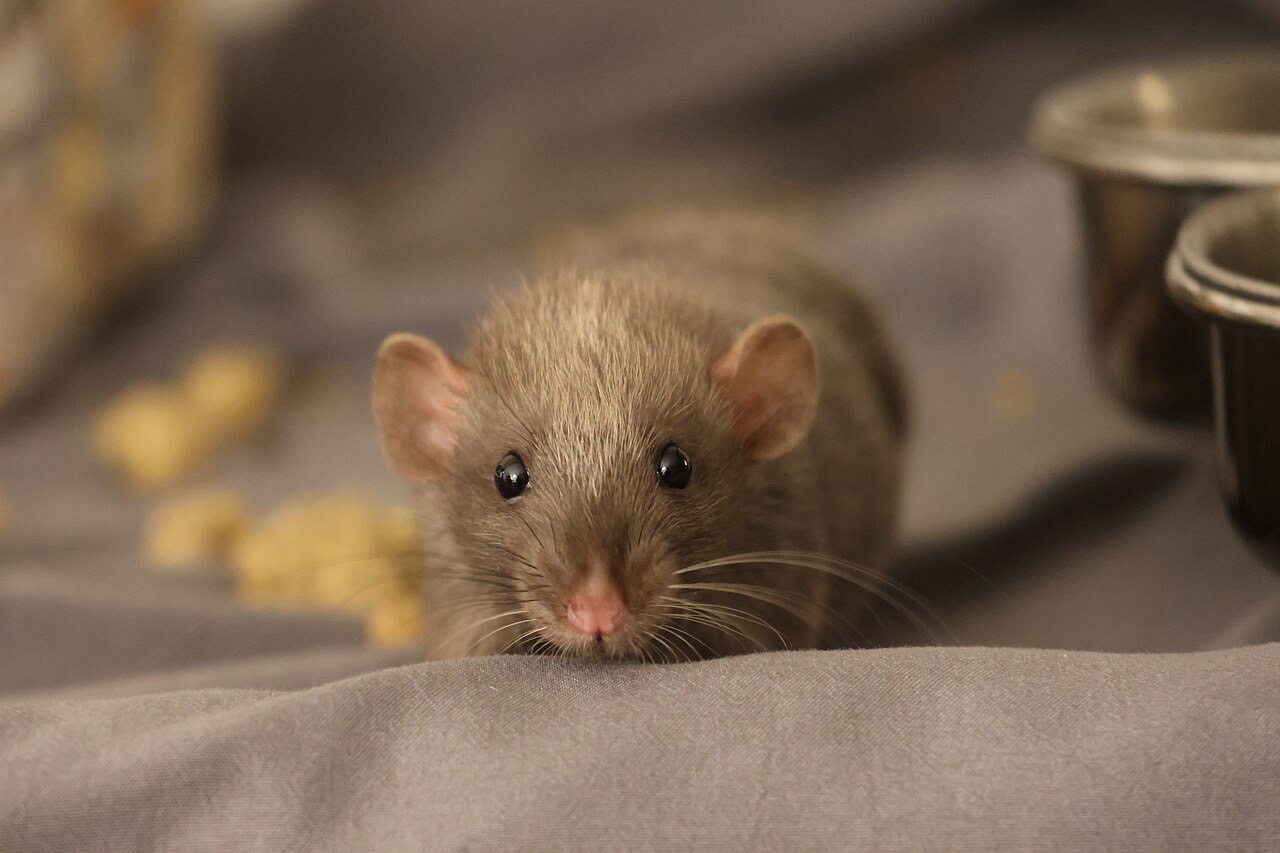
Visual AidThe animal Leo cannot be seen with
Photograph of a seven-week-old pet rat, taken in 2023, its food bowls just behind it — a tame domestic rat of the very kind Stargirl carries on her shoulder. The Knowledge Bank’s word list turns on recoil, and this is the whole of what the flinch is about: an animal the length of a hand, bred gentle for generations, somebody’s cared-for pet. The rat is not Cinnamon, who is invented, and the picture argues nothing about rats; it only shows how small a thing Leo cannot afford to be conspicuous with.
Young pet rat, seven weeks old; photograph by Cat Ball, 2023. Source: Wikimedia Commons, File:Shy baby rat looking curious.jpg, CC0.
loyaltyn.Ch.23
Faithful support given to a person or group
“Leo was pulled apart by two kinds of loyalty.”
sabotagen.Ch.23
Deliberate damage done to spoil something
“The fans treated her kindness as sabotage.”
conspicuousadj.Ch.24
Easily noticed; standing out sharply
“The red heart made Leo painfully conspicuous.”
recoilv.Ch.24
To draw back suddenly in shock or dislike
“He recoiled from the rat on his shoulder.”
isolatev.Ch.24
To cut someone off from others
“The shunning began to isolate Leo as well.”
confrontv.Ch.25
To face someone directly about a problem
“Stargirl confronted him outside the studio.”
justifyv.Ch.25
To show that something is fair or reasonable
“Leo could not justify the rules he was teaching.”
conventionaladj.Ch.26
Ordinary; following the usual customs
“She arrived in conventional jeans and sandals.”
transformv.Ch.26
To change completely in form or nature
“One weekend seemed to transform her entirely.”
oratoricaladj.Ch.26
Having to do with public speech-making
“She set her hopes on the state oratorical contest.”
ⓘ The vocabulary words in this list are selected to help you understand and complete this workbook. Some may not appear verbatim in the original novel.
🧠Knowledge Bank question
1The Knowledge Bank explains that words such as loyalty, conspicuous, and recoil reveal what about Part 6?Ch.23
2Someone who is ‘conspicuous’ blends quietly into the background.Ch.24
3To ‘recoil’ is to ___ suddenly.Ch.24
4To ‘confront’ someone is to face them directly about a problem.Ch.25
5Fill in each blank with the correct word.Ch.24
Word choices:isolateconspicuousrecoilukulele- some words will not be used
The bright red heart made Leo .
The cold shoulder began to him too.
6To ‘justify’ a rule is to show that it is ___.Ch.25
7‘Sabotage’ is deliberate damage done to spoil something.Ch.23
8Something ‘conventional’ follows the ___ customs.Ch.26
9Fill in each blank with the correct word.Ch.26
Word choices:transformoratoricaljustifyloyalty- some words will not be used
One weekend seemed to her completely.
She pinned her hopes on the state contest.
10Something ‘oratorical’ has to do with ___.Ch.26
Part 2
Comprehension
Show you understood what happens in Chapters 23–26.
🧠Knowledge Bank · The Girl Who Tried to Disappear
Narrative Causality · The Girl Who Tried to Disappear
Careful sequence reading reveals the textual evidence, the structural pivot, and the resulting consequence in Chapters 23–26. Leo is living two lives, and they are tearing him apart. Weekends in the desert with Stargirl are the happiest hours he has ever known; every Monday he walks back into a school that has turned its back on both of them. The shunning bites him less than it bites her, but it bites, and Leo discovers something unwelcome about himself: he needs other people to notice him in order to feel that he exists at all. Stargirl, who barely registers the cold, keeps loving him in public. Then someone posts a bright red heart on the school bulletin board announcing that she loves him, and Leo is dragged into the spotlight he has been dreading. Reading evidence around the pivot turns “The Girl Who Tried to Disappear” into meaningful convergence.
🧠Knowledge Bank question
1According to the Knowledge Bank, what unwelcome discovery does Leo make about himself during the shunning?Ch.23
2What uncomfortable truth does Leo learn about himself?Ch.23
3A bright red heart on the school bulletin board announces that Stargirl loves Leo.Ch.24
4What does Leo do when Stargirl playfully puts Cinnamon on his shoulder?Ch.24
5Write the numbers 1–5 in the boxes to show the correct order of events. Number 1 = what happens first.Chapters 23–26
She returns as ‘Susan’ in ordinary clothes and makeup.
He brushes Cinnamon off his shoulder and walks away.
Leo grows torn between happy weekends and cold Mondays.
Stargirl corners him and he tells her she must change.
A red heart on the bulletin board exposes his romance.
6Stargirl immediately understands why the crowd’s opinion should matter to her.Ch.25
7What does Stargirl insist her name is after the change?Ch.26
8How does Mica High respond to Susan’s ordinary new look?Ch.26
9Leo sees Stargirl cry for the first time, and her happy wagon holds only two stones.Ch.26
10What vision does Susan describe at the end of Part 6?Ch.26
Part 3
Literary Elements
Understanding HOW and WHY Jerry Spinelli (author) tells the story across Chapters 23–26.
🧠Knowledge Bank · The Irony at the Heart of the Book
Narrative Technique · The Irony at the Heart of the Book
The pressure of Chapters 23–26 is crafted through irony, character, and names working in combination. Part 6 turns on situational irony — when what happens is the sharp opposite of what a reader would reasonably expect. Consider who asks Stargirl to change. Not Hillari, who despises her; not the crowd that shunned her. It is Leo, the one person who loved her precisely because she was unlike anyone else, who tells her she must become like everyone else. Then a second irony lands on top of the first. Stargirl obeys. She erases the very qualities the school punished her for — and the school still will not have her. The makeover buys nothing. Spinelli builds these reversals on purpose, because they make an argument no speech could make: the crowd was never actually offended by her strangeness, and Leo never actually wanted the ordinary girl he asked for. That authorial design makes “The Irony at the Heart of the Book” a lesson in deliberate perspective.
Situational irony
The boy who loved her difference asks her to erase it — and the school rejects her anyway.
Dynamic character
Stargirl changes across the story; here she remakes herself into Susan under pressure.
Motif (names)
‘Stargirl’ was a name she chose; ‘Susan’ is the name she surrenders to.
🧠Knowledge Bank question
1According to the Knowledge Bank, what second irony lands on top of the first in Part 6?Ch.25
2Fill in each blank with the correct literary term.Ch.26
Word choices:situational ironymotifrhymefootnote- some words will not be used
Her makeover winning nothing is .
The names she is called form a .
3A dynamic character is one who changes in an important way during a story.Ch.26
4Dropping the name ‘Stargirl’ for ‘Susan’ mainly signals that she has ___.Ch.26
5What forces the change in Stargirl in Part 6?Ch.25
6Situational irony happens when events turn out the opposite of what we expect.Ch.26
7The deepest irony of Part 6 is that Stargirl’s change ___.Ch.26
8Fill in each blank with the correct literary term.Ch.25
Word choices:dynamic charactersituational ironynarratorclimax- some words will not be used
A character who truly changes is a .
Leo demanding sameness from her is .
9A dynamic character is one who stays exactly the same from beginning to end.Ch.26
10Spinelli tracks which name Leo uses mainly to show ___.Ch.26
Part 4
Think Deeper
Four deeper challenges — no single-word recall. Read, weigh the evidence, and reason it out.
🧠Knowledge Bank · Masking: Hiding Who You Are
The Psychology of Covering · Masking: Hiding Who You Are
When Stargirl puts on jeans, hoop earrings and a plainer name, she is doing something psychologists study closely: masking, sometimes called covering — playing down a real part of yourself so that a group will accept you. It is far more common than most people realize. The sociologist Erving Goffman described everyday social life as a kind of performance in which each of us manages the impression we give off, and the legal scholar Kenji Yoshino later gave the name covering to the quieter version of this: not lying about who you are, simply turning the volume down. People shorten difficult names, flatten an accent, hide a hobby that would draw teasing, laugh less loudly, dress like everyone in the hallway. What Yoshino’s word catches is that covering is not lying and does not feel like betrayal while you are doing it. It feels like politeness. That is why nobody in the novel — least of all Leo — can name what he has asked Stargirl to surrender.
Visual AidCovering: the volume turned down
Structure diagram of the idea the Knowledge Bank on masking takes from Erving Goffman and Kenji Yoshino: covering is not lying but turning the volume down. Each numbered bar is one visible trait — ukulele, songs, Cinnamon, the dresses, the chosen name — drawn tall in Stargirl’s weeks and short in Susan’s. The heights measure nothing and the five traits are a selection, not a census. The claim is only the Knowledge Bank’s: no bar reaches zero, and holding them all down at once is constant, exhausting work.
Covering as described by Erving Goffman (The Presentation of Self in Everyday Life, 1956) and Kenji Yoshino (Covering, 2006), per the Knowledge Bank. Drawn for Garden Heights Academy.
Picture a hallway that has learned to look through two people at once. The boy has spent his weekend somewhere wide and quiet and honest, and now he is back among lockers, feeling every eye that refuses to meet his. Then the girl he loves comes bounding up and sets a small warm rat on his shoulder, the way she has a hundred times, and something in him snaps: he sweeps it off and keeps walking, and does not look back at her face. Days later she finds him and asks, simply, what is wrong. He tells her. And the next time he sees her she is wearing jeans and hoop earrings and a name that belongs to nobody in particular, practicing ordinariness like a subject she can pass. She has done exactly what he asked. The hallway looks through her anyway.
Original passage written for Garden Heights — not a quotation from the novel.
1Claim: “Part 6 shows that Leo values the crowd’s approval more than he values Stargirl’s true self.” — choose the two details that best prove it.Claim & Evidence
2Belongs to Stargirl, or Belongs to Susan? Tap each detail to sort it — tap again to switch sides. You can keep tapping to change your answer.Sort into two
◄ Belongs to StargirlBelongs to Susan ►
3Match each cause to its result. For each cause, pick its result.Cause & Effect
Leo dreads the school’s cold shoulder→
A red heart names him in public→
Stargirl confronts him about the change→
She returns as plain, careful Susan→
🧠Knowledge Bank question
4Fill both blanks to complete the reasoning.Build the Argument
The Knowledge Bank suggests that covering is such an easy loss to overlook because , which shows that .
Part 5
Standardized Test
Reading passage · Masking: Hiding Who You Are to Fit In · SAT & TOEFL-style practice
Read the passage — the highlighted words are tested — then answer. Tap an answer, then tap it again to confirm.
SATCentral Ideas — the passage's main point
SATDetail — a fact stated in the passage
SATInference — a conclusion the passage implies
SATWords in Context — a word's meaning in this passage
SATText Connections — how two parts of the text relate
TOEFLFactual Information — a fact stated in the passage
TOEFLProse Summary — the three sentences that sum it up
TOEFLVocabulary — a tested word's meaning here
The Hidden Cost of Covering Yourself
When Stargirl walks into school as Susan — ordinary clothes, ordinary name, ordinary laugh — she is doing something sociologists call masking, or covering. Covering is not the same as lying about who you are. It is the quieter act of turning the volume down on a real part of yourself so a group finds you easier to accept. The sociologist Erving Goffman argued that social life works like a stage performance, in which each of us manages the impression we give off. Most of us do it without thinking, choosing which stories to tell and which to keep back.
Covering takes many small forms: a student shortens a name teachers stumble over, softens an accent, or stops mentioning a hobby that once drew teasing — trimming away whatever might make her conspicuous. Each adjustment seems harmless — too small to notice as a loss. The difficulty is that these adjustments do not stay small or occasional. To keep the performance running, a person must suppress her natural reactions all day, checking each word and gesture against an imagined rulebook of normal. Researchers find this genuinely tiring, as any task requiring constant self-monitoring is.
There is a lonelier cost as well. A person who covers successfully may be surrounded by people who like her and still feel unknown — the self they like is carefully edited. Worse, covering often fails to deliver: a group that rejected someone for being different may go on rejecting her; the difference was only ever an excuse. When that happens the cost has been paid for nothing: the authentic self was set aside, and the acceptance never arrived. This is what Susan Caraway discovers: she makes herself the conventional girl the school seemed to want — usual, expected, like everyone else — and the hallway looks through her anyway.
Original passage written for Garden Heights — not a quotation from the novel.
1What is the passage mainly about?SAT · Central Ideas
2According to the passage, covering is different from lying because it means ___.TOEFL · Factual Information
3Erving Goffman compared social life to ___.SAT · Detail
4Which is given as an example of covering?TOEFL · Factual Information
5Why do individual acts of covering seem harmless?SAT · Inference
6In the passage, conspicuous most nearly means ___.SAT · Words in Context
7The passage says covering is tiring because it requires ___.SAT · Detail
8Prose Summary (TOEFL).This passage explains why people hide parts of themselves to fit in, and what that hiding costs. This TOEFL task lists six sentences; choose the THREE that best capture the passage’s main ideas. The other three do not belong — they state minor details or ideas the passage does not present.TOEFL · Prose Summary
9In the passage, conventional most nearly means ___.TOEFL · Vocabulary
10How does this passage best help explain Part 6?SAT · Text Connections
Part 6 · Optional
Creative Writing
A bonus challenge to practice your English. Take your time and have fun with it.
About This Section
This writing task is optional and is not part of your auto-graded score. The feedback below checks only the basics — length, spelling, and grammar — not whether your ideas are right or wrong. It is meant for classroom discussion and creative practice, so feel free to use your imagination!
Writing Task — Part 6 “Turning the Volume Down”
Susan hides the parts of herself the school punished, and it still is not enough. Write about a time you played down something real about yourself — an interest, an opinion, a way of speaking — to fit in. What did you hide, who were you hiding it from, and how did it feel? 6–10 sentences. End with what you would tell someone facing that same choice now.
You can start with: “There was a part of me I decided not to mention, and at first it seemed like nothing...”
0 / 40 words minimum
🗣 Teach It · Just for Fun (optional)
No right or wrong — close the screen and tell someone nearby what happened in this part. Can’t find anyone? Tell yourself out loud. The moment you teach it, you truly understand it.
Part 6 Complete!
You finished Chapters 23–26 of Stargirl.
Here are your auto-graded results:
-
points out of 100
Teach it to someone
The best last step is to teach it. In your own words, explain what happened — retell a favorite scene, teach a character’s big choice, or sum up the main idea for a parent, friend, or classmate. When you can teach it clearly, you truly own it.
Independent study guide by Garden Heights. Not affiliated with or endorsed by Jerry Spinelli. Contains original analysis only; no text from the novel is reproduced. Reference text: This workbook follows Jerry Spinelli’s classic text (the standard Puffin edition sold worldwide). Revised 2023 UK editions change some wording and may not match the vocabulary studied here.
SAT® is a registered trademark of College Board, which is not affiliated with, and does not endorse, these materials. TOEFL® is a registered trademark of ETS. These materials are not endorsed or approved by ETS. Garden Heights is an independent provider of test-style reading practice.