New here? Just sign up with Google — your account includes Matilda, our gift book, forever.
Stargirl · Garden Heights
Part 7
for Stargirl · Part 7 · Chapters 27–30
8 Parts40 min
What Happens in Part 7
Susan wins the state oratorical contest with an improvised speech, but Mica High's cold welcome home brings Stargirl back.
Drive to PhoenixMr. McShane drives Susan and Leo to Phoenix, her parents following in their own car. On the way she admits Dori Dilson is angry with her — not for losing a contest but for losing herself, trading Stargirl away in the hope of being liked. Pulling over in the blooming April desert, she hears a mockingbird and remembers one of Archie's strange, beautiful ideas about what such a bird might carry in its borrowed songs.
The moa speechAt the competition she abandons her prepared speech and improvises, weaving Barney the fossil skull, Cinnamon, and the dying of the sun into a talk called 'I Might Have Heard a Moa.' In the finals she opens with a spin and a curtsy and speaks so simply and strangely that the hall goes silent — then erupts. She wins.
The empty lotTelevision cameras, a silver plate she carries everywhere, a front-page write-up, strangers wanting to talk. All the way home she imagines the welcome waiting at Mica High; what waits is an almost empty parking lot — two teachers, and Dori with one small homemade sign. By Monday Susan is gone and Stargirl is back — ukulele, long dress, a tray of happy-face cookies — and Hillari Kimble grinds one under her heel while Leo, ashamed, says nothing.
Situational irony, the turning point of the novel, and the empty lot as symbol
Cross-Curricular
Mockingbirds and vocal mimicry — the desert bird that sings in borrowed songs
Chapter Summary
Ch.
What happens
Chapters 27–28
The Road to Phoenix — Mr. McShane drives Susan and Leo to the state contest; she hears a mockingbird in the blooming desert, then throws away her prepared speech, improvises, and wins the finals to a roaring ovation.
Chapters 29–30
An Empty Parking Lot — television, a silver plate, a front-page story — and then a homecoming of two teachers and one small sign; by Monday Stargirl is back, and Hillari crushes her cookie underfoot.
Part 1
Vocabulary
Study 10 key words from Chapters 27–30, then answer each question.
🧠Knowledge Bank · Words of a Hollow Victory
Lexical Semantics · Words of a Hollow Victory
Three of these words are about performing and one is about a bird. Oratorical has to do with formal public speaking, which is what takes Susan to Phoenix and the state contest. To mimic is to copy the sound or manner of another — a mockingbird can do dozens of other birds, and the novel puts that fact in front of you at exactly the moment a girl is copying a school. To improvise is to make something up on the spot, without preparation, and it is what she chooses to do instead of reading the speech she came with. Eloquent means speaking in a fluent, moving, persuasive way, and she is: the hall goes silent. Then she drives home a state champion and finds an empty parking lot waiting for her, which is exactly the point of putting the mockingbird in the same chapter.
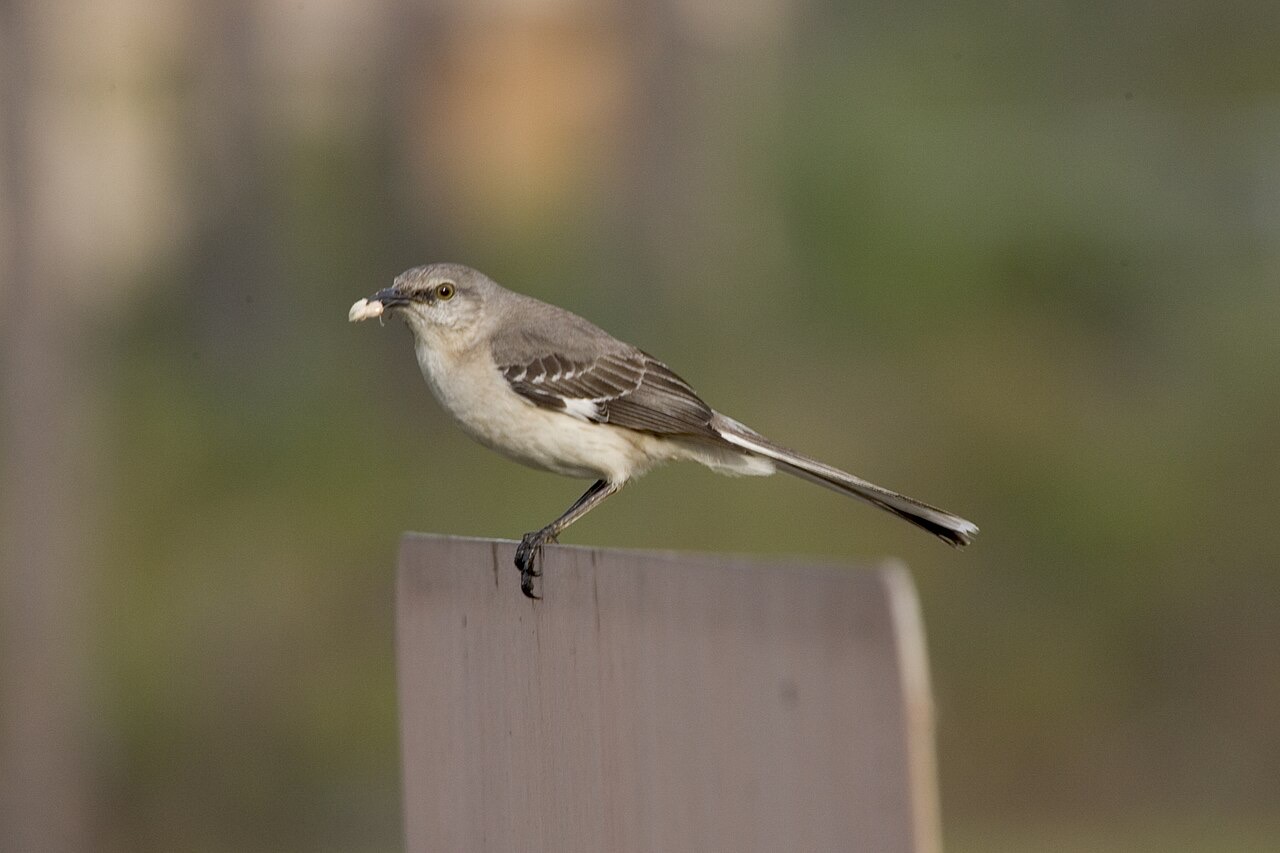
Visual AidThe bird that sings borrowed songs
Photograph of a northern mockingbird in Everglades National Park, Florida, 2005, food in its beak. This is the bird behind the Knowledge Bank’s word mimic: a plain gray singer that performs dozens of other birds’ songs in a row, none of them its own invention. The novel puts one within earshot on the drive to Phoenix at the exact moment a girl is performing a borrowed self. Notice where the comparison deliberately breaks: mimicry is this bird’s nature and costs it nothing, and no photograph can carry the sound.
Northern mockingbird, Everglades National Park, Florida; National Park Service photograph by R. Cammauf, 2005. Source: Wikimedia Commons, File:Mockingbird, NPSPhoto, R. Cammauf (9099311161).jpg, public domain.
oratoricaladj.Ch.27
Having to do with formal public speaking
“Susan traveled to Phoenix for the state oratorical contest.”
mimicv.Ch.27
To copy the sound or manner of another
“A mockingbird can mimic dozens of other birds.”
improvisev.Ch.28
To make something up on the spot, without preparation
“She chose to improvise instead of reading her speech.”
eloquentadj.Ch.28
Speaking in a fluent, moving, persuasive way
“Her eloquent talk held the whole hall silent.”
ovationn.Ch.28
Long, enthusiastic applause from an audience
“The judges rose in a thundering ovation.”
elatedadj.Ch.29
Filled with great happiness and pride
“She was elated as the cameras crowded around her.”
desertedadj.Ch.29
Empty of people; abandoned
“The school parking lot stood almost deserted.”
shunv.Ch.30
To deliberately avoid and exclude someone
“The students continued to shun her anyway.”
cowardicen.Ch.30
A shameful lack of courage
“Leo’s silence was plain cowardice, and he knew it.”
authenticadj.Ch.30
Genuine; truly what one really is
“On Monday she chose to be authentic again.”
ⓘ The vocabulary words in this list are selected to help you understand and complete this workbook. Some may not appear verbatim in the original novel.
🧠Knowledge Bank question
1The Knowledge Bank explains that the novel mentions a mockingbird's talent to mimic at the exact moment when ___.Ch.27
2To ‘mimic’ a sound is to copy it.Ch.27
3To ‘improvise’ is to ___.Ch.28
4An ‘ovation’ is a long burst of enthusiastic applause.Ch.28
5Fill in each blank with the correct word.Ch.28
Word choices:eloquentimprovisedesertedukulele- some words will not be used
She decided to rather than read her speech.
Her talk held the whole hall silent.
6A place that is ‘deserted’ is ___.Ch.29
7Someone who is ‘elated’ feels quiet disappointment.Ch.29
8To ‘shun’ someone is to ___ them.Ch.30
9Fill in each blank with the correct word.Ch.30
Word choices:cowardiceauthenticovationmimic- some words will not be used
Leo’s silence was plain .
On Monday she chose to be again.
10Something ‘authentic’ is ___.Ch.30
Part 2
Comprehension
Show you understood what happens in Chapters 27–30.
🧠Knowledge Bank · The Prize and the Empty Lot
Narrative Causality · The Prize and the Empty Lot
The narrative’s growing tension gives way to a crucial revelation and redirects the story’s direction. The state oratorical contest arrives, and Mr. McShane drives Susan and Leo to Phoenix while her parents follow in their own car. On the way she admits that Dori Dilson is angry with her — not for losing a contest, but for losing herself, for trading Stargirl away in the hope of being liked. The April desert is blooming, and when they pull over she hears a mockingbird and remembers one of Archie’s strange, beautiful ideas about what such a bird might be carrying in its borrowed songs. At the competition she abandons her prepared speech entirely and improvises, weaving Barney the fossil skull, Cinnamon, and the dying of the sun into a talk she calls ‘I Might Have Heard a Moa.’ The accumulated tension makes “The Prize and the Empty Lot” a genuine story threshold.
🧠Knowledge Bank question
1According to the Knowledge Bank, Dori Dilson is angry with Susan because Susan ___.Ch.27
2Why is Dori Dilson angry with Susan?Ch.27
3During the drive, Susan hears a mockingbird in the blooming April desert.Ch.27
4What does Susan do with her carefully prepared speech?Ch.28
5Write the numbers 1–5 in the boxes to show the correct order of events. Number 1 = what happens first.Chapters 27–30
She wins the state title to a roaring ovation.
Mr. McShane drives Susan and Leo toward Phoenix.
She comes home to two teachers and one small sign.
Stargirl returns on Monday, and Hillari crushes her cookie.
She throws out her speech and improvises instead.
6Susan loses the state oratorical contest.Ch.28
7What kind of welcome does Susan expect at Mica High?Ch.29
8Who is actually waiting in the parking lot with a homemade sign?Ch.29
9What does Hillari do to the happy-face cookie Stargirl offers?Ch.30
10Leo steps forward and defends Stargirl when the cookies are refused.Ch.30
Part 3
Literary Elements
Understanding HOW and WHY Jerry Spinelli (author) tells the story across Chapters 27–30.
🧠Knowledge Bank · A Win That Feels Like a Loss
Narrative Technique · A Win That Feels Like a Loss
As the story nears its end, irony, symbol, and point turn earlier details into consequences. Part 7 is built on situational irony — the gap between what we expect to happen and what actually does. Everything is arranged for triumph. A state title, a silver plate, television lights, a newspaper front page, a girl rehearsing her own homecoming out loud in the car: Spinelli lets the expectation swell for two full chapters. Then the car turns into the school lot and there is almost no one there. Two teachers. One handmade sign in Dori Dilson’s hands. The irony bites twice over. Susan wins the very prize she believed would buy her the crowd’s love, and the winning changes nothing — and she wins it, note carefully, by throwing away her careful, ordinary speech and improvising something wildly strange, which is to say she wins by being Stargirl at the exact moment she is trying hardest not to be. That authorial design makes “A Win That Feels Like a Loss” a lesson in deliberate structure.
Situational irony
The gap between the expected triumph and the real result — a state title that buys her nothing at all.
Symbol
The near-empty parking lot and Dori’s single small sign — a hollow crowd against a stubborn friend.
Turning point
The moment Susan gives up the borrowed self and comes back to school as Stargirl for good.
🧠Knowledge Bank question
1According to the Knowledge Bank, the deepest irony of Susan's victory is that she wins by ___.Ch.29
2The vast, near-empty parking lot works mainly as a ___.Ch.29
3Situational irony is the gap between what we expect to happen and what actually happens.Ch.29
4Monday morning, when Susan returns to school as Stargirl for good, is the story’s ___.Ch.30
5Fill in each blank with the correct literary term.Ch.29
Word choices:symbolsituational ironyrhymeglossary- some words will not be used
A win that buys her nothing is .
The empty parking lot works as a .
6A symbol is an object or image that carries a meaning larger than itself.Ch.29
7It deepens the irony that Susan wins the contest by ___.Ch.28
8Dori’s single homemade sign is meant to show that no one in Mica cares for Stargirl at all.Ch.29
9Fill in each blank with the correct literary term.Ch.30
Word choices:turning pointsymbolnarratorprologue- some words will not be used
Coming back as Stargirl is the story’s .
Dori’s small sign is a of loyalty.
10Leo’s silence while the cookie is crushed matters most because it ___.Ch.30
Part 4
Think Deeper
Four deeper challenges — no single-word recall. Read, weigh the evidence, and reason it out.
🧠Knowledge Bank · Why Conforming Did Not Work
The False Self · Why Conforming Did Not Work
Susan did everything the crowd seemed to demand. She put away the ukulele, dressed like everyone else, answered to an ordinary name, and then went out and won a state championship — and Mica High still would not have her. Psychologists studying social rejection have found this pattern again and again, and it explains her empty parking lot. Once a group has decided to exclude someone, the exclusion tends to harden into an identity the group holds about that person, and later changes in behavior are read as proof of the original judgment rather than as reasons to revise it: see, she was faking all along. Worse, the effort itself is costly. Studies of people who spend their days managing how they come across find real exhaustion in it — the work of monitoring yourself never stops, and it drains the attention you would otherwise spend on anything else. Susan paid that price for weeks and got nothing, because there was never anyone at Mica willing to let it succeed.
Visual AidWhy the makeover could not work
Sequence diagram of the pattern the Knowledge Bank on the false self reports from research on social rejection: once exclusion hardens into an identity the group holds about a person, later changes are read as proof of the original judgment rather than reasons to revise it. The loop underneath is the trap — each new act, even a state title, is folded back into the same verdict. The diagram maps an argument about groups in general; the empty parking lot in Chapters 27–30 is the novel’s own evidence for it.
Rejection-hardening as described in the Knowledge Bank; the pattern per research on social exclusion. Drawn for Garden Heights Academy.
Picture the drive home from Phoenix. A silver plate sits in a girl’s lap, and she keeps touching it. She has been on television. Her face is on a front page. She has spent the whole trip describing out loud the welcome that must be waiting — the noise, the banners, the crowd finally, finally turning her way. The car swings into the school lot and slows, and then simply stops, because there is nothing to drive toward. Sun, gravel, painted lines, two teachers standing awkwardly, and one girl holding a small handmade sign that shakes a little in her hands. Nobody in the car says anything. The proof of everything she wanted is right there in her lap, and it has bought her exactly one friend she already had.
Original passage written for Garden Heights — not a quotation from the novel.
1Claim: “Part 7 shows that giving up her real self won Susan nothing from the crowd.” — choose the two details that best prove it.Claim & Evidence
2Evidence the world outside Mica admired her, or Evidence Mica itself would not have her? Tap each detail to sort it — tap again to switch sides. You can keep tapping to change your answer.Sort into two
◄ Evidence the world outside Mica admired herEvidence Mica itself would not have her ►
3Match each cause to its result. For each cause, pick its result.Cause & Effect
Susan puts Stargirl away to be liked→
She throws out her prepared speech→
The parking lot is nearly deserted→
Leo says nothing as the cookie is crushed→
🧠Knowledge Bank question
4Fill both blanks to complete the reasoning.Build the Argument
According to the Knowledge Bank, Susan's weeks of conforming failed because the group's exclusion had hardened into , which meant her changed behavior was read as .
Part 5
Standardized Test
Reading passage · The Bird That Sings in Borrowed Songs · SAT & TOEFL-style practice
Read the passage — the highlighted words are tested — then answer. Tap an answer, then tap it again to confirm.
SATCentral Ideas — the passage's main point
SATDetail — a fact stated in the passage
SATWords in Context — a word's meaning in this passage
SATText Connections — how two parts of the text relate
TOEFLFactual Information — a fact stated in the passage
TOEFLVocabulary — a tested word's meaning here
The Mockingbird's Borrowed Songs
The bird Susan hears in the blooming April desert is a northern mockingbird, one of the finest singers in North America. Plain gray and easy to overlook, it is famous for one astonishing talent: it copies. A mockingbird will mimic the songs of the birds around it — cardinals, wrens, jays — and does not stop there; frogs, insects, car alarms, and barking dogs also find their way in. A single male may command well over a hundred distinct song types, adding to that collection all his life, so an older bird carries a more varied repertoire than a young one.
Why would evolution build a bird out of other creatures’ voices? The leading explanation is courtship: the song is an advertisement, and its length and variety are the measure of the singer. A male who performs an enormous range of borrowed sounds is demonstrating memory, sharp hearing, years of survival, and the health to sing for hours from an exposed perch. Importantly, the copying is not mindless playback. The mockingbird arranges its stolen material into phrases, repeats each one several times, and improvises transitions, so a listener who knows the pattern identifies it instantly.
That is the paradox worth carrying into the novel: a mockingbird borrows every note it sings and is still authentic — unmistakably itself — because the arrangement and daring are its own. Archie’s musings go further, imagining a bird passing down calls from species long vanished — a lovely speculation, not a fact. Susan spent months attempting the opposite experiment: she put her own songs away and lived inside an elaborate imitation of everyone else, and the result was not a richer performance but silence. The mockingbird thrives by adding other voices to its own; Susan tried to replace hers, and nearly lost the only song she had.
Original passage written for Garden Heights — not a quotation from the novel.
1What is the passage mainly about?SAT · Central Ideas
2According to the passage, a mockingbird copies ___.TOEFL · Factual Information
3How many distinct song types may a single male command?SAT · Detail
4Compared with a young mockingbird, an older one usually has ___.TOEFL · Factual Information
5The passage says the leading explanation for the mimicry is ___.SAT · Detail
6A huge range of borrowed sounds signals to a mate that the male has ___.TOEFL · Factual Information
7The passage says a listener can identify a mockingbird because it ___.SAT · Detail
8In the passage, mimic most nearly means ___.SAT · Words in Context
9In the passage, authentic most nearly means ___.TOEFL · Vocabulary
10How does the passage BEST help explain Susan’s story in Part 7?SAT · Text Connections
Part 6 · Optional
Creative Writing
A bonus challenge to practice your English. Take your time and have fun with it.
About This Section
This writing task is optional and is not part of your auto-graded score. The feedback below checks only the basics — length, spelling, and grammar — not whether your ideas are right or wrong. It is meant for classroom discussion and creative practice, so feel free to use your imagination!
Writing Task — Part 7 “The Prize That Changed Nothing”
Susan wins a state championship and comes home to an almost empty parking lot. Write about a time you worked hard for something — approval, a place on a team, a friendship — and the reward did not arrive, or did not feel the way you expected. What did you give up along the way? 6–10 sentences. End with what you would tell someone about to trade away something of their own to be liked.
You can start with: “I had everything I thought I wanted in my hands, and the lot was empty...”
0 / 40 words minimum
🗣 Teach It · Just for Fun (optional)
No right or wrong — tell someone nearby what happened in this part. Can’t find anyone? Tell yourself out loud. The moment you teach it, you truly understand it.
Part 7 Complete!
You finished Chapters 27–30 of Stargirl.
Here are your auto-graded results:
-
points out of 100
Teach it to someone
The best last step is to teach it. In your own words, explain what happened — retell a favorite scene, teach a character’s big choice, or sum up the main idea for a parent, friend, or classmate. When you can teach it clearly, you truly own it.
Independent study guide by Garden Heights. Not affiliated with or endorsed by Jerry Spinelli. Contains original analysis only; no text from the novel is reproduced. Reference text: This workbook follows Jerry Spinelli’s classic text (the standard Puffin edition sold worldwide). Revised 2023 UK editions change some wording and may not match the vocabulary studied here.
SAT® is a registered trademark of College Board, which is not affiliated with, and does not endorse, these materials. TOEFL® is a registered trademark of ETS. These materials are not endorsed or approved by ETS. Garden Heights is an independent provider of test-style reading practice.