New here? Just sign up with Google — your account includes Matilda, our gift book, forever.
What Happens in Part 1
Peter Hatcher is back — a little older, in the sixth grade now — and telling his own story again in his honest, funny voice. His wild little brother Fudge is still a whirlwind, but this book opens with news that knocks Peter flat: his mother is going to have another baby. Peter cannot believe it. One Fudge was already more than enough — now there will be two little kids in the family, and Peter is sure the new baby will be just as much trouble. He is so upset that he even announces he will run away and go live with his friend Jimmy Fargo. In the end, of course, Peter stays. Slowly he begins to get used to the idea, and the whole family starts getting ready for the new arrival — painting, planning, and picking names. Life in the Hatcher apartment is about to get even busier.
What We Will Learn
Focus
What It Means
First-Person Narrator
Peter telling his own story in his own voice
Internal Conflict
Peter wrestling with big, mixed feelings about the news
Theme (Family Change)
How a family faces a big new change together
Chapter Summary
Pages
Key Events
pp. 1–20
Peter Hatcher, now in sixth grade, learns his mother is expecting a new baby; horrified at the idea of a second little kid like Fudge, he even threatens to run away — but he stays, and the family begins to get ready for the new arrival
💭 Before You Read · Warm-Up (not scored)
There are no wrong answers here — just think, guess, and talk:
Peter is shocked and worried to learn a new baby is coming. Why might an older child feel nervous about a new brother or sister?
Peter threatens to run away but chooses to stay. What do you think finally helps him decide to face the change instead of fleeing it?
Predict: with a new baby on the way and Fudge still around, what kind of trouble — and fun — do you think is ahead for Peter?
Copyright Notice
This is an independent study guide created by Garden Heights Academy to support reading comprehension and literary analysis. It contains original analysis questions and does not reproduce any text from the novel. Superfudge is a work by Judy Blume. This guide is not affiliated with, authorized by, or endorsed by the author or any associated rights holder.
Part 1
Vocabulary
Study 10 key words from pages 1–20, then answer each question.
🧠Knowledge Bank · Words of Big News
Lexicology · Words of Big News
When parents share that a new baby is on the way, the child who is already in the family often feels two things at once. Part of him is curious and even proud, but another part feels a quiet worry: will there still be enough love and attention for me? Psychologists call this the first stir of siblingrivalry, and it is completely normal. A young mind cannot yet picture how a family stretches to hold one more person, so the unknown feels like a threat. This is why big news — a baby, a move, a change — can land as exciting and scary in the very same breath. Understanding that mix helps you read Peter honestly, because his grumbling hides a real fear.
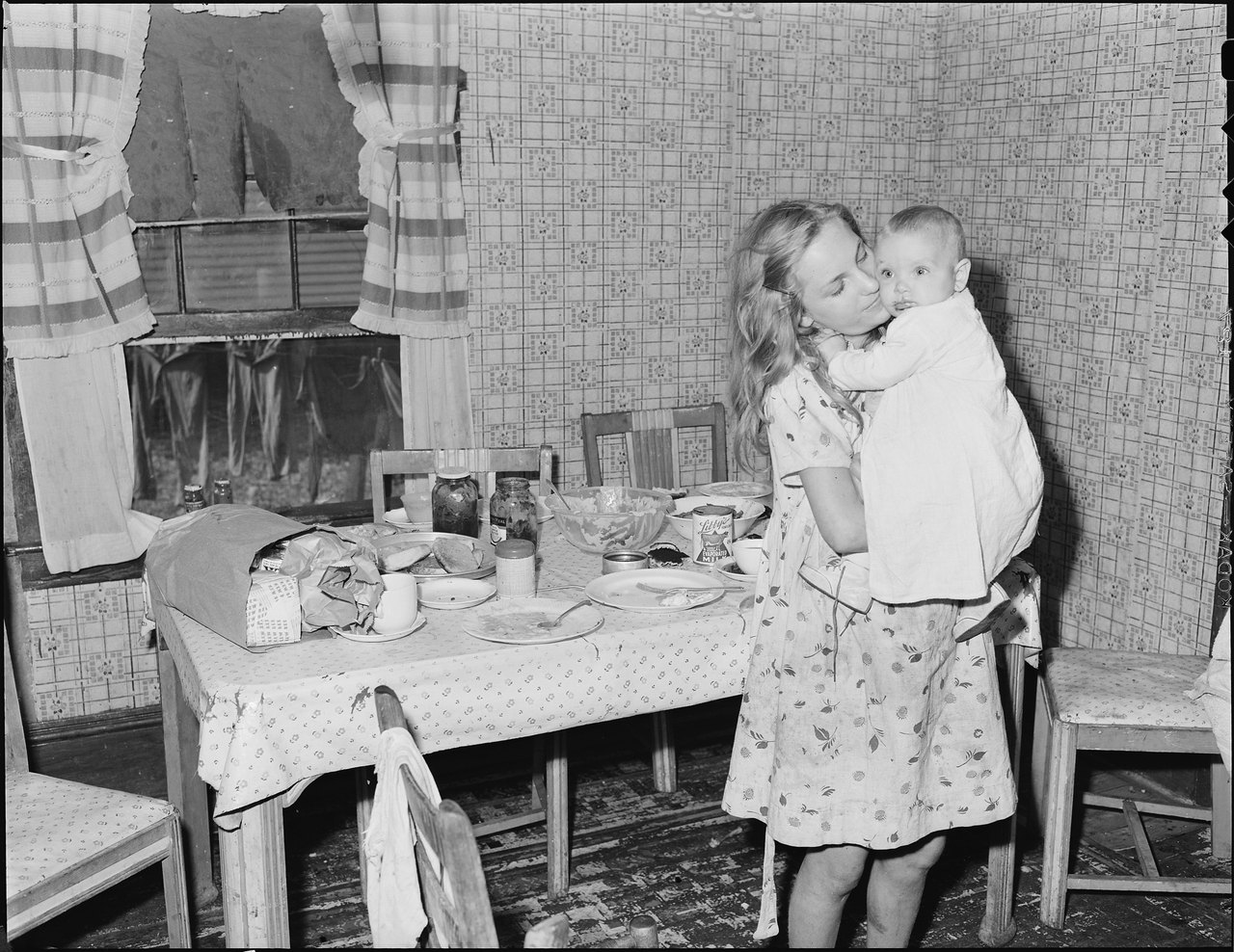
Visual AidA big sister and the new baby
Photograph by Russell Lee, taken in August 1946 for a government survey of coal-mining towns, of a miner’s daughter holding the family’s baby in their kitchen. The Knowledge Bank explains that when a new baby arrives, the child already in the family feels two things at once, curiosity and a quiet worry about whether there will still be enough love to go around, and that this first stir of sibling rivalry is completely normal. The photograph shows the other half of the story: the older child who has grown into the baby’s helper. This is a real family in a mining town, not the Hatchers, and eight children lived in that four-room house. Notice how naturally she holds the baby — the worry has long since turned into a job.
Children of Clabe Hicks, a miner, in their kitchen, August 27, 1946; photograph by Russell Lee, U.S. National Archives. Source: Wikimedia Commons, public domain.
announcev.p.1
To tell people some news out loud
“Peter’s parents announce big news.”
anotheradj.p.2
One more; an additional one
“There will be another baby in the family.”
apartmentn.p.3
A home on one floor of a larger building
“The Hatchers live in a city apartment.”
shockn.p.4
A sudden, upsetting surprise
“The news came as a shock to Peter.”
jealousadj.p.7
Upset that someone else may get attention you want
“Peter feels a little jealous of the new baby.”
threatenv.p.9
To warn that you will do something
“Peter threatens to run away.”
preparev.p.14
To get ready for something
“The family begins to prepare for the baby.”
responsibilityn.p.12
A duty you are trusted to handle
“Being a big brother is a responsibility.”
acceptv.p.18
To agree to take or allow something
“Slowly Peter begins to accept the news.”
matureadj.p.19
Grown-up in the way you act
“Choosing to stay is a mature decision.”
🧠Knowledge Bank question
1According to the Knowledge Bank, psychologists call a child's quiet worry about a new baby ___.p.1
2‘Another’ baby means —p.2
3Fill in each blank with the correct word.pp. 1–20
Word choices:apartmentshockprizegarden- some words will not be used
The Hatchers live in a city
The baby news came as a big to Peter.
4Someone ‘jealous’ feels —p.7
5To be ‘jealous’ is to feel glad when someone else gets attention.p.7
6To ‘prepare’ is to —p.14
7Fill in each blank with the correct word.pp. 1–20
Word choices:responsibilityacceptannouncejealous- some words will not be used
Being a big brother is a real
Slowly, Peter starts to the idea of a new baby.
8To ‘threaten’ to do something is to —p.9
9Someone ‘mature’ acts —p.19
10To ‘accept’ the news means to refuse it completely.p.18
Part 2
Comprehension
How well do you understand pages 1–20?
🧠Knowledge Bank · Reading a Character’s Reaction
Narrative Logic · Reading a Character’s Reaction
A skilled reader watches not just what a character says, but how he reacts — the eye-roll, the stomp, the sudden silence. Judy Blume rarely stops to announce that Peter feels jealous or left out; instead she shows his behavior and trusts you to work out the feeling underneath. This is called making an inference: you gather small clues and add them to what you already know about people. Because Peter meets big news with complaints rather than cheers, you can reason that the news has unsettled him, even though he never uses that word. Reading a reaction closely turns a plain scene into a window on the heart, and it trains you to notice the same quiet signals in the real people you know.
Visual AidReading a reaction
Diagram for the Knowledge Bank on reading a character’s reaction. The left card is what Peter actually does with the big news, the right card is what you already know about people, and the red card is the inference the Knowledge Bank says you reach by adding them. It does not quote the book. Notice the plus sign — an inference always needs both halves, the clue on the page and the knowledge you bring to it.
Behavior, prior knowledge and inference as described in the Knowledge Bank. Drawn for Garden Heights Academy.
🧠Knowledge Bank question
1The Knowledge Bank says that when you gather small clues about a character's behavior and add what you know about people, you are ___.p.1
2What grade is Peter in now?p.1
3What is the big news at the start?p.2
4Peter is thrilled and calm the moment he hears the news.p.4
5Write the numbers 1–5 in the boxes to show the correct order across Part 1. Number 1 = what happens first.pp. 1–20
They announce that a new baby is coming.
Peter decides to stay and the family gets ready.
Peter’s parents call him for a talk.
Peter feels shocked and a little jealous.
Peter threatens to run away to Jimmy’s.
6Who is Fudge?p.3
7What does Peter threaten to do?p.9
8Where does Peter say he will go?p.9
9In the end, Peter chooses to stay at home.p.18
10How does the family begin to get ready?p.14
Part 3
Literary Elements
Understanding HOW and WHY Judy Blume tells the story across pages 1–20.
🧠Knowledge Bank · Internal Conflict
Literary Technique · Internal Conflict
Some struggles happen out in the open — a fight, a race, a storm. Others happen entirely inside a person’s head, and writers call this internalconflict: a battle between two feelings that both belong to the same character. Peter wants to be a good big brother, yet he also resents sharing his parents, and those two wishes pull hard against each other. Blume builds much of the book on this quiet tension, because a child adjusting to a new sibling truly does feel torn. When you notice a character arguing with himself, you have found the story’s real engine: outer events matter less than the choice he must make between his own competing feelings. Learning to name that inner tug makes you a sharper, more patient reader.
📚 Literary Devices in This Part · definitions & examples
Internal conflict is a struggle that takes place inside a character — between their own wishes, fears, and feelings. Peter’s battle is not with a villain but with himself: part of him wants to run from the new baby, and part of him knows he should stay. Watching a character work through internal conflict teaches us about their characterization and pushes the story’s theme forward.
🧠Knowledge Bank question
1According to the Knowledge Bank, an internal conflict is a battle between ___.p.4
2Internal conflict is a struggle that happens inside a character.p.4
3Fill in each blank with the correct word.pp. 1–20
Word choices:internal conflictfirst-person narratorsettingrhyme- some words will not be used
Peter’s inner struggle over the baby is an
Peter telling his own story with ‘I’ makes him the .
4Peter’s conflict is mainly —p.7
5How we learn who Peter is by the way he copes is called characterization.p.1
6Fill in each blank with the correct word.pp. 1–20
Word choices:characterizationthemeinternal conflictmood- some words will not be used
How Blume shows what Peter is like is
The big idea about facing family change is the .
7The tone of Peter’s narration is best described as —p.1
8A big idea about family that runs through the whole book is a —p.7
9Fill in each blank with the correct word.pp. 1–20
Word choices:internal conflictcharacterizationthemeplot- some words will not be used
Peter torn between running and staying shows
Choosing to stay reveals his growing, braver side through .
10Peter choosing to stay instead of running away mainly shows he is —p.18
Part 4
Think Deeper
Four deeper challenges — no single-word recall. Read, weigh the evidence, and reason it through.
🧠Knowledge Bank · Facing a Big Family Change
Ethical Reasoning · Facing a Big Family Change
Every family meets moments that change its shape — a new baby, a move, a job that shifts everyone’s routine. What makes these moments hard is not that they are bad, but that they arrive whether or not each person feels ready. Peter did not vote on a new sibling, so at first the change feels like something done to him rather than with him. Psychologists find that children handle big changes far better when adults let them ask questions, share worries, and keep some small comforts the same. The change itself is rarely the whole problem; the feeling of having no say is. The moral pressure first appears as Peter Hatcher returns — a little older, in the sixth grade.
1Claim: “Peter is dismayed by the news that a new baby is coming.” — choose the two details that best prove it.Claim & Evidence
2Shows Peter’s reaction to the baby news, or just a background detail? Tap each item to sort it — tap again to switch sides. You can keep tapping to change your answer.Sort into two
◄ Peter’s reactionJust a detail ►
3Match each cause to its result. For each cause, pick its result.Cause & Effect
Peter is older now→
His mother shares big news→
Peter dreads the idea→
Another sibling is coming→
🧠Knowledge Bank question
4Fill both blanks to complete the reasoning.Build the Argument
The Knowledge Bank says a big change first feels like something done to Peter because , so the real problem is .
Part 5
Standardized Test
Key Details & Inference — SAT & TOEFL-style practice
Read the passage — the highlighted words are tested — then answer. Tap an answer, then tap it again to confirm.
SATWords in Context — a word's meaning in this passage
SATInference — a conclusion the passage implies
TOEFLFactual Information — a fact stated in the passage
TOEFLRhetorical Purpose — why the author included a detail
Adjusting to a New Baby Sibling
Becoming a big brother or big sister is one of childhood's biggest changes. When a new baby joins a family, an older child often feels many things at once: excitement, curiosity, and sometimes a quiet worry about being replaced. It is normal to feel a little jealous, because a brand-new baby needs care around the clock, so grown-ups are suddenly very busy. Wise parents help the older child prepare ahead of time: they explain what is coming, answer questions, and let the child help get the room and clothes ready. Being included this way helps an older child feel important rather than pushed aside. In time, most big brothers and sisters discover a surprising reward: a baby who lights up at the sight of them. Being looked up to by a little one is a special kind of responsibility, and it can turn a nervous older child into a proud and gentle helper. Growing into that role does not happen overnight, but it teaches patience, kindness, and the quiet pride of being trusted with someone small.
Original passage written for Garden Heights — not a quotation from the novel.
1According to the passage, an older child sometimes quietly worries about being —TOEFL · Factual Information
2In the passage, an older child who feels jealous is ___.SAT · Words in Context
3Parents help the older child prepare, which means to ___.SAT · Words in Context
4Why does the passage say grown-ups become very busy with a new baby?TOEFL · Factual Information
5Being included in getting ready helps the older child feel —SAT · Inference
6The surprising “reward” an older child discovers is —TOEFL · Factual Information
7Being looked up to is called a special “responsibility,” meaning a —SAT · Words in Context
8What can the reader infer about the older child’s feelings over time?SAT · Inference
9According to the passage, growing into the big-sibling role teaches —TOEFL · Factual Information
10This passage mainly helps the reader understand why Peter —TOEFL · Rhetorical Purpose
Part 6 · Optional
Creative Writing
A bonus challenge to practice your English. Take your time and have fun with it.
About This Section
This writing task is optional and is not part of your auto-graded score. The feedback below checks only the basics — length, spelling, and grammar — not whether your ideas are right or wrong. It is meant for classroom discussion and creative practice, so feel free to use your imagination!
Writing Task — Part 1 “Big News”
Peter gets news that changes his whole family. Write about a time you got surprising news — good or bad — and how you felt at first and later. Or, if you have a younger brother or sister, write about what that is like. Write at least 40 words.
You can start with: “The surprising news I remember is…”
0 / 40 words minimum
🗣 Teach It · Just for Fun (optional)
No right or wrong — close the screen and tell someone nearby about Peter, the big news, and his threat to run away. Can’t find anyone? Tell yourself out loud. The moment you teach it, you truly understand it.
Part 1 Complete!
You finished pages 1–20 of Superfudge.
Here are your auto-graded results:
-
points out of 100
Teach it to someone
The best last step is to teach it. In your own words, explain what happened — retell a favorite scene, teach a character’s big choice, or sum up the main idea for a parent, friend, or classmate. When you can teach it clearly, you truly own it.
Independent study guide by Garden Heights Academy. Not affiliated with or endorsed by the author or any rights holders. Contains original analysis only; no text from the novel is reproduced.
SAT® is a registered trademark of College Board, which is not affiliated with, and does not endorse, these materials. TOEFL® is a registered trademark of ETS. These materials are not endorsed or approved by ETS. Garden Heights is an independent provider of test-style reading practice.