New here? Just sign up with Google — your account includes Matilda, our gift book, forever.
What Happens in Part 2
The new baby arrives — a little sister! Her name is Tamara Roxanne Hatcher, but the family soon nicknames her Tootsie. Peter, who dreaded the whole idea, finds that a real baby is smaller, softer, and quieter than he feared, and he begins to feel a surprising flicker of pride at being a big brother again. Fudge, however, is a different story. Now that he is no longer the baby of the family, Fudge is wildly jealous of Tootsie and all the attention she gets. He announces that the family should simply give the baby away — or sell her — and he schemes to get rid of his tiny rival in his usual outrageous ways. The Hatchers have their hands full: a brand-new baby and a jealous Fudge, all in one small apartment.
What We Will Learn
Focus
What It Means
Characterization
Peter and Fudge revealed through how each meets the baby
Sibling Rivalry
Fudge’s comic jealousy of tiny Tootsie
Theme (Family Change)
Finding your place when the family grows
Chapter Summary
Pages
Key Events
pp. 21–41
Baby Tamara Roxanne — ‘Tootsie’ — is born; Peter surprises himself by warming to his little sister, while Fudge, no longer the baby, grows wildly jealous and schemes to get rid of her
💭 Before You Read · Warm-Up (not scored)
There are no wrong answers here — just think, guess, and talk:
Peter warms to the baby, but Fudge is jealous. Why do you think the two brothers react so differently to the same new sister?
Fudge suggests giving the baby away. What is really going on inside Fudge when he says such an outrageous thing?
Predict: how do you think Fudge’s feelings about his little sister might change as the story goes on?
Copyright Notice
This is an independent study guide created by Garden Heights Academy to support reading comprehension and literary analysis. It contains original analysis questions and does not reproduce any text from the novel. Superfudge is a work by Judy Blume. This guide is not affiliated with, authorized by, or endorsed by the author or any associated rights holder.
Part 1
Vocabulary
Study 10 key words from pages 21–41, then answer each question.
🧠Knowledge Bank · Words of a Growing Family
Lexicology · Words of a Growing Family
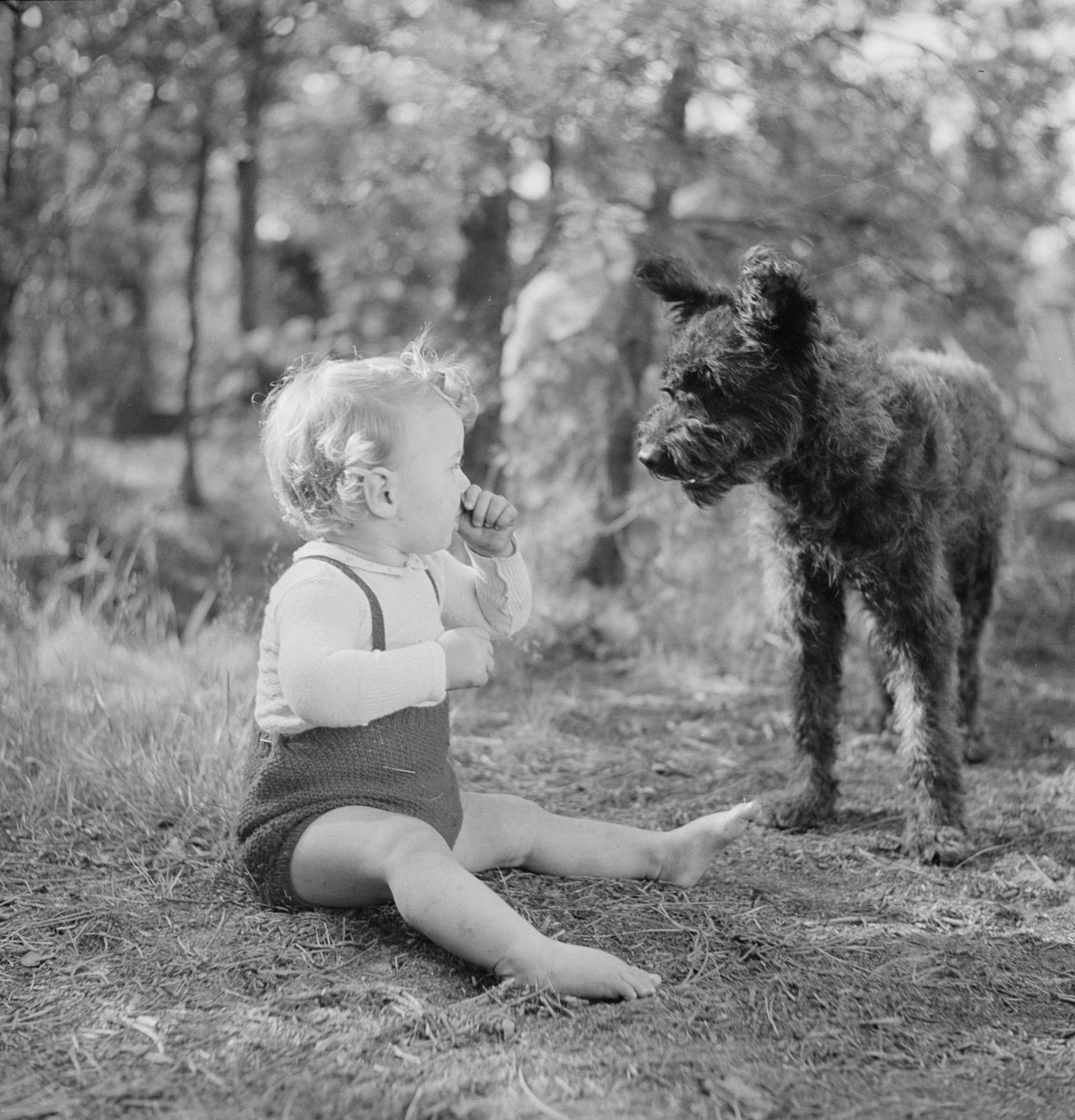
When a new baby joins the home, the youngest child suddenly loses the title of ‘baby of the family,’ and toddlers often protest in surprising ways. Some slip back into old habits — baby talk, thumb-sucking, wanting to be carried — a behavior psychologists call regression. Others act out, testing whether they are still loved. This is why Fudge’s wild schemes about the new baby are less about meanness and more about a small child asking, without words, do I still matter? A toddler cannot yet manage big feelings the way an older child can, so those feelings spill straight out as action. Knowing this, you can read Fudge’s antics with a kinder, more understanding eye. He is not being difficult on purpose; he simply has more feeling than words, and that gap is the whole source of the comedy.
Visual AidA toddler with a thumb in his mouth
Photograph by Willem van de Poll, taken in 1932, of a small child named Boudewijn sitting on the ground under the trees with a thumb in his mouth while a shaggy dog looks on. The Knowledge Bank explains that when a new baby takes the youngest child’s place, toddlers often slip back into old habits, baby talk, thumb-sucking, wanting to be carried, a behavior psychologists call regression. Nobody knows why this particular child is sucking his thumb; he is not Fudge, and no new baby is in the picture. What the photograph shows is the habit itself, the comfort a very small child reaches for when he has more feeling than words. Notice the dog watching — the child is perfectly content, which is the point: regression is a search for comfort, not naughtiness.
Boudewijn and a dog, 1932; photograph by Willem van de Poll, Nationaal Archief of the Netherlands, released under CC0. Source: Wikimedia Commons, CC0.
nicknamen.p.22
A short, friendly name used instead of a real one
“Tamara’s nickname is Tootsie.”
newbornn.p.21
A baby that has just been born
“The newborn slept most of the day.”
jealousadj.p.26
Upset that someone else is getting attention you want
“Fudge is jealous of the new baby.”
attentionn.p.27
Notice and care given to someone
“The baby got all the attention.”
schemev.p.30
To make a sneaky plan
“Fudge schemes to get rid of Tootsie.”
rivaln.p.29
Someone you compete with
“Fudge sees the baby as a rival.”
gentleadj.p.34
Soft, calm, and careful
“Peter is gentle with his baby sister.”
delicateadj.p.33
Easily hurt; needing careful handling
“A newborn is small and delicate.”
adorev.p.38
To love very much
“The parents adore the new baby.”
outrageousadj.p.31
Shockingly bold or over-the-top
“Fudge’s ideas are outrageous.”
🧠Knowledge Bank question
1According to the Knowledge Bank, when a toddler slips back into baby talk or thumb-sucking after a new baby arrives, psychologists call it ___.p.22
2A ‘newborn’ is —p.21
3Fill in each blank with the correct word.pp. 21–41
Word choices:jealousattentiongentlerival- some words will not be used
Fudge is of the new baby.
Tiny Tootsie gets all of the family’s .
4To ‘scheme’ is to —p.30
5A ‘rival’ is someone you compete with.p.29
6Someone ‘gentle’ is —p.34
7Fill in each blank with the correct word.pp. 21–41
Word choices:delicateadoreschemenewborn- some words will not be used
A tiny newborn is small and
Peter’s parents their new baby girl.
8Someone ‘jealous’ feels —p.26
9‘Attention’ means —p.27
10Something ‘outrageous’ is calm and completely ordinary.p.31
Part 2
Comprehension
How well do you understand pages 21–41?
🧠Knowledge Bank · Comparing Two Characters
Narrative Logic · Comparing Two Characters
One of the sharpest reading skills is comparing two characters side by side, because their differences make each person clearer. Peter and Fudge both dislike sharing their parents, yet they show it in opposite ways: Peter grumbles and broods, while little Fudge invents loud, impossible plans. When you line up how two characters meet the same problem, you learn something about age, personality, and how people grow. Blume sets the brothers close together on purpose, so their contrast does the teaching for her. A careful reader asks, what is the same, what is different, and why? That last question — the why — is where real understanding begins, because it pushes you past what happens toward what it means.
Visual AidSame problem, opposite answers
Diagram for the Knowledge Bank on comparing two characters. The red card is the one problem both brothers share, and the two cards beneath it are the opposite ways the Knowledge Bank says they meet it, Peter grumbling and brooding, Fudge inventing loud, impossible plans. It does not add scenes. Notice that the question under the cards is why, not what — the Knowledge Bank says that is where real understanding begins.
Shared problem and opposite responses as described in the Knowledge Bank. Drawn for Garden Heights Academy.
🧠Knowledge Bank question
1The Knowledge Bank says Peter and Fudge both dislike sharing their parents, but ___.p.21
2What is the baby’s real name?p.22
3What nickname does the family give her?p.22
4Fudge is calm and happy about the new baby.p.26
5Write the numbers 1–5 in the boxes to show the correct order across Part 2. Number 1 = what happens first.pp. 21–41
She is named Tamara Roxanne Hatcher.
Jealous Fudge schemes to give her away.
Peter is gentle and quietly proud of her.
The new baby girl is born.
The family nicknames her Tootsie.
6How does Peter treat the new baby?p.34
7Why is Fudge so jealous?p.29
8What does Fudge scheme to do with the baby?p.30
9Peter and Fudge react to the baby in opposite ways.p.26
10How do the parents feel about Tootsie?p.38
Part 3
Literary Elements
Understanding HOW and WHY Judy Blume tells the story across pages 21–41.
🧠Knowledge Bank · Characterization Literary Technique
Writers reveal who a person is through characterization — the small choices of speech, action, and reaction that add up to a personality. Blume seldom writes that Fudge is stubborn; she lets him prove it by trying to trade his baby sister for something better. Show, do not tell, is the craft at work: a character’s deeds paint a fuller portrait than any label could. This matters in a story about growing up, because children change, and characterization lets us watch that change happen rather than simply hear about it. When you catch yourself deciding a character is brave, silly, or kind, pause and ask which exact action taught you that. Tracing your evidence back to the page makes you a more honest judge.
📚 Literary Devices in This Part · definitions & examples
Characterization is the way an author reveals what a character is like — through their actions, speech, thoughts, and feelings, rather than by simply announcing it. Blume shows Peter’s gentleness and Fudge’s jealousy by letting us watch them with Tootsie. This ‘show, don’t tell’ method makes each brother vivid and helps carry the story’s theme.
🧠Knowledge Bank question
1According to the Knowledge Bank, Blume proves Fudge is stubborn by ___.p.34
2Characterization can reveal a person through actions, not just labels about them.p.34
3Fill in each blank with the correct word.pp. 21–41
Word choices:characterizationcontrastsettingrhyme- some words will not be used
Showing Peter’s gentleness through his actions is
Placing gentle Peter beside jealous Fudge is a .
4We learn Fudge is jealous mainly because —p.26
5Placing gentle Peter next to jealous Fudge is a form of contrast that sharpens both.p.26
6Fill in each blank with the correct word.pp. 21–41
Word choices:themecharacterizationplotmood- some words will not be used
The big idea of finding your place in a changing family is the
Showing what each brother is like through action is .
7‘Show, don’t tell’ mainly means an author —p.30
8Fudge’s outrageous plan to give the baby away mostly reveals his —p.31
9Fill in each blank with the correct word.pp. 21–41
Word choices:contrastthemecharacterizationsetting- some words will not be used
Comparing the two brothers side by side is a
The lesson about family love running through the book is the .
10Comparing the two brothers mainly helps the reader —p.34
Part 4
Think Deeper
Four deeper challenges — no single-word recall. Read, weigh the evidence, and reason it through.
🧠Knowledge Bank · When You’re Not the Baby Anymore
Ethical Reasoning · When You’re Not the Baby Anymore
For a long time, Fudge was the youngest, the one everyone fussed over, and then a new baby took that spot. Birth order — whether you are oldest, youngest, or in the middle — quietly shapes how a child sees the family. Losing the baby role can feel like being pushed off a favorite chair, and it often explains behavior that looks like plain naughtiness. Experts point out that a dethroned youngest child is not being bad; he is grieving a place he loved. The kindest answer is to hand him a new, older job — a helper, a teacher, a big brother — so the change feels like a promotion instead of a loss.
1Claim: “The new baby turns out to be far less awful than Peter feared.” — choose the two details that best prove it.Claim & Evidence
2Shows Peter changing his mind about the baby, or just a detail? Tap each item to sort it — tap again to switch sides. You can keep tapping to change your answer.Sort into two
◄ Peter changing his mindJust a detail ►
3Match each cause to its result. For each cause, pick its result.Cause & Effect
The new baby arrives→
The family names her→
Peter had dreaded her→
The reality is gentle→
🧠Knowledge Bank question
4Fill both blanks to complete the reasoning.Build the Argument
The Knowledge Bank says a dethroned youngest child is not being bad; he is , so the kindest answer is .
Part 5
Standardized Test
Key Details & Inference — SAT & TOEFL-style practice
Read the passage — the highlighted words are tested — then answer. Tap an answer, then tap it again to confirm.
SATWords in Context — a word's meaning in this passage
SATInference — a conclusion the passage implies
TOEFLFactual Information — a fact stated in the passage
TOEFLProse Summary — the three sentences that sum it up
TOEFLRhetorical Purpose — why the author included a detail
The Rapid Growth of a Newborn
A human newborn is one of the most helpless creatures on Earth, and also one of the most amazing. Unlike a colt or a calf that can stand within hours of birth, a human baby cannot walk, talk, or even hold up its own head at first. It is small and delicate, and it depends completely on grown-ups for food, warmth, and safety, so everyone must be gentle with it. A newborn spends most of the day asleep, waking mainly to eat and to be held. Its cry is its only language, a signal that says I need something, and caring adults soon learn to read it. Though a newborn cannot do much, it is busy in hidden ways: its brain is growing with astonishing speed, and it needs constant attention, because every sound, face, and touch teaches it about the world. Within weeks the baby begins to recognize the people who care for it, and one day it offers its first smile, a moment families treasure. In a single year the tiny, sleepy bundle grows into a child on the edge of walking and talking.
Original passage written for Garden Heights — not a quotation from the novel.
1Unlike a colt or calf, a human newborn cannot at first —TOEFL · Factual Information
2A newborn is described as “delicate,” meaning —SAT · Words in Context
3The passage says everyone must be gentle with a newborn, meaning ___.SAT · Words in Context
4According to the passage, a newborn’s cry is —TOEFL · Factual Information
5What is a newborn doing in “hidden ways” even while sleeping?TOEFL · Factual Information
6A newborn needs constant attention, meaning ___.SAT · Words in Context
7A newborn’s first smile is described as a moment families —TOEFL · Factual Information
8What can the reader infer about a newborn’s first year?SAT · Inference
9This TOEFL task lists six sentences; choose the THREE that best capture the passage’s main ideas. The other three do not belong — they state minor details or ideas the passage does not present.TOEFL · Prose Summary
10This passage mainly helps the reader understand why the Hatchers must —TOEFL · Rhetorical Purpose
Part 6 · Optional
Creative Writing
A bonus challenge to practice your English. Take your time and have fun with it.
About This Section
This writing task is optional and is not part of your auto-graded score. The feedback below checks only the basics — length, spelling, and grammar — not whether your ideas are right or wrong. It is meant for classroom discussion and creative practice, so feel free to use your imagination!
Writing Task — Part 2 “Two Very Different Brothers”
Peter and Fudge react to the new baby in opposite ways. Write about two people you know who reacted very differently to the same event — or write about a time you felt jealous, and what helped. Write at least 40 words.
You can start with: “Two people who reacted very differently were…”
0 / 40 words minimum
🗣 Teach It · Just for Fun (optional)
No right or wrong — close the screen and tell someone nearby about baby Tootsie and how jealous Fudge became. Can’t find anyone? Tell yourself out loud. The moment you teach it, you truly understand it.
Part 2 Complete!
You finished pages 21–41 of Superfudge.
Here are your auto-graded results:
-
points out of 100
Teach it to someone
The best last step is to teach it. In your own words, explain what happened — retell a favorite scene, teach a character’s big choice, or sum up the main idea for a parent, friend, or classmate. When you can teach it clearly, you truly own it.
Independent study guide by Garden Heights Academy. Not affiliated with or endorsed by the author or any rights holders. Contains original analysis only; no text from the novel is reproduced.
SAT® is a registered trademark of College Board, which is not affiliated with, and does not endorse, these materials. TOEFL® is a registered trademark of ETS. These materials are not endorsed or approved by ETS. Garden Heights is an independent provider of test-style reading practice.