New here? Just sign up with Google — your account includes Matilda, our gift book, forever.
What Happens in Part 3
Big change is coming for the Hatchers — and this time it is not a baby. Peter’s father decides to take a whole year off from his advertising job to write a book, and the family is going to move from their New York City apartment all the way to Princeton, New Jersey. Peter is horrified. He does not want to leave his best friend, Jimmy Fargo, his familiar school, or the only home he has ever known. Leaving the crowded, exciting city for a quiet town feels like the end of the world. But the decision is made, and soon the whole family is packing boxes, saying goodbyes, and driving off to a brand-new house in an unfamiliar place. When they arrive, Princeton is green and roomy, with trees and a yard — a completely different setting from the busy sidewalks Peter grew up on. Like it or not, the Hatchers are starting a new chapter, in a new town.
What We Will Learn
Focus
What It Means
Setting
The story moves from a NYC apartment to a Princeton house
Internal Conflict
Peter dreads leaving his friends and home
Theme (Fresh Start)
Facing a scary new beginning in a new place
Chapter Summary
Pages
Key Events
pp. 42–62
Peter’s father takes a year off to write a book, so the family moves from their New York City apartment to Princeton, New Jersey; Peter dreads leaving Jimmy Fargo and his home, but the Hatchers pack up and settle into a very different, leafy new town
💭 Before You Read · Warm-Up (not scored)
There are no wrong answers here — just think, guess, and talk:
Peter dreads moving away from his friends and his city. Have you ever had to leave a place you loved? What was the hardest part?
The story’s setting changes from a busy city apartment to a quiet town with yards and trees. How might a new place change how the family lives?
Predict: Peter arrives in Princeton certain he will hate it. Do you think he will find anything to like there?
Copyright Notice
This is an independent study guide created by Garden Heights Academy to support reading comprehension and literary analysis. It contains original analysis questions and does not reproduce any text from the novel. Superfudge is a work by Judy Blume. This guide is not affiliated with, authorized by, or endorsed by the author or any associated rights holder.
Part 1
Vocabulary
Study 10 key words from pages 42–62, then answer each question.
🧠Knowledge Bank · Words of Moving On
Lexicology · Words of Moving On
Moving to a new town is one of the biggest changes a family can choose, and researchers count it among childhood’s most stressful events — not because moving is dangerous, but because it swaps the familiar for the unknown all at once. A child leaves behind a bedroom, a school, a best friend, and the map of streets he knows by heart. Even when the reason is happy, like a parent’s new job or study, the body can still feel the strain of so much newness. This is why the Hatchers’ plan to spend a year away stirs such strong feelings in Peter. Change and loss often travel together, and naming that link helps a reader see why leaving can ache even when nothing is truly wrong.
movev.p.42
To go and live in a new home
“The family will move to New Jersey.”
advertisingn.p.43
The business of making ads to sell things
“Peter’s father works in advertising.”
horrifiedadj.p.44
Filled with shock and dismay
“Peter is horrified by the news.”
familiaradj.p.46
Well known; often seen before
“Peter will miss his familiar street.”
unfamiliaradj.p.52
Not known; new and strange
“Princeton feels unfamiliar at first.”
settingn.p.55
Where and when a story takes place
“The setting shifts from city to town.”
suburbn.p.54
A town or area just outside a big city
“Princeton is a leafy suburban town.”
homesickadj.p.58
Sad and missing your home
“Peter feels homesick for the city.”
adjustv.p.60
To get used to something new
“It takes time to adjust to a new town.”
reluctantadj.p.45
Unwilling; not wanting to do something
“Peter is reluctant to leave.”
🧠Knowledge Bank question
1According to the Knowledge Bank, researchers count moving among childhood's most stressful events because it ___.p.42
2Someone ‘horrified’ is —p.44
3Fill in each blank with the correct word.pp. 42–62
Word choices:advertisingsettingsuburbmove- some words will not be used
Peter’s father works in making ads.
The is where and when a story happens.
4Something ‘familiar’ is —p.46
5A ‘suburb’ is a town or area just outside a big city.p.54
6Something ‘unfamiliar’ is —p.52
7Fill in each blank with the correct word.pp. 42–62
Word choices:homesickadjustfamiliarhorrified- some words will not be used
Far from the city, Peter feels
It takes time to to a brand-new town.
8Someone ‘reluctant’ is —p.45
9The ‘setting’ of a story is —p.55
10Someone ‘homesick’ is glad and eager to be far from home.p.58
Part 2
Comprehension
How well do you understand pages 42–62?
🧠Knowledge Bank · Reading Setting Clues
Narrative Logic · Reading Setting Clues
Setting is more than a backdrop; it is a bundle of clues about mood, time, and what characters value. A skilled reader gathers details — a crowded city street, a quiet tree-lined town, the season outside the window — and asks what they reveal. When Blume moves the Hatchers from busy New York to calm Princeton, the change of place mirrors a change in the family’s life. Noticing that the setting has shifted, and how each character responds to it, tells you as much as any line of dialogue. Because a new place can feel exciting to one person and lonely to another, setting clues also expose character. Read the world of the story closely, and it will quietly hand you the story’s meaning.
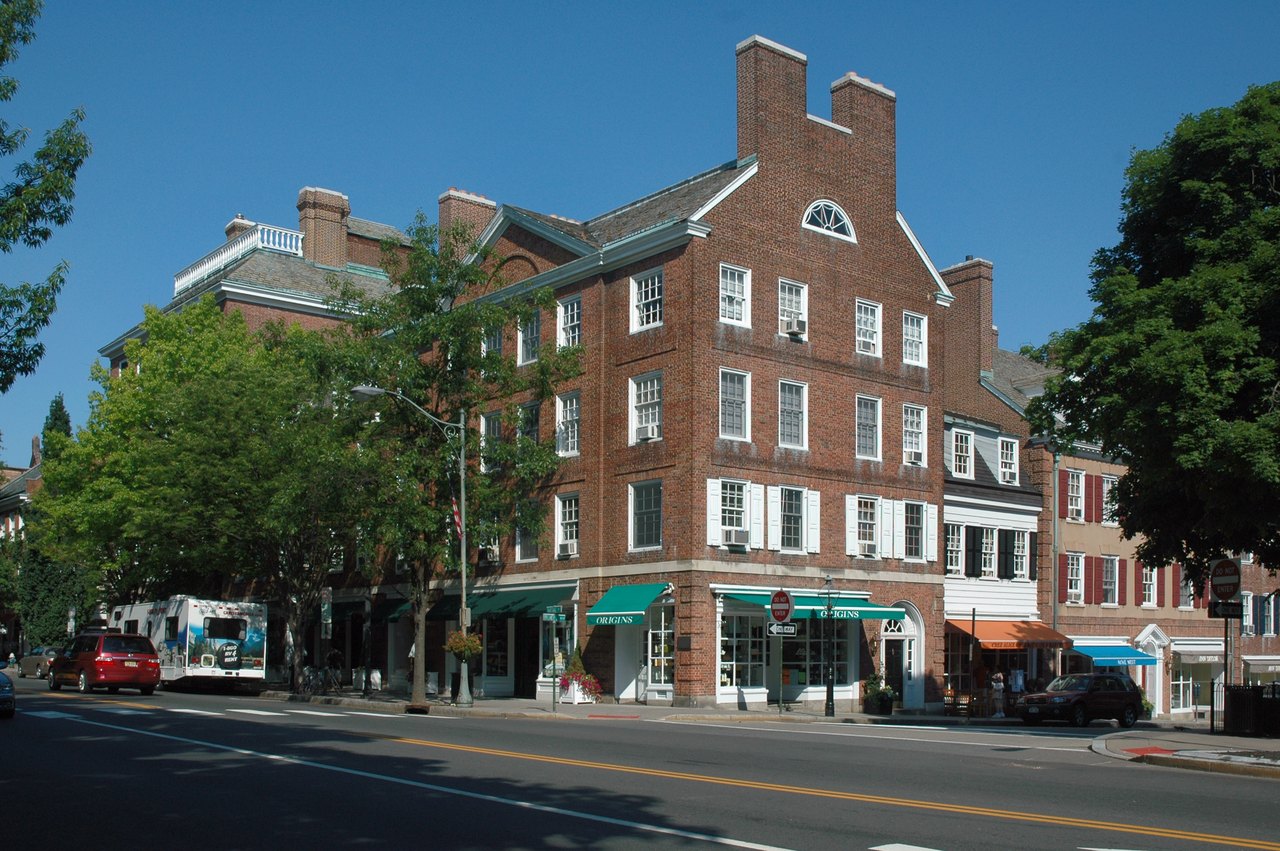
Visual AidNassau Street, Princeton
Photograph of the corner of Nassau Street and Palmer Square in Princeton, New Jersey, taken in July 2007: brick buildings a few stories tall, shop awnings, leafy trees, and a quiet road. The Knowledge Bank says setting is a bundle of clues, and that when Blume moves the Hatchers from busy New York to calm Princeton, the change of place mirrors a change in the family’s life. Here is the calm half of that contrast, the real town’s main street. The picture is decades newer than the story, and the Hatchers’ house and street are invented. Notice how low the buildings are and how much sky shows above them — a New York boy would feel the difference at once.
Corner of Nassau Street and Palmer Square, Princeton, New Jersey, July 2007; photograph by DimiTalen, released under CC0. Source: Wikimedia Commons, CC0.
🧠Knowledge Bank question
1The Knowledge Bank says the move from New York to Princeton mirrors ___.p.42
2Where does the family move to?p.42
3What was Peter’s father’s job in the city?p.43
4Peter is thrilled and excited to leave New York City.p.44
5Write the numbers 1–5 in the boxes to show the correct order across Part 3. Number 1 = what happens first.pp. 42–62
Peter is horrified and dreads leaving Jimmy.
The family plans to move to Princeton.
Homesick Peter slowly starts to adjust.
Dad decides to take a year off to write.
They pack up and drive to the new house.
6Who does Peter most hate to leave behind?p.46
7What is the new setting, Princeton, like?p.52
8What was the family’s old home like?p.42
9Peter is horrified and dreads the move at first.p.44
10What does the family do to get ready to move?p.50
Part 3
Literary Elements
Understanding HOW and WHY Judy Blume tells the story across pages 42–62.
🧠Knowledge Bank · Setting Literary Technique
Literary Technique · Setting Literary Technique
Every story unfolds in a setting — the where and when that surround the characters — and a good writer makes that setting do real work. Blume gives Peter two very different worlds, the tall, humming city and the slower, greener town, so that the contrast can carry the book’s question about home and change. Setting shapes how people feel and behave; the same boy acts differently on a Princeton lawn than on a Manhattan sidewalk. When an author moves characters to a new place, she is usually testing them, seeing who they become once the familiar props are gone. Watch how the new town presses on Peter, because a change of setting in fiction almost always signals a coming change in the heart.
Visual AidTwo worlds, one boy
Diagram for the Knowledge Bank on setting as a literary technique. The two cards are the two worlds the Knowledge Bank gives Peter, the tall, humming city and the slower, greener town, with the same boy drawn between them; the red card is the Knowledge Bank’s claim that a new place tests a character once the familiar props are gone. It lists what the Knowledge Bank says about each place, not scenes from the book. Notice that the boy in the middle does not change on the page — the setting around him does, and that is what makes him change.
City, town and the test of a new place as described in the Knowledge Bank. Drawn for Garden Heights Academy.
📚 Literary Devices in This Part · definitions & examples
Setting is where and when a story takes place. Here the setting shifts dramatically — from a crowded city apartment to a green, roomy town — and that change shapes how the family lives and how Peter feels. A vivid setting can act almost like a character, driving the conflict and carrying the theme of a fresh start.
🧠Knowledge Bank question
1According to the Knowledge Bank, when an author moves characters to a new place, she is usually ___.p.55
2Setting means where and when a story takes place.p.55
3Fill in each blank with the correct word.pp. 42–62
Word choices:settinginternal conflictrhymenarrator- some words will not be used
The city-to-town change of place is a change of
Peter dreading the move is his .
4The setting changes from —p.42
5A vivid setting can act almost like another character in the story.p.55
6Fill in each blank with the correct word.pp. 42–62
Word choices:themesettingplotmood- some words will not be used
The big idea of starting over in a new place is the
The green, roomy town is the story’s new .
7Which detail helps paint the Princeton setting?p.52
8How does the change of setting affect Peter’s mood?p.44
9Fill in each blank with the correct word.pp. 42–62
Word choices:settingmoodthemerhyme- some words will not be used
The dread Peter feels about the move is part of the story’s
The place a story happens is its .
10Noticing the setting mainly helps a reader understand —p.55
Part 4
Think Deeper
Four deeper challenges — no single-word recall. Read, weigh the evidence, and reason it through.
🧠Knowledge Bank · Leaving Home Behind
Ethical Reasoning · Leaving Home Behind
Peter did not ask to leave New York, and letting go of a home you love is a real kind of loss, even when no one has done anything wrong. Psychologists describe a small grief that comes with any goodbye — to a house, a friend, a routine — and they urge us to let children feel it rather than rush them to cheer up. The hard part for Peter is that the move serves his father’s work, so his own sadness can seem unimportant beside the family’s bigger plan. Yet a feeling ignored does not disappear; it waits. The conflict bites because Peter does not want to leave his best friend, Jimmy Fargo, his school, or the only city he has ever known. A move is difficult not because the new place is bad but because the old one was his.
1Claim: “A big move uproots Peter’s life against his wishes.” — choose the two details that best prove it.Claim & Evidence
2Shows the big upheaval, or just a background detail? Tap each item to sort it — tap again to switch sides. You can keep tapping to change your answer.Sort into two
◄ The big upheavalJust a detail ►
3Match each cause to its result. For each cause, pick its result.Cause & Effect
Father wants to write a book→
The family needs a change→
They move to Princeton→
Everything is different→
🧠Knowledge Bank question
4Fill both blanks to complete the reasoning.Build the Argument
The Knowledge Bank says letting go of a home is a real loss even when no one has done anything wrong, and because .
Part 5
Standardized Test
Key Details & Inference — SAT & TOEFL-style practice
Read the passage — the highlighted words are tested — then answer. Tap an answer, then tap it again to confirm.
SATWords in Context — a word's meaning in this passage
SATInference — a conclusion the passage implies
TOEFLFactual Information — a fact stated in the passage
TOEFLRhetorical Purpose — why the author included a detail
Coping With Homesickness After a Move
Moving to a new home is one of the biggest changes a family can go through, and almost everyone finds it hard at first. It is natural to feel homesick, sad and out of place, in the first weeks after a move. A new town can seem strange: the roads go the wrong way, the shops are in the wrong places, and not a single face is known. Yet a move also brings gifts: fresh streets and parks to explore, new activities to try, and new people to meet. A crowded city, with its tall buildings and busy sidewalks, puts everything close together, while a leafy town, with its houses and yards, gives families room to spread out and play outdoors. Neither is better; they are simply different. Most people who move slowly adjust: the strange streets become familiar, new faces become friends, and the new place begins to feel like home. The secret, many say, is to give it time and to stay curious instead of closed off. Homesickness rarely lasts forever; with patience, a strange new town can become a place you love just as much as the one you left.
Original passage written for Garden Heights — not a quotation from the novel.
1According to the passage, what is natural to feel in the first weeks after a move?TOEFL · Factual Information
2To feel “homesick” means to be —SAT · Words in Context
3When the strange streets become familiar, they are ___.SAT · Words in Context
4How does the passage say a crowded city differs from a leafy town?TOEFL · Factual Information
5The passage says that of the city and the town, —TOEFL · Factual Information
6Most people who move slowly “adjust,” meaning they —SAT · Words in Context
7The passage advises newcomers to a town to stay —TOEFL · Factual Information
8What can the reader infer is the passage’s advice about homesickness?SAT · Inference
9According to the passage, over time the strange new streets —TOEFL · Factual Information
10This passage mainly helps the reader understand why Peter —TOEFL · Rhetorical Purpose
Part 6 · Optional
Creative Writing
A bonus challenge to practice your English. Take your time and have fun with it.
About This Section
This writing task is optional and is not part of your auto-graded score. The feedback below checks only the basics — length, spelling, and grammar — not whether your ideas are right or wrong. It is meant for classroom discussion and creative practice, so feel free to use your imagination!
Writing Task — Part 3 “A New Place”
The Hatchers move to a brand-new town. Write about a new place you have gone to — a new home, school, city, or even a first day somewhere — and how it felt to be somewhere unfamiliar. Write at least 40 words.
You can start with: “A new place I remember going to is…”
0 / 40 words minimum
🗣 Teach It · Just for Fun (optional)
No right or wrong — close the screen and tell someone nearby about the Hatchers’ move from the city to Princeton. Can’t find anyone? Tell yourself out loud. The moment you teach it, you truly understand it.
Part 3 Complete!
You finished pages 42–62 of Superfudge.
Here are your auto-graded results:
-
points out of 100
Teach it to someone
The best last step is to teach it. In your own words, explain what happened — retell a favorite scene, teach a character’s big choice, or sum up the main idea for a parent, friend, or classmate. When you can teach it clearly, you truly own it.
Independent study guide by Garden Heights Academy. Not affiliated with or endorsed by the author or any rights holders. Contains original analysis only; no text from the novel is reproduced.
SAT® is a registered trademark of College Board, which is not affiliated with, and does not endorse, these materials. TOEFL® is a registered trademark of ETS. These materials are not endorsed or approved by ETS. Garden Heights is an independent provider of test-style reading practice.