New here? Just sign up with Google — your account includes Matilda, our gift book, forever.
What Happens in Part 4
Slowly, Princeton starts to feel less like a punishment and more like a home. The biggest reason is a boy named Alex Santo, who lives nearby and is just about Peter’s age. The two boys hit it off and become real friends — riding bikes, exploring the roomy new neighborhood, and doing the ordinary, happy things friends do together. Having a friend changes everything. The strange town begins to feel familiar, and Peter realizes that maybe leaving New York was not the end of the world after all. Of course, little Fudge is never far behind, tagging along and sometimes getting underfoot — but even that feels more manageable now. Bit by bit, Peter is adjusting, discovering that a new place can hold new happiness. The move he dreaded is turning into a fresh start he can actually enjoy.
What We Will Learn
Focus
What It Means
Theme (Belonging)
A friend turns a strange town into a home
Character Growth
Peter moving from dread toward acceptance
Setting in Action
Exploring the roomy new neighborhood
Chapter Summary
Pages
Key Events
pp. 63–83
Peter meets Alex Santo, a boy his age nearby, and the two become good friends — riding bikes and exploring; with a friend at his side, Peter begins to adjust and to feel that Princeton, and the move he dreaded, might turn out just fine
💭 Before You Read · Warm-Up (not scored)
There are no wrong answers here — just think, guess, and talk:
Meeting Alex changes how Peter feels about Princeton. Why can having even one good friend make a strange place feel like home?
Peter dreaded the move, but he is starting to adjust. What do you think makes it possible to grow to like a place you did not want to go?
Predict: now that Peter has a friend and is settling in, what new adventures — and Fudge-sized problems — might come next?
Copyright Notice
This is an independent study guide created by Garden Heights Academy to support reading comprehension and literary analysis. It contains original analysis questions and does not reproduce any text from the novel. Superfudge is a work by Judy Blume. This guide is not affiliated with, authorized by, or endorsed by the author or any associated rights holder.
Part 1
Vocabulary
Study 10 key words from pages 63–83, then answer each question.
🧠Knowledge Bank · Words of Belonging
Lexicology · Words of Belonging
Belonging is a basic human need, and starting over in a new town means building it from scratch. Psychologists find that the first weeks in a strange place feel the hardest, because a child has no routines, no inside jokes, and no friend who already knows him. Slowly, though, small anchors form — a familiar walk, a neighbor’s wave, a spot that feels like his own. Each tiny connection lowers the stress of newness and adds a thread of belonging. This is why Peter’s first friendships in Princeton matter far more than they might seem to; they are the very ropes tying him to his new life. Watching those threads gather, a reader sees loneliness slowly turn into comfort.
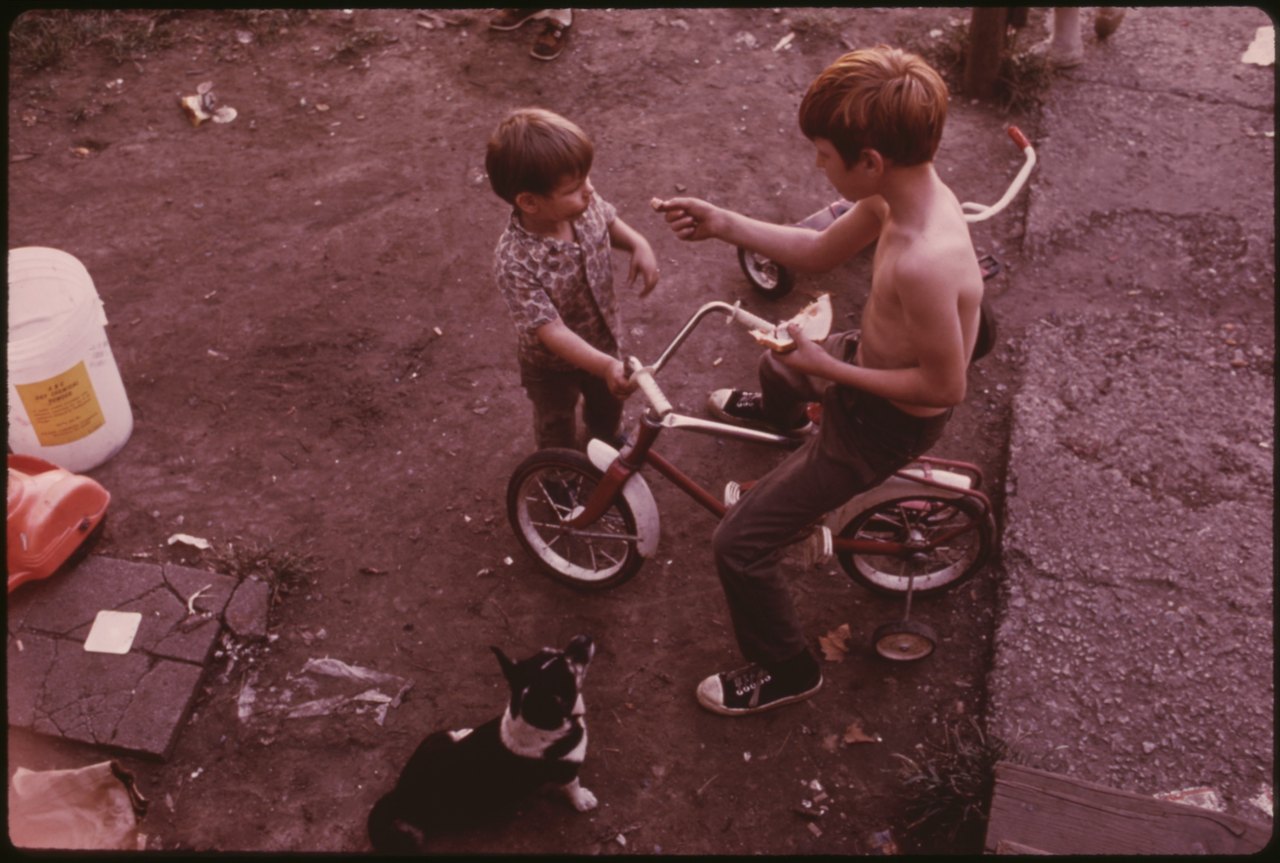
Visual AidTwo boys, a bicycle, and a puppy
Photograph by Kenneth Paik, taken in October 1973 for a government photography project, of two boys with a small bicycle and a puppy in a yard in the Mulky Square neighborhood of Kansas City. The Knowledge Bank says belonging is built from small anchors, a familiar walk, a neighbor’s wave, a spot that feels like your own, and that a child’s first friendships in a new place are the ropes tying him to his new life. This is what such an anchor looks like: two children, one bike, an ordinary patch of ground that is theirs. The boys are not Peter and Alex, and this is Kansas, not Princeton; the neighborhood was about to be torn down for a highway. Notice that nothing here is fancy — belonging rarely is.
Children at play in Mulky Square, Kansas City, October 1973; photograph by Kenneth Paik for the Documerica project, U.S. National Archives. Source: Wikimedia Commons, public domain.
friendn.p.63
A person you know well and like
“Alex becomes Peter’s good friend.”
neighborhoodn.p.64
The area around where you live
“They explore the new neighborhood.”
explorev.p.65
To travel through a place to discover it
“The boys explore the streets on bikes.”
belongv.p.70
To feel accepted and at home
“With a friend, Peter begins to belong.”
adjustv.p.72
To get used to something new
“Peter is slowly adjusting to Princeton.”
attituden.p.74
The way you think and feel about something
“His whole attitude begins to change.”
companionn.p.68
Someone who keeps you company
“Alex is a fine companion on bike rides.”
welcomeadj.p.76
Gladly received; making you feel at home
“The town starts to feel welcoming.”
ordinaryadj.p.67
Normal; not special or unusual
“They do ordinary, happy things together.”
contentadj.p.80
Quietly happy and satisfied
“Peter feels more content in Princeton.”
🧠Knowledge Bank question
1According to the Knowledge Bank, the first weeks in a strange place feel hardest because a child has ___.p.63
2A ‘neighborhood’ is —p.64
3Fill in each blank with the correct word.pp. 63–83
Word choices:explorebelongwelcomeadjust- some words will not be used
On their bikes, the boys the new streets.
With a good friend, Peter starts to in Princeton.
4To ‘belong’ is to —p.70
5A ‘companion’ is someone who keeps you company.p.68
6Your ‘attitude’ is —p.74
7Fill in each blank with the correct word.pp. 63–83
Word choices:contentordinaryattitudefriend- some words will not be used
By the end, Peter feels calm and in his new town.
The boys enjoy simple, days together.
8To ‘explore’ is to —p.65
9Something ‘ordinary’ is —p.67
10Someone ‘content’ is upset and never satisfied.p.80
Part 2
Comprehension
How well do you understand pages 63–83?
🧠Knowledge Bank · Tracking How a Character Changes
Narrative Logic · Tracking How a Character Changes
Characters in a good book are not statues; they change, and tracking that change is one of reading’s great pleasures. To do it, compare a character at two moments — how Peter felt about Princeton on his first day versus a few weeks in — and name what shifted. Blume plants these changes gradually, through small actions rather than big announcements, so a careful reader must hold the earlier Peter in mind to notice the later one. Asking what caused the change is just as important as spotting it; growth in a story usually follows an experience, a friendship, or a choice. When you can chart a character’s path from start to finish, you understand not only who he is, but who he is becoming.
Visual AidTwo moments, one character
Diagram for the Knowledge Bank on tracking how a character changes. The first and last cards are the two moments the Knowledge Bank tells you to compare, Peter on his first day in Princeton and Peter a few weeks in, and the middle card is the cause the Knowledge Bank says to look for between them. It names kinds of causes, not particular scenes. Notice that the middle card is the one readers most often skip — spotting the change is only half the job.
Two moments and the cause between them as described in the Knowledge Bank. Drawn for Garden Heights Academy.
🧠Knowledge Bank question
1The Knowledge Bank says to track how a character changes, you should ___.p.63
2How old is Alex compared to Peter?p.63
3What do the two boys do together?p.65
4Having a friend makes Peter hate Princeton even more.p.74
5Write the numbers 1–5 in the boxes to show the correct order across Part 4. Number 1 = what happens first.pp. 63–83
Peter’s whole attitude starts to change.
He meets a boy his age named Alex.
Peter arrives feeling lonely in Princeton.
Peter feels content and begins to belong.
They ride bikes and explore the neighborhood.
6Who keeps tagging along with the boys?p.68
7What is the new neighborhood like?p.64
8By the end of this part, Peter feels he —p.70
9Meeting Alex changes how Peter feels about the move.p.74
10How does Peter feel about Princeton now, compared to the start?p.80
Part 3
Literary Elements
Understanding HOW and WHY Judy Blume tells the story across pages 63–83.
🧠Knowledge Bank · Theme Literary Technique
Literary Technique · Theme Literary Technique
A theme is the big idea a story explores — a lesson about life that reaches beyond the plot itself. Superfudge is full of events, but underneath them runs a steady question: what makes a place, and a family, feel like home? Blume never prints the answer in a single sentence; instead she lets it surface through Peter’s move, his new friends, and his changing heart. That is how theme works: the writer trusts readers to gather the idea from many scenes, the way you sense a season from many small signs. Naming a theme turns a pile of events into a meaningful whole, and it lets a small family story carry a lesson about change that any reader can recognize.
📚 Literary Devices in This Part · definitions & examples
A theme is the big idea or life-lesson a story quietly teaches — different from the plot, which is simply what happens. Here the theme is that friendship can turn a strange place into a home. Blume does not announce it; she lets it grow out of Peter’s character growth as a new friend changes how he feels about his new setting.
🧠Knowledge Bank question
1According to the Knowledge Bank, the steady question underneath Superfudge is ___.p.74
2A theme is the deeper meaning of a story, not just the events.p.74
3Fill in each blank with the correct word.pp. 63–83
Word choices:themeplotrhymesetting- some words will not be used
The lesson that a friend makes a place a home is the
What actually happens — Peter meets Alex — is the .
4The theme of this part is that —p.74
5Character growth can be a way an author reveals a theme.p.72
6Fill in each blank with the correct word.pp. 63–83
Word choices:character growthsettingrhymeindex- some words will not be used
Peter changing from lonely to content is
The Princeton town where it all happens is the .
7How does Blume mainly reveal the theme?p.72
8Which event most helps the theme come alive?p.63
9Fill in each blank with the correct word.pp. 63–83
Word choices:themeplotsettingrhyme- some words will not be used
The sequence of events in the story is its
The meaning those events add up to is the .
10Noticing the theme mainly helps a reader understand —p.74
Part 4
Think Deeper
Four deeper challenges — no single-word recall. Read, weigh the evidence, and reason it through.
🧠Knowledge Bank · How a Place Becomes Home
Ethical Reasoning · How a Place Becomes Home
A house and a home are not the same thing. A house is walls and a roof; a home is the feeling of belonging that grows inside those walls over time. When the Hatchers arrive in Princeton, they have a house at once, but home takes longer, built from routines, memories, and people who know them. Researchers who study how families settle say that belonging is made, not given — it comes from repeated small moments rather than one big welcome. Ask what small acts are quietly turning his strange new street into a place he can trust. The episode tests what Peter values by handing him the one thing he was not expecting: a friend. A strange street stops being strange the moment somebody on it knows your name.
1Claim: “A new friendship helps Princeton feel like home.” — choose the two details that best prove it.Claim & Evidence
2Shows how Peter settles in, or just a detail of the scene? Tap each item to sort it — tap again to switch sides. You can keep tapping to change your answer.Sort into two
◄ How Peter settles inJust a detail ►
3Match each cause to its result. For each cause, pick its result.Cause & Effect
Peter dreads Princeton→
He meets Alex Santo→
They become real friends→
Peter finds a friend→
🧠Knowledge Bank question
4Fill both blanks to complete the reasoning.Build the Argument
The Knowledge Bank says belonging is made, not given, because it comes from , which is why a strange street stops being strange .
Part 5
Standardized Test
Key Details & Inference — SAT & TOEFL-style practice
Read the passage — the highlighted words are tested — then answer. Tap an answer, then tap it again to confirm.
SATWords in Context — a word's meaning in this passage
SATInference — a conclusion the passage implies
TOEFLFactual Information — a fact stated in the passage
TOEFLInsert Text — where a sentence best fits
How New Friendships Begin
Making a new friend is one of life's quiet miracles, and it often happens more simply than we expect. Many friendships begin with something small: two people who live nearby, sit near each other, or happen to like the same game. From that tiny start, a friendship grows whenever people spend time together and discover they enjoy having a companion. Sharing an activity, such as riding bikes or going out to explore a neighborhood, gives new friends an easy way to connect without having to force a conversation. Over time, small shared moments add up to trust, and trust is the heart of any real friendship. Scientists who study children have found that having even one good friend makes a young person feel they truly belong, which is why a single friendship can change how a whole place feels. Friendship does not require anything fancy; it grows from kindness, honesty, and time spent together. The best way to make a friend is simply to be one: reliable, ready to listen, and kind. A place with a friend in it rarely stays strange for long; little by little, it becomes a home.
Original passage written for Garden Heights — not a quotation from the novel.
1According to the passage, many friendships begin with something —TOEFL · Factual Information
2In the passage, a companion is ___.SAT · Words in Context
3To explore a neighborhood is to ___.SAT · Words in Context
4What did scientists find that even one good friend does for a child?TOEFL · Factual Information
5To “belong” means to feel —SAT · Words in Context
6According to the passage, how does a shared activity help new friends?TOEFL · Factual Information
7The passage says the best way to make a friend is to —TOEFL · Factual Information
8What can the reader infer is the passage’s main message?SAT · Inference
9According to the passage, a place with a friend in it rarely stays —TOEFL · Factual Information
10Insert Text (TOEFL). Look at the four squares [1]–[4] in the excerpt below. They show where this sentence could be added: “That slow, shared time, more than any grand gesture, is what turns two strangers into real friends.”
Friendship rarely needs anything fancy. [1] It grows from small, ordinary moments spent together. [2] Two people ride bikes, share a game, or explore a street. [3] Little by little, they come to trust and enjoy each other. [4]
Where would the sentence fit best?TOEFL · Insert Text
Part 6 · Optional
Creative Writing
A bonus challenge to practice your English. Take your time and have fun with it.
About This Section
This writing task is optional and is not part of your auto-graded score. The feedback below checks only the basics — length, spelling, and grammar — not whether your ideas are right or wrong. It is meant for classroom discussion and creative practice, so feel free to use your imagination!
Writing Task — Part 4 “A Good Friend”
Alex helps Peter feel at home in Princeton. Write about a good friend of yours — how you met, what you like to do together, and why the friendship matters. Or write about a time a friend helped you feel welcome somewhere new. Write at least 40 words.
You can start with: “A good friend of mine is…”
0 / 40 words minimum
🗣 Teach It · Just for Fun (optional)
No right or wrong — close the screen and tell someone nearby how meeting Alex helped Peter start to like Princeton. Can’t find anyone? Tell yourself out loud. The moment you teach it, you truly understand it.
Part 4 Complete!
You finished pages 63–83 of Superfudge.
Here are your auto-graded results:
-
points out of 100
Teach it to someone
The best last step is to teach it. In your own words, explain what happened — retell a favorite scene, teach a character’s big choice, or sum up the main idea for a parent, friend, or classmate. When you can teach it clearly, you truly own it.
Independent study guide by Garden Heights Academy. Not affiliated with or endorsed by the author or any rights holders. Contains original analysis only; no text from the novel is reproduced.
SAT® is a registered trademark of College Board, which is not affiliated with, and does not endorse, these materials. TOEFL® is a registered trademark of ETS. These materials are not endorsed or approved by ETS. Garden Heights is an independent provider of test-style reading practice.