New here? Just sign up with Google — your account includes Matilda, our gift book, forever.
What Happens in Part 5
It is Fudge’s turn for a big adventure: he starts kindergarten! But things go wrong from the very first day. Fudge insists that everyone must call him “Fudge,” but his teacher firmly refuses and calls him by his real name, Farley Drexel Hatcher. Fudge is outraged. He decides he does not like this teacher one bit, and — in true, over-the-top Fudge fashion — he even gives her a rude secret nickname and throws an epic tantrum, at one point kicking her. It is a full-blown kindergarten disaster, and the family is called in. Fudge, who is used to getting his own way at home, discovers that school has rules and a teacher who will not simply give in to him. The whole mess is enormously funny to read — Judy Blume piles the trouble sky-high — but underneath the comedy, Fudge is learning a hard lesson about being one small kid in a big new world.
What We Will Learn
Focus
What It Means
Hyperbole & Humor
Blume piling Fudge’s trouble sky-high for comedy
Characterization
Fudge meeting rules that will not bend to him
Theme (Growing Up)
Learning that home and school are different worlds
Chapter Summary
Pages
Key Events
pp. 84–103
Fudge starts kindergarten and it goes spectacularly wrong: he demands to be called ‘Fudge,’ his teacher insists on his real name, Farley, and Fudge rebels with a rude nickname and a tantrum — even kicking her — before learning that school has rules he cannot bend
💭 Before You Read · Warm-Up (not scored)
There are no wrong answers here — just think, guess, and talk:
Fudge is used to getting his way at home, but school has different rules. Why can that be such a hard adjustment for a little kid?
Blume makes Fudge’s tantrum wildly, hugely funny. How does exaggerating the trouble make a scene more comic?
Predict: after this rocky start, do you think Fudge will settle into kindergarten — or find brand-new ways to cause trouble?
Copyright Notice
This is an independent study guide created by Garden Heights Academy to support reading comprehension and literary analysis. It contains original analysis questions and does not reproduce any text from the novel. Superfudge is a work by Judy Blume. This guide is not affiliated with, authorized by, or endorsed by the author or any associated rights holder.
Part 1
Vocabulary
Study 10 key words from pages 84–103, then answer each question.
🧠Knowledge Bank · Words of the Classroom
Lexicology · Words of the Classroom
Starting at a new school asks a child to learn two things at once: the lessons on the board and the hidden rules of a whole new community. Every classroom has its own way of doing things — how you line up, when you may speak, what makes the teacher smile — and a newcomer must decode all of it while strangers watch. For a young child like Fudge, who has barely left home before, this can feel overwhelming, and big feelings often come out as bold or silly behavior. Older children like Peter face a quieter test: fitting in without losing themselves. Knowing that school is a social puzzle, not only an academic one, helps you understand why the Hatcher boys’ first days stir up so much trouble.
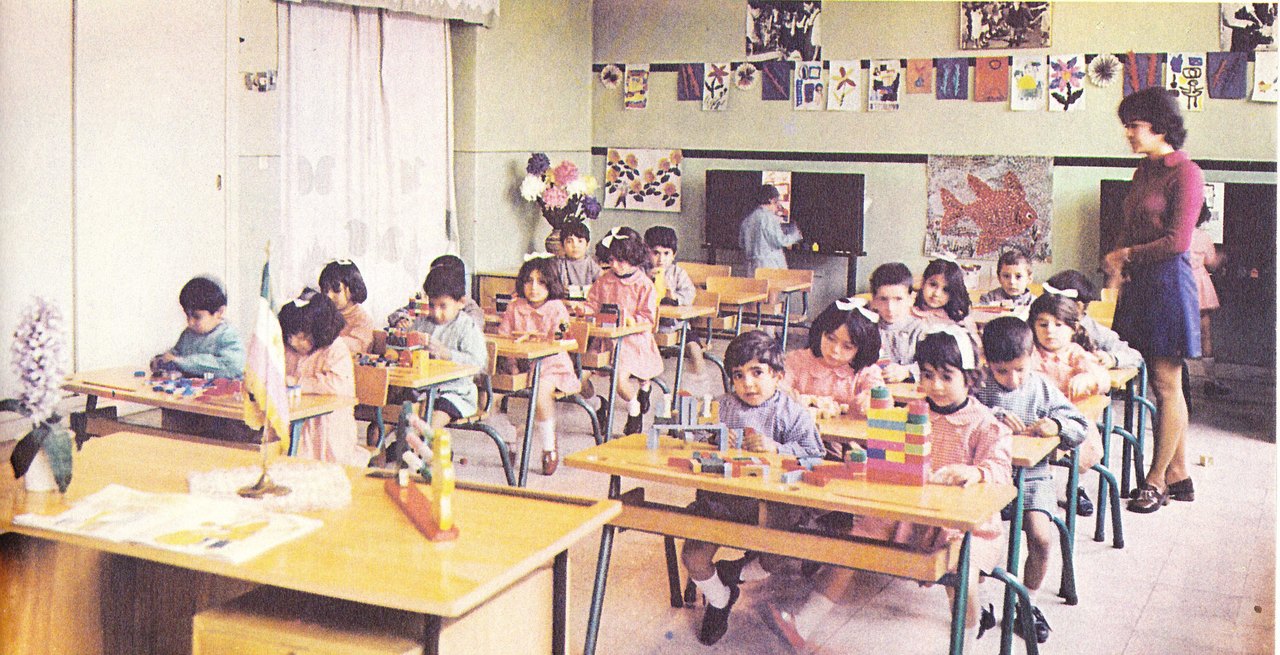
Visual AidTwenty children, one teacher
Photograph from 1972 of a preschool classroom in Iran, published in a government report three years later: about twenty small children at low tables with blocks and papers, and one teacher standing at the side. The Knowledge Bank explains that a new school asks a child to learn the hidden rules of a whole community, how you line up, when you may speak, what makes the teacher smile, while strangers watch. Every one of those rules is being learned at these tables. The classroom is in Iran, not Princeton, and the children are not Fudge’s classmates. Notice how many children share the one grown-up — that ratio is the whole shock of starting school.
Preschool classroom in Iran, 1972; photographer unknown, from a 1975 government publication, public domain. Source: Wikimedia Commons, public domain.
kindergartenn.p.84
A class for children just starting school
“Fudge begins kindergarten this year.”
insistv.p.86
To say firmly that something must be so
“Fudge insists on being called Fudge.”
refusev.p.87
To say you will not do something
“The teacher refuses to use his nickname.”
outragedadj.p.88
Very angry and offended
“Fudge is outraged by the teacher.”
tantrumn.p.92
A sudden fit of bad temper
“Fudge throws an epic tantrum.”
behavev.p.95
To act in a certain way
“Fudge does not behave in class.”
rulen.p.90
A statement of what you must or must not do
“School has rules to follow.”
exaggeratev.p.99
To make something seem bigger than it is
“The author exaggerates the trouble for laughs.”
stubbornadj.p.93
Refusing to change your mind
“Fudge is famously stubborn.”
firmadj.p.87
Strong and not giving in
“The teacher stays firm with Fudge.”
🧠Knowledge Bank question
1According to the Knowledge Bank, a newcomer at school must decode ___.p.84
2To ‘insist’ is to —p.86
3Fill in each blank with the correct word.pp. 84–103
Word choices:refuseoutragedbehaverule- some words will not be used
The teacher will to use his nickname.
Fudge is that she will not call him Fudge.
4Someone ‘outraged’ is —p.88
5A ‘tantrum’ is a sudden fit of bad temper.p.92
6To ‘behave’ is to —p.95
7Fill in each blank with the correct word.pp. 84–103
Word choices:stubbornexaggeratefirminsist- some words will not be used
Never changing his mind, Fudge is famously
Blume likes to the trouble to make readers laugh.
8To ‘refuse’ is to —p.87
9Someone ‘stubborn’ —p.93
10Someone ‘firm’ gives in easily to whatever is asked.p.87
Part 2
Comprehension
How well do you understand pages 84–103?
🧠Knowledge Bank · Reading for Cause and Effect
Narrative Logic · Reading for Cause and Effect
Stories run on cause and effect: one event makes another happen, like a line of dominoes. A strong reader keeps asking why did that happen, and what will it lead to, linking each moment to the ones around it. When Fudge acts up in kindergarten, the trouble does not come from nowhere; a cause sits behind it, and a consequence follows. Blume builds both her humor and her lessons on these chains, so missing a cause means missing the point of the joke or the growth. Tracing cause and effect also helps you predict, because once you spot the pattern you can guess where a character’s choices are heading. Sorting what led to what turns a string of funny scenes into a story that actually makes sense.
Visual AidOne event knocks over the next
Diagram for the Knowledge Bank on cause and effect. The three cards are the chain the Knowledge Bank describes, a cause behind Fudge’s kindergarten trouble, the event itself, and the consequence that follows, with the two questions a strong reader keeps asking written under the arrows. It does not name the exact scene. Notice that the questions point in both directions — backward to the cause and forward to the effect, which is also how prediction works.
Cause, event and effect as described in the Knowledge Bank. Drawn for Garden Heights Academy.
🧠Knowledge Bank question
1The Knowledge Bank says that when Fudge acts up in kindergarten, ___.p.84
2What does Fudge insist everyone call him?p.86
3What does the teacher call him instead?p.87
4Fudge is delighted that the teacher won’t say ‘Fudge.’p.88
5Write the numbers 1–5 in the boxes to show the correct order across Part 5. Number 1 = what happens first.pp. 84–103
Outraged, Fudge invents a rude nickname for her.
The family is called in about his behavior.
The teacher refuses and uses ‘Farley.’
He throws a tantrum and kicks the teacher.
Fudge starts kindergarten and insists on his name.
6What does Fudge do at his worst moment?p.92
7What happens because of Fudge’s behavior?p.94
8What does Fudge discover about school?p.90
9The teacher stays firm and does not give in to Fudge.p.87
10Why is the kindergarten mess so hard for Fudge?p.93
Part 3
Literary Elements
Understanding HOW and WHY Judy Blume tells the story across pages 84–103.
🧠Knowledge Bank · Hyperbole & Humor
Literary Technique · Hyperbole & Humor
Hyperbole is deliberate exaggeration — stretching the truth on purpose to make a point or spark a laugh. When a narrator calls something the worst thing that has ever happened in the history of the world, he does not mean it literally; he means he feels it strongly. Blume uses hyperbole to match how children actually experience life, where a small embarrassment can seem enormous and a good day can feel endless. That is why her humor rings true even as it exaggerates: the size of the feeling is real, only the words are blown up. Spotting hyperbole teaches a reader to separate the fact from the feeling, and to enjoy the way a well-aimed exaggeration can be both funny and surprisingly honest.
📚 Literary Devices in This Part · definitions & examples
Hyperbole is deliberate exaggeration — making something far bigger, louder, or more extreme than it really is — often used for humor. Blume exaggerates Fudge’s first day into a giant disaster to make readers laugh, while keeping his character believable: the huge fuss grows from a real feeling of being overwhelmed.
🧠Knowledge Bank question
1According to the Knowledge Bank, hyperbole is ___.p.99
2Hyperbole means making something bigger or more extreme than it really is.p.99
3Fill in each blank with the correct word.pp. 84–103
Word choices:hyperbolehumorsettingrhyme- some words will not be used
Blowing the trouble up far past real life is
The laughter it creates is the scene’s .
4Blume uses hyperbole here mainly to —p.99
5Even with the exaggeration, Fudge’s feelings stay believable and true.p.93
6Fill in each blank with the correct word.pp. 84–103
Word choices:hyperbolecharacterizationrhymeindex- some words will not be used
Fudge’s giant reaction to a small matter is
Showing us he is stubborn through his acts is .
7Fudge’s huge reaction to a small matter (his name) is an example of —p.88
8A wobbly first day at school is a realistic experience many children share.p.84
9Fill in each blank with the correct word.pp. 84–103
Word choices:humorhyperbolesettingplot- some words will not be used
Spotting the exaggeration lets us enjoy the story’s
Piling trouble sky-high is the tool called .
10Spotting hyperbole mainly helps a reader enjoy —p.99
Part 4
Think Deeper
Four deeper challenges — no single-word recall. Read, weigh the evidence, and reason it through.
🧠Knowledge Bank · Home Rules vs. School Rules
Ethical Reasoning · Home Rules vs. School Rules
At home, Fudge is used to one set of rules, made by parents who love him and bend when he cries. School runs on different rules, the same for everyone, kept by a teacher who cannot stop for one child’s feelings. Learning that different places carry different expectations is a real developmental step, and young children often clash with it hard before they master it. Psychologists call this learning to read social context — understanding that behavior welcome in one setting may not fit another. Peter already knows this dance; Fudge is only beginning it, which is why his classroom antics feel so familiar to any older sibling. Blume is not mocking either brother; she is showing one lesson arriving at two different ages.
1Claim: “Fudge’s stubbornness turns his first day of school into a battle.” — choose the two details that best prove it.Claim & Evidence
2Shows the name-battle conflict, or just a detail of the scene? Tap each item to sort it — tap again to switch sides. You can keep tapping to change your answer.Sort into two
◄ The name-battle conflictJust a detail ►
3Match each cause to its result. For each cause, pick its result.Cause & Effect
Fudge starts kindergarten→
Fudge demands to be called ‘Fudge’→
She uses his real name→
Neither will give in→
🧠Knowledge Bank question
4Fill both blanks to complete the reasoning.Build the Argument
The Knowledge Bank says home rules and school rules differ because school rules , and learning that different places carry different expectations is .
Part 5
Standardized Test
Key Details & Inference — SAT & TOEFL-style practice
Read the passage — the highlighted words are tested — then answer. Tap an answer, then tap it again to confirm.
SATWords in Context — a word's meaning in this passage
SATInference — a conclusion the passage implies
TOEFLFactual Information — a fact stated in the passage
TOEFLRhetorical Purpose — why the author included a detail
The Big Adjustment of Starting School
For many young children, kindergarten is the first big step into the wider world, and not an easy one. At home, a small child is often the center of attention, but school is different. A kindergarten class may hold twenty children, all sharing one teacher, and each child must learn to take turns, to wait, and to follow rules that a parent did not make. This can be a shock. A child who is used to getting their own way may refuse to join in at first, or grow upset. A good teacher helps by staying firm and kind at the same time: firm about the rules, so the class is fair, and kind enough that each child feels safe. Little by little, most children learn that following rules is not a punishment but a way of helping everyone get along. They make friends, learn to share, and begin to enjoy the routine of school days. The child who cried on the first morning is often, weeks later, racing happily through the classroom door. Starting school teaches more than letters and numbers; it teaches the great lesson of living with others.
Original passage written for Garden Heights — not a quotation from the novel.
1Why can kindergarten be a shock, according to the passage?TOEFL · Factual Information
2A child must follow “rules” at school, meaning —SAT · Words in Context
3A child may refuse to join in, meaning they ___.SAT · Words in Context
4How does the passage say a good teacher helps a new class?TOEFL · Factual Information
5A teacher who stays “firm” is one who —SAT · Words in Context
6Most children eventually learn that following rules is —TOEFL · Factual Information
7Over time, the passage says, children who start school begin to —TOEFL · Factual Information
8What can the reader infer about the child who cried on the first day?SAT · Inference
9The passage says starting school teaches, above all, how to —SAT · Inference
A bonus challenge to practice your English. Take your time and have fun with it.
About This Section
This writing task is optional and is not part of your auto-graded score. The feedback below checks only the basics — length, spelling, and grammar — not whether your ideas are right or wrong. It is meant for classroom discussion and creative practice, so feel free to use your imagination!
Writing Task — Part 5 “My First Day”
Fudge’s first day of kindergarten is unforgettable — for all the wrong reasons. Write about a first day of your own — a new school, class, team, or place — and how it felt. Or write about a rule you found hard to follow at first. Write at least 40 words.
You can start with: “A first day I remember is…”
0 / 40 words minimum
🗣 Teach It · Just for Fun (optional)
No right or wrong — close the screen and tell someone nearby about Fudge’s wild first day of kindergarten. Can’t find anyone? Tell yourself out loud. The moment you teach it, you truly understand it.
Part 5 Complete!
You finished pages 84–103 of Superfudge.
Here are your auto-graded results:
-
points out of 100
Teach it to someone
The best last step is to teach it. In your own words, explain what happened — retell a favorite scene, teach a character’s big choice, or sum up the main idea for a parent, friend, or classmate. When you can teach it clearly, you truly own it.
Independent study guide by Garden Heights Academy. Not affiliated with or endorsed by the author or any rights holders. Contains original analysis only; no text from the novel is reproduced.
SAT® is a registered trademark of College Board, which is not affiliated with, and does not endorse, these materials. TOEFL® is a registered trademark of ETS. These materials are not endorsed or approved by ETS. Garden Heights is an independent provider of test-style reading practice.