New here? Just sign up with Google — your account includes Matilda, our gift book, forever.
What Happens in Part 6
The day of the contest arrives, and Room 13 takes everyone’s breath away. The girls’ side of the room is covered with one hundred drawings of dresses — brilliant, dazzling, every one a different color and design. And every single one was drawn by Wanda Petronski. Miss Mason announces that Wanda has won the medal; there was never any contest. But Wanda is not there to hear it. Miss Mason reads a letter from Wanda’s father: the family has moved away to a big city, where no one will laugh at a funny name or a foreign family. The room falls silent. The girls who teased Wanda about a hundred dresses now stand surrounded by a hundred beautiful dresses she made — and she is gone. Into that silence, the first cold weight of guilt settles over Peggy and Maddie.
What We Will Learn
Focus
What It Means
Climax
The story’s turning point — the medal, the drawings, the empty seat
Dramatic Irony
We and the class now grasp what the teasers never did
Foil
Two characters set side by side so each shows the other more clearly
Chapter Summary
Chapter
Key Events
Ch. 5 — The Hundred Dresses
The room is filled with one hundred dazzling drawings of dresses, all by Wanda, who wins the medal. But she has moved away: her father’s letter says the family left to escape being mocked. The class stands in silence, and guilt settles over Peggy and Maddie.
💭 Before You Read · Warm-Up (not scored)
There are no wrong answers here — just think, guess, and talk:
Why might a family choose to leave a whole town rather than keep facing unkindness?
The girls mocked Wanda about dresses — and she turns out to be a brilliant dress artist. Why does that make the moment sting so much?
Predict: now that Wanda is gone, what do you think Peggy and Maddie will do?
Copyright Notice
This is an independent study guide created by Garden Heights Academy to support reading comprehension and literary analysis. It contains original analysis questions and does not reproduce any text from the novel. The Hundred Dresses is a work by Eleanor Estes. This guide is not affiliated with, authorized by, or endorsed by the author or any associated rights holder.
Part 1
Vocabulary
Study 10 key words from Chapter 5, then answer each question.
🧠Knowledge Bank · Why a Family Moves Away
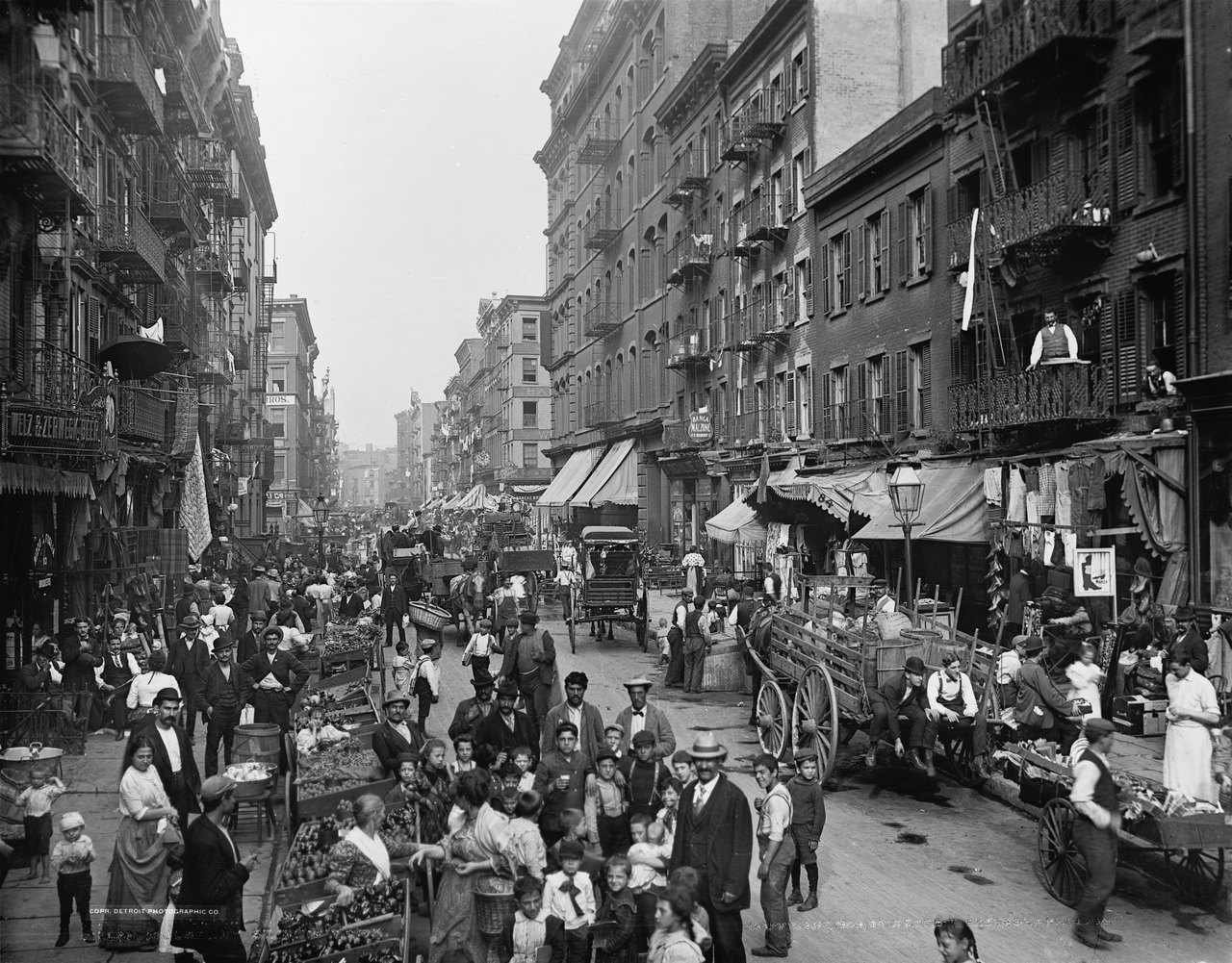
History · Prejudice and MigrationPrejudice means judging people before knowing them, usually by a name, an accent, a religion or a coat. Immigrant families in mid-century America met it constantly, and one common answer was to move again. Cities offered crowded neighborhoods where a Polish or Italian surname was ordinary, where shops sold familiar food and nobody stumbled over a greeting. Historians describe whole districts built by that search, block after block of people who left small towns for the relief of being unremarkable. Such a move is rarely an adventure. It is a family deciding that the daily cost of being mocked outweighs the cost of starting over somewhere anonymous.
Visual AidAn immigrant street, about 1900
Hand-colored photograph, made around 1900 by the Detroit Publishing Company, of Mulberry Street in New York City, a street of tall tenements, pushcarts, awnings, and hundreds of people, most of them Italian immigrants. The Knowledge Bank explains that immigrant families facing prejudice in small towns often moved again to crowded city neighborhoods where their surname was ordinary, the shops sold familiar food, and nobody stumbled over a greeting. This is one of the districts that search built. It is an Italian street rather than a Polish one, and it was photographed decades before the story. Notice how full the street is — here, being unremarkable was the whole relief.
Mulberry Street, New York City, about 1900; Detroit Publishing Company, Library of Congress. Source: Wikimedia Commons, public domain.
brilliantadj.Ch.5
Very bright; also very fine or clever
“The dresses were brilliant in color.”
dazzlingadj.Ch.5
So bright it almost blinds; amazing
“A dazzling row of drawings.”
stunnedadj.Ch.5
Shocked; unable to speak or move
“The class sat stunned and silent.”
gaspv.Ch.5
To catch your breath in surprise
“The girls gasped at the drawings.”
prejudicen.Ch.5
An unfair opinion formed without really knowing
“Prejudice drove the family away.”
departv.Ch.5
To leave; to go away
“The Petronskis had departed for good.”
realizev.Ch.5
To suddenly understand something
“Maddie began to realize the truth.”
remarkableadj.Ch.5
Unusual and worth noticing
“Wanda had a remarkable gift.”
silencen.Ch.5
Complete quiet
“A deep silence filled Room 13.”
regretn.Ch.5
A sad feeling about what you did or failed to do
“Maddie felt a stab of regret.”
🧠Knowledge Bank question
1According to the Knowledge Bank, immigrant families often moved to crowded city neighborhoods for ___.Ch.5
2A ‘dazzling’ sight is one that is —Ch.5
3Fill in each blank with the correct word.Ch. 5
Word choices:prejudicedepartsilenceregret- some words will not be used
An unfair opinion formed without really knowing is .
To leave or to go away is to .
4To be ‘stunned’ is to be —Ch.5
5To ‘gasp’ is to catch your breath in surprise.Ch.5
6‘Prejudice’ means —Ch.5
7Fill in each blank with the correct word.Ch. 5
Word choices:realizeremarkablestunnedgasp- some words will not be used
To suddenly understand something is to it.
Something unusual and worth noticing is .
8‘Silence’ is —Ch.5
9To ‘depart’ is to —Ch.5
10‘Regret’ is a proud, happy feeling about a fine thing you did.Ch.5
Part 2
Comprehension
How well do you understand Chapter 5?
📚Knowledge Bank · The Story’s Turning Point
Reading Skill · Turning PointsMost books hold one moment after which nothing can return to how it was, and finding it is a skill worth practicing. A turning point usually arrives as new information rather than a new event, and it often carries two feelings at once. That is true here, where the class receives news lifting one girl up and news removing her within the same few minutes. On reaching such a moment, ask three questions. What exactly changed, who now knows something they did not know before, and what has become impossible? The third is sharpest, because a turning point is defined by what can no longer be undone.
Visual AidThree questions at a turning point
Diagram for the Knowledge Bank on turning points. The red card is the turning point as the Knowledge Bank describes it, two pieces of news within the same few minutes, and the three cards beneath are the three questions the Knowledge Bank says to ask on reaching such a moment, with the last marked as the sharpest. It does not say what the news is. Notice that the third question is about what is impossible, not what happened — that is how you know a turning point from an ordinary event.
The turning point and its three questions as described in the Knowledge Bank. Drawn for Garden Heights Academy.
🧠Knowledge Bank question
1The Knowledge Bank says a turning point is defined by ___.Ch.5
2Who drew all one hundred of the dresses?Ch.5
3Who wins the medal?Ch.5
4Why is Wanda not there to receive her medal?Ch.5
5Write the numbers 1–5 in the boxes to show the order of events in Chapter 5. Number 1 = what happens first.Ch. 5
Miss Mason announces that Wanda has won.
Guilt settles over Peggy and Maddie.
They realize every drawing is Wanda’s work.
A letter from Wanda’s father reaches the class.
The class sees a hundred dazzling dress drawings.
6Who wrote the letter that Miss Mason reads?Ch.5
7Why does the letter say the family has moved?Ch.5
8How does the classroom feel after the letter is read?Ch.5
9Wanda’s hundred dresses turn out to be real silk gowns in a closet.Ch.5
10Peggy and Maddie begin to feel guilty once they understand what has happened.Ch.5
Part 3
Literary Elements
Understanding HOW and WHY Eleanor Estes tells the story in Chapter 5.
🎭Knowledge Bank · Climax, Dramatic Irony and Foils
Literary Craft · The Highest PointThe climax is the peak a story has been climbing toward, and skilled writers often let it happen quietly. Estes withholds speeches; a room simply goes still, and stillness carries weight that shouting would waste. Layered over the moment is dramatic irony, which occurs when a reader, or a character, understands something too late for the understanding to help. Beside it sits the foil, a character placed next to another so contrast sharpens both, the way one girl’s admired confidence throws another girl’s hidden gift into relief. Craft like this explains how a scene with almost no dialogue becomes the loudest in a book.
📚 Literary Devices in This Part · definitions & examples
Climax is the turning point where the story’s tension peaks (the medal, the drawings, the empty seat). Dramatic irony is when we understand something a character does not, or grasp it too late (the class sees Wanda’s worth only after she is gone). A foil is a character who contrasts with another to highlight their traits (gifted, humble Wanda beside admired, careless Peggy).
🧠Knowledge Bank question
1According to the Knowledge Bank, a foil is ___.Ch.5
2Dramatic irony is when the reader understands something the characters do not, or grasp too late.Ch.5
3Fill in each blank with the correct word.Ch. 5
Word choices:climaxfoilrhymeindex- some words will not be used
The story’s highest turning point is the .
A character set beside another to show contrast is a .
4Humble, gifted Wanda placed beside admired, careless Peggy is an example of a —Ch.5
5A foil is a character who is exactly the same as another in every way.Ch.5
6Fill in the blank with the correct word.Ch. 5
Word choices:climaxrhymesetting- some words will not be used
The peak moment where the tension breaks open is the story’s .
7Why is it dramatic irony that the class praises Wanda now?Ch.5
8Setting kind, quiet Wanda beside proud, popular Peggy mainly works as a —Ch.5
9Fill in the blank with the correct word.Ch. 5
Word choices:climaxrhymeplot- some words will not be used
The moment the drawings are revealed and Wanda is gone is the book’s .
10The silence of the room at the climax mainly makes the guilt feel —Ch.5
Part 4
Think Deeper
Four deeper challenges — no single-word recall. Read, weigh the evidence, and reason it through.
💭Knowledge Bank · The Price Everyone Pays
Social Studies · The Cost of PrejudiceUnfair judgment is usually discussed as harm done to one person, yet it charges the group as well. A class that decided in advance who was worth knowing spent a year beside someone it never asked a single real question, and what it lost cannot be recovered. Economists studying discrimination make the same point about workplaces and whole countries: ability that goes unrecognized is ability nobody gets to use. The private version of that cost has a familiar name, regret, and it stings particularly because the chance it mourns was available on any ordinary day. Seeing people accurately, while they are still nearby, is the only remedy.
1Claim: “The hundred dazzling drawings reveal Wanda’s hidden gift.” — choose the two details that best prove it.Claim & Evidence
2Shows Wanda’s talent revealed, or just a detail? Tap each item to sort it — tap again to switch sides. You can keep tapping to change your answer.Sort into two
◄ Wanda’s talent revealedJust a detail ►
3Match each cause to its result. For each cause, pick its result.Cause & Effect
The contest results are shown→
There are a hundred dress drawings→
All were drawn by Wanda→
Her talent is undeniable→
🧠Knowledge Bank question
4Fill both blanks to complete the reasoning.Build the Argument
The Knowledge Bank says prejudice charges the group as well, because a class that decided in advance who was worth knowing , and the private name for that cost is .
Part 5
Standardized Test
When People Move to Belong — SAT & TOEFL-style practice
Read the passage — the highlighted words are tested — then answer. Tap an answer, then tap it again to confirm.
SATWords in Context — a word's meaning in this passage
TOEFLFactual Information — a fact stated in the passage
TOEFLProse Summary — the three sentences that sum it up
TOEFLRhetorical Purpose — why the author included a detail
Prejudice and the Urge to Flee
Why do families sometimes pack up and leave a place they have lived for years? One painful reason is prejudice, an unfair judgment made about people before anyone truly knows them. A family might be looked down on for being poor, for coming from another country, or simply for having a name that others find strange. Day after day, small unkindnesses add up, until leaving feels easier than staying. So they move, hoping that among new faces they might at last be seen for who they really are. Sometimes this helps; sometimes the same troubles follow. But the deepest cure is not moving at all. It is a community that chooses to respect its neighbors, to learn their names and welcome their differences, so that everyone feels they truly belong. When people are treated with that kindness, they rarely feel the need to depart.
Original passage written for Garden Heights — not a quotation from the novel.
1According to the passage, what is one painful reason families move away?TOEFL · Factual Information
2For what reasons might a family be looked down on?TOEFL · Factual Information
3In the passage, prejudice is ___.SAT · Words in Context
4What does the passage call the ‘deepest cure’?TOEFL · Factual Information
5To “belong” means to feel that you —SAT · Words in Context
6Does moving always solve the problem, according to the passage?TOEFL · Factual Information
7To depart is to ___.SAT · Words in Context
8When are people said to rarely feel the need to flee?TOEFL · Factual Information
9This TOEFL task lists six sentences; choose the THREE that best capture the passage’s main ideas. The other three do not belong — they state minor details or ideas the passage does not present.TOEFL · Prose Summary
10This passage connects to Part 6 because Wanda’s family —TOEFL · Rhetorical Purpose
Part 6 · Optional
Creative Writing
A bonus challenge to practice your English. Take your time and have fun with it.
About This Section
This writing task is optional and is not part of your auto-graded score. The feedback below checks only the basics — length, spelling, and grammar — not whether your ideas are right or wrong. It is meant for classroom discussion and creative practice, so feel free to use your imagination!
Writing Task — Part 6 “The Silent Room”
Imagine you are standing in Room 13 as the hundred drawings are revealed and the letter is read. How does the room feel? What are you thinking as you look at Wanda’s beautiful dresses and her empty seat? Write about that silent, heavy moment. Write at least 40 words.
You can start with: “The room went completely silent as we looked at…”
0 / 40 words minimum
🗣 Teach It · Just for Fun (optional)
No right or wrong — close the screen and tell someone nearby what the class discovers at the contest, and why Wanda’s family moved away. Can’t find anyone? Tell yourself out loud. The moment you teach it, you truly understand it.
Part 6 Complete!
You finished Chapter 5 of The Hundred Dresses.
Here are your auto-graded results:
-
points out of 100
Teach it to someone
The best last step is to teach it. In your own words, explain what happened — retell a favorite scene, teach a character’s big choice, or sum up the main idea for a parent, friend, or classmate. When you can teach it clearly, you truly own it.
Independent study guide by Garden Heights Academy. Not affiliated with or endorsed by the author or any rights holders. Contains original analysis only; no text from the novel is reproduced.
SAT® is a registered trademark of College Board, which is not affiliated with, and does not endorse, these materials. TOEFL® is a registered trademark of ETS. These materials are not endorsed or approved by ETS. Garden Heights is an independent provider of test-style reading practice.