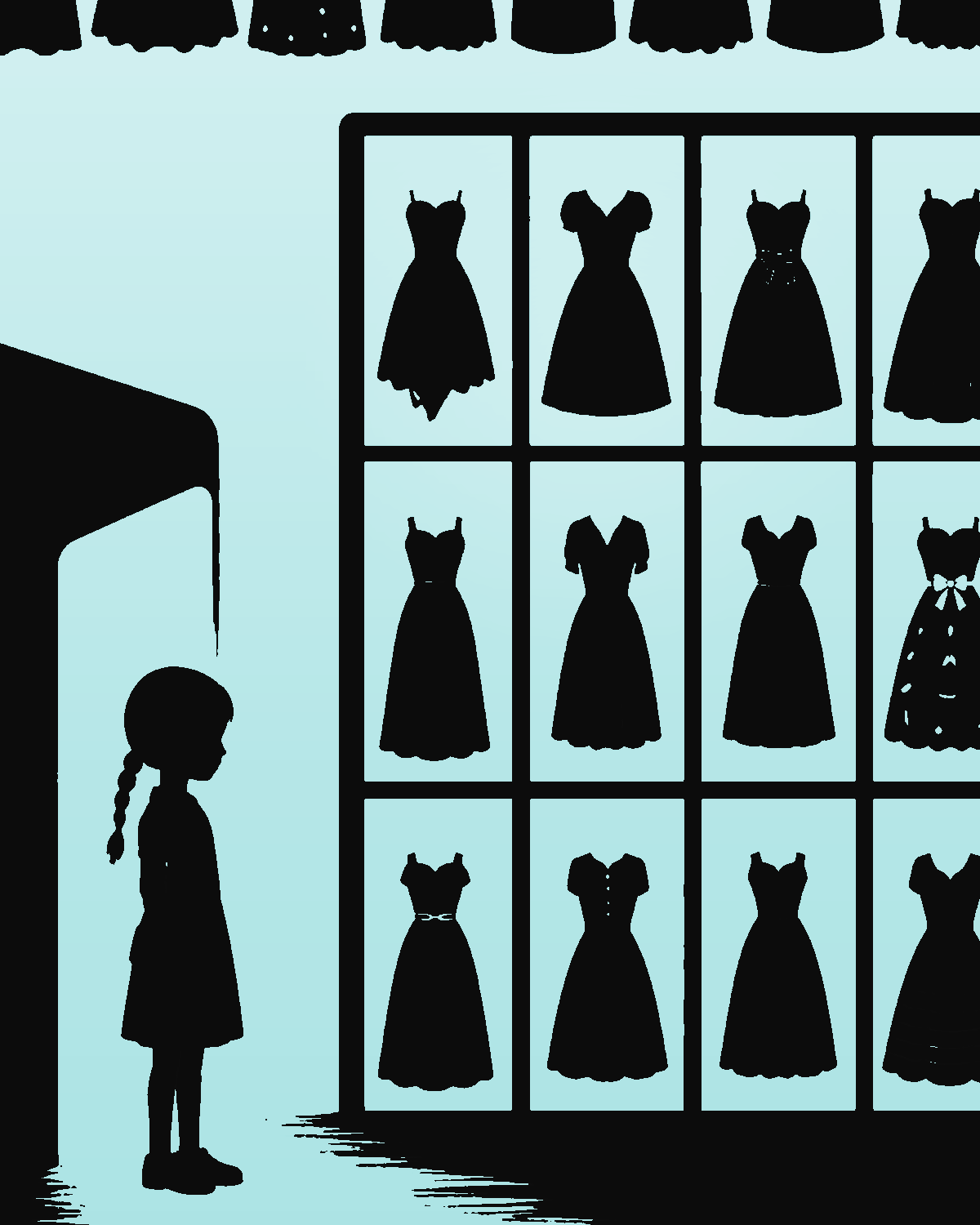
The Hundred Dresses cover
Garden Heights Academy

The Hundred Dresses

This workbook is for Garden Heights members. Sign in to continue.

Sign in with Google →
New here? Just sign up with Google — your account includes Matilda, our gift book, forever.
What Happens in Part 7

Maddie cannot live with her guilt. She begs Peggy to go with her up to Boggins Heights, to Wanda’s house, so they can tell her that she won the medal — and, though Maddie hardly dares say it, so they can say they are sorry. The two girls trudge up the long, lonely hill as dusk falls. But when they reach the little house, they find it dark, closed, and deserted. The Petronskis are truly gone. Standing before the empty house, Maddie feels her remorse turn into something firm and lasting. She makes a promise to herself: never again will she stand silently by while someone is treated unkindly — not even if speaking up costs her a friend. Peggy is sorry too, in her way, but it troubles her less; she tells herself she never really did anything so wrong. The two girls walk home in the dark, changed by what they did not find.

What We Will Learn
FocusWhat It Means
Dynamic CharacterA character who changes inside the story — Maddie grows
SimileA comparison using ‘like’ or ‘as’ to paint a picture
Falling ActionThe events after the climax that carry us toward the end
Chapter Summary
ChapterKey Events
Ch. 6 — Up on Boggins HeightsMaddie and Peggy climb to Wanda’s house to apologize and share her good news, but the house is dark and deserted — the family has gone. Maddie vows never again to stay silent while someone is treated unkindly. Peggy is sorry, but troubled far less.
💭 Before You Read · Warm-Up (not scored)

There are no wrong answers here — just think, guess, and talk:

  • Have you ever wanted to say sorry to someone but missed your chance? How did it feel?
  • Maddie and Peggy do the same wrong, yet feel it very differently. Why might two people react so unlike each other?
  • Predict: how do you think Maddie will keep the promise she makes to herself?
Copyright Notice

This is an independent study guide created by Garden Heights Academy to support reading comprehension and literary analysis. It contains original analysis questions and does not reproduce any text from the novel. The Hundred Dresses is a work by Eleanor Estes. This guide is not affiliated with, authorized by, or endorsed by the author or any associated rights holder.

Part 1
Vocabulary
Study 10 key words from Chapter 6, then answer each question.
🧠Knowledge Bank · Feeling What Others Feel
Psychology · Empathy and RemorseEmpathy is the ability to build another person’s experience inside your own mind — not pity offered from a distance, but a reconstruction of how a morning felt from the other desk. It grows with practice, and psychologists find that reading stories, of all things, strengthens it. Remorse is what follows when empathy lands on something you did: a sharp, specific sorrow attached to an act rather than a vague bad mood. The two together do real work, because sorrow without imagination stays comfortable and imagination without sorrow changes nothing. A long hill, climbed slowly with time to think, is exactly when both tend to arrive.
empathyn.Ch.6
Understanding how another person feels
“Empathy let Maddie feel Wanda’s hurt.”
remorsen.Ch.6
Deep, sorry regret for a wrong done
“Maddie was filled with remorse.”
resolvev.Ch.6
To decide something firmly
“She resolved never to stay silent.”
desertedadj.Ch.6
Empty; left behind and abandoned
“The little house was deserted.”
trudgev.Ch.6
To walk slowly with heavy, tired steps
“They trudged up the long hill.”
wearyadj.Ch.6
Very tired
“The girls felt weary and sad.”
apologizev.Ch.6
To say that you are sorry
“They came to apologize to Wanda.”
vowv.Ch.6
To make a serious promise
“Maddie made a solemn vow.”
forlornadj.Ch.6
Sad and lonely
“The empty house looked forlorn.”
dimadj.Ch.6
Not bright; faintly lit
“They climbed in the dim dusk.”
1‘Empathy’ is —Ch.6
2‘Remorse’ is —Ch.6
3Fill in each blank with the correct word.Ch. 6
Word choices:resolvedesertedapologizeweary- some words will not be used
To decide something firmly is to .
A house that is empty and abandoned is .
4To ‘trudge’ is to —Ch.6
5To ‘apologize’ is to say that you are sorry.Ch.6
6To ‘vow’ is to —Ch.6
7Fill in each blank with the correct word.Ch. 6
Word choices:forlorndimempathyvow- some words will not be used
A sad and lonely house looks .
Light that is faint and not bright is .
8To be ‘weary’ is to be —Ch.6
9Something ‘deserted’ is —Ch.6
10A ‘forlorn’ place feels cheerful, warm, and full of happy people.Ch.6
Part 2
Comprehension
How well do you understand Chapter 6?
📚Knowledge Bank · Watching a Character Change
Reading Skill · Character GrowthSome characters finish a book precisely as they started; others are altered, and tracing the alteration is one of reading’s pleasures. Change is easiest to follow as a sequence: a feeling, then a realization, then a decision. Maddie moves through all three here, and the decision is the piece that counts, because feelings fade while decisions can be kept. Compare her with Peggy, who meets identical facts and files them away almost untouched. That comparison is the author’s real argument, since it shows events alone change nobody. Naming what a character has resolved to do is the surest way to say how far she has grown.
1Where does Maddie ask Peggy to go with her?Ch.6
2Why do the girls go to Wanda’s house?Ch.6
3What do the girls find at Wanda’s house?Ch.6
4What promise does Maddie make to herself?Ch.6
5Write the numbers 1–5 in the boxes to show the order of events in Chapter 6. Number 1 = what happens first.Ch. 6
  • She begs Peggy to come find Wanda with her.
  • They find the house dark, closed, and empty.
  • They trudge up the long, lonely hill at dusk.
  • Maddie’s guilt grows too heavy to bear.
  • Maddie vows never to stay silent again.
6How does Maddie feel as she stands before the empty house?Ch.6
7How does Peggy feel about what they did, compared with Maddie?Ch.6
8What does Peggy tell herself to feel better?Ch.6
9The girls find Wanda at home and give her the medal in person.Ch.6
10Maddie is changed by the visit and resolves to act differently from now on.Ch.6
Part 3
Literary Elements
Understanding HOW and WHY Eleanor Estes tells the story in Chapter 6.
🎭Knowledge Bank · After the Peak
Literary Craft · Falling Action and SimileA story does not stop at its loudest moment; something has to settle. The stretch afterward is falling action, and it exists so a reader can watch consequences instead of merely hearing about them. Writers fill it with small physical business — a walk, a closed door, a long hill at dusk — because feelings become visible only when fastened to something you can see. A simile serves the same end, comparing one thing to another with like or as, so an abstract weight turns into an object with size. A character genuinely altered inside is called dynamic, which is what these quiet pages are built to show.
📚 Literary Devices in This Part · definitions & examples
A dynamic character is one who changes during the story (Maddie, who learns and vows to do better). A simile compares two things using ‘like’ or ‘as’ (the house stood as still as a held breath). Falling action is what happens after the climax, easing the story toward its ending (the sorry walk up the hill).
1Maddie, who changes and grows across the story, is a —Ch.6
2A simile compares two things using the word ‘like’ or ‘as.’Ch.6
3Fill in each blank with the correct word.Ch. 6
Word choices:similedynamicrhymeindex- some words will not be used
‘The house was as dark as a closed eye’ is a .
A character who changes across the story is a character.
4The quieter events after the climax, easing toward the ending, are called the —Ch.6
5A dynamic character stays exactly the same from beginning to end.Ch.6
6Fill in the blank with the correct word.Ch. 6
Word choices:similerhymesetting- some words will not be used
‘Her guilt sat on her like a heavy stone’ is a .
7Which change in Maddie best shows she is a dynamic character?Ch.6
8‘The empty house watched them like a sad, closed face’ is an example of a —Ch.6
9Fill in the blank with the correct word.Ch. 6
Word choices:dynamicrhymeplot- some words will not be used
A character who grows and changes, like Maddie, is called .
10The sorry climb to the empty house mostly serves as the story’s —Ch.6
Part 4
Think Deeper
Four deeper challenges — no single-word recall. Read, weigh the evidence, and reason it through.
💭Knowledge Bank · Two Kinds of Sorry
Ethics · Real RemorseApologies come in two grades, and the difference is not in the words. One kind protects the speaker: it explains, it points out that matters could have been worse, it observes that other people did more. The other kind accepts the description of what happened and then alters future behavior, which is why ethicists treat a commitment as the only reliable evidence of real remorse. Peggy and Maddie are both sorry, yet only one is different afterward. Watch how excuses operate here, because an excuse is a request to keep feeling like a good person while doing nothing. Regret that changes nothing slowly turns into comfort.
1Claim: “Maddie’s guilt drives her to make things right — but she is too late.” — choose the two details that best prove it.Claim & Evidence
2Shows Maddie trying to make amends too late, or just a detail? Tap each item to send it left or right.Sort into two
◄ Amends made too lateJust a detail ►
3Match each cause to its result. For each cause, pick its result.Cause & Effect
Maddie’s guilt grows unbearable
She begs Peggy to come
They mean to apologize
They arrive at last
4Fill both blanks to complete the reasoning.Build the Argument
The girls arriving too late shows that , which means that .
Part 5
Standardized Test
Walking in Someone Else’s Shoes — SAT & TOEFL-style practice
🎯 You already have the skills from the sections above — this is just a fun way to meet real SAT & TOEFL-style questions. Read the passage (the highlighted words are tested below), then answer the questions below. Tap an answer to select it, then tap it again to confirm — you can change your choice until you confirm.

People often say, ‘Try to walk in someone else’s shoes.’ It is a way of describing empathy — the effort to imagine how the world feels to another person. Empathy does not come only by accident; it can be practiced, like any skill. When we pause to picture what a lonely or teased classmate might be feeling, our own view of them softens and changes. This matters, because it is easy to be careless with people we have not truly seen. Sometimes empathy arrives with remorse — a deep, sorry ache for a hurt we caused before we understood. That ache is painful, but it is not useless. In fact, it can be a beginning, pushing us to act more kindly from that day on. The truest sign that we have learned is not merely feeling sorry, but choosing to amend how we behave.

Original passage written for Garden Heights — not a quotation from the novel.
1The saying ‘walk in someone else’s shoes’ is a way of describing —TOEFL · Factual Information
2To “imagine” how the world feels to another is to —SAT · Words in Context
3According to the passage, empathy —TOEFL · Factual Information
4What happens when we picture a teased classmate’s feelings?TOEFL · Factual Information
5“Remorse” in the passage is a deep, sorry ache for —SAT · Words in Context
6Is the ache of remorse useless, according to the passage?TOEFL · Factual Information
7To “amend” how we behave means to —SAT · Words in Context
8What is the truest sign that we have learned, the passage says?TOEFL · Factual Information
9What is the passage mainly about?TOEFL · Rhetorical Purpose
10This passage connects to Part 7 because Maddie —TOEFL · Rhetorical Purpose
Part 6 · Optional
Creative Writing
A bonus challenge to practice your English. Take your time and have fun with it.
About This Section

This writing task is optional and is not part of your auto-graded score. The feedback below checks only the basics — length, spelling, and grammar — not whether your ideas are right or wrong. It is meant for classroom discussion and creative practice, so feel free to use your imagination!

Writing Task — Part 7 “Maddie’s Promise”

Standing before the empty house, Maddie makes a promise to herself. Write that promise in her own words. What does she vow to do differently from now on? Why does she mean it so deeply? Write at least 40 words.

You can start with: “From this day on, I promise that I will…”
0 / 40 words minimum
🗣 Teach It · Just for Fun (optional)

No right or wrong — close the screen and tell someone nearby what the girls find at Boggins Heights, and how Maddie and Peggy react so differently. Can’t find anyone? Tell yourself out loud. The moment you teach it, you truly understand it.


Garden Heights Academy

Part 7 Complete!

You finished Chapter 6 of The Hundred Dresses.

Here are your auto-graded results:

-
points out of 100
Your Writing

Your writing was checked automatically for length, spelling, and grammar. Scroll back to Part 6 anytime to read your feedback and improve your work.

Move on to Part 8 →

Independent study guide by Garden Heights Academy. Not affiliated with or endorsed by the author or any rights holders. Contains original analysis only; no text from the novel is reproduced.