New here? Just sign up with Google — your account includes Matilda, our gift book, forever.
The Outsiders · Garden Heights
Part 2
for The Outsiders · Part 2 · Chapters 3–4
8 Parts40 min
What Happens in Part 2
A midnight fountain attack ends with Johnny killing Bob, turning two greasers into fugitives bound for an abandoned country church.
Sunsets and MustangsWalking Cherry and Marcia to Two-Bit's for a car, Ponyboy retells Johnny's beating by the ringed Soc; Cherry answers that Socs feel too little where greasers feel too much, and discover they watch the same sunset from opposite sides of town. A blue Mustang pulls alongside — Bob and Randy, the girls' drunk boyfriends — and the girls leave with them to stop a fight, Cherry warning that school snubs aren't personal and admitting she could fall in love with Dallas Winston.
Darry's blowPonyboy and Johnny lie in the vacant lot watching stars, talk about the country life they wish they had, and fall asleep. When Ponyboy gets home at two in the morning, Darry's worry boils over into fury, the argument spirals, and Darry strikes him — the first time anyone in his family has ever hit him. Ponyboy runs, pulls Johnny out of the lot, and the two walk to the park to cool off.
The fountainThe blue Mustang finds them there. Five drunk Socs, Bob and Randy among them, circle the boys, grab Ponyboy, and force his head under the freezing fountain until he blacks out. He wakes soaked on the pavement beside Johnny, who is shaking and holding his switchblade: he killed Bob to stop them.
Dally's planThe boys find Dally at Buck Merril's party, and he wastes no word on blame — he hands over a loaded gun and fifty dollars, gets shivering Ponyboy dry clothes, and lays out the plan: hop the 3:15 freight to Windrixville and hide in the abandoned church on Jay Mountain. Before dawn the two are climbing off a boxcar and hiking up a dark hill, fugitives.
What We Will Learn
Section
What you will practice
Vocabulary
Words for a night gone wrong: aloof, resignedly, premonition, bewildered, apprehensive…
Literary Elements
A sunset that becomes a symbol, foreshadowing that darkens the walk to the park, and the turning point the whole novel pivots on
Cross-Curricular
Cultural history — where the greaser style really came from, and how movies, newspapers, and the United States Senate taught adults to read hair grease and leather as delinquency
Chapter Summary
Ch.
What happens
Chapter 3
The Same Sunset, Then the Slap — Walking the girls toward a ride home, Ponyboy and Cherry trade sunset views and something like understanding. Bob and Randy pull up in the blue Mustang, and the girls leave with them to stop a fight. Ponyboy falls asleep in the vacant lot, gets home at two in the morning, and Darry — frantic and furious — strikes him. Ponyboy runs.
Chapter 4
The Fountain and the Freight — In the park, five drunk Socs corner Ponyboy and Johnny. Bob’s crowd forces Ponyboy’s head under the fountain until he blacks out, and Johnny — jumped once too often — kills Bob with his switchblade. Dally supplies a gun, fifty dollars, and a plan: the 3:15 freight to Windrixville and an abandoned church on Jay Mountain.
Part 1
Vocabulary
Study 10 key words from Chapters 3–4, then answer each question.
📚Knowledge Bank · Talking Tuff
Linguistics · Teen SlangPonyboy pauses in these chapters to explain his own slang: tough means rough and hardened, while tuff means sharp-looking, something to admire — calling a car tuff is a compliment. That one-letter change is doing real work. Linguists — scientists who study how language operates — observe that every close-knit group builds an insider vocabulary, because using its words correctly proves membership faster than any password could. Greaser talk in the mid-1960s drew on hot-rod garages, rock ’n’ roll radio, and older street language: dig meant understand, lousy meant bad, and a heater — a word you will meet in Chapter 4 — meant a gun. An outsider who used the words wrong exposed himself in a single sentence. Slang also carries an argument. Calling a battered, carefully waxed car tuff insists that style is a matter of care and not of money, which is the entire greaser code in one syllable. So listen for doubled meanings as you read: every slang word in Ponyboy’s mouth is quietly announcing his loyalty.
aloofadj.Ch.3
Cool and distant, keeping apart from others
“Pony had always figured Socs were too aloof to feel anything.”
orneryadj.Ch.3
Grouchy, stubborn, and looking for trouble
“Two-Bit was feeling ornery enough to needle a passing Soc.”
resignedlyadv.Ch.3
In a way that accepts something bad without fighting it
“Johnny spoke resignedly about the endless shouting at his house.”
premonitionn.Ch.3
A feeling that something bad is about to happen
“Pony could not shake the premonition that the night was not over.”
contemptuousadj.Ch.4
Showing scorn, as if someone were worthless
“Bob gave the two greasers a slow, contemptuous once-over.”
ruefullyadv.Ch.4
With regret, and sometimes a sad half-smile
“Pony thought ruefully of the warm bed he had stormed away from.”
bewilderedadj.Ch.4
Totally confused about what is happening
“Pony woke up by the fountain soaked, coughing, and bewildered.”
apprehensiveadj.Ch.4
Uneasy and worried about what may come
“The boys felt apprehensive climbing into the dark boxcar.”
defiancen.Ch.4
Bold refusal to back down or obey
“There was a strange new defiance in Johnny’s quiet voice.”
dumbfoundedadj.Ch.4
Too shocked to say a word
“Pony sat dumbfounded when Johnny told him what he had done.”
ⓘ The vocabulary words in this list are selected to help you understand and complete this workbook. Some may not appear verbatim in the original novel.
🧠Knowledge Bank question
1According to the Knowledge Bank, a bewildered outsider could give himself away in a single sentence by ___.Ch.3
2‘Resignedly’ means accepting something bad without fighting it.Ch.3
3An ‘ornery’ person is ___.Ch.3
4A ‘premonition’ is ___.Ch.3
5Fill in each blank with the correct word.Ch.3
Word choices:aloofpremonitionorneryruefully- some words will not be used
Pony figured Socs were too to feel anything.
A cold told Pony the night was not over.
6A ‘contemptuous’ glance shows that the person feels ___.Ch.4
7‘Ruefully’ means with cheerful pride and no regret at all.Ch.4
8‘Bewildered’ means completely confused.Ch.4
9Fill in each blank with the correct word.Ch.4
Word choices:apprehensivedefiancedumbfoundedcontemptuous- some words will not be used
The boys felt about hopping the dark freight.
There was a new in Johnny’s quiet voice.
10‘Dumbfounded’ means ___.Ch.4
Part 2
Comprehension
Show you understood what happens in Chapters 3–4.
🔍Knowledge Bank · Catching the 3:15
History · Freight HoppingWhen Dally says to hop the 3:15 freight, he is handing the boys a piece of American history. Riding freight trains without paying began almost as soon as the trains did, and it exploded during the Great Depression of the 1930s, when hundreds of thousands of broke, jobless travelers — many of them teenagers — crossed the country in empty boxcars looking for work. The method Ponyboy and Johnny use is the classic one: wait where a curve or a grade forces the train into a slow roll, run alongside in the dark, and swing up through an open door. It was never safe. Steel wheels forgave no slip, shifting loads could crush a rider, and the railroads hired their own police — riders called them bulls — to search the cars and throw stowaways off. By the 1960s the great hobo era had faded, but every poor neighborhood near a rail line still knew the technique, because a freight was the one ride out of town that asked for no ticket, no name, and no questions.
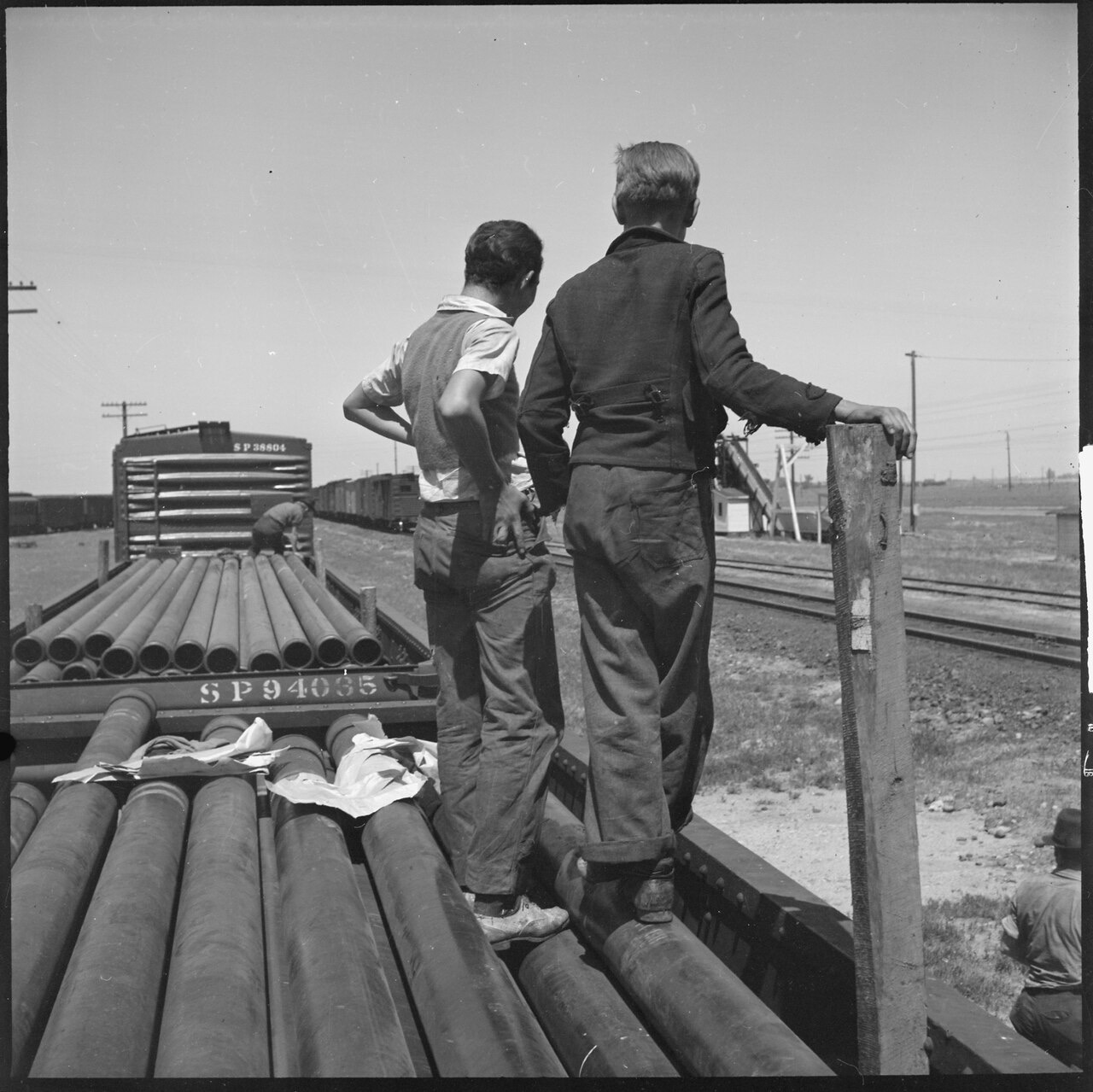
Visual AidTeenagers riding the freights
Photograph by Rondal Partridge, May 1940: two boys, aged fifteen and sixteen, riding a loaded flatcar through California’s San Joaquin Valley in the company of an older hobo — the living tail end of the history Catching the 3:15 summarizes, when every poor neighborhood near a rail line knew how to board a freight. The picture shows real riders, not Ponyboy and Johnny, and a bright valley, not a 3:15 in the dark. Notice the boys’ feet and hands: one stands braced on the load, one grips the car’s post, because — as the Knowledge Bank says — steel wheels forgave no slip.
Two youngsters, aged fifteen and sixteen, riding the freights through the San Joaquin Valley, California; photograph by Rondal Partridge, May 11, 1940; U.S. National Archives. Source: Wikimedia Commons, file “On the Freights — two youngsters aged fifteen and sixteen” (NARA 532077), public domain.
🧠Knowledge Bank question
1According to the Knowledge Bank, riders like Ponyboy and Johnny boarded a freight at the spot where ___.Ch.3
2Why do Cherry and Marcia agree to leave with Bob and Randy?Ch.3
3When Pony gets home at two in the morning, Darry strikes him — the first time anyone in his family has ever hit him.Ch.3
4What does Cherry tell Ponyboy about Dallas Winston?Ch.3
5Write the numbers 1–5 in the boxes to show the correct order of events. Number 1 = what happens first.Chapters 3–4
Dally sends the boys to the 3:15 freight for Windrixville.
Darry strikes Pony, and Pony runs to find Johnny.
The Socs corner the two boys at the park fountain.
Cherry and Ponyboy trade sunset views on the walk from the drive-in.
Pony falls asleep in the vacant lot and gets home at two.
6Johnny is asleep in his own bed when Ponyboy comes running to find him.Ch.3
7What do the Socs do to Ponyboy at the fountain?Ch.4
8Why do Pony and Johnny go to Dally for help?Ch.4
9Dally hands the boys a loaded gun and fifty dollars.Ch.4
10Where does Dally tell the boys to hide?Ch.4
Part 3
Literary Elements
Understanding HOW and WHY S. E. Hinton tells the story across Chapters 3–4.
🎭Knowledge Bank · One Sunset, Two Porches
Literature · Shared SymbolsA symbol is a concrete thing — an object, a place, an image — that a story loads with meaning beyond itself. Writers rarely announce one; they build it through repetition and careful placement. Watch how S. E. Hinton (author) constructs hers. Cherry mentions watching the sunset from her patio; Ponyboy admits he watches it from his back steps; and the narration quietly closes the circuit — it is the same sun going down on both sides of town. Nothing else in these chapters is allowed to belong to both worlds: not clothes, not cars, not music, not even slang. So the one shared image carries enormous weight. There is a craft lesson here worth stealing. A symbol works best when it is ordinary, free, and available to every character equally — money divides the two groups, but the sky does not. When the sunset returns later in the novel, remember that it was planted here, in one casual conversation.
Symbolism
One sunset, seen from a rich patio and from a greaser’s back steps, quietly becomes the novel’s image of common ground.
Foreshadowing
Pony’s hope that things simply cannot get worse, and a switchblade riding in a back pocket, both point straight at the park.
Turning Point
Bob’s death at the fountain splits the story into before and after; nothing past this scene can be undone.
🧠Knowledge Bank question
1According to the Knowledge Bank, the sunset can carry so much symbolic weight because it is ___.Ch.3
2Pony telling himself that things simply have to get better, right before the park, is ___.Ch.3
3A turning point is a moment after which the story cannot return to the way things were.Ch.4
4Which event is the turning point of these chapters?Ch.4
5Symbolism means an object or image stands for a larger idea than itself.Ch.3
6Fill in each blank with the correct literary term.Ch.3
Word choices:symbolforeshadowingdialoguerhyme- some words will not be used
The shared sunset works as a of common ground.
Pony’s uneasy feeling on the walk to the park is .
7By giving the Soc girl and the greaser boy the very same sunset, S. E. Hinton (author) suggests that ___.Ch.3
8Foreshadowing appears after the event that it points toward.Ch.4
9Who narrates these chapters in the first person?Ch.3
10Fill in each blank with the correct literary term.Ch.4
Word choices:turning pointmoodrhymeglossary- some words will not be used
Bob’s death is the of the whole novel.
The cold, empty park at two in the morning builds a tense .
Part 4
Think Deeper
Four deeper challenges — no single-word recall. Read, weigh the evidence, and reason it out.
💡Knowledge Bank · Why They Run
Civics · Juvenile JusticeTo understand why two boys with a strong claim of innocence flee instead of calling the police, look at what the law of the 1960s offered them. Anyone under eighteen went before a juvenile court — a separate system that decided not only guilt but custody, meaning where a child would live. That is the threat hanging over the Curtis brothers from the start: one bad report and a judge could send Ponyboy and Sodapop to a boys’ home, ending the family Darry works two jobs to hold together. Johnny also has a real legal argument — self-defense, the right to use force to stop a deadly attack — because Ponyboy was being drowned when the knife came out. But claiming that right means trusting a courtroom, and these boys have watched police and courts weigh a greaser’s word against a Soc’s before. Add a dead boy from a wealthy family, and running to Dally feels safer than the law. Their flight is not proof of guilt; it is a perfect measurement of their trust.
Visual AidTwo roads from the fountain
Sequence diagram of the choice the Knowledge Bank lays out in Why They Run: report the killing and hand a juvenile court the power to decide both guilt and custody, or run to Dally and keep the family whole at the price of becoming fugitives. A legal system is compressed into a phrase per box, and the drawing does not claim the boys weighed it this calmly on the night itself — panic did much of the work. Notice what each road puts at risk: the court road risks the Curtis family, the outlaw road only the two runners. That asymmetry is the Knowledge Bank’s measurement of trust.
The custody powers of 1960s juvenile courts as described in standard histories of American juvenile justice. Drawn for Garden Heights Academy.
Picture two kids outside a drive-in, talking about the view from their own back doors. One watches the sunset from a patio on the rich side of town; the other watches it over a weedy vacant lot — and it is, they slowly realize, the same sun. For about an hour, the wall between Soc and greaser feels thin enough to talk through. Then the night turns. A blue Mustang trails the group down the street. A brother’s hand cracks across a face at two in the morning, for the first time ever. And in a cold park, five drunk Socs decide to teach two greasers a lesson in a fountain — until a quiet boy with a switchblade, beaten half to death once already, decides that nobody is going to drown his friend. By the time the sun that started all the talking comes up again, Ponyboy Curtis is crouched in a boxcar rattling out of Tulsa with fifty borrowed dollars, a loaded gun, and a best friend who has killed someone. Part 2 is the hour when everything breaks.
Original passage written for Garden Heights — not a quotation from the novel.
1Claim: “Part 2 argues that the killing grows out of stacked-up pressures, not out of one villain’s plan.” — choose the two details that best prove it.Claim & Evidence
2Builds toward the killing, or Bridges the two worlds? Tap each detail to send it left or right.Sort into two
◄ Builds toward the killingBridges the two worlds ►
3Match each cause to its result. For each cause, pick its result.Cause & Effect
Pony and Johnny fall asleep watching stars in the lot→
The girls leave the drive-in crowd with Bob and Randy→
The Socs force Pony’s head under the fountain→
The boys find Dally at Buck Merril’s party→
🧠Knowledge Bank question
4Fill both blanks to complete the reasoning.Build the Argument
The Knowledge Bank argues that Johnny and Ponyboy run to Dally instead of claiming self-defense because , which shows that their flight is really .
Part 5
Standardized Test
The Grease in Greaser · Reading & Vocabulary · SAT & TOEFL-style practice
Read the passage — the highlighted words are tested — then answer. Tap an answer, then tap it again to confirm.
SATCentral Ideas — the passage's main point
SATWords in Context — a word's meaning in this passage
SATInference — a conclusion the passage implies
SATAuthor’s Purpose — what the author wants to achieve
TOEFLFactual Information — a fact stated in the passage
TOEFLVocabulary — a tested word's meaning here
TOEFLProse Summary — the three sentences that sum it up
The Grease in Greaser
The style that gave greasers their name was built out of work clothes. Blue jeans, plain T-shirts, boots, and leather jackets were cheap, durable, and easy to replace, which is why farmhands, mechanics, and factory workers wore them first. The name itself came from the hair: worn long and combed back with pomade — a heavy hair grease — into a shining sweep. A boy who could not afford new clothes could still afford a comb, and the look said he took care of what he had.
The rest of the style ran on skill instead of money. Older brothers and neighbors rebuilt worn-out cars into hot rods, tuning junkyard engines in driveways until a ten-year-old sedan could outrun a new showroom car. The music was early rock ’n’ roll — loud, fast, and rooted in working-class Southern sound — and its first great star, Elvis Presley, had driven a delivery truck before he made a record. Hair, denim, engine, and song added up to an emblem: a way for boys with thin wallets to wear pride, loyalty, and craft in plain sight.
Most adults did not read the style that way. Movies like The Wild One in 1953 and Blackboard Jungle in 1955 dressed their troublemakers in leather, newspapers ran alarmed stories about juvenile delinquency — the era’s term for youth crime — and the United States Senate held hearings on it. Store owners watched greasy-haired boys a little longer, contemptuous teachers expected less of them, and police stopped them first. The clothes had become a menace in the public eye long before any particular boy pulled them on. To the wearer the outfit was a badge of defiance; to much of the country it was a warning.
Original passage written for Garden Heights — not a quotation from the novel.
1What is the main idea of the passage?SAT · Central Ideas
2According to the passage, jeans, T-shirts, and leather jackets were first worn by ___.TOEFL · Factual Information
3In the passage, contemptuous most nearly means ___.SAT · Words in Context
4The passage says the name ‘greaser’ came from ___.TOEFL · Factual Information
5In the passage, emblem most nearly means ___.TOEFL · Vocabulary
6The passage suggests that a style built on skill instead of money let greasers ___.SAT · Inference
7Which two movies does the passage name as spreading fear of the style?TOEFL · Factual Information
8In the passage, defiance most nearly means ___.SAT · Words in Context
9Prose Summary (TOEFL).The passage explains where the greaser style came from and how the public learned to read it. This TOEFL task lists six sentences; choose the THREE that best capture the passage’s main ideas. The other three do not belong — they state minor details or ideas the passage does not present.TOEFL · Prose Summary
10Why does the author end with the badge and the warning?SAT · Author’s Purpose
Part 6 · Optional
Creative Writing
A bonus challenge to practice your English. Take your time and have fun with it.
About This Section
This writing task is optional and is not part of your auto-graded score. The feedback below checks only the basics — length, spelling, and grammar — not whether your ideas are right or wrong. It is meant for classroom discussion and creative practice, so feel free to use your imagination!
Writing Task — Part 2 “The Same Sunset”
Cherry and Ponyboy come from opposite sides of town, yet they discover they watch the same sunset. Write about a time you found something real in common with a person you expected to be completely different from you. What did you assume about them, what did you actually find, and did it change how you treated each other afterward? 6–10 sentences. End with what the discovery taught you about first impressions.
You can start with: “I thought we had nothing in common until...”
0 / 40 words minimum
🗣 Teach It · Just for Fun (optional)
No right or wrong — close the screen and tell someone nearby what happened in this part. Can’t find anyone? Tell yourself out loud. The moment you teach it, you truly understand it.
Independent study guide by Garden Heights. Not affiliated with or endorsed by S. E. Hinton. Contains original analysis only; no text from the novel is reproduced. Reference text: This workbook follows S. E. Hinton’s classic text (the standard Puffin edition sold worldwide). Revised 2023 UK editions change some wording and may not match the vocabulary studied here.