New here? Just sign up with Google — your account includes Matilda, our gift book, forever.
The Outsiders · Garden Heights
Part 4
for The Outsiders · Part 4 · Chapter 6
8 Parts40 min
What Happens in Part 4
Johnny decides to turn himself in — then a burning church full of children changes everything.
Turning backDally drives the boys to a Dairy Queen for their first hot meal in days and news from home: greasers and Socs are sliding toward an all-out fight, and Cherry Valance is willing to testify that Bob was drunk and the killing began as self-defense. Then Johnny stuns them: he is going back to turn himself in — he has a decent chance in court, he is tired of hiding, and Ponyboy's brothers should not keep paying for what he did.
Dally's warningDally argues hard — he has been inside, and he would rather see Johnny anywhere than watch jail turn him mean — but Johnny holds on, asking only whether his parents ever wondered where he was. They have not, and the answer sits on him all the way back over Jay Mountain.
Into the fireThey find the church wrapped in flame, a school picnic scattered outside, a child-count coming up short. Ponyboy is out before the car stops, Johnny right behind; through a window they hand the little ones out under raining embers, Ponyboy wondering whether their cigarette began it. As the last child goes out, Johnny shoves him through; the roof caves in, a burning timber striking Johnny's back. Dally beats the fire off Ponyboy — knocking him cold — and drags Johnny clear.
Darry's tearsPonyboy wakes in an ambulance beside Jerry Wood, a picnic teacher who calls the boys heroes even after learning who they are. At the hospital Johnny is critical — back struck and badly burned — and Dally's arm is seared. Then Soda and Darry arrive: Soda swings Ponyboy off his feet, but Darry stands apart, gripping the doorway, crying. In one look Ponyboy understands the hardness was never dislike but fear of losing him, and the three brothers stand together at last.
What We Will Learn
Section
What you will practice
Vocabulary
Courtrooms, fire, and hospitals: testify, conviction, ablaze, stifling, critical…
Literary Elements
Situational irony that turns fugitives into rescuers, an epiphany in a hospital hallway, and pacing that sprints through fire and slows for tears
Cross-Curricular
Rescue science — why crowds freeze at an emergency, what unfreezes them, and what heat and smoke actually do inside a burning building
Chapter Summary
Ch.
What happens
Chapter 6 · i
The Decision at the Dairy Queen — Over burgers, Dally lays out the news: the gangs are heading for open war, and Cherry Valance is helping the greasers — she will testify that the fight began as self-defense. Then Johnny announces that he is going back to turn himself in. Dally fights the idea, afraid of what jail does to people, but Johnny has decided — and it stings him that his own parents never once asked where he was.
Chapter 6 · ii
The Church on Fire — Driving back over Jay Mountain, the boys find their hideout burning and a school picnic scattered around it, with children unaccounted for. Ponyboy is out of the car before it stops. He and Johnny climb in through a window and pass the children out over the sill while embers fall and Dally shouts that the roof will not hold.
Chapter 6 · iii
The Roof Comes Down — As the last child goes out, Johnny shoves Ponyboy through the window. The roof caves, and a flaming timber lands across Johnny’s back. Dally beats out the fire on Ponyboy’s back, knocking him senseless, then plunges back to the doorway and drags Johnny clear of the burning church.
Chapter 6 · iv
Heroes and Brothers — Ponyboy wakes in an ambulance beside Jerry Wood, a teacher who keeps calling the boys heroes even after hearing who they are. At the hospital the word on Johnny is critical. Then Soda and Darry arrive, and Darry — unbreakable Darry — is crying. In one look Ponyboy finally understands his brother, and the three of them stand together again.
Part 1
Vocabulary
Study 10 key words from Chapter 6, then answer each question.
🔥Knowledge Bank · What a Fire Does to a Building
Fire Science · Smoke and HeatMost people picture flames as the killer in a building fire, but firefighters learn a harsher fact first: smoke takes more lives than fire does. Burning materials pour out carbon monoxide — an invisible gas that crowds oxygen out of the blood — along with a cloud of scorching, poisonous particles. Because heated air expands and rises, that cloud collects at the ceiling and stacks downward like water filling a glass turned upside down, which is why survivors are taught to crawl: the coolest, cleanest air in a burning room is the last foot above the floor. Heat builds the same way. When the ceiling layer nears 1,100 degrees Fahrenheit, everything in the room can ignite in a single instant — a moment called flashover, which almost no one outside protective gear survives. An old wooden building adds one more clock: fire chews through the beams holding up the roof, and the scream Dally lets out about the roof is a warning about exactly that failure — collapse.
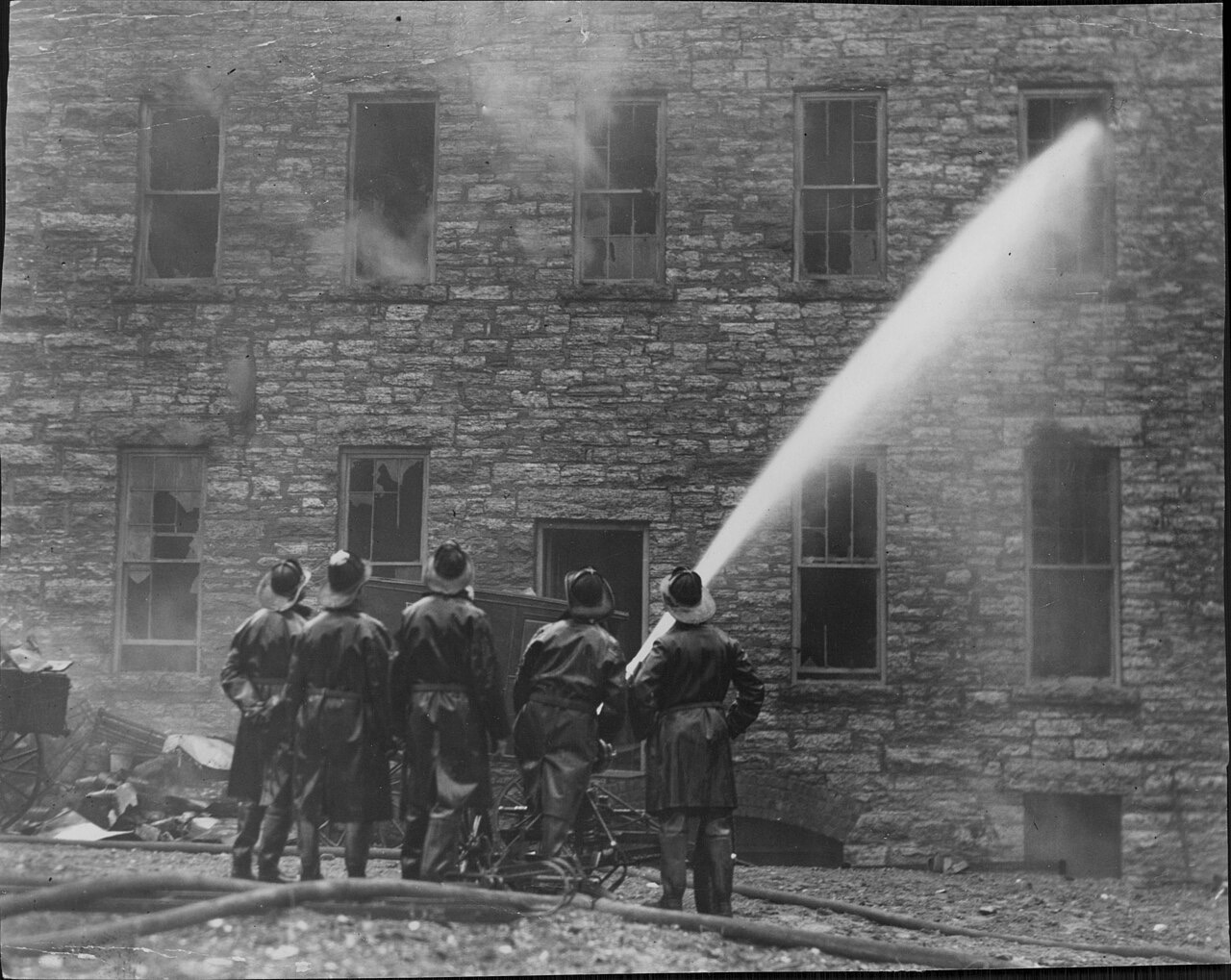
Visual AidWhat a crew actually fights
Photograph of Minneapolis firefighters at a workshop fire in 1928. Almost nothing in the frame is flame: what pours from the windows is smoke — the killer What a Fire Does to a Building names first — and the stream is aimed high because heat and smoke stack downward from the ceiling, so the fire’s real body lives in the upper stories. The picture shows one crew at one fire, decades before the novel; the burning church, and everyone inside it, are S. E. Hinton (author)’s invention. Notice that the crew works from outside the walls: collapse, the failure Dally screams about, is the first thing a fire officer calculates.
Firemen battling a blaze at the Salvation Army workshop, Minneapolis, 1928; Minneapolis Photo Collection, Hennepin County Library, via the Digital Public Library of America. Source: Wikimedia Commons, File:Firemen Battle Blaze at the Salvation Army Workshop - DPLA - 6c2eb74d487398143130a96b9640bc02.jpg, public domain.
testifyv.Ch.6
To give evidence as a witness, especially in court
“Cherry Valance is willing to testify about how the fight began.”
convictionn.Ch.6
A firm belief held with certainty
“Johnny announces his plan with quiet conviction.”
reluctantadj.Ch.6
Unwilling; hesitating to do something
“Dally is reluctant to point the car back toward Tulsa.”
ablazeadj.Ch.6
On fire; burning brightly
“One end of the old church is already ablaze.”
engulfv.Ch.6
To swallow up or cover something completely
“Flames threaten to engulf the whole roof at once.”
franticadj.Ch.6
Wild with fear, worry, or hurry
“A frantic teacher counts the children and comes up short.”
stiflingadj.Ch.6
So hot and airless that breathing is difficult
“The smoke makes the air inside the church stifling.”
debrisn.Ch.6
Scattered pieces of something broken or destroyed
“Burning debris drops from the ceiling as they work.”
criticaladj.Ch.6
So serious that life is in danger
“The doctors list Johnny in critical condition.”
reassurev.Ch.6
To calm someone and ease their doubts or fears
“Jerry Wood tries to reassure Ponyboy on the ride to town.”
ⓘ The vocabulary words in this list are selected to help you understand and complete this workbook. Some may not appear verbatim in the original novel.
🧠Knowledge Bank question
1According to the Knowledge Bank, survivors of a building fire are taught to crawl beneath the stifling smoke because ___.Ch.6
2‘Reluctant’ means eager to begin something.Ch.6
3‘Conviction’ in this chapter means ___.Ch.6
4A building that is ‘ablaze’ is ___.Ch.6
5Fill in each blank with the correct word.Ch.6
Word choices:ablazetestifyfranticengulf- some words will not be used
One end of the church was already when Dally slowed the car.
Cherry Valance agreed to about how the fight started.
6To ‘engulf’ something is to ___.Ch.6
7A person in ‘critical’ condition is in serious danger.Ch.6
8‘Stifling’ air is air that ___.Ch.6
9Fill in each blank with the correct word.Ch.6
Word choices:debrisreassurecriticalstifling- some words will not be used
Burning dropped from the roof beams.
Jerry Wood tried to Ponyboy in the ambulance.
10To ‘reassure’ someone is to make them feel calmer.Ch.6
Part 2
Comprehension
Show you understood what happens in Chapter 6.
👥Knowledge Bank · The Crowd That Does Nothing
Social Psychology · BystandersIn 1968, psychologists John Darley and Bibb Latané piped fake smoke into a room where volunteers sat filling out forms. A person alone usually reported it within minutes; a person seated among calm strangers usually stayed put, even as the haze thickened. They had documented the bystander effect: the more witnesses an emergency has, the less likely any single one is to act. Two forces drive it. One is pluralistic ignorance — each person hides alarm and reads everyone else’s stillness as proof that nothing is wrong. The other is diffusion of responsibility — the feeling that with so many people present, the job belongs to no one in particular. But the effect has a famous reverse gear. The instant one person moves, the emergency becomes real to everyone, and helpers pour in behind the first mover. Chapter 6 stages that sequence in a churchyard: a ring of adults, frozen, until two boys stop being witnesses.
Visual AidThe smoke experiment, and its reverse gear
Sequence diagram of the 1968 experiment the Knowledge Bank describes in The Crowd That Does Nothing: alone, a person reports the smoke within minutes; among calm strangers, the same person usually stays put while pluralistic ignorance and diffusion of responsibility do their work; and the moment one person moves, the emergency becomes real and helpers pour in. Dozens of trials are compressed into three rows, and the drawing quotes no percentages because they varied study to study. Notice that the entire bottom row turns on a single mover — which is exactly the hinge of the churchyard scene in Chapter 6.
John Darley and Bibb Latané’s smoke-filled-room studies, 1968, as summarized in introductory social psychology. Drawn for Garden Heights Academy.
🧠Knowledge Bank question
1The Knowledge Bank explains that pluralistic ignorance takes hold when each witness ___.Ch.6
2What news does Dally pass along about Cherry Valance?Ch.6
3Dally immediately supports Johnny’s decision to surrender.Ch.6
4Why does Dally argue against Johnny’s plan?Ch.6
5Write the numbers 1–5 in the boxes to show the correct order of events. Number 1 = what happens first.Chapter 6
Driving back over Jay Mountain, the boys find the church on fire.
The roof caves in and a burning timber strikes Johnny.
Ponyboy and Johnny hand the children out through a window.
Ponyboy wakes in an ambulance beside Jerry Wood.
Johnny announces at the Dairy Queen that he will turn himself in.
6A school group had been picnicking near the church when it caught fire.Ch.6
7How do the boys get the children out of the church?Ch.6
8What injures Johnny inside the church?Ch.6
9Johnny hears that his parents have been asking for him.Ch.6
10What does Darry’s crying reveal to Ponyboy?Ch.6
Part 3
Literary Elements
Understanding HOW and WHY S. E. Hinton tells the story across Chapter 6.
✍Knowledge Bank · Writing at the Speed of Adrenaline
Authorial Craft · Action ProsePeople who survive emergencies report strange things: time stretching out, sound dropping away, an eerie calm that feels nothing like courage. The cause is adrenaline — a hormone the body floods itself with in danger — which narrows attention to a tunnel and shuts down everything unnecessary, sometimes including fear itself. S. E. Hinton (author) writes the church fire the way rescuers actually remember rescues. Ponyboy narrates the inside of a burning building almost dreamily, registering stray details while the terror waits outside the tunnel, and the sentences shrink until each one carries a single action and nothing else — no commentary, no reflection. That is pacing doing its work: a slower style would give the reader room to think, and thinking is precisely what nobody inside that church has time to do. Then the chapter reaches the hospital, the sentences stretch out, reflection floods back in, and the prose itself comes down off the adrenaline.
Situational irony
An outcome that lands opposite to expectation — here, two boys wanted for a killing become the rescuers a churchyard full of law-abiding adults could not supply.
Epiphany
A sudden flash of understanding, when a character abruptly sees a truth that was there all along — Ponyboy’s, in this chapter, arrives with Darry’s tears.
Pacing
The speed of the prose itself. S. E. Hinton (author) strips the fire scene down to short, bare sentences, then lets the lines lengthen again once the hospital brings time to think.
🧠Knowledge Bank question
1The Knowledge Bank explains that during the church fire, the sentences shrink so that ___.Ch.6
2Ponyboy suddenly understanding Darry’s strictness is best called ___.Ch.6
3An epiphany changes how a character understands something.Ch.6
4Fill in each blank with the correct literary term.Ch.6
Word choices:pacingepiphanydialoguesetting- some words will not be used
The rush of short sentences in the fire scene is fast .
Ponyboy’s flash of insight about Darry is an .
5During the fire, the author keeps the sentences ___.Ch.6
6Situational irony means a story’s events match what readers expect.Ch.6
7Which moment is the clearest situational irony in the chapter?Ch.6
8Short sentences tend to speed a scene up for the reader.Ch.6
9Fill in each blank with the correct literary term.Ch.6
Word choices:ironysuspensemoralcaption- some words will not be used
Wanted boys turned rescuers is situational .
Dally’s warning about the roof adds .
10The chapter’s pacing slows down again when ___.Ch.6
Part 4
Think Deeper
Four deeper challenges — no single-word recall. Read, weigh the evidence, and reason it out.
🏅Knowledge Bank · What Hero Research Actually Finds
Psychology · HeroismSince 1904 the Carnegie Hero Fund Commission has investigated civilian rescues across North America and awarded medals to more than ten thousand people who risked their lives for strangers. What researchers find when they study such people is deflating in the best possible way: heroes test as remarkably ordinary. They are not fearless, not saintly, and not a special breed; they are welders, students, and retirees who happened to be standing there when it mattered. Interviewed afterward, most insist the act involved no decision at all — they were moving before they had weighed anything — and nearly all wave the label away, saying anyone would have done the same, even though the motionless crowd behind them proves otherwise. Two things best predict who runs in: relevant skill, since strong swimmers attempt more water rescues, and identification, the sense that the victim is one’s own. Children pull hardest of all — their helplessness seems to cancel the usual calculation of risk.
Picture a country church that has stood empty on its hill for years, floor deep in dry leaves, walls of old wood the sun has been curing for decades. Now put a school picnic beside it, a dozen small children wandering loose, and a spark somewhere in all that tinder. Two boys who are wanted for a killing come driving up the road at exactly the wrong moment — or exactly the right one. Nobody orders them in. A ring of grown-ups is already standing in the yard, and not one of them has moved. That frozen crowd, and the two fugitives who break through it, are what this chapter is really about: the window, the smoke, the weight of a child handed through fire, a roof giving way. And afterward, in a hospital hallway, the strangest sight in the whole book so far — the face of the strongest person Ponyboy knows, doing something Ponyboy has never once seen it do.
Original passage written for Garden Heights — not a quotation from the novel.
1Claim: “Chapter 6 argues that heroism belongs to ordinary, even unlikely, people.” — choose the two details that best prove it.Claim & Evidence
2Freezes a bystander, or Launches a rescuer? Tap each detail to send it left or right.Sort into two
◄ Freezes a bystanderLaunches a rescuer ►
3Match each cause to its result. For each cause, pick its result.Cause & Effect
Johnny announces he will turn himself in→
Flames show over Jay Mountain on the drive back→
The roof gives way as the last child goes out→
Darry stands crying in the hospital hallway→
🧠Knowledge Bank question
4Fill both blanks to complete the reasoning.Build the Argument
The Knowledge Bank calls Carnegie-medal heroes 'remarkably ordinary' because , which suggests that the will to run in comes from .
Part 5
Standardized Test
The Bystander and the Hero · Reading & Vocabulary · SAT & TOEFL-style practice
Read the passage — the highlighted words are tested — then answer. Tap an answer, then tap it again to confirm.
SATCentral Ideas — the passage's main point
SATInference — a conclusion the passage implies
SATAuthor’s Purpose — what the author wants to achieve
SATWords in Context — a word's meaning in this passage
TOEFLFactual Information — a fact stated in the passage
TOEFLInsert Text — where a sentence best fits
TOEFLVocabulary — a tested word's meaning here
The Bystander and the Hero
In a well-known 1968 experiment, college students listened over an intercom as another student seemed to collapse in a medical emergency. Nearly every listener who believed no one else could hear rushed to intervene; among those who believed four others were listening too, most proved reluctant to act and never left their seats. Psychologists call this the bystander effect, and its engine is diffusion of responsibility — the sense that when many people could act, the duty belongs to no one in particular. A crowd can make an emergency feel like someone else’s problem.
Yet the crowd’s spell has a simple counterspell. The moment one witness moves — shouting, pointing, running toward the victim — the situation becomes official, and others follow as though they had been waiting for a signal. Research on real rescues shows who that first mover tends to be. The Carnegie Hero Fund Commission, which has honored civilian rescuers since 1904, reports that its medalists are overwhelmingly ordinary people — students, welders, grandmothers — rather than trained professionals. Asked to explain themselves, most say the act involved no deliberation: they were already moving before they had time to be afraid.
Two more findings complete the picture. People run fastest for victims they identify with — neighbors, teammates, and above all children, whose helplessness seems to switch off the mind’s usual arithmetic of danger. The risk such rescuers accept is real, because in a burning building the deadliest threats are heat and stifling, poisonous smoke, which pool at the ceiling and can make a room unsurvivable within minutes. Heroism is not a rare personality; it is a decision made at speed, by an ordinary person who feels that the emergency is theirs.
Original passage written for Garden Heights — not a quotation from the novel.
1What is the main idea of the passage?SAT · Central Ideas
2In the intercom experiment, listeners who believed four others could hear mostly ___.TOEFL · Factual Information
3According to the passage, Carnegie medalists are mostly ___.TOEFL · Factual Information
4The rescuers’ claim that the act involved no deliberation suggests that ___.SAT · Inference
5Insert Text (TOEFL). Look at the four squares [1]–[4] in the excerpt below. They show where this sentence could be added: “One decisive act, in other words, hands the whole crowd its signal to help.”
Research on real rescues shows who that first mover tends to be. [1] The moment one witness moves — shouting, pointing, running toward the victim — the situation becomes official, and others follow as though they had been waiting for a signal. [2] Yet the crowd’s spell has a simple counterspell. [3] The Carnegie Hero Fund Commission, which has honored civilian rescuers since 1904, reports that its medalists are overwhelmingly ordinary people rather than trained professionals. [4]
Where would the sentence fit best?TOEFL · Insert Text
6Why does the author mention students, welders, and grandmothers?SAT · Author’s Purpose
7Based on the passage, a lone witness to an accident would most likely ___.SAT · Inference
8In the passage, official most nearly means ___.SAT · Words in Context
9In the passage, reluctant most nearly means ___.TOEFL · Vocabulary
10In the passage, stifling most nearly means ___.TOEFL · Vocabulary
Part 6 · Optional
Creative Writing
A bonus challenge to practice your English. Take your time and have fun with it.
About This Section
This writing task is optional and is not part of your auto-graded score. The feedback below checks only the basics — length, spelling, and grammar — not whether your ideas are right or wrong. It is meant for classroom discussion and creative practice, so feel free to use your imagination!
Writing Task — Part 4 “The Second You Decided”
Nobody orders Ponyboy and Johnny into the burning church — they are moving before the thought finishes. Write about a moment when you acted before you had time to talk yourself out of it, or watched someone else do it. What was the signal that made the move happen? What did everyone else do, and what did it cost or earn? 6–10 sentences. End with what that moment taught you about who you are when there is no time to decide.
You can start with: “Everyone else was standing perfectly still, and then...”
0 / 40 words minimum
🗣 Teach It · Just for Fun (optional)
No right or wrong — close the screen and tell someone nearby what happened in this part. Can’t find anyone? Tell yourself out loud. The moment you teach it, you truly understand it.
Independent study guide by Garden Heights. Not affiliated with or endorsed by S. E. Hinton. Contains original analysis only; no text from the novel is reproduced. Reference text: This workbook follows S. E. Hinton’s classic text (the standard Puffin edition sold worldwide). Revised 2023 UK editions change some wording and may not match the vocabulary studied here.