
The Outsiders cover
Garden Heights

The Outsiders

This workbook is for Garden Heights members. Sign in to continue.

Sign in with Google →
New here? Just sign up with Google — your account includes Matilda, our gift book, forever.
The Outsiders · Garden Heights

Part 5

for The Outsiders · Part 5 · Chapters 7–8
8 Parts40 min
What Happens in Part 5

Front-page heroes now, the greasers face Johnny's grim prognosis, a possible boys' home, and a fragile peace with Cherry.

Split verdictWhile doctors work, Sodapop keeps the waiting-room reporters laughing, Darry answers what he can, and Jerry Wood tells everyone what the boys did. The news splits down the middle: Dally's burned arm will heal in days, but Johnny is critical — his back broken by the flaming timber, his burns severe and shock setting in. Even if he lives, the doctors warn, he will never walk again.

Front-page heroesNext morning, over eggs and chocolate cake, Two-Bit and Steve burst in with the front page: 'Juvenile Delinquents Turn Heroes.' The article praises the rescue and reports Cherry and Randy will testify Bob was drunk and Johnny fought in self-defense — though Johnny faces manslaughter and both face juvenile court for running away. One line stops Ponyboy cold: a judge could split the brothers into a boys' home. His old nightmare is back, and Soda's girlfriend Sandy has moved to Florida.

Hospital visitsAt the Tasty Freeze, Randy calls Ponyboy over: he is sick of the fighting, grieving for Bob, and will skip the rumble. Later Two-Bit and Ponyboy visit the hospital, where a doctor grimly allows that visitors cannot hurt anything now. Johnny, weak and gray, asks for a fresh Gone with the Wind, admits sixteen years does not feel like enough, and faints after refusing to see his mother. Down the hall, restless Dally borrows Two-Bit's prized black-handled switchblade.

Peace of sunsetsWalking home, the boys meet Cherry near the corner by the vacant lot. She confirms the Socs will fight fair — no weapons — and promises to testify, but she cannot make herself visit the boy who killed Bob, and she and Ponyboy part with a fragile peace made out of sunsets.

What We Will Learn
SectionWhat you will practice
VocabularyCourtrooms, hospitals, and headlines: manslaughter, delinquent, guardian, testify, aghast
Literary ElementsSituational irony packed into a two-faced headline, an allusion carried into a hospital room, and foreshadowing sharpened to a borrowed blade
Cross-CurricularHow a mid-1960s local newspaper framed a story — headlines, labels, and the facts that never make the page
Chapter Summary
Ch.What happens
Chapter 7Heroes on the Front Page — A night of reporters ends with two verdicts: Dally’s burned arm will heal, but Johnny’s back is broken and his condition is critical. The morning paper crowns the boys heroes and, in the same breath, reports a manslaughter charge, a coming juvenile-court hearing, and the one threat Ponyboy never saw coming — that a judge could split the Curtis brothers apart. At the Tasty Freeze, Randy tells Ponyboy he is through with fighting and will skip the rumble.
Chapter 8Visits, Verdicts, and a Sunset — Two-Bit and Ponyboy find Johnny weak and whispering; he asks for a fresh copy of Gone with the Wind and says sixteen years is not enough. He refuses to see his mother and faints. Down the hall, Dally wants out in time for the rumble and borrows Two-Bit’s treasured switchblade. On the walk home, Cherry promises to testify and reports that the Socs will fight fair — but admits she cannot visit the boy who killed Bob.
Part 1
Vocabulary
Study 10 key words from Chapters 7–8, then answer each question.
📚Knowledge Bank · The Verdict Inside a Word
Linguistics · Loaded WordsEvery word has two layers. Its denotation is the plain dictionary meaning; its connotation is the cloud of feelings and judgments that travels along with it. The word delinquent shows how heavy that cloud can get. It comes from a Latin verb meaning to fail in a duty, and when the United States built its first juvenile courts in the early 1900s, ‘juvenile delinquent’ became the official label for a young lawbreaker. By the 1950s, newspapers and movies had stretched it into something broader and meaner — a word for any teenager an adult had decided to distrust, complete with imagined leather jackets and switchblades. ‘Hero,’ borrowed from ancient Greek, plays the same trick in reverse: it hands out honor before you know a single fact. Part 5’s word list is full of language like this — manslaughter, guardian, testify — words that do not just describe people but sort them. Watch what each label smuggles in, because every name is also a judgment.
criticaladj.Ch.7
So sick or badly hurt that death is possible
“The doctors listed Johnny in critical condition.”
manslaughtern.Ch.7
The crime of killing a person without planning it beforehand
“The paper reported that Johnny would be charged with manslaughter.”
delinquentn.Ch.7
A young person who breaks the law
“The headline used delinquent and hero in the same breath.”
guardiann.Ch.7
A person legally responsible for the care of a child
“Darry has been his brothers’ guardian since their parents died.”
bewilderingadj.Ch.7
So confusing that it is hard to follow
“The night at the hospital was a bewildering swirl of flashbulbs and questions.”
testifyv.Ch.7
To formally give evidence in a court of law
“Cherry and Randy agreed to testify about the night in the park.”
exploitn.Ch.7
A bold, daring deed
“The article described the boys’ exploits at the burning church.”
aghastadj.Ch.7
Struck with shock or horror
“Ponyboy was aghast at the idea of a boys’ home.”
listlessadj.Ch.8
Without energy or interest
“Johnny lay listless against the white hospital pillows.”
reluctantadj.Ch.8
Unwilling and hesitant to do something
“Cherry was not reluctant to testify — only to visit.”

ⓘ The vocabulary words in this list are selected to help you understand and complete this workbook. Some may not appear verbatim in the original novel.

🧠Knowledge Bank question
1According to the Knowledge Bank, the word 'delinquent' comes from a Latin verb meaning ___.Ch.7
2‘Manslaughter’ means the crime of stealing valuable property.Ch.7
3Someone who is ‘aghast’ is ___.Ch.7
4A child’s ‘guardian’ is the person who ___.Ch.7
5Fill in each blank with the correct word.Ch.7
Word choices:testifyguardianmanslaughterlistless- some words will not be used
Cherry and Randy agreed to at the hearing.
The paper said the charge against Johnny would be .
6A ‘delinquent’ is ___.Ch.7
7‘Listless’ describes someone with little energy or interest.Ch.8
8To ‘testify’ is to ___.Ch.7
9Fill in each blank with the correct word.Ch.7
Word choices:aghastexploitsreluctantcritical- some words will not be used
The article described the boys’ daring at the fire.
Ponyboy was at the idea of a boys’ home.
10‘Bewildering’ describes something confusing and hard to follow.Ch.7
Part 2
Comprehension
Show you understood what happens in Chapters 7–8.
Knowledge Bank · A Court Built for Children
Civics · Courts and CustodyWhen the paper says Ponyboy must appear in juvenile court, it names a real American invention. The first juvenile court opened in Chicago in 1899, built on the idea that children who broke the law should be corrected rather than simply punished, and within a generation nearly every state had copied it. A juvenile case was a hearing, not a public trial: no jury, reporters often kept out, and one judge holding sweeping power to decide what a child needed. The outcomes ran from probation — supervised freedom at home — to placement in a state boys’ home or reform school. Crucially, the judge could also weigh the household itself. An older brother serving as guardian had to convince the court that his home was fit, which is why a single newspaper paragraph can threaten everything Darry has built. Not until 1967 did the Supreme Court guarantee young people lawyers and formal rights in these hearings, so in Ponyboy’s world the judge’s opinion is nearly the whole of the law, and one morning in court will settle the question of custody.
Visual AidA separate door for children
A separate door for childrenA sequence diagram. First box: in 1899 Chicago opens the first juvenile court and every state copies it. Second box: a hearing, not a trial, with no jury and one judge weighing the whole household. Three arrows fan out to three outcomes: probation, supervised freedom at home; a state boys' home or reform school; or the guardian removed and the brothers scattered. Notes say outcomes varied by state, lawyers and formal rights arrive only with the Supreme Court in 1967, and that the judge could reach past the boy to the household itself.ONE MORNING IN COURT — WHAT THE JUDGE COULD DECIDE1899 · Chicago opens thefirst juvenile court;every state copies ita HEARING, not a trial:no jury, one judge, thewhole household weighedprobation — supervisedfreedom at homea state boys’ homeor reform schoolguardian removed —the brothers scatteredoutcomes varied by state; lawyers and formal rights arrive only with the Supreme Court in 1967the judge could reach past the boy to the household — the threat hanging over Darry
Sequence diagram of the system A Court Built for Children explains: the first juvenile court opens in Chicago in 1899, the hearing replaces the public trial — no jury, one judge, the whole household on the scales — and the outcomes fan out from probation to a boys’ home to the removal of a guardian. Fifty states’ worth of variation is compressed into five boxes, and the drawing makes no claim about how Ponyboy’s own hearing will go; that is Part 8’s business. Notice the third outcome, the gray one: the Knowledge Bank’s point is that a court built to protect children could also scatter them.
The juvenile court from Chicago, 1899, to In re Gault, 1967, as summarized in standard histories of American juvenile justice. Drawn for Garden Heights Academy.
🧠Knowledge Bank question
1The Knowledge Bank explains that a juvenile hearing differed from a public trial because ___.Ch.7
2Why is Dally in the hospital?Ch.7
3The newspaper praises the boys for the rescue but also reports a coming court hearing.Ch.7
4What does the newspaper story make Ponyboy realize for the first time?Ch.7
5Write the numbers 1–5 in the boxes to show the correct order of events. Number 1 = what happens first.Chapters 7–8
  • Cherry tells the boys she cannot visit Johnny.
  • Randy tells Ponyboy he is finished with fighting.
  • Johnny asks Two-Bit for a fresh copy of Gone with the Wind.
  • Doctors report that Johnny’s back was broken in the fire.
  • Two-Bit and Steve arrive with the morning newspaper.
6Randy tells Ponyboy that he plans to fight extra hard in the rumble.Ch.7
7What does Johnny ask for during the hospital visit?Ch.8
8Johnny refuses to see his mother when she comes to the hospital.Ch.8
9What does Dally ask Two-Bit for?Ch.8
10What does Cherry agree to do for the greasers?Ch.8
Part 3
Literary Elements
Understanding HOW and WHY S. E. Hinton tells the story across Chapters 7–8.
🎭Knowledge Bank · A Narrator Reads About Himself
Authorial Craft · Outside VoicesFirst-person narration is a sealed room. Everything in this novel reaches us through Ponyboy’s voice, pre-shaped by one fourteen-year-old’s loyalties and blind spots. In Part 5, S. E. Hinton (author) briefly breaks the seal: she slides a document into the story — a newspaper article — and makes her narrator read about himself. The trick is older than it looks. Novelists have been smuggling letters, diaries, and clippings into fiction since the 1700s, because a document carries an outside voice the narrator cannot soften or argue with. The article shows Ponyboy exactly what he looks like to strangers — a delinquent, a hero, a case for a judge — and not one of those labels matches the boy we have been living inside for seven chapters. That gap is where the chapter’s irony lives, and it teaches a durable reading skill: when a story sets two versions of the same person side by side, measure the distance between them. The distance is the author’s real subject — the gulf between a self and a public perspective.
Situational Irony
Events land opposite to expectation — the boys the town calls delinquents are the ones who ran into a burning building for somebody’s children.
Allusion
A reference to another real work — Gone with the Wind follows Johnny from the church to the hospital bed, carrying its gallant Southern gentlemen with it.
Foreshadowing
Hints of trouble ahead — a borrowed switchblade, a fever nobody reports to Darry, and a doctor who suddenly stops limiting visitors.
🧠Knowledge Bank question
1The Knowledge Bank explains that novelists slide documents such as letters or clippings into fiction because ___.Ch.7
2Naming a real novel like Gone with the Wind inside a story is ___.Ch.8
3Foreshadowing gives the reader a hint of something still to come.Ch.8
4Dally borrowing Two-Bit’s switchblade while still in a hospital bed mainly works as ___.Ch.8
5An allusion is a made-up word that appears nowhere else in the language.Ch.8
6Fill in each blank with the correct literary term.Ch.7
Word choices:ironyallusionforeshadowingdialogue- some words will not be used
Calling lawbreakers heroes in the same breath is .
Naming a real novel inside the story is an .
7Which detail is the clearest example of situational irony?Ch.7
8Situational irony happens when events turn out opposite to what is expected.Ch.7
9S. E. Hinton (author) returning again and again to Ponyboy’s rising fever mainly ___.Ch.8
10Fill in each blank with the correct literary term.Ch.8
Word choices:foreshadowingironymetaphorglossary- some words will not be used
Dally asking for a blade before the rumble is .
Being famous for heroism while facing a manslaughter charge is .
Part 4
Think Deeper
Four deeper challenges — no single-word recall. Read, weigh the evidence, and reason it out.
💡Knowledge Bank · Six Words Before the Facts
Journalism · HeadlinesA headline is journalism’s smallest and most powerful form — and the reporter almost never writes it. A copy editor does, working against a deadline, squeezing a whole story into the width of a column. In the hot-metal printing era of the 1960s, every letter was a physical block of lead, so headline writers counted characters and reached for short, punchy verbs. ‘Turn’ is a classic of the trade: four letters, and it smuggles in an entire story of transformation, as if the boys had been one thing on Friday and became another on Saturday. Two-Bit spots the trick instantly — nothing about his friends ‘turned’; the label moved, not the boys. That is the lesson hiding on Part 5’s front page. A headline is not a summary. It is a frame chosen under pressure, and it sets a reader’s feelings before the first sentence gets a chance to speak. A detective reads the evidence before forming the theory; a strong reader reads the story before trusting the headline.
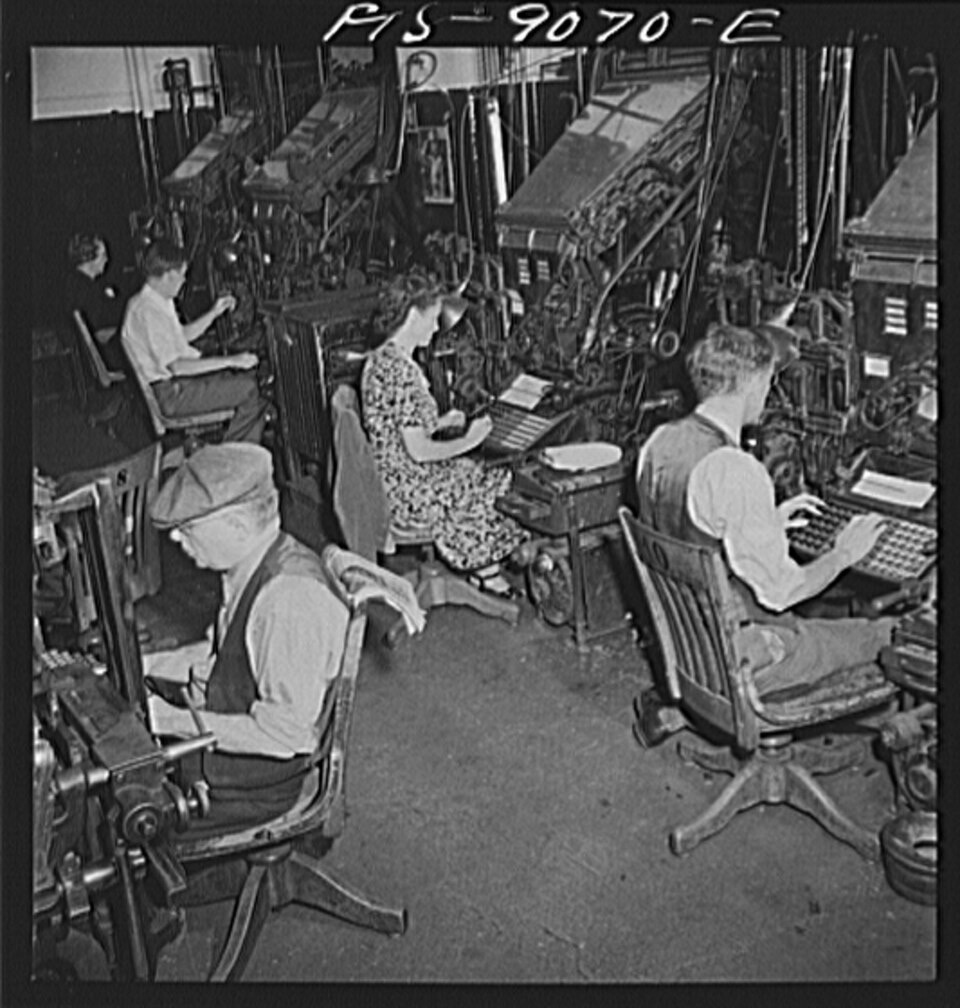
Visual AidWhere headlines were made of lead
A black-and-white photograph looking across a composing room, where five operators sit at the keyboards of tall, machinery-crowded linotype machines
Photograph by Marjory Collins, September 1942: linotype operators in the composing room of the New York Times, casting each line of the next day’s paper as a solid slug of hot lead. This is the machinery behind Six Words Before the Facts — in this room every letter had physical width, which is why the copy editors the Knowledge Bank describes counted characters and reached for four-letter verbs like ‘turn.’ The picture shows a great metropolitan daily, not the smaller paper Ponyboy reads, and no headline in it concerns the novel. Notice how the machines dwarf the people: the technology, as much as any writer, set the shape of the words.
Linotype operators in the composing room of the New York Times; photograph by Marjory Collins, September 1942; Library of Congress, FSA/OWI Collection. Source: Wikimedia Commons, File:Composing room of the New York Times newspaper.8d22721v.jpg, public domain.

Picture a hospital waiting room after midnight, filled with the wrong kind of famous. Flashbulbs pop, reporters fire questions, and a fourteen-year-old who has not really slept in a week is asked how it feels to be a hero. Down one hallway a friend lies cursing the nurses over a badly burned arm; down another lies a boy with a broken back, and the doctors will not quite meet anyone’s eyes. By morning it is all on the front page — the fire, the rescue, the dead boy in the park — under a headline that manages to call the same three boys criminals and heroes in a single line. Ponyboy reads it twice. The praise feels good. But buried near the end sits a quiet sentence about juvenile court, and a question nobody at the breakfast table can answer: what if a judge decides the Curtis brothers should not stay together? Part 5 is about who gets to tell your story — and what their version can cost you.

Original passage written for Garden Heights — not a quotation from the novel.
1Claim: “Part 5 shows that one event can carry two opposite labels at the same time.” — choose the two details that best prove it.Claim & Evidence
2The hero frame, or The delinquent frame? Tap each detail to send it left or right.Sort into two
◄ The hero frameThe delinquent frame ►
3Match each cause to its result. For each cause, pick its result.Cause & Effect
The paper questions whether the brothers can stay together
A flaming timber fell across Johnny’s back
Randy is sickened by grief over Bob’s death
Cherry cannot face the boy who killed Bob
🧠Knowledge Bank question
4Fill both blanks to complete the reasoning.Build the Argument
The Knowledge Bank argues that a headline deserves caution because , which means a strong reader .
Part 5
Standardized Test
Reading Like a Detective · Reading & Vocabulary · SAT & TOEFL-style practice
Reading Like a Detective

A good detective never takes a story at face value, and neither does a good newspaper reader. Every article is built out of choices: which fact goes first, which words describe the people involved, and which details never appear. Journalists call the result framing — the angle that tells readers how to feel before the first paragraph ends. The headline is the frame’s front door. The same house fire can reach the breakfast table as ‘Vandals Blamed in Blaze’ or as ‘Neighborhood Boys Rescue Children,’ and although both may be technically accurate — one announcing a crime, the other a daring exploit — they hand the reader opposite instructions.

Word choice does the quiet work of a frame. Every word carries connotations — the feelings and judgments that ride along with its plain meaning — and reporters choose among near-synonyms constantly. ‘Youth,’ ‘teen,’ and ‘delinquent’ can all point to the same sixteen-year-old, but the first two state an age while the third delivers a verdict. Language this heavy with built-in judgment is called loaded language. A second habit is checking attribution: a claim introduced by ‘police say’ or ‘witnesses report’ is somebody’s statement, not yet a proven fact.

The hardest trick to catch is omission, because a reader cannot see what is not there. A story that quotes the shop owner but never the accused can mislead without printing one false word. A single morning’s coverage can pile up into a bewildering flood, too many competing angles to sort at a glance. So careful readers finish every article with three questions: who got to speak, who got labeled, and what is missing. Asking them is not cynicism — it is reading the news the way a detective reads a room.

Original passage written for Garden Heights — not a quotation from the novel.
1What is the main idea of the passage?SAT · Central Ideas
2According to the passage, what does a headline do?TOEFL · Factual Information
3The passage uses ‘youth’ and ‘delinquent’ to show that ___.TOEFL · Factual Information
4It can be inferred that the two fire headlines ___.SAT · Inference
5According to the passage, a phrase like ‘police say’ signals that ___.TOEFL · Factual Information
6Why does the author compare a newspaper reader to a detective?SAT · Author’s Purpose
7The passage suggests that a story with no false sentences ___.SAT · Inference
8In the passage, exploit most nearly means ___.SAT · Words in Context
9In the passage, connotations most nearly means ___.TOEFL · Vocabulary
10In the passage, bewildering most nearly means ___.TOEFL · Vocabulary
Part 6 · Optional
Creative Writing
A bonus challenge to practice your English. Take your time and have fun with it.
About This Section

This writing task is optional and is not part of your auto-graded score. The feedback below checks only the basics — length, spelling, and grammar — not whether your ideas are right or wrong. It is meant for classroom discussion and creative practice, so feel free to use your imagination!

Writing Task — Part 5 “The Headline About You”

In one morning, a single newspaper page calls Ponyboy a delinquent and a hero. Write about a time a label — from a teacher, a teammate, another kid, or even yourself — did not match who you really were. Explain where the label came from, what it left out, and what a fairer ‘headline’ about you would have said. 6–10 sentences. End with the headline you would write about yourself today.

You can start with: “The label people had for me was one word, and it was wrong...”
0 / 40 words minimum
🗣 Teach It · Just for Fun (optional)

No right or wrong — close the screen and tell someone nearby what happened in this part. Can’t find anyone? Tell yourself out loud. The moment you teach it, you truly understand it.

Garden Heights

Part 5 Complete!

You finished Chapters 7–8 of The Outsiders.

Here are your auto-graded results:

-
points out of 100
🗣 Teach It · Just for Fun (optional)
Move on to Part 6 →

Independent study guide by Garden Heights. Not affiliated with or endorsed by S. E. Hinton. Contains original analysis only; no text from the novel is reproduced. Reference text: This workbook follows S. E. Hinton’s classic text (the standard Puffin edition sold worldwide). Revised 2023 UK editions change some wording and may not match the vocabulary studied here.