New here? Just sign up with Google — your account includes Matilda, our gift book, forever.
The Secret Garden · Garden Heights
Part 2
for The Secret Garden · Part 2 · Chapters 5–8
8 Parts40 min
What Happens in Part 2
Mary grows stronger outdoors, hears crying in the house, and finds the buried key and hidden door.
Wind and hungerDays outdoors in the moor wind do their work: Mary wakes genuinely hungry for the first time and empties her porridge bowl. She keeps returning to the long walk outside the walled gardens, where the robin meets her on the wall. Watching him fly to a tree-top inside, she reasons that a garden with no door must once have had one, since Mr. Craven buried its key.
Crying in the corridorThat evening Martha explains why the master hates the place: the garden was his young wife's, and she died after an old bent branch broke beneath her. While the wind roars, Mary hears crying down a corridor; a draft bangs the door open and the sound carries clearly before a far door slams. Martha blames the wind, then a scullery-maid with toothache, and Mary believes neither.
A hundred roomsIn another downpour Mary sets out to count the closed rooms herself. She wanders portrait galleries, opens door after door on unused furniture, plays with a cabinet of a hundred ivory elephants, and finds a gray mouse with six babies nested in a velvet cushion. Lost on the way back, she hears the fretful cry again, nearer, touches a tapestry that hides a door, and is seized by Mrs. Medlock, who denies everything and threatens to lock her up.
The key turnsTwo days later the storm blows out. Ben Weatherstaff says spring is stirring underground and no one has entered the garden for ten years. The robin hops onto earth a dog scratched up hunting a mole, and Mary lifts a key from the soil. Martha returns from her day out with a skipping rope. Skipping to her private walk, Mary sees a gust swing the ivy aside: a knob, an iron lock. The key fits, and she steps inside.
What We Will Learn
Section
What you will practice
Vocabulary
Weather, temper, and old houses: disdainfully, surly, torrents, tapestry, fretful…
Literary Elements
Setting used as a force that pushes the plot, personification that turns wind and soil into characters, foreshadowing planted in what adults refuse to explain, and a key that works as a symbol
Cross-Curricular
The Yorkshire moors — how peat and acid soil build a treeless upland, why it looks dead for ten months and blazes purple for two, and how families lived along its edge
Chapter Summary
Ch.
What happens
Chapter 5
The Cry in the Corridor — Days of running in the moor wind give Mary an appetite and a temper she almost likes. She meets the robin on the ivy wall and reasons out that the tree he sings in must stand inside the locked garden. That night Martha explains that the garden belonged to Mr. Craven’s wife, who was killed when a bent branch broke under her. Then a draft blows the door open and the two of them hear a child crying far off in the house.
Chapter 6
There Was Someone Crying — There Was! — Rain keeps Mary indoors, so she goes hunting for the hundred closed rooms. She walks a gallery of old portraits, opens shut-up bedrooms, plays with a cabinet of carved ivory elephants, and finds a mouse and six babies living in a velvet cushion. Lost on the way back, she hears the cry again, discovers a door hidden behind a tapestry, and is dragged away by Mrs. Medlock, who insists she heard nothing at all.
Chapter 7
The Key to the Garden — The storm blows itself out overnight and the moor turns blue under a clear sky. Martha sets off on her day out, five miles across the moor to a cottage of fourteen people. Ben Weatherstaff, softened by the weather, tells Mary the earth is getting ready to grow and that nobody has been inside the shut garden for ten years. Following the robin, Mary spots something in soil a dog has dug up: a rusty old key.
Chapter 8
The Robin Who Showed the Way — Mary decides to carry the key with her always. Martha returns from home with a skipping rope her mother bought for tuppence out of Martha’s wages, and Mary skips until her cheeks are red and even Ben Weatherstaff is impressed. On her own walk a strong gust lifts the loose ivy, showing a round knob and then a square iron lock. The key turns, the door swings inward, and Mary is standing inside the secret garden.
Part 1
Vocabulary
Study 10 key words from Chapters 5–8, then answer each question.
📚Knowledge Bank · The Words a Great House Needs
Language History · Names for Rooms and PassagesThe words Mary uses for her explorations are older than the house she explores. A corridor began as a military term: Italian builders used a word meaning a running place for the covered walkway where soldiers ran along the top of a fortification. It moved indoors in the 1600s, and it changed how houses worked. Before corridors, rooms opened straight into one another, so reaching the last room meant walking through every room before it and privacy barely existed. A gallery was first a long covered walk for exercise in bad weather; because its walls were blank and its light was good, families began hanging ancestors along it, and the word came to mean a room full of pictures. A tapestry takes its name through French from a Greek word for a woven cloth, and it was hung on stone walls for warmth long before anyone hung it for beauty. Learn where such words started and a floor plan turns into history.
Visual AidBefore and after the corridor
Structure diagram of the change the Knowledge Bank describes: rooms that open straight into one another, so the last room can be reached only by walking through all the others, and then the corridor, which lets one passage serve every door. Four rooms stand in for a wing of dozens, and stairs, chimneys and thickness of wall are all left out. The plan is generic and is not a map of Misselthwaite, which Frances Hodgson Burnett (author) never gives one for. Notice what the second plan buys: privacy, and a route for servants that does not cross the family.
Room-through-room planning and the arrival of the corridor in the 1600s, and the origins of corridor and gallery, as described in the Knowledge Bank and in standard architectural histories of the English house. Drawn for Garden Heights Academy.
disdainfullyadv.Ch.5
In a way that shows scorn for something beneath you
“At first Mary looked disdainfully at her porridge and pushed it away.”
perplexedadj.Ch.6
Puzzled and unable to work something out
“Martha looked perplexed when Mary said she had nothing to play with.”
languidadj.Ch.5
Slow and weak, with no energy for anything
“In India Mary had felt too languid to care about much.”
torrentsn.Ch.6
Heavy rushing streams of water
“The rain came down in torrents and hid the moor in gray mist.”
tapestryn.Ch.6
A heavy woven cloth with a picture in it, hung on a wall
“The tapestry at the end of the passage was really covering a door.”
surlyadj.Ch.5
Grumpy and unfriendly in a rude, short way
“Ben Weatherstaff was too busy or too surly to look at her.”
fretfuladj.Ch.6
Complaining in a weak, unhappy, worn-out way
“The second cry was short and fretful, muffled by the walls.”
wistfullyadv.Ch.7
With a longing that is a little sad
“Mary looked wistfully at the far blue line of the moor.”
perennialadj.Ch.7
Describing a plant that lives on and grows again each year
“The perennial plants had been cut back for their winter rest.”
mystifiedadj.Ch.8
Completely puzzled by something you cannot explain
“Mary stared at the skipping rope with a mystified expression.”
ⓘ The vocabulary words in this list are selected to help you understand and complete this workbook. Some may not appear verbatim in the original novel.
🧠Knowledge Bank question
1According to the Knowledge Bank, a tapestry was first hung on a stone wall in order to ___.Ch.5
2Someone who is ‘perplexed’ is ___.Ch.6
3‘Languid’ describes a person who is quick and full of energy.Ch.5
4Fill in each blank with the correct word.Ch.6
Word choices:tapestrytorrentssurlyperennial- some words will not be used
The rain came down in and hid the moor.
A hanging turned out to be covering a door.
5A person described as ‘surly’ is ___.Ch.5
6A ‘fretful’ cry is a weak, complaining, unhappy one.Ch.6
7To look at something ‘wistfully’ is to look at it ___.Ch.7
8A ‘perennial’ plant dies off for good after a single season.Ch.7
9Fill in each blank with the correct word.Ch.8
Word choices:mystifiedlanguiddisdainfullywistfully- some words will not be used
Mary stared at the rope with a expression.
In the heat of India she had been thin and .
10Rain that falls in ‘torrents’ is rain that ___.Ch.6
Part 2
Comprehension
Show you understood what happens in Chapters 5–8.
🏰Knowledge Bank · A Hundred Rooms, Ten in Use
Architectural History · The Shut-Up Country HouseMary is told there are a hundred rooms and that nearly all are locked, and that is not a Gothic invention. Great English houses were built in stages across centuries, each owner adding a wing, until the building was far larger than any one family could occupy. Every room in use in 1900 cost real labor: a coal fire laid and lit before dawn, ash carried out, lamps trimmed and filled, water hauled up stairs by hand, floors and grates cleaned daily. A room nobody entered cost nothing, so owners simply closed most of them. The furniture went under pale linen covers, the shutters were fastened so sunlight would not fade the fabrics, and the doors were locked. Falling farm rents in the late 1800s squeezed these families further, and a house with a hundred rooms might really live in twelve. What Mary walks through is not a mystery so much as an economy of closure.
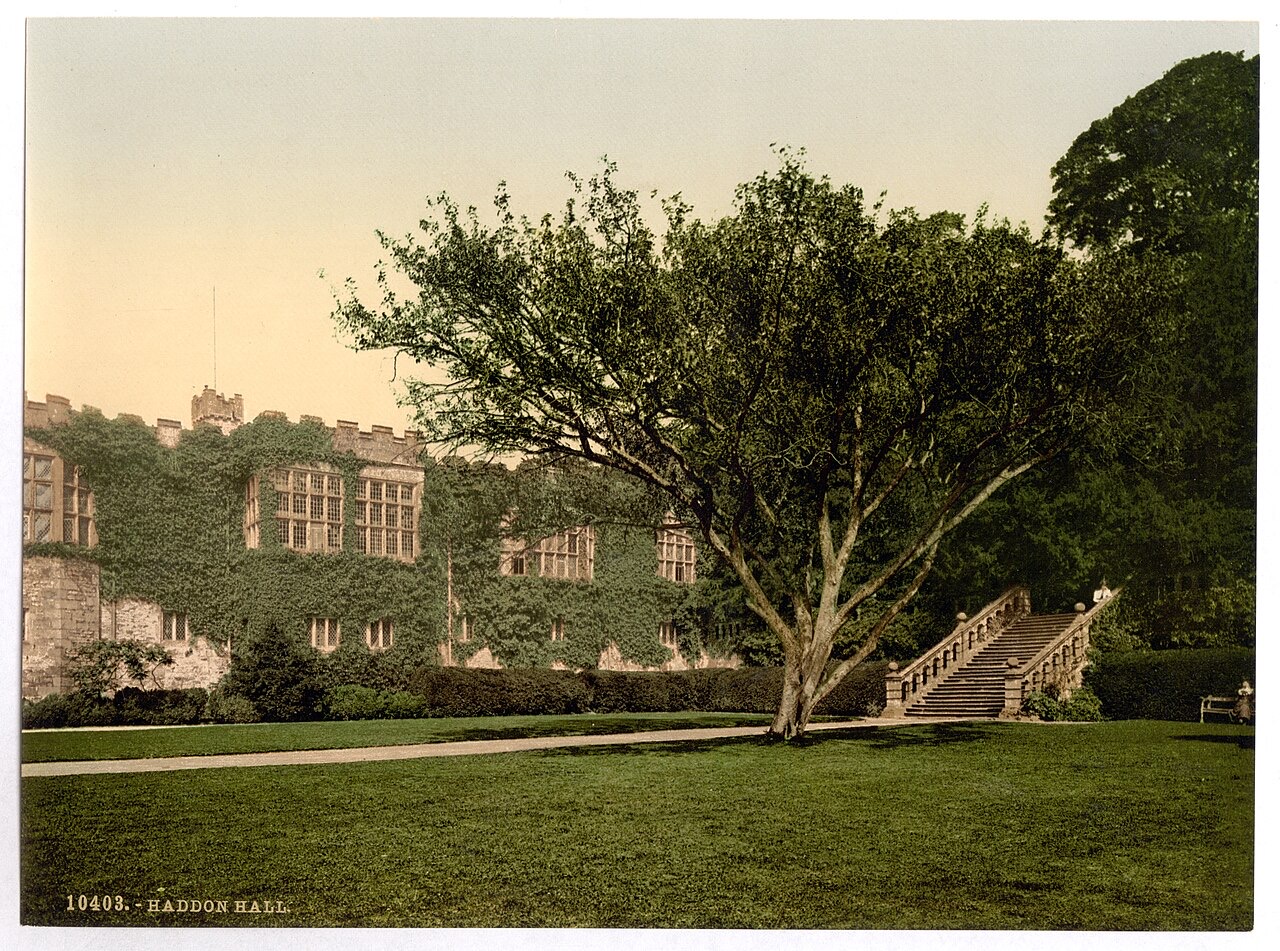
Visual AidA house too large to live in
Photochrom print of Haddon Hall in Derbyshire, made from a photograph of the 1890s. Read it the way the Knowledge Bank reads great houses: the front is not one design but centuries of additions, and every window on it stood for a room somebody had to heat, light and clean. Haddon itself was left almost unused for about two hundred years, which is the economy of closure in its extreme form. A photochrom is a black-and-white photograph printed in colors chosen by the printer, so the greens are not a record of that day. This is not Misselthwaite, which is invented.
Haddon Hall, from the terrace, Derbyshire, England; photochrom print, Detroit Publishing Company, from a photograph of the 1890s, Photochrom Print Collection, Library of Congress. Source: Wikimedia Commons, File:Haddon Hall, from the terrace, Derbyshire, England-LCCN2002696683.jpg, public domain.
🧠Knowledge Bank question
1The Knowledge Bank explains that most rooms in a great house were locked because ___.Ch.5
2According to Martha, how did Mrs. Craven die?Ch.5
3Martha agrees at once that a child is crying somewhere in the house.Ch.5
4What living thing does Mary find in a velvet cushion?Ch.6
5Write the numbers 1–5 in the boxes to show the correct order of events. Number 1 = what happens first.Chapters 5–8
Ben Weatherstaff tells Mary the earth is getting ready to grow things.
Mary plays with a cabinet full of carved ivory elephants.
Mary skips down her own walk until she has counted thirty.
Mary follows the robin along the wall and decides the tree stands inside the shut garden.
Mary walks a long gallery lined with old family portraits.
6Martha’s family cottage stands about five miles away across the moor.Ch.7
7How does the buried key come to be lying in loose soil?Ch.7
8Where did Mary’s skipping rope come from?Ch.8
9Mrs. Medlock gives Mary permission to explore the closed upstairs rooms.Ch.6
10What finally shows Mary where the hidden door is?Ch.8
Part 3
Literary Elements
Understanding HOW and WHY Frances Hodgson Burnett tells the story across Chapters 5–8.
🎭Knowledge Bank · The Art of Not Telling You
Literary Craft · Suspense and Withheld InformationPart 2 works by refusing to answer questions. Burnett (author) plants three locked things in a row — a garden with no door, a hundred shut rooms, and a cry down a corridor — and explains none of them. This is withheld information, and it is different from a plot twist: the reader is not tricked, only made to wait, and waiting is what turns curiosity into suspense. Notice who does the withholding. Adults deny what a child has plainly heard, which does two jobs at once, keeping the secret and telling us exactly how much power Mary lacks. Notice also that the setting is doing the work of a character here. Rain shuts Mary indoors and pushes her into the corridors; wind batters the house so the crying can hide inside it; a gust finally uncovers the door. Weather, in these chapters, is the story’s quietest engine.
Setting
The moor, the weather, and a house of locked rooms are not scenery here; they decide what Mary can do on any given day.
Personification
The wind beats at the walls like an unseen giant, and Ben Weatherstaff talks about soil that is in a good humor and glad to grow things.
Foreshadowing
A cry nobody will explain and a key nobody meant to be found are promises the book intends to keep.
Symbol
A key buried for ten years stands for far more than a lock: it is a shut-up life waiting to be opened.
🧠Knowledge Bank question
1The Knowledge Bank explains that Burnett (author) withholds answers in Part 2 in order to ___.Ch.5
2A cry heard twice that no adult will explain mainly works as ___.Ch.6
3Setting means only the year in which a book was published.Ch.5
4A key buried for ten years that opens a shut-away life is best called ___.Ch.7
5Personification gives human feelings or actions to things that are not human.Ch.7
6Fill in each blank with the correct literary term.Ch.7
Word choices:personificationsettingsymbolrhyme- some words will not be used
Calling the earth glad to grow things is .
Moor, weather, and locked house together make the .
7Which detail best shows the setting pushing the plot forward?Ch.6
8A symbol is an object that also stands for a larger idea.Ch.7
9Mrs. Medlock insisting Mary heard nothing mainly makes the reader ___.Ch.6
10Fill in each blank with the correct literary term.Ch.8
Word choices:foreshadowingsymbolindexpreface- some words will not be used
The unexplained crying is a clear case of .
The rusty key works in this story as a .
Part 4
Think Deeper
Four deeper challenges — no single-word recall. Read, weigh the evidence, and reason it out.
💡Knowledge Bank · When a Grown-Up Says You Heard Nothing
Logic · Testimony and DenialMary makes a claim, two adults deny it, and Part 2 hands the reader the job of deciding who is right. Doing that properly means separating three things. First the testimony: what Mary actually observed, which is a sound she heard twice, in two places, once short and childish. Second the corroboration: Martha was in the room and jumped up too, and a door slammed somewhere far off, so the evidence is not only in one person’s head. Third the motive: Mrs. Medlock is under orders that certain subjects are never discussed, which gives her a reason to deny the sound whether or not it is real. Notice that a denial is not evidence by itself; it is a statement that needs weighing like any other. The uncomfortable lesson is that authority and accuracy are two different things, and Part 2 asks you to tell them apart.
Picture a house so large that nobody in it can tell you how many rooms it has. Outside, a wind comes off the moor with nothing to break it for miles and hits the windows like something alive. Inside, a ten-year-old girl who has never wanted anything is beginning, against her will, to want three things at once: to know why a man buried a key, to know who is crying at the far end of a corridor, and to know what is behind a wall with no door in it. Nobody will tell her. The housekeeper says she heard nothing. The maid says it was the wind. So Mary starts doing the only thing left to a child that everyone is lying to — she goes looking. Part 2 is four chapters of that search, and it ends with a rusty key, a gust of wind, a knob under the ivy, and a door that has not opened in ten years swinging slowly inward.
Original passage written for Garden Heights — not a quotation from the novel.
1Claim: “Part 2 shows that Mary’s discoveries come from being left completely alone.” — choose the two details that best prove it.Claim & Evidence
2Changes Mary’s body, or Changes Mary’s mind? Tap each detail to send it left or right.Sort into two
◄ Changes Mary’s bodyChanges Mary’s mind ►
3Match each cause to its result. For each cause, pick its result.Cause & Effect
Rain shuts Mary indoors for a day→
A draft blows their door wide open→
A dog digs a hole hunting a mole→
A strong gust swings the loose ivy aside→
🧠Knowledge Bank question
4Fill both blanks to complete the reasoning.Build the Argument
According to the Knowledge Bank, Mary’s report of the crying is worth believing because , which shows that .
Part 5
Standardized Test
The Moor Through the Year · Reading & Vocabulary · SAT & TOEFL-style practice
Read the passage — the highlighted words are tested — then answer. Tap an answer, then tap it again to confirm.
SATCentral Ideas — the passage's main point
SATWords in Context — a word's meaning in this passage
SATInference — a conclusion the passage implies
SATAuthor’s Purpose — what the author wants to achieve
TOEFLFactual Information — a fact stated in the passage
TOEFLVocabulary — a tested word's meaning here
TOEFLProse Summary — the three sentences that sum it up
The Moor Through the Year
A moor is a wide, treeless upland covered in low shrubs, and the reason begins underground. Rain falls on these hills in torrents, faster than the ground can drain it, so the soil stays cold and waterlogged most of the year. Water sitting in soil pushes out the air, and without air the bacteria and fungi that rot dead leaves work very slowly. Dead plants pile up instead of disappearing, packing down into peat — a dark, spongy layer of half-rotted vegetation that on some English moors lies more than ten feet deep.
Peat is strongly acid, and acid ground locks away the nutrients most plants depend on, so anything ambitious is stunted there. Heather is the great exception: a low evergreen perennial that lives on year after year instead of dying at the end of one season, and its small tough leaves lose little water to the wind. That one plant gives the moor its two faces. For most of the year its foliage is a dull olive brown, and the hills look dead from a distance. Then, over a few weeks in late summer, millions of tiny bell-shaped flowers open at once and the moor burns purple to the horizon.
Weather rules the rest of the calendar. Wet Atlantic winds meet these hills, are forced upward, cool, and drop their rain on the high ground, so moorland can catch twice the rainfall of farmland twenty miles east. Winter brings fog, sleet, and gales with no trees to slow them, and the heather waits dormant, alive but shut down until warmth returns. People have always lived along the edge of a moor rather than on top of it, grazing sheep on the lower slopes and cutting peat to burn.
Original passage written for Garden Heights — not a quotation from the novel.
1What is the passage mainly about?SAT · Central Ideas
2According to the passage, dead plants pile up on a moor because ___.TOEFL · Factual Information
3In the passage, torrents most nearly means ___.SAT · Words in Context
4How deep can peat lie on some English moors?TOEFL · Factual Information
5The passage suggests that trees are rare on a moor because ___.SAT · Inference
6In the passage, perennial most nearly means ___.TOEFL · Vocabulary
7The author describes the moor’s two faces in order to ___.SAT · Author’s Purpose
8Prose Summary (TOEFL).The passage explains what a moor is, why it looks the way it does, and how the seasons and the weather shape it. This TOEFL task lists six sentences; choose the THREE that best capture the passage’s main ideas. The other three do not belong — they state minor details or ideas the passage does not present.TOEFL · Prose Summary
9In the passage, dormant most nearly means ___.SAT · Words in Context
10How does this passage best help a reader of Part 2?SAT · Inference
Part 6 · Optional
Creative Writing
A bonus challenge to practice your English. Take your time and have fun with it.
About This Section
This writing task is optional and is not part of your auto-graded score. The feedback below checks only the basics — length, spelling, and grammar — not whether your ideas are right or wrong. It is meant for classroom discussion and creative practice, so feel free to use your imagination!
Writing Task — Part 2 “The Thing Nobody Would Explain”
Mary hears crying twice and is told, twice, that she heard nothing at all. Write about a time you were sure of something the adults around you denied or would not explain — or a time you found out something on your own because nobody would tell you. Describe what you noticed, what you were told, and what you did about it. 6–10 sentences. End with whether you were right.
You can start with: “They kept telling me I had imagined it, but I knew what I heard...”
0 / 40 words minimum
🗣 Teach It · Just for Fun (optional)
No right or wrong — close the screen and tell someone nearby what happened in this part. Can’t find anyone? Tell yourself out loud. The moment you teach it, you truly understand it.
Independent study guide by Garden Heights. Not affiliated with or endorsed by Frances Hodgson Burnett. Contains original analysis only; no text from the novel is reproduced. Reference text: This workbook follows Frances Hodgson Burnett’s classic text (the standard Puffin edition sold worldwide). Revised 2023 UK editions change some wording and may not match the vocabulary studied here.