New here? Just sign up with Google — your account includes Matilda, our gift book, forever.
The Secret Garden · Garden Heights
Part 3
for The Secret Garden · Part 3 · Chapters 9–12
8 Parts40 min
What Happens in Part 3
Inside the garden Mary finds living wood, meets Dickon, and asks her uncle for a bit of earth.
Green points, black earthThe garden is silent, its walls matted with bare rose stems and long gray tendrils swung down from the trees; Mary cannot tell whether the wood is dead. In a sheltered alcove she sees sharp pale green points pushing out of the black earth, finds a pointed stick, and clears the thick grass away from them, bed after bed, until she is warm, filthy, and late for dinner.
Tools and seedsAt dinner Martha identifies the white onion-shaped root as a bulb that looks after itself underground for years, and says her brother Dickon knows everything about growing. Instead of a spade, she suggests Mary print a letter to Dickon and send her pocket money for tools and penny seed packets from Thwaite village. That evening the far-off crying comes a third time, and Martha changes the subject in a hurry.
Dickon and wick woodA week of sun leaves Mary stronger and less sour, and she wears Ben Weatherstaff into conversation: he once gardened for a young lady who loved roses like children, dead about ten years, and he still slips in to prune them. Near a gate she finds Dickon piping under a tree with a squirrel, a pheasant, and two rabbits. He brings her tools and seed, and she weeps and confesses she has stolen a garden.
A bit of earthDickon cuts into branches to show her the test: greenish damp wood is wick — alive — while dry wood snaps. Most roses are wick, though someone has pruned here recently. Then Mr. Craven, home briefly after Susan Sowerby spoke for her, admits he forgot Mary existed and offers toys; she asks instead for a bit of earth. He grants her any ground she likes and leaves. In the garden a thorn pins Dickon's promise to return.
What We Will Learn
Section
What you will practice
Vocabulary
Growing things, old walls, and grown-up moods: tendril, alcove, bulb, wick, imperious…
Literary Elements
Symbolism carried by living and dead wood, personification that gives a bird opinions, sensory imagery, and foreshadowing hidden in a pruned branch
Cross-Curricular
Bird behavior — what a European robin really is, why it works beside a digging spade, and what taming a wild animal actually involves
Chapter Summary
Ch.
What happens
Chapter 9
The Strangest House — Inside the walls Mary finds gray, matted rose stems, hanging tendrils, and winter grass, and cannot tell whether anything is living. Then she spots pale green points in an old bed and clears the grass away from them with a sharp stick. At dinner Martha names the white roots as bulbs and helps her print a letter asking Dickon to buy tools and seeds.
Chapter 10
Dickon — A week of sun, digging, and skipping leaves Mary stronger and friendlier. Ben Weatherstaff lets slip that he still prunes the roses of a lady dead ten years, and the robin startles him by landing on his spade handle. In the wood Mary finds Dickon piping to a squirrel, a pheasant, and two rabbits; he has her tools, and she confesses that she has found a garden.
Chapter 11
The Nest of the Missel Thrush — Dickon walks the garden softly, cuts into gray branches, and shows Mary that greenish, damp wood is wick and dry wood is done for. Most of the roses have survived. They agree to keep the place wild, Dickon promises to come every day, and he notices that someone has pruned here far more recently than the locked door should allow.
Chapter 12
A Bit of Earth — Martha reports that Mr. Craven is home and asking for Mary, because Susan Sowerby stopped him on the road and spoke for her. In his study the stooped, miserable man tells Mary to run wild and offers her toys. Mary asks instead for a bit of earth, and he grants her any ground she wants. She returns to the garden to find Dickon gone and a promise pinned to a rose bush.
Part 1
Vocabulary
Study 10 key words from Chapters 9–12, then answer each question.
📚Knowledge Bank · Old Words Hiding in Plain Sight
Linguistics · Word OriginsSeveral words in these chapters are much older than they look. Wick is the northern English form of the Old English word cwic, which meant living rather than fast. The same root gives us quick in its ancient sense: the tender skin under a fingernail is still called the quick, and quicksilver was named for a metal that runs about as though alive. So when Dickon cuts a branch and calls the wood wick, he is using a word a thousand years old for exactly what it once meant. Alcove traveled a longer road, from the Arabic al-qubba, a domed chamber, through Spanish and French into English. Tendril arrived through French too, and word historians still argue over whether it traces to a Latin verb meaning to stretch or a Latin word meaning tender and young. A girl raised to expect that servants will obey her is called imperious, from imperium, the Latin word for command and for empire — a word that carries its own history of who gave orders to whom.
tendriln.Ch.9
A thin, curling stem a climbing plant uses to grip and hang on
“Long tendrils swung between the trees like gray curtains.”
alcoven.Ch.9
A small space set back into a wall or a hedge
“A stone seat stood in an evergreen alcove near the wall.”
bulbn.Ch.9
A rounded underground bud that stores food for next season’s plant
“Martha said the white root was a bulb, not an onion.”
sarcasticadj.Ch.10
Saying the opposite of what you mean in order to mock
“Ben Weatherstaff was sarcastic about the robin’s vanity.”
imperiousadj.Ch.10
Behaving as though you have a right to give orders
“Mary sounded imperious even when she was miserable.”
wickadj.Ch.11
Yorkshire word for alive, still holding green life
“Dickon cut the branch and showed her it was wick.”
reverentadj.Ch.11
Full of deep respect, almost as if before something holy
“Mary touched the green shoot in a reverent way.”
industriousadj.Ch.11
Working hard and steadily without needing to be told
“The two of them were industrious all morning.”
guardiann.Ch.12
An adult who is legally responsible for a child
“Mr. Craven admitted he was a poor guardian for her.”
tremulousadj.Ch.12
Shaky or trembling, usually from nerves or feeling
“Her voice came out tremulous when she asked.”
ⓘ The vocabulary words in this list are selected to help you understand and complete this workbook. Some may not appear verbatim in the original novel.
🧠Knowledge Bank question
1According to the Knowledge Bank, the northern word wick comes from an older word meaning ___.Ch.9
2An ‘alcove’ is a small space set back into a wall or hedge.Ch.9
3A ‘bulb’ is an underground bud that ___.Ch.9
4Someone who is ‘sarcastic’ is ___.Ch.10
5Fill in each blank with the correct word.Ch.10–11
Word choices:wickimperiousalcovebulb- some words will not be used
Green and damp inside means the wood is still .
Mary sounded because she was raised to be obeyed.
6To touch something in a ‘reverent’ way is to touch it ___.Ch.11
7‘Industrious’ means unwilling to start a difficult job.Ch.11
8A ‘guardian’ is an adult who is ___.Ch.12
9A ‘tremulous’ voice is loud, flat, and perfectly steady.Ch.12
10Fill in each blank with the correct word.Ch.10–12
Word choices:sarcastictremuloustendrilguardian- some words will not be used
Ben’s praise of the bird was really .
Her question came out in a whisper.
Part 2
Comprehension
Show you understood what happens in Chapters 9–12.
🐦Knowledge Bank · What Taming a Wild Bird Really Means
Zoology · Bird BehaviorDickon does not tame animals in the way a circus trainer does; nothing in these chapters is trained at all. Two ordinary processes are doing the work. The first is habituation — an animal learning to stop reacting to something that happens over and over and never hurts it. Every wild animal keeps a flight-initiation distance, the range at which it breaks and runs, and that distance shrinks with harmless experience. That is why Dickon rises so slowly: a sudden movement resets the distance and the rabbits go. The second process is association. Birds that meet a person who repeatedly turns up food come to treat that person as a moving feeding opportunity, and several species can tell individual human faces apart and remember which ones to avoid for years. So a robin landing on a spade handle is not affection. It is a small, sharp animal running a calculation about safety and worms and deciding the odds are good.
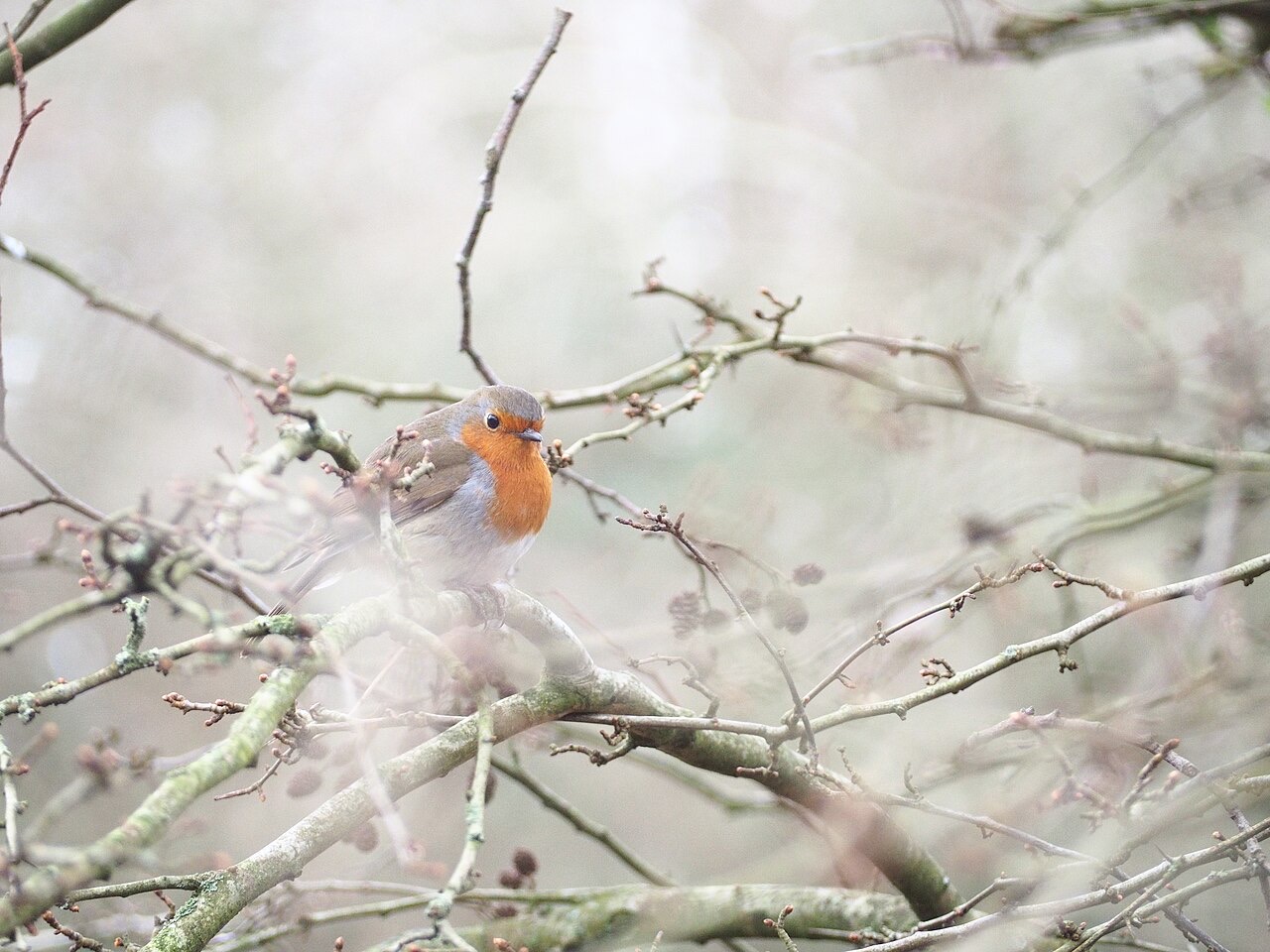
Visual AidThe bird that decides you are safe
Photograph of a European robin in bare winter branches, taken at a wetland reserve in Sussex, England, in January 2023 — a place where people pass all day, which is exactly the harmless experience the Knowledge Bank calls habituation. What a photograph cannot show is the flight-initiation distance shrinking, since that is measured across many meetings, not in one instant. The picture does not claim the bird is tame or affectionate. Notice how small it is against the twigs, and that it is watching.
European robin (Erithacus rubecula) at WWT Arundel, Sussex, England, 28 January 2023; photograph by Jethro Busby. Source: Wikimedia Commons, File:20230128-robin.jpg, CC0.
🧠Knowledge Bank question
1According to the Knowledge Bank, an animal’s flight-initiation distance is ___.Ch.9
2Ben Weatherstaff says that in a flower garden he would plant mostly ___.Ch.10
3Dickon tells Mary he is used to keeping secrets about nests and animal dens.Ch.10
4What does the robin do that leaves Ben Weatherstaff afraid to breathe?Ch.10
5Write the numbers 1–5 in the boxes to show the correct order of events. Number 1 = what happens first.Chapters 9–12
She kneels in an old bed and scrapes grass off the pale green points.
Mary asks her uncle for a bit of earth in his study.
Dickon slices a lifeless-looking branch and finds green inside.
Martha dictates a letter and Mary prints it out for Dickon.
Mary steps through the ivy-hung door into a silent gray garden.
6When Mary first sees Dickon in the wood, he is ___.Ch.10
7Mary and Dickon decide the garden should be clipped neat and tidy.Ch.11
8Which creatures are gathered near Dickon while he pipes?Ch.10
9Dickon walks about five miles to get home from Misselthwaite.Ch.12
10Why does Mr. Craven finally send for Mary?Ch.12
Part 3
Literary Elements
Understanding HOW and WHY Frances Hodgson Burnett tells the story across Chapters 9–12.
🎭Knowledge Bank · Making a Garden Stand for Something
Rhetoric · Figurative LanguageA symbol is a real thing in a story that also carries a meaning larger than itself, and the test Dickon teaches is the clearest one Frances Hodgson Burnett (author) puts in this book. Cut into gray wood; if the inside is green and damp, the plant is still living. Nothing about that is metaphor yet — it is simply how gardeners check a rose. It becomes symbolism because the same test is being applied, silently, to a sour, neglected, apparently finished child, and to a house full of shut doors. Around the symbol sit two more tools. Personification hands the robin vanity and property rights and lets bulbs cheer up underground, so the garden feels populated before a single flower opens. And imagery keeps it physical: matted stems, damp black earth, green points barely above the soil. The meaning never has to be announced, because the reader has already handled the evidence and felt it turn green.
Symbolism
Wick wood and dead wood stand for more than gardening: a neglected thing that still has green inside it is the whole argument of the book.
Personification
The robin is given pride, opinions, and a sense of ownership, and the bulbs underground are described as cheering up and working.
Imagery
Gray matted stems, the smell of turned earth, and points of green no bigger than pencil tips let the reader see the garden before it blooms.
Foreshadowing
Dickon spots pruning done long after the door was locked, and the crying in the corridor comes a third time — two questions the book means to answer.
🧠Knowledge Bank question
1The Knowledge Bank explains that Dickon’s wick test becomes symbolism because ___.Ch.11
2Calling the robin proud and vain, and saying the bulbs cheer up, is ___.Ch.10
3Imagery is language that appeals to the reader’s senses.Ch.9
4Dickon noticing recent pruning behind a locked door is an example of ___.Ch.11
5Fill in each blank with the correct literary term.Ch.9–11
Word choices:imagerysymbolismrhymeindex- some words will not be used
The smell of turned black earth is .
Live wood inside a dead-looking branch is .
6Which detail is the strongest example of sensory imagery?Ch.9
7Foreshadowing is a hint about something that will matter later on.Ch.11
8Burnett (author) keeps the garden’s meaning unstated mainly so the reader ___.Ch.11
9Symbolism means describing a plant using only scientific measurements.Ch.11
10Fill in each blank with the correct literary term.Ch.10–11
Word choices:personificationforeshadowingfootnotepreface- some words will not be used
Giving the robin vanity and pride is .
A branch pruned behind a locked door is .
Part 4
Think Deeper
Four deeper challenges — no single-word recall. Read, weigh the evidence, and reason it out.
💡Knowledge Bank · Testing a Claim About Change
Logic · Weighing EvidenceA claim is only as good as the evidence that fits it, and Part 3 is unusually easy to argue about because the evidence is physical. Suppose the claim is that Mary is changing. Tight stockings, two helpings at dinner, a hundred skips, and falling asleep in a chair are all evidence for it. A locked door, a buried key, and the price of a spade in a village shop are true details that support nothing about her, and learning to tell those two piles apart is most of what careful reading is. Watch for the second trap as well. A detail can be relevant and still not be the strongest support available; a reader who takes the first fact that fits is settling for a weak case. Sorting details, ranking them, and saying plainly why the survivors matter is the difference between an opinion and an argument that does real work.
Visual AidSorting the evidence for one claim
Structure diagram of the sorting the Knowledge Bank asks for: the details of these chapters split into the ones that support the claim that Mary is changing and the ones that are perfectly true but say nothing about her. Seven details stand in for the dozens in the text, and the drawing settles nothing about the garden itself. It does not rank the four survivors, because ranking them is the reader’s job. Notice that the right-hand column is not made of errors — those facts are true, and still useless as support.
The relevance test and the strength-of-support test as set out in the Knowledge Bank; details drawn from the chapters covered by this part. Drawn for Garden Heights Academy.
A door swings inward under a curtain of ivy and shuts again behind a ten-year-old girl, and for the first time in a decade somebody is standing inside a walled garden. What she finds is not a ruin and not a paradise. It is a gray tangle: leafless rose stems matted over the walls, climbers swung from tree to tree like hanging curtains, brown winter grass, stone seats going green with moss. She cannot tell whether any of it is alive. Then, kneeling in an old flowerbed, she sees something no bigger than the tip of a pencil pushing up through black earth, and she starts scraping the grass away so it can breathe. That is the whole engine of Part 3. A child who has never worked at anything in her life discovers that she wants something to live, finds a boy who can tell live wood from dead by cutting into it, and finally walks into her uncle’s study to ask — out loud, in front of a man who frightens her — for a bit of ground of her own.
Original passage written for Garden Heights — not a quotation from the novel.
1Claim: “Part 3 shows that Mary is changing because of physical work and open air, not because anyone has corrected her behavior.” — choose the two details that best prove it.Claim & Evidence
2Evidence Mary is reviving, or Evidence the garden is alive? Tap each detail to send it left or right.Sort into two
◄ Evidence Mary is revivingEvidence the garden is alive ►
3Match each cause to its result. For each cause, pick its result.Cause & Effect
Mary clears grass from the green points→
Martha names the white roots as bulbs→
Dickon cuts into a lifeless-looking branch→
Susan Sowerby stops Mr. Craven on the road→
🧠Knowledge Bank question
4Fill both blanks to complete the reasoning.Build the Argument
According to the Knowledge Bank, the claim that Mary is changing is best supported by , which matters because .
Part 5
Standardized Test
The Robin and the Spade · Reading & Vocabulary · SAT & TOEFL-style practice
Read the passage — the highlighted words are tested — then answer. Tap an answer, then tap it again to confirm.
SATCentral Ideas — the passage's main point
SATInference — a conclusion the passage implies
SATAuthor’s Purpose — what the author wants to achieve
SATWords in Context — a word's meaning in this passage
TOEFLFactual Information — a fact stated in the passage
TOEFLVocabulary — a tested word's meaning here
The Robin and the Spade
The bird that hops onto a British gardener’s spade is not the bird an American means by that name. The American robin is a large thrush with a brick-colored belly that hunts worms across open lawns. The European robin is far smaller, about the size of a sparrow, with an orange-red face and chest rather than a red underside. The two are not close relatives; homesick settlers handed a familiar name to an unfamiliar bird.
Its boldness around people has a practical history. In old European woodland the bird followed wild boar, which turn over the forest floor with their snouts and expose worms, beetles, and grubs that are otherwise buried out of reach. An industrious gardener, digging steadily hour after hour, does the same job more reliably, so the robin treats a working spade as a moving supply of food and will forage within a step of a human hand. Robins in parts of continental Europe, where small birds were trapped and shot for far longer, keep to the hedges instead.
None of this is friendliness. A robin is the year-round guardian of its own patch of ground, and females as well as males defend a winter territory, which is why the species sings through the coldest months when most birds have fallen quiet. The song is a boundary claim, and the conspicuous red front is a warning flag; rivals that ignore it may be attacked. What looks like tameness is habituation — learning to ignore a harmless thing that happens again and again — plus plain calculation about food. The bird has decided it can tolerate one large animal because that animal keeps turning up worms.
Original passage written for Garden Heights — not a quotation from the novel.
1What is the main idea of the passage?SAT · Central Ideas
2According to the passage, a robin follows a digging gardener because ___.TOEFL · Factual Information
3The passage says the American robin differs from the European robin in that it is ___.TOEFL · Factual Information
4It can be inferred that robins on parts of the European continent stay in hedges because ___.SAT · Inference
5According to the passage, robins sing in the coldest months because they ___.TOEFL · Factual Information
6The passage most strongly suggests that a robin close to a gardener has ___.SAT · Inference
7The author mentions wild boar mainly in order to ___.SAT · Author’s Purpose
8In the passage, industrious most nearly means ___.SAT · Words in Context
9In the passage, guardian most nearly means ___.TOEFL · Vocabulary
10In the passage, tolerate most nearly means ___.SAT · Words in Context
Part 6 · Optional
Creative Writing
A bonus challenge to practice your English. Take your time and have fun with it.
About This Section
This writing task is optional and is not part of your auto-graded score. The feedback below checks only the basics — length, spelling, and grammar — not whether your ideas are right or wrong. It is meant for classroom discussion and creative practice, so feel free to use your imagination!
Writing Task — Part 3 “A Bit of Earth of Your Own”
Mary is offered toys, books, and dolls, and asks instead for a patch of ground. Write about something you would choose that most adults would not expect — a space, a tool, a responsibility, a chance to make something — and explain why it matters more to you than an easier gift would. Describe what you would do with it and what you would want to have happen. 6–10 sentences. End with what you think your choice says about you.
You can start with: “If someone asked me what I wanted, I would not ask for...”
0 / 40 words minimum
🗣 Teach It · Just for Fun (optional)
No right or wrong — close the screen and tell someone nearby what happened in this part. Can’t find anyone? Tell yourself out loud. The moment you teach it, you truly understand it.
Independent study guide by Garden Heights. Not affiliated with or endorsed by Frances Hodgson Burnett. Contains original analysis only; no text from the novel is reproduced. Reference text: This workbook follows Frances Hodgson Burnett’s classic text (the standard Puffin edition sold worldwide). Revised 2023 UK editions change some wording and may not match the vocabulary studied here.