New here? Just sign up with Google — your account includes Matilda, our gift book, forever.
The Secret Garden · Garden Heights
Part 5
for The Secret Garden · Part 5 · Chapters 17–20
8 Parts40 min
What Happens in Part 5
Mary shouts Colin out of his terror, and the children wheel him secretly into the garden.
Screaming in the nightMary wakes to one of Colin's fits and goes straight past pity into rage. The nurse, pale for once, begs her to try. Mary bursts in shouting that she hates him, that everybody hates him, that he can scream himself to death. Being contradicted is the one experience Colin has never had, and it stops him. Choking, he insists he has felt a lump on his back and will grow a hunch and die.
Nothing on his backMary orders the nurse to bare his back and bends over his spine as gravely as a specialist. There is nothing there but the backbone of a thin boy. The nurse adds mildly that his back is weak because he will not try to sit up. Colin's storm dies into relief; he asks whether he could live to grow up, offers Mary his hand, and is talked to sleep with descriptions of the garden.
Telling the secretNext morning Mary goes first to Dickon, who says the boy must be got outside without delay. Back at the house she makes Colin laugh in broad Yorkshire, then holds both his hands and tells him the secret: there is a door under the ivy, and she has been inside for weeks. Dr. Craven finds his patient sitting up over a picture of delphiniums, announcing he is going out in his chair without the nurse, and reluctantly agrees.
Into the gardenDickon arrives upstairs with the fox, the crow, two squirrels, and a newborn lamb laid on Colin's lap with a feeding bottle. Wind and a threatened cold delay the outing over a week while the children plan the route like generals. Colin orders the head gardener, Mr. Roach, to clear every man from the Long Walk. Carried down to his chair and wheeled through the ivy door, Colin looks, goes pink, and shouts that he will live forever.
What We Will Learn
Section
What you will practice
Vocabulary
The language of the sickroom and of secrets: hysterics, restrain, invalid, bromide, secrecy…
Literary Elements
Situational irony in a cure delivered by shouting, the Rajah motif that keeps returning to Colin’s hand, dramatic irony held over a boy who does not yet know what his cousin knows, and a closed room used as a symbol
Cross-Curricular
The invalid child in Victorian medicine — darkened rooms, spinal fears and braces, sedatives, and what doctors later learned about the cost of lying still
Chapter Summary
Ch.
What happens
Chapter 17
A Tantrum — Colin’s screaming wakes the house, and the nurse comes for Mary because no adult dares go in. Mary shouts him quiet, orders his back bared, and reports that there is no lump on his spine at all. Told the truth for the first time, Colin asks whether he might live to grow up, and falls asleep to Mary’s description of the garden.
Chapter 18
Tha’ Munnot Waste No Time — Mary carries the story of the night to Dickon, who says the boy must be got outdoors quickly. Back indoors she makes Colin laugh until Mrs. Medlock stops in the corridor to listen, then takes both his hands and tells him the secret: she has found the door under the ivy and has been inside the garden for weeks.
Chapter 19
It Has Come! — Dr. Craven arrives expecting a wrecked, sobbing patient and finds Colin sitting up over a garden book, refusing the nurse and planning an outing. He leaves without new orders. Next morning Mary throws the window open with news that spring has arrived, and Dickon walks in with the fox, the crow, the squirrels, and a newborn lamb to feed.
Chapter 20
I Shall Live Forever — Wind and a threatened cold delay them more than a week while the children plot a route that will look innocent. Colin summons Mr. Roach and clears every gardener off the Long Walk. A footman carries him down, Dickon pushes the chair through the ivy-hidden door, and Colin uncovers his eyes inside the garden and shouts that he will get well.
Part 1
Vocabulary
Study 10 key words from Chapters 17–20, then answer each question.
🦴Knowledge Bank · What a Backbone Actually Is
Anatomy · The SpineA back is not one bone but a stack. The human spine is built from thirty-three vertebrae, twenty-four of them movable, cushioned by discs of tough cartilage that work as shock absorbers and hinges at the same time. What your hand feels when it runs down someone’s back is not the body of each bone but its spinous process, a thin blade of bone that points backward and gives muscles and ligaments something to pull against. On a very thin person those blades stand out in a row like knuckles, so a frightened hand exploring its own back can easily find what feels like a line of growths. A genuine forward hunch of the upper spine does have a name, kyphosis, and in Victorian Britain its most feared cause was tuberculosis of the bone — an infection that eats into the vertebrae until they collapse. That disease was real, visible, and common enough that families dreaded it in any back that looked thin.
Visual AidThe stack a hand counts down
Structure diagram of the anatomy the Knowledge Bank explains: vertebrae stacked with cartilage discs between them, and from each bone a thin blade, the spinous process, pointing backward under the skin. Six bones are drawn where a real spine has thirty-three, the column is straightened although a real one curves, and no muscle or ligament is shown. The drawing does not diagnose anything, least of all a character. Notice that what a frightened hand finds in a row down a thin back is this ordinary blade, one per bone.
Vertebrae, intervertebral discs and the spinous process, and the count of thirty-three vertebrae with twenty-four movable, as set out in the Knowledge Bank and in standard human anatomy. Drawn for Garden Heights Academy.
hystericsn.Ch.17
An uncontrollable fit of crying, screaming, or panic
“The nurse says the boy has worked himself into hysterics.”
restrainv.Ch.17
To hold someone back or stop them from doing something
“No one in the house had ever tried to restrain him.”
contradictv.Ch.17
To say that what another person has said is not true
“Mary is the first person willing to contradict Colin.”
obstinateadj.Ch.17
Refusing to change your mind or give way
“She was obstinate about the lump he thought he felt.”
relentv.Ch.17
To soften and become less harsh or less severe
“Looking at his swollen eyes, Mary began to relent.”
enrapturedadj.Ch.18
Filled with delight; completely carried away by pleasure
“Colin lay enraptured while she described the garden.”
invalidn.Ch.19
A person kept in bed or indoors by long illness
“The servants called his rooms the invalid’s chamber.”
bromiden.Ch.19
A calming drug once given to quiet the nerves
“Dr. Craven asks whether Colin took his bromide.”
reclusen.Ch.19
Someone who lives shut away from other people
“The servants joke about the unpopular young recluse.”
secrecyn.Ch.20
The act of keeping something hidden from others
“Getting Colin to the garden required real secrecy.”
ⓘ The vocabulary words in this list are selected to help you understand and complete this workbook. Some may not appear verbatim in the original novel.
🧠Knowledge Bank question
1According to the Knowledge Bank, when a frightened invalid runs a hand down a very thin back, the row of bumps under the fingers is ___.Ch.17
2To ‘restrain’ someone is to hold them back or stop them.Ch.17
3To ‘contradict’ someone is to ___.Ch.17
4A ‘recluse’ is a person who ___.Ch.19
5Fill in each blank with the correct word.Ch.17
Word choices:relentsecrecybromiderecluse- some words will not be used
Seeing his tired face made Mary a little.
The trip to the garden depended on complete .
6An ‘invalid’ is a healthy person who works in a hospital.Ch.19
7A ‘bromide’ was a medicine given to ___.Ch.19
8Someone who is ‘enraptured’ is ___.Ch.18
9Fill in each blank with the correct word.Ch.17
Word choices:obstinatehystericsenrapturedinvalid- some words will not be used
Mary was and refused to take back a word.
The nurse said the boy had worked himself into .
10Someone who is ‘obstinate’ gives way easily to other people.Ch.17
Part 2
Comprehension
Show you understood what happens in Chapters 17–20.
🧠Knowledge Bank · When Fear Speaks Through the Body
Psychology · Symptoms and ExpectationExpectation changes what a body actually does. Researchers who study the nocebo effect — the mirror image of the placebo effect — have shown that volunteers warned that a harmless pill may cause headaches go on to report more headaches, and that people told to expect pain rate the same pinch as worse. The pathway is ordinary physiology rather than imagination. Alarm switches on the stress response: the heart speeds up, breathing shortens, muscles tighten, and attention narrows onto the body itself. Clinicians call that inward searching hypervigilance, and it almost always finds something, because every body produces small aches, twinges, and thumps all day long that a busy person never notices. None of this makes the suffering fake; the racing pulse and the exhaustion can be measured. It does mean that terror and attention help produce symptoms, which is why plain, calm information from someone a patient trusts can act like medicine.
🧠Knowledge Bank question
1According to the Knowledge Bank, the nocebo effect is best shown by volunteers who ___.Ch.17
2Who comes to Mary’s door and asks her to go to Colin?Ch.17
3Mary calms Colin by speaking gently and pitying him.Ch.17
4What does Colin insist has appeared on his back?Ch.17
5Write the numbers 1–5 in the boxes to show the correct order of events. Number 1 = what happens first.Chapters 17–20
Colin orders the gardeners to keep off the Long Walk.
Mary talks Colin to sleep by describing the garden.
The wheeled chair is pushed through the hidden door.
Dickon carries a newborn lamb into Colin’s room.
Mary tells Dickon what happened during the night.
6The nurse says Colin’s back is weak because he will not try to sit up.Ch.17
7Why is Colin’s recovery awkward for Dr. Craven?Ch.19
8Whom does Colin refuse to take with him on the outing?Ch.19
9Dr. Craven forbids the outing and orders Colin to stay in bed.Ch.19
10What does Colin shout once he is inside the garden?Ch.20
Part 3
Literary Elements
Understanding HOW and WHY Frances Hodgson Burnett tells the story across Chapters 17–20.
📚Knowledge Bank · The Invalid in the Bedroom Novel
Literature · A Nineteenth-Century FigureReaders in 1911 already knew the sick child in the shut room; the figure had been a fixture of storytelling for decades. Charles Dickens gave the world Tiny Tim in 1843, Susan Coolidge put Katy on her back for years in a book published in 1872, and Johanna Spyri sent a mountain girl to keep company with a girl in a wheeled chair in 1881. The pattern was so familiar that it counted as a convention: an invalid, a shadowed room, a household organized around one child’s fragility, and a visitor who arrives from outside and changes everything. Such stories are useful to a writer because a sickroom is a stage with only one exit. Every scene is a small siege, every arrival is an event, and the reader watches for a threshold to be crossed. Notice how much of this part is doorways — a nurse in a doorway, a doctor, a gardener, a boy with a lamb — until the plot finally leaves the room.
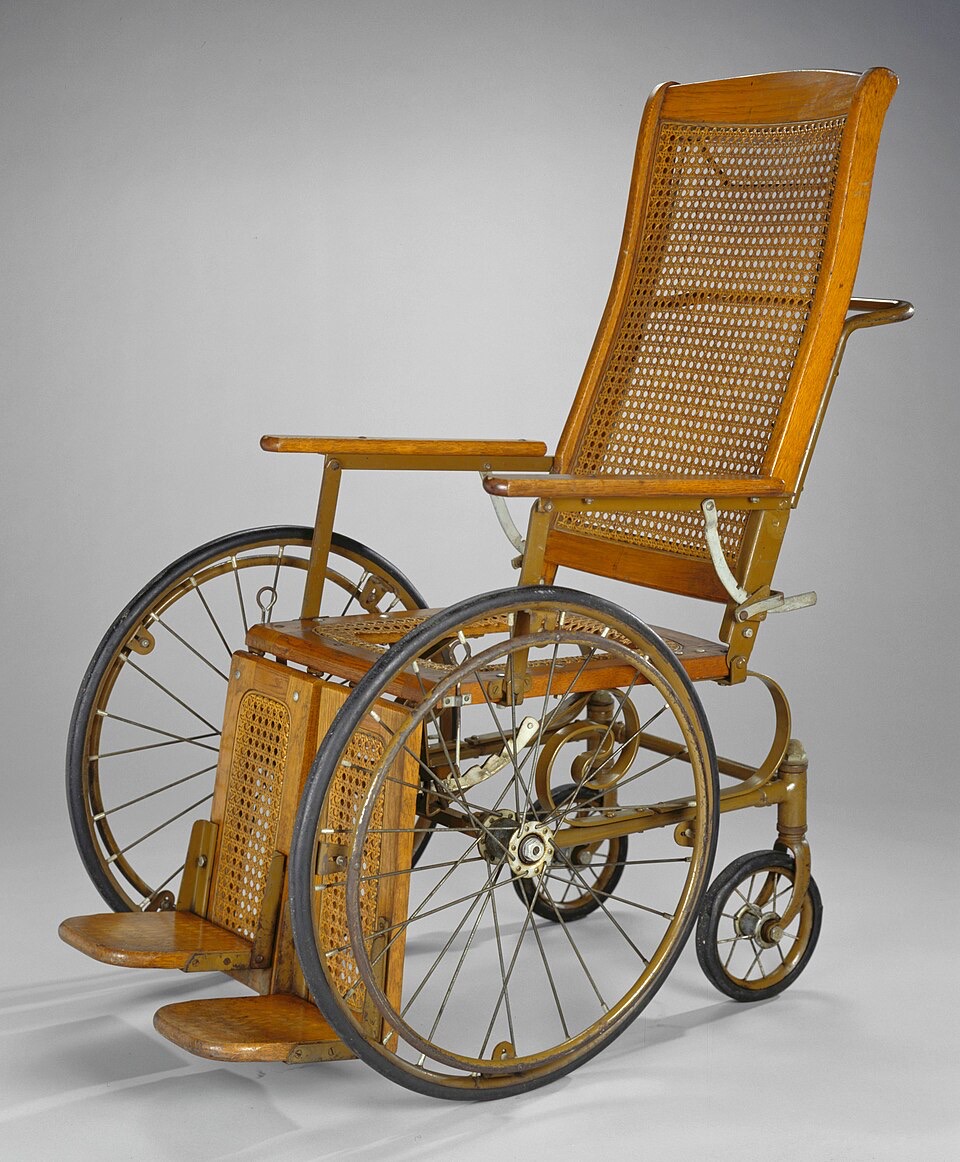
Visual AidThe chair the sickroom story needs
Photograph of a wooden invalid chair of the late 1800s or early 1900s, held by a museum in the United States — the wheeled chair that the convention in the Knowledge Bank runs on, from Tiny Tim to the girl in the chair in the 1881 mountain story. The chair is empty and belongs to no character; photographed against plain gray, it tells you nothing about the room it stood in. Notice the reclining back, the footrests and the pushing height: this is furniture built for someone expected to stay in it for hours.
Wood and wicker wheelchair typical of the late nineteenth and early twentieth centuries, Missouri History Museum. Source: Wikimedia Commons, File:Wood and Wicker Wheelchair.jpg, public domain.
Situational Irony
The gentleness of ten years has kept Colin screaming; a furious girl telling him she hates him is what quiets him. The result is the opposite of what everyone expected.
Dramatic Irony
Readers have been inside the walled garden for chapters. Colin has not, and every question he asks about it lands differently because we know the answer first.
Motif
The word Rajah returns whenever Colin gives an order — a repeated image that measures how much of the tyrant is left in him from one scene to the next.
Symbol
The shut room with drawn curtains stands for a life sealed off; the window Mary throws open and the door under the ivy are the same idea in reverse.
🧠Knowledge Bank question
1The Knowledge Bank explains that a sickroom is useful to a writer because ___.Ch.17
2Calling Colin a Rajah again whenever he gives orders creates a ___.Ch.19
3Dramatic irony means readers know something a character does not.Ch.18
4The shut room with its drawn curtains works in this part mainly as a ___.Ch.20
5A motif is a single detail that appears only once in a book.Ch.19
6Fill in each blank with the correct literary term.Ch.17
Word choices:ironymotifrhymeindex- some words will not be used
A cure delivered by shouting is situational .
Colin being called a Rajah again and again is a .
7Colin asking whether he will live to get into the garden hits hard because ___.Ch.18
8Situational irony happens when events turn out the opposite of what is expected.Ch.17
9Mary throwing the window wide open works best as a symbol of ___.Ch.19
10Fill in each blank with the correct literary term.Ch.20
Word choices:symboldramaticstanzapreface- some words will not be used
The door hidden under the ivy is a of a way out.
Knowing more than Colin does gives readers irony.
Part 4
Think Deeper
Four deeper challenges — no single-word recall. Read, weigh the evidence, and reason it out.
💡Knowledge Bank · What Stillness Costs a Body
Physiology · DeconditioningMuscle and bone are expensive to maintain, so a body keeps only what it is asked to use. Take the asking away and the accounting starts immediately. In strict bed rest the large muscles of the legs and back lose roughly one to one and a half percent of their strength a day; weight-bearing bone thins by about one percent of its mineral density a week, since bone rebuilds itself in response to load. Plasma volume falls within seventy-two hours, so blood pools in the legs on standing and the patient goes dizzy and pale. The heart, working against less gravity, grows less efficient too. Doctors call the whole cascade deconditioning, and its signature is that it mimics disease: breathlessness on the stairs, a pounding pulse, exhaustion after ten minutes upright. That is why hospitals now get patients sitting and walking as soon as it is safe, treating movement itself as part of the treatment.
Somewhere in a house of a hundred locked rooms, a boy is screaming, and every adult in the building has decided that the only cure is to give him whatever he wants. It has worked for ten years. It is not working tonight. Down the corridor a girl who has been shouted at all her own life puts her hands over her ears, discovers that fear can turn into fury, and marches into the room nobody else will enter. What she does there is not kind. She shouts louder than he does, calls the terror by its name, and then does the one thing no adult has dared to do in a decade: she looks at his back and tells him the truth about it. Part 5 is the hinge of the whole novel. In four chapters a boy goes from insisting that a lump is growing on his spine to being wheeled through a door in an ivied wall with his hands over his eyes, afraid to look at the thing he has been promised. When he finally lowers them, the sentence he shouts is about the rest of his life.
Original passage written for Garden Heights — not a quotation from the novel.
1Claim: “In Part 5 Colin begins to recover once someone treats him as an ordinary boy rather than a dying one.” — choose the two details that best prove it.Claim & Evidence
2What kept Colin in bed, or What gets him out of it? Tap each detail to send it left or right.Sort into two
◄ What kept Colin in bedWhat gets him out of it ►
3Match each cause to its result. For each cause, pick its result.Cause & Effect
Mary shouts at Colin instead of giving way→
The nurse bares his back for inspection→
Mary admits she has been inside the garden→
Dr. Craven hears that Dickon will push the chair→
🧠Knowledge Bank question
4Fill both blanks to complete the reasoning.Build the Argument
The Knowledge Bank explains that weeks of strict bed rest weaken a patient because , and this matters because the change .
Part 5
Standardized Test
When Rest Was the Cure · Reading & Vocabulary · SAT & TOEFL-style practice
Read the passage — the highlighted words are tested — then answer. Tap an answer, then tap it again to confirm.
SATCentral Ideas — the passage's main point
SATWords in Context — a word's meaning in this passage
SATInference — a conclusion the passage implies
SATAuthor’s Purpose — what the author wants to achieve
TOEFLFactual Information — a fact stated in the passage
TOEFLVocabulary — a tested word's meaning here
When Rest Was the Cure
For most of the nineteenth century, the treatment for a fragile child was to take movement away. A doctor who suspected a weak heart, a diseased spine, or delicate nerves prescribed quiet: months in bed, lessons stopped, visitors limited, curtains closed against light and noise. A dose of bromide, the sedative of the age, quieted a fretful child. The reasoning was not foolish. Surgeons had watched broken bones knit cleanly when a limb was held still, and had seen joints infected with tuberculosis — a bacterial disease that attacks the lungs and bones — quiet down when the patient rested them.
Nobody measured the price. A body keeps only the muscle and bone it is asked to use, so a person lying flat loses both: strength falls by about one to one and a half percent for each day of strict bed rest, and weight-bearing bone sheds roughly one percent of its density in a week. Blood volume drops too, which is why a patient down for weeks turns dizzy on standing. Doctors call the slide deconditioning, and it imitates illness, so every new symptom looked like proof that the rest was needed. A child shut in that room became a recluse as well.
The correction came slowly, and from an odd direction. During the Second World War, hospitals short of beds got surgical patients up within a day or two and found they recovered faster. In 1947 the British physician Richard Asher published a blunt paper on the dangers of going to bed, listing the clots, sores, and low spirits that confinement itself produced. Hospitals now get patients walking as soon as it is safe, and the invalid in a shaded room describes a treatment as much as an illness.
Original passage written for Garden Heights — not a quotation from the novel.
1What is the main idea of the passage?SAT · Central Ideas
2According to the passage, a prescription of quiet often included ___.TOEFL · Factual Information
3The passage says surgeons trusted stillness partly because they had seen ___.TOEFL · Factual Information
4In the passage, bromide most nearly means ___.SAT · Words in Context
5According to the passage, strict bed rest costs muscle strength at about ___.TOEFL · Factual Information
6Why did new symptoms make the rest cure look correct?SAT · Inference
7In the passage, confinement most nearly means ___.TOEFL · Vocabulary
8The author mentions wartime hospitals mainly in order to ___.SAT · Author’s Purpose
9The passage suggests that today a hospital would most likely ___.SAT · Inference
10In the passage, recluse most nearly means ___.SAT · Words in Context
Part 6 · Optional
Creative Writing
A bonus challenge to practice your English. Take your time and have fun with it.
About This Section
This writing task is optional and is not part of your auto-graded score. The feedback below checks only the basics — length, spelling, and grammar — not whether your ideas are right or wrong. It is meant for classroom discussion and creative practice, so feel free to use your imagination!
Writing Task — Part 5 “The Thing Nobody Would Say”
Colin spends years certain that a lump is growing on his back, and the adults around him are too careful, or too frightened, to check. Write about a time somebody told you a plain truth you did not want to hear — or a time you told one to someone else. Explain what the fear or the mistake was, how the truth was delivered, and whether the bluntness helped or hurt. 6–10 sentences. End by saying what you would do differently if you had to deliver that truth today.
You can start with: “Nobody wanted to be the one to tell me...”
0 / 40 words minimum
🗣 Teach It · Just for Fun (optional)
No right or wrong — close the screen and tell someone nearby what happened in this part. Can’t find anyone? Tell yourself out loud. The moment you teach it, you truly understand it.
Independent study guide by Garden Heights. Not affiliated with or endorsed by Frances Hodgson Burnett. Contains original analysis only; no text from the novel is reproduced. Reference text: This workbook follows Frances Hodgson Burnett’s classic text (the standard Puffin edition sold worldwide). Revised 2023 UK editions change some wording and may not match the vocabulary studied here.