New here? Just sign up with Google — your account includes Matilda, our gift book, forever.
The Secret Garden · Garden Heights
Part 7
for The Secret Garden · Part 7 · Chapters 24–25
8 Parts40 min
What Happens in Part 7
Mrs. Sowerby joins the secret with food and advice while Colin trains in hiding.
News at the cottageDickon keeps a second garden beside the Sowerby cottage, raising potatoes, cabbages, turnips, carrots, and herbs, with penny flower seed tucked among the vegetables. In the long twilight Mrs. Sowerby sits on the wall to hear the day's news, and with permission Dickon tells her everything — the buried key, the robin, the gray branches, Ben's furious face above the wall, and Colin standing on his own feet. She laughs until she rocks in her blue cloak.
Buns and milkShe laughs most at the play-acting: Colin is still carried to his chair, still snaps at John the footman, still refuses to lift his head until the house is out of sight, so that no one writes to his father first. Their real trouble is appetite — the nurse and Dr. Craven have noticed. Mrs. Sowerby solves it: every morning Dickon carries in new milk and hot currant buns, hidden behind a rosebush until the children are starving.
Paying their wayLearning the cottage already feeds fourteen, Colin and Mary send shillings home for what they eat, and Dickon builds a stone oven in a hollow in the wood for roasting eggs and potatoes. He also brings muscle exercises learned from Bob Haworth, a champion wrestler, and Colin adds them to the daily Magic. The children now eat almost nothing indoors, the trays come back polished, and the household is baffled until the doctor says to let them laugh.
Running the galleryThe robin, watching Colin move slowly and stop, decides that the boy is learning to walk as a young bird learns to fly. On a wet morning Colin is wheeled to the picture gallery, sends John away, runs its length, jumps, and does the wrestler's exercises among his ancestors' portraits; the luncheon tray goes back empty. That afternoon Mary sees the curtain over his mother's portrait drawn back for good, because Colin is no longer angry at her laughing face.
What We Will Learn
Section
What you will practice
Vocabulary
Service, secrecy, and a rainy day indoors: twilight, footman, mystified, restive, brocade…
Literary Elements
Dialect written into the spelling itself, dramatic irony aimed at the grown-ups, and a narrator who hands two pages to a bird
Cross-Curricular
Language and social class — what a dialect actually is, how a great house sorted its servants, and why a cottage kitchen matters to the plot
Chapter Summary
Ch.
What happens
Chapter 24
“Let Them Laugh” — Dickon tells his mother the whole secret in the cottage garden at twilight. Hearing that the children dare not eat enough, Mrs. Sowerby sends milk and currant buns out each morning; Colin and Mary send shillings back, Dickon builds a stone oven in a hollow, and Bob Haworth’s exercises join the daily Magic while the household stays baffled.
Chapter 25
The Curtain — The robin’s mate broods a nest of eggs, and the robin finally decides that Colin is only learning to walk. A wet morning sends Mary and Colin exploring the unused rooms, where Colin runs the picture gallery end to end. That afternoon Mary sees that the curtain over his mother’s portrait has been drawn back for good.
Part 1
Vocabulary
Study 10 key words from Chapters 24–25, then answer each question.
📚Knowledge Bank · The Danish Layer in Yorkshire
Etymology · Northern Word StockMany words that sound strangest in Yorkshire speech are in fact older in England than the words that replaced them further south. In the ninth and tenth centuries, Danish and Norwegian settlers took control of a wide band of northern and eastern England later called the Danelaw — the region governed under Danish law — and their language soaked into the English spoken there. That is why a stream in Yorkshire is a beck, a narrow valley is a gill, and to play is to laik. Place names keep the same fingerprint: the ending -by marks a farmstead or village, and -thwaite marks a clearing cut out of woodland, which is why the map around a house named Misselthwaite is thick with such endings. None of this is a sloppy version of southern speech. It is a separate line of descent, kept in the north while London drank in French and Latin borrowings after 1066. When Martha uses a word Mary cannot follow, Mary is not hearing carelessness. She is hearing a thousand-year-old inheritance.
Visual AidTwo lines of descent
Structure diagram of the family tree the Knowledge Bank sketches: one Old English root, then a northern line soaked in Danish and Norwegian speech and a southern line that took in French and Latin after 1066. Three words and two place-name endings stand in for hundreds, the dates are broad, and real dialects mixed far more than two clean branches suggest. The drawing does not claim that Yorkshire speech is older word for word than every southern form. Notice which branch Martha speaks from, and that Mary’s vocabulary sits on the other one.
Norse settlement in the Danelaw and its deposit in northern English vocabulary and place names, and the post-1066 French and Latin borrowings of southern English, as set out in the Knowledge Bank and in standard histories of the English language. Drawn for Garden Heights Academy.
twilightn.Ch.24
The dim light after sunset, before full dark
“Mrs. Sowerby liked the long twilight best for talking.”
thrivev.Ch.24
To grow strong and healthy
“Dickon says plants thrive for anyone who is friendly to them.”
mystifiedadj.Ch.24
Completely puzzled by something you cannot explain
“The nurse was mystified by the polished, empty plates.”
footmann.Ch.24
A male household servant who carries, fetches, and answers doors
“John the footman carried Colin down to his chair each day.”
disdainv.Ch.24
To treat something as beneath you, not good enough for you
“It is easy to disdain your dinner when you are already full.”
luxuryn.Ch.24
Something pleasant that nobody actually needs
“A roasted egg in the wood counted as a real luxury.”
repressv.Ch.24
To hold a feeling down instead of letting it out
“Mary tried to repress a laugh and nearly choked instead.”
restiveadj.Ch.25
Restless and impatient at being kept still
“Rain kept Colin on his sofa until he grew restive.”
atrophiedadj.Ch.25
Wasted away and weakened from not being used
“Muscles left unused for years become atrophied.”
brocaden.Ch.25
A heavy cloth woven with a raised pattern
“One portrait showed a girl in stiff green brocade.”
ⓘ The vocabulary words in this list are selected to help you understand and complete this workbook. Some may not appear verbatim in the original novel.
🧠Knowledge Bank question
1According to the Knowledge Bank, Mary is mystified by Martha's words because Yorkshire speech ___.Ch.24
2To ‘thrive’ is to grow strong and healthy.Ch.24
3Someone who is ‘mystified’ is ___.Ch.24
4A ‘footman’ is a ___.Ch.24
5Fill in each blank with the correct word.Ch.24
Word choices:twilightthrivefootmanmystified- some words will not be used
Dickon works his mother’s garden in the long after supper.
Plants for him because he treats them as friends.
6To ‘disdain’ a meal is to ___.Ch.24
7To ‘repress’ a laugh means to let it burst out freely.Ch.24
8A ‘luxury’ is something ___.Ch.24
9Fill in each blank with the correct word.Ch.25
Word choices:restiveatrophiedbrocadedisdain- some words will not be used
Shut indoors by rain, Colin grew on his sofa.
Muscles that are never used become .
10‘Brocade’ is a heavy cloth woven with a raised pattern.Ch.25
Part 2
Comprehension
Show you understood what happens in Chapters 24–25.
🏠Knowledge Bank · Who Answers the Bell
Social History · Life Below StairsA house the size of Misselthwaite ran on a ladder of jobs that everyone in it could recite. At the top of the female staff stood the housekeeper, who carried the keys, hired and dismissed the maids, and answered only to the family; a butler ran the male staff and the wine. Beneath them the cook ruled her own kitchen, a footman fetched, carried, and opened doors and was often hired partly for his height, and housemaids swept and laid fires. At the bottom came the scullery maid, frequently twelve or thirteen years old, up before anyone else, scrubbing pots for the smallest wage in the house. Pay was low, but it included meals and a bed, so much of a young servant’s money went home to a family that needed it. That is why a returned dinner tray becomes news downstairs. In a household with this many watchers, almost nothing stays private for long, and two children hiding an enormous secret are gambling against an entire hierarchy.
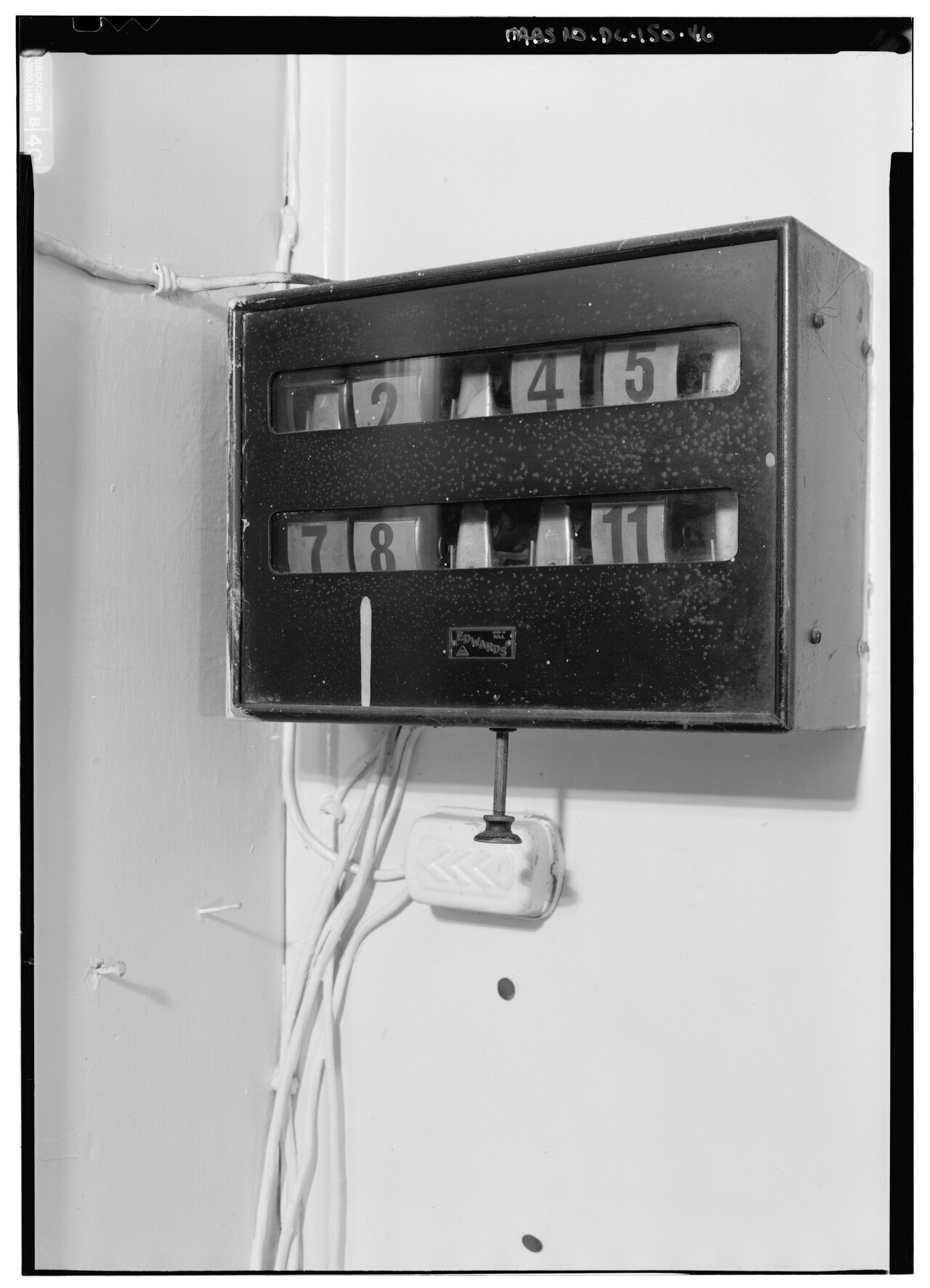
Visual AidThe board that says which room rang
Photograph, made for an architectural survey, of a call annunciator in a large town house: a bell pulled upstairs dropped a numbered flag here, so the staff downstairs could see at a glance which room had rung. That is the machinery behind the Knowledge Bank’s question. This box is electric and American, later and tidier than the row of wires and bells an English country house of 1900 would have used, and it shows the signal rather than the ladder of jobs the Knowledge Bank sets out. Notice what the numbers stand for: rooms, never people.
Butler call annunciator, Colonel John Cox House, Georgetown, Washington, D.C.; photograph by Jack E. Boucher, 2000, Historic American Buildings Survey (HABS DC,GEO,37-46), National Park Service, public domain.
🧠Knowledge Bank question
1The Knowledge Bank explains that a returned dinner tray becomes news at Misselthwaite because ___.Ch.24
2What problem do the children’s new appetites create?Ch.24
3Dr. Craven agrees not to write to Colin’s father about the improvement.Ch.24
4How many people does Mrs. Sowerby already have to feed at the cottage?Ch.24
5Write the numbers 1–5 in the boxes to show the correct order of events. Number 1 = what happens first.Chapters 24–25
Dickon shows Colin the wrestler’s muscle exercises.
Dickon lifts two tin pails out from behind a rosebush.
Mrs. Sowerby offers to bake buns and send fresh milk.
Colin gets out of his chair and runs the picture gallery.
Dickon tells his mother the whole story of the hidden garden.
6Where does Dickon learn the exercises he teaches Colin?Ch.24
7Mrs. Medlock can explain exactly where the children are finding extra food.Ch.24
8What does Dickon build in a hollow in the wood?Ch.24
9Colin says he now keeps the curtain over his mother’s portrait drawn back.Ch.25
10How does the robin finally make sense of Colin’s halting movements?Ch.25
Part 3
Literary Elements
Understanding HOW and WHY Frances Hodgson Burnett tells the story across Chapters 24–25.
🎭Knowledge Bank · Spelling a Voice Aloud
Narrative Craft · Voice and PerspectiveBurnett (author) writes two kinds of English side by side. The narrator uses the standard written English of 1911, while the Sowerbys and Martha get a phonetic respelling full of apostrophes, clipped articles, and old pronouns. That choice carries a risk: because readers are trained to see apostrophes as missing letters, written dialect can look like error rather than difference, and a careless author can turn a speaker into a joke. Notice that the warmest, shrewdest, most competent adult in these two chapters speaks that way, which pushes hard against the joke. Chapter 25 then changes perspective entirely and follows the robin, who reasons from bird evidence and gets a human boy comically wrong. Meanwhile the household downstairs frets over empty trays it cannot explain, and the reader, who knows everything, watches with pure dramatic irony. Both devices do the same job: they make you notice how much a story depends on whose voice.
Dialect
Speech written the way a region actually sounds — clipped articles, dropped endings, and old pronouns spelled straight into the sentence.
Dramatic irony
The reader knows what the nurse, the cook, and the doctor do not, so every worried conversation downstairs reads as comedy.
Point of view
Chapter 25 hands the story to the robin for several pages and lets us watch Colin from outside, through a bird’s guesswork.
🧠Knowledge Bank question
1The Knowledge Bank explains that writing dialect with apostrophes is risky because readers ___.Ch.24
2The reader knowing the secret while the nurse and doctor do not is ___.Ch.24
3Written dialect can be misread as error because apostrophes look like missing letters.Ch.24
4Chapter 25 telling part of the story through the robin is a shift in ___.Ch.25
5Fill in each blank with the correct literary term.Ch.24
Word choices:dialectironyprefaceindex- some words will not be used
Mrs. Sowerby’s clipped articles are written .
The doctor worrying while we know better is dramatic .
6Point of view means the paper size a book is printed on.Ch.25
7The robin deciding that Colin may be stalking prey mainly shows that ___.Ch.25
8Fill in each blank with the correct literary term.Ch.25
Word choices:perspectivedialectrhymemargin- some words will not be used
Seeing Colin through the robin is a change of .
Writing ‘tha’’ instead of ‘you’ is .
9Giving the wisest adult in these chapters a broad Yorkshire voice mainly ___.Ch.24
10Dramatic irony requires that the characters know more than the reader does.Ch.24
Part 4
Think Deeper
Four deeper challenges — no single-word recall. Read, weigh the evidence, and reason it out.
💬Knowledge Bank · Which English Counts
Sociolinguistics · Prestige and PowerLinguists separate two ideas that ordinary talk mixes together. A variety has prestige when the people who hold money, offices, and schools happen to speak it; a variety carries stigma when speaking it invites a listener to assume its speaker is poor, rural, or slow. Neither judgment says anything about the grammar involved, and both can flip within a century as power moves. Because the cost of stigma is real, most people learn to move between varieties, choosing one at home and another in a job interview — a skill called code-switching, and evidence of extra ability rather than of confusion. All of this is why Mary crossing into Yorkshire matters. A gentleman’s daughter in a great house is expected to keep the speech of her class as carefully as she keeps her clothes, and she deliberately does not. Choosing a stigmatized variety on purpose is a public statement about where a person wants to belong.
Picture a low wall of rough stones at the edge of the moor, a boy weeding potatoes in the last of the light, and his mother sitting on the wall to hear the day’s news. Everything that happens up at the great house arrives out here eventually — and out here it gets solved, in Yorkshire, in the very grammar that the gentry inside the house think of as no grammar at all. The problem the boy brings home is a strange one. Two children at the manor have become so hungry that hunger itself is now the danger: if they eat what they want, the household guesses their secret; if they do not, they cannot keep going. A cottage woman with fourteen mouths of her own listens, laughs until she rocks, and answers it with a pail of milk and a napkin of hot buns hidden behind a rosebush. Meanwhile, in the garden, a robin who has been deeply suspicious of a boy who moves all wrong decides at last that he is only learning to fly — or walk — and goes back to his eggs. And on a rainy afternoon, a curtain that has hung shut over a dead woman’s portrait for ten years stays open.
Original passage written for Garden Heights — not a quotation from the novel.
1Claim: “Chapters 24 and 25 show that the cottage, not the manor, is where problems actually get solved.” — choose the two details that best prove it.Claim & Evidence
2Language and class, or Keeping the secret? Tap each detail to send it left or right.Sort into two
◄ Language and classKeeping the secret ►
3Match each cause to its result. For each cause, pick its result.Cause & Effect
Dickon tells his mother everything→
The children dare not eat their fill→
A wet morning traps Colin indoors→
Moonlight wakes Colin two nights before→
🧠Knowledge Bank question
4Fill both blanks to complete the reasoning.Build the Argument
The Knowledge Bank explains that one variety of English gains prestige because , so Mary's turn to Yorkshire matters because .
Part 5
Standardized Test
Everyone Speaks a Dialect · Reading & Vocabulary · SAT & TOEFL-style practice
Read the passage — the highlighted words are tested — then answer. Tap an answer, then tap it again to confirm.
SATCentral Ideas — the passage's main point
SATInference — a conclusion the passage implies
SATAuthor’s Purpose — what the author wants to achieve
SATWords in Context — a word's meaning in this passage
TOEFLFactual Information — a fact stated in the passage
TOEFLVocabulary — a tested word's meaning here
Everyone Speaks a Dialect
Every speaker of English speaks a dialect of it. To a linguist, a dialect is simply one regional or social variety of a language, complete with its own pronunciation, its own vocabulary, and its own grammar. That definition covers the speech of a Yorkshire farm worker, a London banker, a schoolteacher in Ohio, and a television news reader equally. None of them is speaking the language itself while the others speak damaged copies of it. The word carries no insult in linguistics, though in ordinary conversation it often carries real disdain.
The strongest evidence that dialects are real grammars is that they are systematic. Northern English dialects kept a separate singular form of you, the old thou, long after southern English had collapsed every you into one word. Speakers who use a double negative are not doubling by accident either; they follow a pattern so consistent that other speakers of the same dialect can hear at once when someone gets it wrong, even while an outsider is left mystified. Being correctable is the whole proof, because you cannot break a rule that does not exist. Errors are real, but they are departures from the pattern a community actually uses, not from somebody else's pattern.
So why is one variety called correct English? The answer is history rather than logic. The English of London and the counties around it was the English of the printing press, the royal offices, the schools, and later the dictionaries, and centuries of that company gave it enormous prestige. Many people move between varieties depending on who is listening, a habit linguists call code-switching — shifting from one way of speaking to another to suit the moment. Judging a person's intelligence by the dialect they grew up in tells you their address, not their mind.
Original passage written for Garden Heights — not a quotation from the novel.
1What is the main idea of the passage?SAT · Central Ideas
2According to the passage, a dialect has its own ___.TOEFL · Factual Information
3Which older feature does the passage say northern dialects kept?TOEFL · Factual Information
4The passage suggests that a speaker can be told they used a dialect wrongly because ___.SAT · Inference
5According to the passage, what gave one variety of English its authority?TOEFL · Factual Information
6Why does the writer mention printing presses, offices, and schools?SAT · Author’s Purpose
7A speaker who talks one way at home and another at work is most likely ___.SAT · Inference
8In the passage, dialect most nearly means ___.SAT · Words in Context
9In the passage, mystified most nearly means ___.TOEFL · Vocabulary
10In the passage, disdain most nearly means ___.SAT · Words in Context
Part 6 · Optional
Creative Writing
A bonus challenge to practice your English. Take your time and have fun with it.
About This Section
This writing task is optional and is not part of your auto-graded score. The feedback below checks only the basics — length, spelling, and grammar — not whether your ideas are right or wrong. It is meant for classroom discussion and creative practice, so feel free to use your imagination!
Writing Task — Part 7 “The Way You Talk at Home”
Mrs. Sowerby settles the hardest problem in these two chapters in one sentence, and she does it in the kind of English her employers would call incorrect. Write about the way people speak where you come from — words, expressions, or a way of saying things that outsiders notice. Explain one thing your version of English can do that a textbook version cannot, and describe a time you changed how you spoke for a different listener. 6–10 sentences. End by saying whether that change felt like a skill or like hiding.
You can start with: “The first thing people notice about the way we talk is...”
0 / 40 words minimum
🗣 Teach It · Just for Fun (optional)
No right or wrong — tell someone nearby what happened in this part. Can’t find anyone? Tell yourself out loud. The moment you teach it, you truly understand it.
Independent study guide by Garden Heights. Not affiliated with or endorsed by Frances Hodgson Burnett. Contains original analysis only; no text from the novel is reproduced. Reference text: This workbook follows Frances Hodgson Burnett’s classic text (the standard Puffin edition sold worldwide). Revised 2023 UK editions change some wording and may not match the vocabulary studied here.