New here? Just sign up with Google — your account includes Matilda, our gift book, forever.
The Wanderer · Garden Heights
Part 8
for The Wanderer · Part 8 · Chapters 71–78
8 Parts40 min
What Happens in Part 8
The Wanderer completes her voyage: the crew crosses to England and travels at last to Bompie’s home, and Sophie finally meets, in the flesh, the grandfather whose stories she has carried her whole life. Overjoyed, she begins to tell Bompie his own tales back to him — and here comes the quiet thunderclap of the whole book. When she tells the story of a child whose parents were swept away by a great wave and drowned, Bompie does not know it. It was never his story. Cody realizes the truth first: this one belongs to Sophie herself. The drowning child was Sophie. Her birth parents were lost to the water when she was very small, and to survive it her mind had hidden the memory so completely that she could only carry it disguised as someone else’s tale. Facing this at last, Sophie weeps — and then, held by Bompie and by the family that crossed an ocean with her, she begins to accept it: she was orphaned by the sea, and she is loved, chosen, and whole. Uncle Dock’s own story finds a hopeful turn as well. In the final journal entry, Sophie is home, her cousins staying on with her, her adoptive parents checking on her each night — safe, and at peace.
The story’s resolution, a startling irony, and the theme made whole
Cross-Curricular
Adoption and found family — the bonds we build by choice
Chapter Summary
Ch.
What happens
Chapters 71–74
Meeting Bompie — the crew reaches England and Bompie’s home; Sophie meets him at last and tells his stories back to him, until one story turns out not to be his.
Chapters 75–78
The Truth and Home — the drowning story is revealed to be Sophie’s own; she faces the loss of her birth parents, accepts it within her loving family, and comes safely home.
Part 1
Vocabulary
Study 10 key words from Chapters 71–78, then answer each question.
🧠Knowledge Bank · Words of Homecoming
Lexicology · Words of Homecoming
Part 8’s words bring the journey home: a joyful reunion with Bompie, a truth revealed about Sophie’s past, and an adoption and embrace that let an orphan know she truly belongs. The Wanderer’s whole voyage carries a quiet argument about what makes a family. For most of history, many people assumed ‘family’ meant only those you are born to. Adoption tells a different, older, and equally true story: a child who has lost their first family, or who has no safe place, is welcomed and made fully and permanently a daughter or son. The bond that grows through adoption is not a lesser bond — it is chosen, renewed day after day, and just as real as any other. Psychologists describe ‘found family’ too: the circle of people who, related to us or not, choose to show up, protect, and stay.
reunionn.Ch.71
A coming together again
“Meeting Bompie was a joyful reunion.”
adoptionn.Ch.74
The making of a child into your family
“Her adoption had given her a home.”
belongv.Ch.77
To have a rightful place
“At last Sophie knew she did belong.”
reconcilev.Ch.72
To make peace after conflict
“Cody and Mo began to reconcile.”
acceptancen.Ch.76
The act of embracing something as it is
“Acceptance let her carry the grief.”
revealv.Ch.74
To make known something hidden
“The story would reveal Sophie’s truth.”
embracev.Ch.77
To hold close; to accept fully
“Bompie moved to embrace her.”
resilientadj.Ch.76
Able to recover from hard things
“Sophie proved deeply resilient.”
journeyn.Ch.78
A trip; the passage of a life
“The journey had changed her forever.”
wholenessn.Ch.78
The state of being complete
“She felt a new wholeness at last.”
ⓘ The vocabulary words in this list are selected to help you understand and complete this workbook. Some may not appear verbatim in the original novel.
🧠Knowledge Bank question
1According to the Knowledge Bank, what does the book argue makes a family?Ch.74
2A coming together again is a ___.Ch.71
3To ‘belong’ is to have a rightful place.Ch.77
4‘Adoption’ is the making of a child into ___.Ch.74
5Fill in each blank with the correct word.Ch.77
Word choices:embracebelongreunionjourney- some words will not be used
Bompie moved to her warmly.
For the first time, Sophie knew she did .
6To ‘reconcile’ is to ___.Ch.72
7Someone ‘resilient’ is able to recover from hard things.Ch.76
8‘Acceptance’ is the act of ___ something as it is.Ch.76
9Fill in each blank with the correct word.Ch.78
Word choices:journeywholenessrevealadoption- some words will not be used
The long had changed Sophie forever.
Facing the truth, she felt a new .
10To ‘embrace’ something can mean to accept it fully.Ch.77
Part 2
Comprehension
Show you understood what happens in Chapters 71–78.
🧠Knowledge Bank · Meeting Bompie, Coming Home
Narrative Logic · Meeting Bompie, Coming Home
The narrative traces the voyage’s end: reaching England and Bompie, the story that turns out to be Sophie’s own, the truth about her lost birth parents, and a wounded girl accepting her past and coming home whole. Chapters 71–74: Meeting Bompie — the crew reaches England and Bompie’s home; Sophie meets him at last and tells his stories back to him, until one story turns out not to be his. Chapters 75–78: The Truth and Home — the drowning story is revealed to be Sophie’s own; she faces the loss of her birth parents, accepts it within her loving family, and comes safely home. The Wanderer completes her voyage: the crew crosses to England and travels at last to Bompie’s home, and Sophie finally meets, in the flesh, the grandfather whose stories she has carried her whole life.
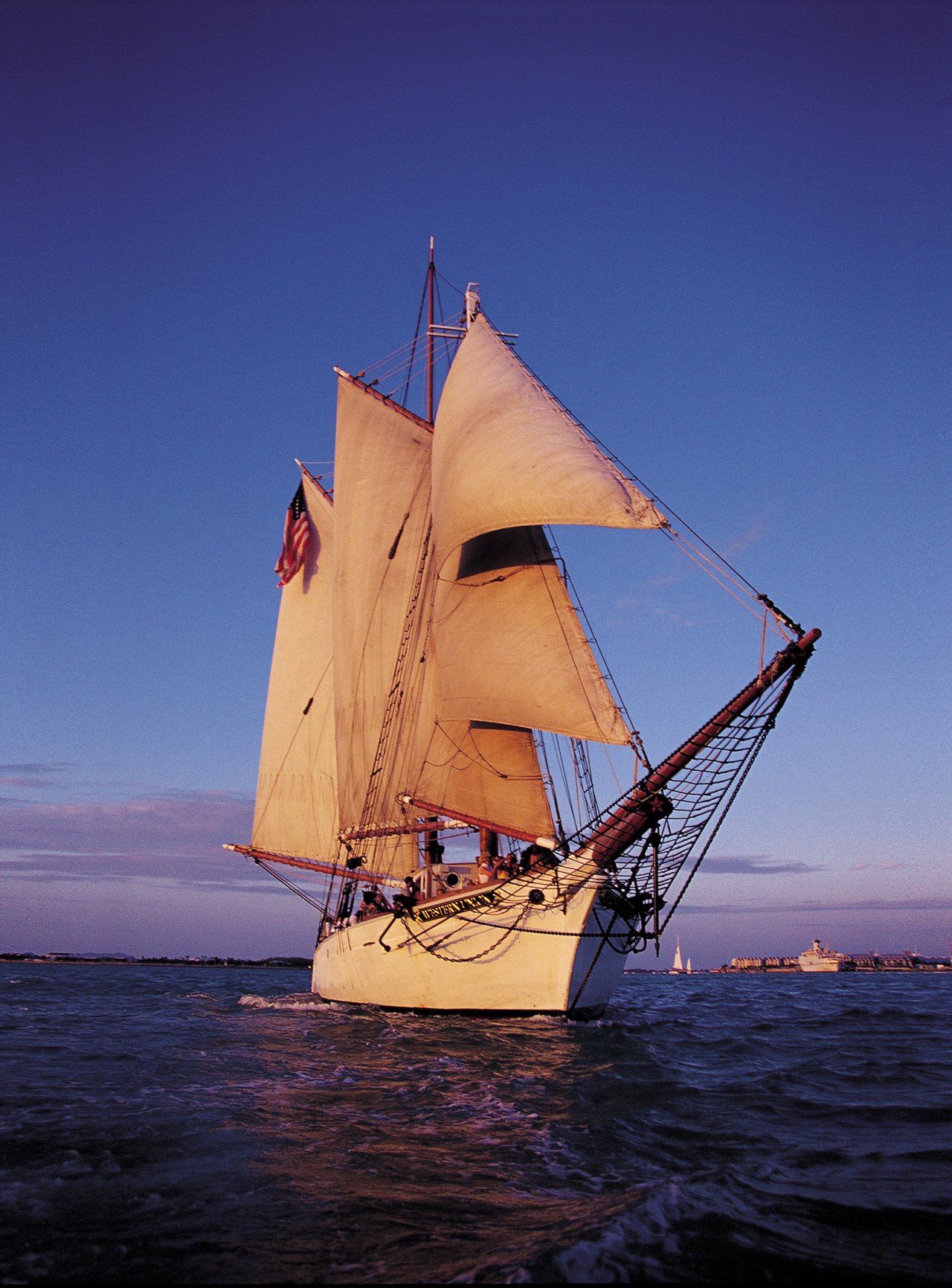
Visual AidThe last of a long passage
A schooner under full sail in the last of the light, land showing low on the horizon behind her. The Knowledge Bank explains that the voyage ends when the crew reaches England and Bompie, and that what waits there turns out to be Sophie’s own history rather than his. This is not the Wanderer and not England; it is what the end of a long crossing looks like from outside — a small boat, still under sail, with the shore finally in sight.
The schooner Western Union under full sail, Florida Keys; U.S. National Archives. Source: Wikimedia Commons, public domain.
🧠Knowledge Bank question
1The Knowledge Bank explains that the story Sophie has been telling turns out to be ___.Ch.71
2When Sophie meets Bompie, she begins to ___.Ch.72
3Bompie recognizes every single story Sophie tells as his own.Ch.74
4The drowning story turns out to belong to ___.Ch.74
5Write the numbers 1–5 in the boxes to show the correct order of events. Number 1 = what happens first.Chapters 71–78
Bompie does not recognize the drowning story.
The crew crosses to England and reaches Bompie’s home.
Cody realizes the story is Sophie’s own memory.
Sophie meets Bompie and tells him his stories.
Sophie accepts her past and comes safely home.
6Sophie’s birth parents were lost to the sea when she was very young.Ch.75
7The reason Sophie knew the ‘Bompie’ drowning story is that ___.Ch.75
8After facing the truth, Sophie is able to ___.Ch.76
9In the end, Sophie is alone and unloved.Ch.78
10The final journal entry shows Sophie ___.Ch.78
Part 3
Literary Elements
Understanding HOW and WHY Sharon Creech tells the story across Chapters 71–78.
🧠Knowledge Bank · Resolution and Irony
Literary Technique · Resolution and Irony
Part 8 completes three tools: the tying-up of the story (resolution), a truth opposite to what all believed (situational irony), and the central idea made whole (theme). In the resolution, the book gathers its threads and completes its central theme: that the same sea can wound and heal. Water took Sophie’s first family and buried her memory; water — the crossing, the storm, the great wave — is also what finally shakes the truth loose and carries her to Bompie, where she can face it inside a circle of love. Sophie does not ‘get over’ her loss; instead she integrates it, letting the grief become part of her story rather than a locked door. Held by Bompie and her family, she can finally say who she is: orphaned by the sea, and also chosen, loved, and whole.
Visual AidWhat everyone believed, and what was true
Diagram for the Knowledge Bank on the ending. Card 1 is what the whole family believed and card 2 is what turns out to be the case, with card 3 naming the shape of the reversal. Card 4 is the theme the reversal completes. Notice that nobody lied. Everyone had the direction of the storytelling backwards, which is exactly what situational irony is: the truth arriving as the opposite of the belief.
The turn at the end of the book, as described in the Knowledge Bank. Drawn for Garden Heights Academy.
Resolution
The story’s threads are tied up: Sophie meets Bompie, faces her past, and comes home whole.
Situational irony
The truth is the opposite of what all believed — the ‘Bompie’ drowning story was really Sophie’s own memory.
Theme
The same sea that wounds also heals; and family is who chooses you, holds on, and makes you whole.
🧠Knowledge Bank question
1According to the Knowledge Bank, situational irony means the truth is ___.Ch.78
2Fill in each blank with the correct literary term.Ch.74
Word choices:situational ironyresolutionsettingrhyme- some words will not be used
A truth opposite to what all believed is .
The tying-up of the story is the .
3Situational irony is when the truth turns out opposite to what was expected.Ch.74
4The startling irony of the ending is that the drowning story belongs to ___.Ch.74
5The book’s central idea, made whole at the end, includes that the same sea can ___.Ch.76
6A resolution ties up a story’s loose threads near its end.Ch.78
7Fill in each blank with the correct literary term.Ch.76
Word choices:themeresolutionnarratorrhyme- some words will not be used
That family is who chooses you is a .
The tying-up of the story is the .
8Looking back, the earlier clues (Sophie’s uncanny knowledge, her pull to the sea) show Creech was ___.Ch.74
9The irony of the ending is just a trick with no deeper meaning.Ch.75
10By the resolution, Sophie can finally say she is ___.Ch.78
Part 4
Think Deeper
Four deeper challenges — no single-word recall. Read, weigh the evidence, and reason it out.
🧠Knowledge Bank · Reading the Homecoming
Ethical Reasoning · Reading the Homecoming
A first meeting with Bompie, a story that turns out to be her own, a truth faced at last, a girl safely home. The great turn of the ending is a piece of situational irony — when the truth is the opposite of what everyone believed. All along, the family thought Sophie was mysteriously telling Bompie’s stories, and could not explain how she knew them. The real answer is stranger and sadder: the darkest of those ‘Bompie’ stories — the child lost to a great wave — was never Bompie’s at all. It was Sophie’s own buried memory, so unbearable that her mind could only carry it by pretending it belonged to someone else. Look back and every earlier clue clicks into place: her uncanny knowledge, her pull to the sea, the little kid, the nightmares.
Picture the moment in Bompie’s house at the end of the world’s longest voyage. A girl who has crossed an ocean sits at last before the grandfather she has known only through stories, and, glowing, she gives his tales back to him one by one. He nods and laughs — yes, the car in the river, yes, the swimming hole — until she reaches the one about a small child and a great wave and parents swept away, and Bompie goes still, and shakes his head, because he has never heard it. In the silence a cousin understands first, and then Sophie does too: this story was never Bompie’s. It was always hers. The little kid was her. And as the truth breaks over her like one more wave, the whole family closes around her — the family that chose her, that sailed an entire ocean to bring her here — and holds on while she cries, and while, at last, she begins to be whole.
Original passage written for Garden Heights — not a quotation from the novel.
1Claim: “Part 8 reveals that Sophie’s buried memory, not Bompie’s past, was the source of the ‘Bompie’ drowning story.” — choose the two details that best prove it.Claim & Evidence
2What adoption / found family means, or How Sophie’s story resolves? Tap each detail to sort it — tap again to switch sides. You can keep tapping to change your answer.Sort into two
◄ What adoption / found family meansHow Sophie’s story resolves ►
3Match each cause to its result. For each cause, pick its result.Cause & Effect
Sophie tells Bompie his stories→
Bompie does not know the drowning tale→
Sophie faces her true loss→
Her family holds her close→
🧠Knowledge Bank question
4Fill both blanks to complete the reasoning.Build the Argument
The Knowledge Bank argues that the ending completes the book's theme because , which shows that .
Part 5
Standardized Test
Reading passage · Family Built by Choice · SAT & TOEFL-style practice
Read the passage — the highlighted words are tested — then answer. Tap an answer, then tap it again to confirm.
SATCentral Ideas — the passage's main point
SATDetail — a fact stated in the passage
SATText Connections — how two parts of the text relate
SATWords in Context — a word's meaning in this passage
TOEFLFactual Information — a fact stated in the passage
TOEFLInsert Text — where a sentence best fits
Adoption and Found Family
The Wanderer's long voyage carries a quiet question: what really makes a family? For much of history, many people assumed the answer was simple, that family meant only those you were born to. But there has always been another answer, just as old and just as true. Through adoption, a child who has lost their first family, or who has no safe place, is welcomed and made a full, permanent daughter or son. The bond that grows is not a weaker version of a birth bond; it is a chosen bond, renewed every ordinary day, and can be every bit as deep and lasting.
People who study families also describe what they call found family, the circle of people who, related to us by blood or not, decide to show up, protect us and stay. What matters, they find, is not where a bond begins but whether it holds: whether someone chooses you again and again, until you know that you belong. This is exactly Sophie's story. She was orphaned by the sea, robbed of her first family by a wave when she was far too young to understand. And then she was chosen, adopted into a loud, imperfect, seagoing clan that argued and teased and worried over her, and that sailed across an entire ocean at her side. When her oldest wound finally broke open, they did not turn away; they drew close and held on.
Original passage written for Garden Heights — not a quotation from the novel.
1What is the main idea of the passage?SAT · Central Ideas
2For much of history, many people assumed family meant ___.TOEFL · Factual Information
3Through adoption, a child is made a ___ daughter or son.SAT · Detail
4The passage says the adoptive bond is ___ a birth bond.TOEFL · Factual Information
5‘Found family’ is the circle of people who ___.SAT · Detail
6According to researchers, what matters most about a bond is ___.TOEFL · Factual Information
7How did Sophie lose her first family?SAT · Detail
8When Sophie’s old wound broke open, her adoptive family ___.SAT · Text Connections
9In the passage, belong most nearly means ___.SAT · Words in Context
10Insert Text (TOEFL). Look at the four squares [1]–[4] in the excerpt below. They show where this sentence could be added: “In this way, a family can be built not only by birth but by choice.”
For most of history, many people assumed family meant only those you were born to. [1] But adoption tells a different story: a child with no safe place is welcomed and made fully a daughter or son. [2] The bond that grows is not a lesser bond; it is chosen day after day, and just as real. [3] Sophie lost her first family to the sea, yet crossed an ocean inside a second family that had already claimed her. [4]
Where would the sentence fit best?TOEFL · Insert Text
Part 6 · Optional
Creative Writing
A bonus challenge to practice your English. Take your time and have fun with it.
About This Section
This writing task is optional and is not part of your auto-graded score. The feedback below checks only the basics — length, spelling, and grammar — not whether your ideas are right or wrong. It is meant for classroom discussion and creative practice, so feel free to use your imagination!
Writing Task — Part 8 “Who Is My Family”
The book says family is not only who you are born to, but who chooses you, stays, and helps you become whole. Write about the people who are ‘family’ to you — by birth or by choice — and what they do that makes them so. Who shows up for you, and how? 6–10 sentences. End with what family means to you after reading Sophie’s story.
You can start with: “To me, family means the people who...”
0 / 40 words minimum
🗣 Teach It · Just for Fun (optional)
No right or wrong — tell someone nearby what happened in this part. Can’t find anyone? Tell yourself out loud. The moment you teach it, you truly understand it.
Part 8 Complete — You Finished the Book! 🎉
You finished Chapters 71–78 — the final part of The Wanderer.
Here are your auto-graded results:
-
points out of 100
Teach it to someone
The best last step is to teach it. In your own words, explain what happened — retell a favorite scene, teach a character’s big choice, or sum up the main idea for a parent, friend, or classmate. When you can teach it clearly, you truly own it.
Independent study guide by Garden Heights. Not affiliated with or endorsed by Sharon Creech. Contains original analysis only; no text from the novel is reproduced. Reference text: This workbook follows Sharon Creech’s classic text (the standard Puffin edition sold worldwide). Revised 2023 UK editions change some wording and may not match the vocabulary studied here.
SAT® is a registered trademark of College Board, which is not affiliated with, and does not endorse, these materials. TOEFL® is a registered trademark of ETS. These materials are not endorsed or approved by ETS. Garden Heights is an independent provider of test-style reading practice.