New here? Just sign up with Google — your account includes Matilda, our gift book, forever.
The Wednesday Wars · Garden Heights
Part 2
for The Wednesday Wars · Part 2 · November
8 Parts40 min
What Happens in Part 2
November brings The Tempest, Caliban's curses, a costume Holling dreads, and a war death that changes what the month means.
The Tempest arrivesNovember comes in gray and wet. Holling and his father seal the Perfect House for winter while his mother finds a leak spreading through a ceiling. At school, Wednesday afternoon finally becomes more than chores: Mrs. Baker hands Holling The Tempest. Expecting slow punishment, he gets a storm, an island, a wizard with a grudge, a spirit named Ariel, and Caliban, who curses magnificently.
Curses in gym classHolling memorizes the curses, tries them on his sister, rehearses at the mirror, and finally aims one at Coach Quatrini in gym class, winning the admiration of Doug Swieteck's terrifying older brother. It also brings a shock: muttering Caliban's language near Mrs. Baker, he learns she recognizes it instantly. She has not assigned the play as torture. She has read it closely and is waiting for him to catch up.
Yellow tightsThe October cream puffs still must be bought. His father, delighted that his firm beat Meryl Lee's father's firm for the new Baker Sporting Emporium, refuses any allowance. Short at the register, Holling finds that Mr. Goldman needs a boy who knows Shakespeare for a holiday production. He recites Caliban, gets his pastries cheap, and learns too late that Ariel wears yellow tights with white feathers behind.
A folded flagHolling spends days panicking over the costume. Then Mrs. Bigio, the school cook, comes into the classroom shaking and unable to speak: her husband has been killed in Vietnam on a reconnaissance mission that accomplished nothing. Mrs. Baker, whose own husband, Lieutenant Tybalt Baker, has gone to that war, goes to her. Weeks later the paper prints Mrs. Bigio accepting the folded flag, and Holling, who measured the month in tights and pastries, is handed a different unit of measurement.
What We Will Learn
Section
What you will practice
Vocabulary
Insults, money, and war: taunt, haggle, conspicuous, reconnaissance, grief…
Literary Elements
Allusion hiding in two rats’ names, juxtaposition of a costume panic with a war death, and comic hyperbole
Cross-Curricular
Who Shakespeare actually was — a Stratford glover’s son, a grammar-school education, the Globe, and the 1623 book that rescued the plays
Chapter Summary
Ch.
What happens
Early November
The Play in His Hands — The Perfect House goes into winter and a ceiling starts to leak. On Wednesday afternoon Mrs. Baker gives Holling The Tempest. Bracing for boredom, he finds a shipwreck, a magician, a spirit, and a furious monster, and he reads far past where he was told to stop.
Mid-November
An Armory of Insults — Holling memorizes Caliban’s curses and drills them at the mirror. One escapes in gym class in Coach Quatrini’s direction. When Mrs. Baker hears the same language from Holling, she identifies it at once, and he understands that she has read every line herself.
Late November
A Debt and a Bargain — The cream puffs Holling owes his class still have to be bought. His father, celebrating the Baker Sporting Emporium contract that beat Meryl Lee’s father’s firm, refuses an advance. Short at the bakery counter, Holling trades Shakespeare to Mr. Goldman — and is cast as Ariel, in yellow tights.
End of November
The Cook at the Door — While Holling is consumed by the tights, Mrs. Bigio comes into the classroom in tears. Her husband has been killed in Vietnam on a mission that gained nothing. Mrs. Baker, whose own husband has gone to that same war, goes to her, and the newspaper later prints the funeral.
Part 1
Vocabulary
Study 10 key words from November, then answer each question.
📖Knowledge Bank · Words That Arrived With the Plays
Linguistics · Coined WordsEnglish in the 1590s was growing at speed. Latin and French words were pouring in, printing was spreading them, and no English dictionary yet existed to rule on which ones were allowed — so a writer could coin a word and simply expect an audience to keep up. Shakespeare took the invitation. The Oxford English Dictionary, which records the earliest use it can find of every word, credits him with the first known appearance of hundreds of them, and the tally is often quoted as roughly seventeen hundred. Handle that number carefully: it measures his inventiveness partly, and partly measures how much harder scholars have hunted through his plays than through everybody else’s. What is not in doubt is the method. He turned nouns into verbs, bolted prefixes onto ordinary words, and stacked adjectives until a phrase landed like a slap. That habit is exactly what Holling runs into in November, and it is why a four-hundred-year-old page can still sound modern.
tauntn.November
A mocking remark meant to wound someone
“Holling collects every taunt the play has to offer.”
relishv.November
To take great pleasure in something
“He comes to relish the sound of a four-hundred-year-old curse.”
recitev.November
To say something aloud from memory
“Holling can recite the monster’s lines without the book.”
advancen.November
Money handed over before the day it is owed
“He asks his father for an advance on his allowance.”
hagglev.November
To argue with a seller over a price
“Short of cash, Holling has to haggle at the bakery counter.”
conspicuousadj.November
Easily noticed; standing out from everything nearby
“Yellow tights would make anybody conspicuous on a stage.”
reconnaissancen.November
A military mission sent out to scout and bring back information
“Her husband was killed on a reconnaissance mission.”
futileadj.November
Producing no useful result; pointless
“The mission is called futile, which makes the loss harder.”
griefn.November
Deep sorrow, especially after someone has died
“Grief walks into the classroom in the middle of a lesson.”
dignityn.November
Calm self-respect that other people can see
“Mrs. Bigio takes the folded flag with dignity.”
ⓘ The vocabulary words in this list are selected to help you understand and complete this workbook. Some may not appear verbatim in the original novel.
🧠Knowledge Bank question
1According to the Knowledge Bank, what allowed a writer in the 1590s to advance a brand-new word and simply expect an audience to keep up?November
2To ‘relish’ something is to take great pleasure in it.November
3If you ‘recite’ a speech, you say it ___.November
4Fill in each blank with the correct word.November
Word choices:advancehagglegrieftaunt- some words will not be used
Holling asks his father for an on his allowance.
Short of money, he has to with the baker.
5Someone or something ‘conspicuous’ is ___.November
6A ‘reconnaissance’ mission is sent out to gather information.November
7An effort described as ‘futile’ ___.November
8Fill in each blank with the correct word.November
Word choices:dignityconspicuousrecitefutile- some words will not be used
Mrs. Bigio takes the folded flag with .
Bright yellow tights are from every seat in the hall.
9‘Grief’ is the deep sorrow a person feels after ___.November
10To ‘haggle’ is to accept the first price you are offered.November
Part 2
Comprehension
Show you understood what happens in November.
🏫Knowledge Bank · What a Stratford Boy Learned
Education History · The Grammar SchoolNo school register survives to prove it, but the son of a Stratford town officer would almost certainly have gone to the free grammar school there, and the plays read like the work of someone who did. An Elizabethan grammar school was not gentle. Boys arrived around six in the morning, six days a week, and spent the day on Latin — reading it, speaking it, translating out of it and back into it, and learning long passages by heart. They also drilled in rhetoric, the formal art of persuasion, which supplied named techniques for building an argument, demolishing an opponent, and swinging a crowd. Ovid, Terence, and Seneca handed over stories and stagecraft that turn up later, reshaped, in the plays. That schooling explains something worth noticing: the word-power in Shakespeare did not come from a university, because he never attended one. It came from a market-town classroom and an enormous amount of memory.
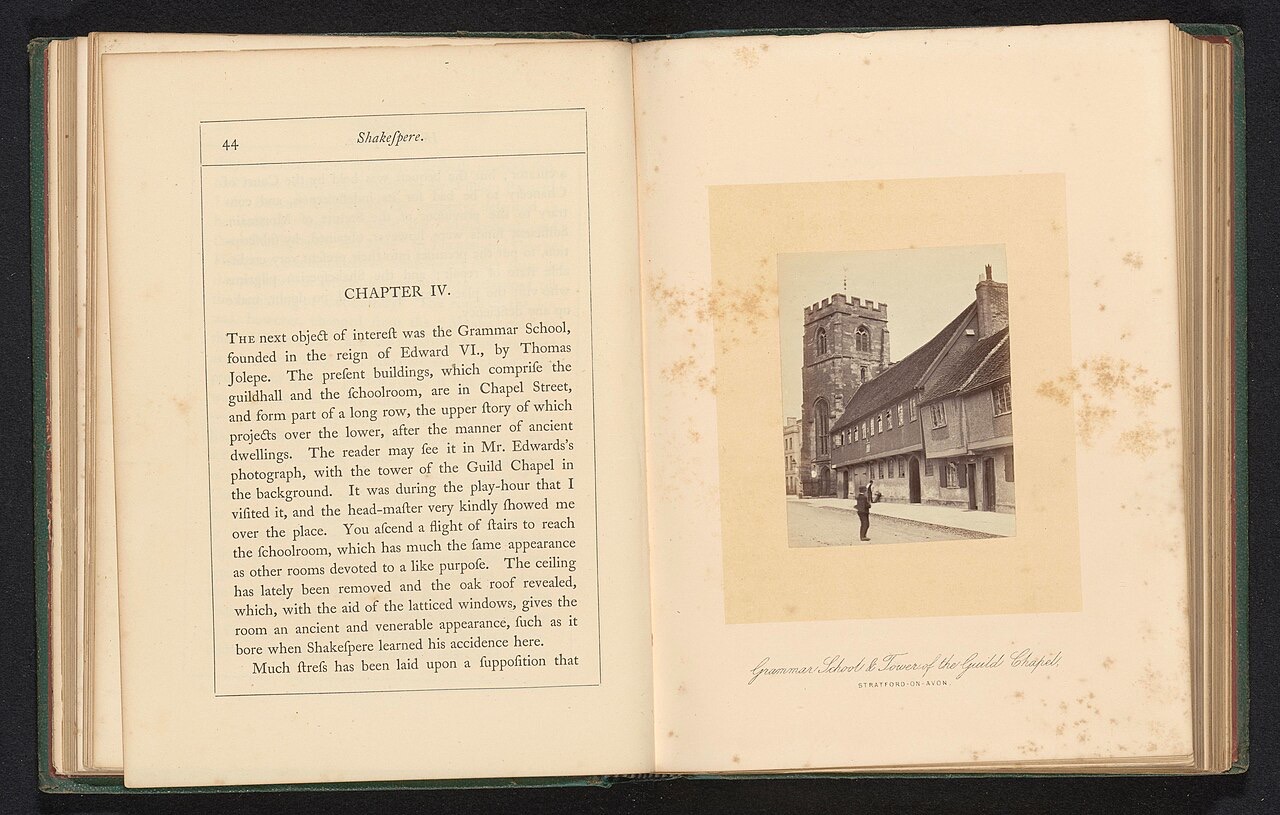
Visual AidThe school on Church Street
Photograph of a Victorian book opened to a mounted albumen print made in Stratford-upon-Avon in the early 1860s. The long timber-framed range on the right is the guildhall and grammar school; the tower behind it belongs to the Guild Chapel. This is the building the Knowledge Bank on the Elizabethan grammar school describes — the schoolroom is upstairs, in the projecting upper story. Two cautions. The photograph was taken almost three hundred years after Shakespeare’s boyhood, so windows, roofs and street level have all changed; and the printed page beside it is Victorian travel writing, not evidence. No register survives to prove that any particular boy sat there.
Grammar School and tower of the Guild Chapel, Stratford-upon-Avon; albumen print by Ernest Edwards, ca. 1863, mounted in a book, Rijksmuseum. Source: Wikimedia Commons, file RP-F-2001-7-342-8, CC0.
🧠Knowledge Bank question
1According to the Knowledge Bank, where did Shakespeare’s command of language come from?November
2What does Holling expect the play to be before he opens it?November
3Holling is disappointed to find no storm and no monster in the play.November
4What does Holling do with the insults he finds in the play?November
5Write the numbers 1–5 in the boxes to show the correct order of events. Number 1 = what happens first.November
His father refuses to advance him any allowance.
Mrs. Baker hands Holling a copy of the play.
Mr. Goldman offers Holling a deal at the bakery.
Mrs. Bigio comes into the classroom in tears.
Holling memorizes the curses and rehearses them at home.
6Why does Holling need money in November?November
7Holling’s father hands over the allowance advance the moment it is asked for.November
8What does Mr. Goldman want in exchange for the pastries?November
9Mrs. Bigio’s husband is killed while serving in Vietnam.November
10Which part is Holling given in the holiday production?November
Part 3
Literary Elements
Understanding HOW and WHY Gary D. Schmidt tells the story across November.
🎵Knowledge Bank · The Line That Sounds Like Speech
Poetics · Blank VerseMost of Shakespeare is written in blank verse — unrhymed lines built on five beats, a form called iambic pentameter. An iamb is a light syllable followed by a heavier one, the pattern you hear in ‘belong’ or ‘today’; five of them make a line of roughly ten syllables. Ordinary English falls into that rhythm on its own, which is the whole point. Rhyme announces itself and can tip into comedy, while blank verse hands an actor a steady pulse to lean on without ever sounding like a poem being performed. Then the pattern gets broken on purpose: a line runs short when someone is cut off, a spare syllable hangs at the end when a mind is unsettled, and plain prose takes over for servants, jokes, and business. Caliban, a monster, is given some of the loveliest verse in The Tempest, and that choice tells a reader how to weigh him better than any speech about fairness.
Visual AidOne line, five beats
Structure diagram of the line the Knowledge Bank on blank verse takes apart: five light-heavy pairs, ten boxes for ten syllables, with the beats bracketed underneath. Real verse is far less tidy — syllables are elided, stresses shift with meaning, and a good actor never taps the pattern out — and the drawing shows a pattern, not any actual speech from a play. Notice the second row, which is where the writing happens: the meter matters mostly because breaking it says something.
Iambic pentameter and its deliberate variations as described in the Knowledge Bank and in standard accounts of English prosody. Drawn for Garden Heights Academy.
Allusion
A reference to another work, person, or event that the reader is expected to recognize — two classroom rats carry the names of characters out of The Tempest.
Juxtaposition
Placing two very different things side by side so each one changes the other — a panic about yellow tights, and then a folded flag.
Hyperbole
Deliberate exaggeration for effect — Holling reports his teacher’s hatred of him as a settled fact of the universe.
🧠Knowledge Bank question
1The Knowledge Bank explains that playwrights favored blank verse over rhyme because ___.November
2Setting a boy’s panic about tights right beside a soldier’s death is ___.November
3Hyperbole is deliberate exaggeration used for effect.November
4Holling’s claim that his teacher hates him with her whole heart is ___.November
5An allusion is a reference to a work, person, or event the reader is expected to know.November
6Fill in each blank with the correct literary term.November
Word choices:allusionhyperboleindexpreface- some words will not be used
Rats named for a play are an .
Saying a day lasted a thousand years is .
7Which pairing best shows juxtaposition in November?November
8Juxtaposition means placing two closely similar ideas side by side.November
9Why does the yellow-tights problem shrink by the end of the chapter?November
10Fill in each blank with the correct literary term.November
Word choices:juxtapositionallusionfootnoterhyme- some words will not be used
A costume joke set against a funeral is .
A name borrowed from another play is an .
Part 4
Think Deeper
Four deeper challenges — no single-word recall. Read, weigh the evidence, and reason it out.
💡Knowledge Bank · How an Insult Is Built
Rhetoric · The Art of the InsultA good insult is a small machine, and Shakespeare built better ones than almost anybody. Three parts do the work. First a vivid noun that plants a picture in the ear — a disease, a vermin, a lump of something spoiled — because a listener sees before he judges. Second, rhythm: the abuse arrives in short punchy runs an actor can throw across a noisy open-air playhouse. Third, invention, which is the part that stings, since a stock curse can be shrugged off while one built on the spot proves the speaker has been studying exactly what you are. Notice as well that these lines are furious without being obscene, which is precisely why a seventh grader can carry them the length of a school corridor and never once be sent to the office. That is Holling’s November discovery: the oldest homework in the building turns out to be an armory of usable ammunition.
Rain, a house being sealed up for winter, and a boy who owes his whole class a bakery box of cream puffs he cannot pay for. That is where November begins. Then the teacher Holling is certain despises him puts a play in his hands — a shipwreck, an island, a magician, a spirit, and a monster who has been stripped of everything he owns and has nothing left to fight with except language. Holling opens it expecting a punishment and finds a weapon. The curses go straight into his memory and come out again in front of his bedroom mirror, and for a few glorious weeks a seventh grader walks the halls of Camillo Junior High armed with four-hundred-year-old abuse that no adult in the building can prove is swearing. And then, on an ordinary afternoon, the school cook opens the classroom door, and nothing about November is funny anymore.
Original passage written for Garden Heights — not a quotation from the novel.
1Claim: “November measures Holling’s troubles against somebody else’s and lets the reader feel the difference in size.” — choose the two details that best prove it.Claim & Evidence
2Belongs to the war, or Belongs to the comedy? Tap each detail to send it left or right.Sort into two
◄ Belongs to the warBelongs to the comedy ►
3Match each cause to its result. For each cause, pick its result.Cause & Effect
Mrs. Baker hands over The Tempest→
His father refuses an advance→
Mr. Goldman needs a young actor→
Mrs. Bigio hears from Vietnam→
🧠Knowledge Bank question
4Fill both blanks to complete the reasoning.Build the Argument
The Knowledge Bank explains that a Shakespearean insult stings because , and Holling can carry one down a school corridor because .
Part 5
Standardized Test
The Man From Stratford · Reading & Vocabulary · SAT & TOEFL-style practice
Read the passage — the highlighted words are tested — then answer. Tap an answer, then tap it again to confirm.
SATCentral Ideas — the passage's main point
SATWords in Context — a word's meaning in this passage
SATInference — a conclusion the passage implies
SATAuthor’s Purpose — what the author wants to achieve
TOEFLFactual Information — a fact stated in the passage
TOEFLVocabulary — a tested word's meaning here
TOEFLProse Summary — the three sentences that sum it up
The Man From Stratford
William Shakespeare was born in 1564 in Stratford-upon-Avon, a market town about a hundred miles northwest of London. His father made and sold gloves and other leather goods, learning to haggle with customers over every price, and for a few years he held the town’s highest office. We know when the baby was christened because a clerk wrote it into the parish register, the book a church kept for christenings and burials. Official records like that, rather than personal ones, are the backbone of the biography, because no diary, no letters, and no play in his own handwriting has ever been found.
What the records do show is a working life. The free grammar school in his town drilled boys in Latin, in speeches they had to recite from memory, and in the tricks of persuasion, and that training echoes through the plays. By the early 1590s Shakespeare was in London as an actor and a writer, and by 1599 he was part owner of the Globe playhouse, which paid him a share of every ticket. Tax lists, property deeds, and a will describe a man who earned well, bought a large house in Stratford, and wrote roughly thirty-eight plays before he died in 1616.
The gaps between those documents are wide, and wide gaps invite speculation — guessing that runs ahead of the evidence. Nobody knows what he did between leaving Stratford and turning up on the London stage, or what he thought about most of what he wrote. What survives is the work, and even that was a near thing. Eighteen plays, The Tempest among them, had never been printed when two fellow actors gathered the scripts and published them posthumously in 1623, seven years after his death.
Original passage written for Garden Heights — not a quotation from the novel.
1What is the main idea of the passage?SAT · Central Ideas
2According to the passage, how did Shakespeare’s father earn a living?TOEFL · Factual Information
3In the passage, haggle most nearly means ___.SAT · Words in Context
4According to the passage, what did part ownership of the Globe give him?TOEFL · Factual Information
5The passage suggests that most of what we know about Shakespeare comes from ___.SAT · Inference
6In the passage, speculation most nearly means ___.TOEFL · Vocabulary
7In the passage, recite most nearly means ___.SAT · Words in Context
8The writer mentions the missing diary and letters mainly to ___.SAT · Author’s Purpose
9Prose Summary (TOEFL).This passage explains what the surviving record can and cannot tell us about William Shakespeare. This TOEFL task lists six sentences; choose the THREE that best capture the passage’s main ideas. The other three do not belong — they state minor details or ideas the passage does not present.TOEFL · Prose Summary
10What does the passage say nearly happened to eighteen of the plays?SAT · Central Ideas
Part 6 · Optional
Creative Writing
A bonus challenge to practice your English. Take your time and have fun with it.
About This Section
This writing task is optional and is not part of your auto-graded score. The feedback below checks only the basics — length, spelling, and grammar — not whether your ideas are right or wrong. It is meant for classroom discussion and creative practice, so feel free to use your imagination!
Writing Task — Part 2 “The Small Thing and the Big One”
Holling spends November agonizing over a costume while a classmate’s family and a school cook are living through something far heavier. Write about a time your own worry suddenly looked small next to somebody else’s trouble. What were you worried about, what did you learn about the other person, and how did your own problem look afterward? 6–10 sentences. End with what you did next.
You can start with: “I was completely wrapped up in my own problem until...”
0 / 40 words minimum
🗣 Teach It · Just for Fun (optional)
No right or wrong — close the screen and tell someone nearby what happened in this part. Can’t find anyone? Tell yourself out loud. The moment you teach it, you truly understand it.
Independent study guide by Garden Heights. Not affiliated with or endorsed by Gary D. Schmidt. Contains original analysis only; no text from the novel is reproduced. Reference text: This workbook follows Gary D. Schmidt’s classic text (the standard Puffin edition sold worldwide). Revised 2023 UK editions change some wording and may not match the vocabulary studied here.