New here? Just sign up with Google — your account includes Matilda, our gift book, forever.
The Wednesday Wars · Garden Heights
Part 4
for The Wednesday Wars · Part 4 · January
8 Parts40 min
What Happens in Part 4
A humiliating photograph, a snowball feud, and a shove in a snowstorm turn Holling from joke to hero.
The front-page photoThe New Year's Day Home Town Chronicle runs a feature on citizens who gave something to the town in 1967, and there on the front page is Holling in midair in his Ariel costume, yellow tights and white feathers. Copies go up all over Camillo Junior High, and his friends and his sister tear down every one they can find.
Macbeth and iceMrs. Baker leaves a note assigning Macbeth for the first Wednesday of January. Holling loves the daggers, the blood, the king murdered in his sleep, and privately disagrees when she says the play shows spite is small beside love. An ice storm kills the school's power and heat; working in coats by window light, the class watches Mrs. Bigio pass Mai Thi without hot chocolate, and Mrs. Baker sets her own cup on Mai Thi's desk.
One snowballOutside, Doug Swieteck's brother has taken to riding the bumpers of buses through the slush. Something in Holling snaps: he packs a snowball, waits, throws once, hits the older boy squarely in the face, and is back inside unseen. The revenge lasts a day. In the bathroom a knot of eighth graders decides he threw it; Holling denies it, and Doug's brother informs him he is a dead man.
The shoveThen come the statewide tests and a snowstorm. Walking home through blowing snow, Holling sees a bus slide toward his sister, who cannot see it, and shoves her clear, taking the hit himself. Mrs. Baker and Mr. Guareshi drive him for x-rays; his father approves treatment by telephone, promises to come when convenient, and never arrives. A photographer catches the shove in midair, and that picture replaces the other one all over school. Classmates call him a hero.
Allusion — a Scottish tragedy running underneath a Long Island January — plus the situational irony of two photographs and the foreshadowing packed into one threat
Cross-Curricular
History and civics — how Americans experienced Vietnam at home: the draft and its deferments, the first war broadcast into living rooms, casualty numbers and notification telegrams, and the January 1968 offensive that changed public opinion
Chapter Summary
Ch.
What happens
January · A New Year in Print
The Photograph Nobody Forgets — the Home Town Chronicle’s New Year’s Day edition honors local citizens and puts Holling on the front page in yellow tights and white feathers; copies go up around school and his friends and his sister tear them down.
January · Macbeth on Wednesdays
Daggers and an Argument — Mrs. Baker’s note assigns Macbeth for the first Wednesday; Holling is delighted by the murders and refuses to accept her reading that spite counts for little against love.
January · A Classroom Without Heat
Coats, Window Light, and One Cup — ice knocks out the power, the class works in winter coats, Mrs. Bigio’s hot chocolate goes around the room without stopping at Mai Thi, and Mrs. Baker quietly puts her own cup on the desk.
January · Snow, a Snowball, and a Bus
Two Kinds of Flying — one perfect throw at Doug Swieteck’s brother earns Holling a death threat in the bathroom; days later he shoves his sister out of the path of a skidding bus, is taken to the emergency room by Mrs. Baker and Mr. Guareshi, and ends the month on the front page again as a hero.
Part 1
Vocabulary
Study 10 key words from January, then answer each question.
📚Knowledge Bank · The Five O’Clock Follies
Journalism · Reporting a War by NumbersEvery afternoon in Saigon, military spokesmen briefed reporters on the day’s fighting: operations launched, positions held, and above all counts — how many enemy soldiers had been killed against how many Americans. Because there was no front line to move on a map, those totals became the official measure of progress, and they traveled straight into newspapers and evening newscasts back home. Reporters who worked the briefings grew skeptical fast. Figures were rounded, guessed at, or passed up a chain of command where each level had a reason to make them look better, and the daily session earned a mocking nickname: the Five O’Clock Follies. The word choice mattered. A follies is a silly stage show, and calling a military briefing one told readers that the people closest to the war no longer trusted its arithmetic. That distrust has a name historians still use for the late 1960s: the credibility gap.
Visual AidHow a daily number got made
Structure diagram of the pipeline the Knowledge Bank on the Five O’Clock Follies describes: a count made fast in the field, passed up a chain where every level looked better if it grew, read out at the afternoon briefing in Saigon, and broadcast at home that night. The chain is drawn with three links where the real one had more, and the drawing does not claim that any particular figure was invented — the Knowledge Bank’s point is that nobody could check. Notice the note on the right: with no front line to move on a map, the totals became the only published score.
The daily Saigon briefings, inflated counts and the credibility gap, as summarized in the Knowledge Bank and in standard histories of Vietnam War reporting. Drawn for Garden Heights Academy.
mortifiedadj.January
Deeply embarrassed and ashamed
“Holling was mortified to find himself on the front page in feathers.”
malicen.January
The wish to do harm to someone
“Mrs. Baker argues that malice is a small thing measured against love.”
pettyadj.January
Small and of little importance
“She calls spite petty; Holling, who has been threatened, is not convinced.”
vengeancen.January
Harm done in return for a wrong
“One well-packed snowball was Holling’s entire plan of vengeance.”
interceptv.January
To stop or catch something on its way somewhere
“The throw intercepted the older boy as the bus rolled past.”
ampleadj.January
More than enough
“The storm left ample snow for the perfect throw.”
fortifyv.January
To strengthen something against attack or hardship
“A cup of hot chocolate is meant to fortify a class working in coats.”
consonantn.January
A speech sound that is not a vowel
“Shakespeare crowds hard consonant sounds into the play’s ugliest lines.”
remorsen.January
Deep regret for something wrong you have done
“Macbeth’s remorse arrives far too late to undo anything.”
treacheryn.January
Betrayal of someone who trusted you
“A king murdered under his host’s roof is treachery of the worst kind.”
ⓘ The vocabulary words in this list are selected to help you understand and complete this workbook. Some may not appear verbatim in the original novel.
🧠Knowledge Bank question
1According to the Knowledge Bank, why did reporters have ample reason to doubt the numbers given at the daily Saigon briefing?January
2‘Malice’ means the wish to harm someone.January
3A ‘petty’ complaint is one that is ___.January
4Fill in each blank with the correct word.January
Word choices:vengeanceampleremorseconsonant- some words will not be used
The storm left snow for one good throw.
A single snowball was his whole idea of .
5To ‘intercept’ something is to let it pass by untouched.January
6To ‘fortify’ people is to ___.January
7A ‘consonant’ is ___.January
8‘Remorse’ is the pleasure you take in getting even.January
9Fill in each blank with the correct word.January
Word choices:treacherymortifiedfortifypetty- some words will not be used
Killing a trusting host is .
Holling was by the front-page picture.
10‘Treachery’ means ___.January
Part 2
Comprehension
Show you understood what happens in January.
🔍Knowledge Bank · Khesanh and the Tet Offensive
Military History · January 1968The month Holling spends on snowballs was the month the war in Vietnam turned. On January 21, 1968, North Vietnamese forces began shelling a remote Marine base near the Laotian border called Khe Sanh, and for seventy-seven days roughly six thousand Marines were surrounded and pounded from the hills. American commanders read it as the enemy’s main effort, and newspapers ran maps of the base for weeks. Then, on the night of January 30, during a truce declared for Tet — the lunar new year, the biggest holiday in Vietnam — some eighty thousand communist troops attacked more than a hundred cities and towns at once. Fighting reached the grounds of the American embassy in Saigon; the old imperial capital of Hue took weeks of house-to-house combat to retake. Militarily the attackers were shattered. What they destroyed instead was the belief, repeated for years by officials, that the war was nearly won.
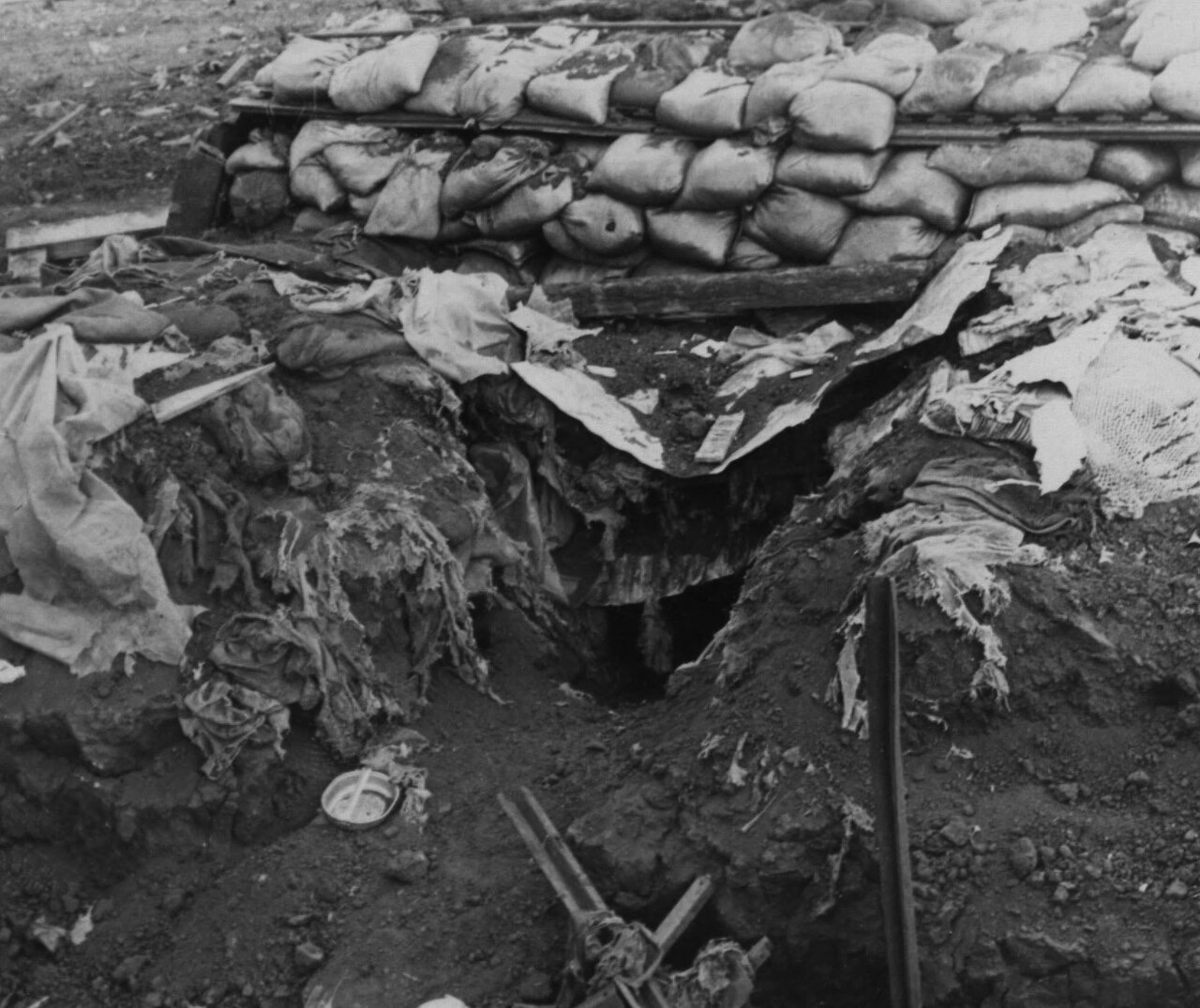
Visual AidA bunker at Khe Sanh
Photograph taken at the Khe Sanh combat base on January 22, 1968 — the day after the shelling began — showing a bunker hit directly by a rocket. This is the position the Knowledge Bank on Khe Sanh and Tet describes: roughly six thousand Marines dug in and pounded from the hills for seventy-seven days, while American newspapers printed maps of the base for weeks. Nobody is visible in the picture, and it shows one bunker, not the battle; the sandbags and packed earth in it are all the shelter there was.
Bunker at Khe Sanh after a direct hit by a PAVN rocket, January 22, 1968; official U.S. Marine Corps photograph A801356, U.S. National Archives 26389687. Source: Wikimedia Commons, File:Bunker at Khe Sanh after direct hit by PAVN rocket.jpg, public domain.
🧠Knowledge Bank question
1According to the Knowledge Bank, what did the Tet attacks of 1968 actually destroy?January
2Which play does Mrs. Baker assign for the first Wednesday of January?January
3The school loses its heat and power, and the class works in winter coats.January
4What does Mrs. Baker do when Mrs. Bigio skips Mai Thi with the hot chocolate?January
5Write the numbers 1–5 in the boxes to show the correct order of events. Number 1 = what happens first.January
Holling’s snowball hits Doug Swieteck’s brother in the face.
An ice storm leaves the school cold and dark, and the hot chocolate goes around.
Holling pushes his sister clear of a skidding bus and is driven to the hospital.
Mrs. Baker’s note assigns Macbeth for the first Wednesday of the month.
The New Year’s Day paper prints the photograph of Holling as Ariel.
6Holling admits to Doug Swieteck’s brother that he threw the snowball.January
7What was Doug Swieteck’s brother doing when the snowball hit him?January
8Who takes Holling to the emergency room after the bus hits him?January
9How does Holling’s father respond to the accident?January
10By the end of the month a second photograph of Holling is taped up around school.January
Part 3
Literary Elements
Understanding HOW and WHY Gary D. Schmidt tells the story across January.
🎭Knowledge Bank · A Boy Telling It Later
Authorial Craft · The Retrospective NarratorJanuary is narrated by Holling, but not by the Holling living it. Gary D. Schmidt (author) uses a retrospective narrator — a character looking back on a year already finished — and that choice buys him two things at once. It buys comedy, because the older voice can make a disaster sound like a weather report and let the reader do the laughing. And it buys weight, because the same voice knows what is coming and can plant a detail now that will not pay off until spring. Watch how the humor is built. The narrator reports catastrophes in flat, calm sentences and saves his outrage for small injustices, so the size of the feeling never matches the size of the event; that mismatch is the joke. Then the technique reverses. When something genuinely serious happens, the same flat voice refuses to swell, and the restraint is what makes the moment land.
Allusion
A reference to another work that lends its meaning to this one. Macbeth runs underneath the whole month: a story about a small ambition that grows teeth sits next to a boy weighing one snowball’s worth of revenge.
Situational Irony
An outcome that reverses what everyone expected. The same walls, the same tape, the same students — one photograph makes Holling a joke and the next makes him a hero, and he is the same person in both.
Foreshadowing
A hint planted early that points at trouble later. When the eighth graders corner Holling in the bathroom and promise he is finished, the threat is left hanging over the rest of the school year.
🧠Knowledge Bank question
1The Knowledge Bank explains that the comedy of January comes from ___.January
2That the school mocks one photograph and cheers the next is ___.January
3Fill in each blank with the correct literary term.January
Word choices:allusionforeshadowingchorusglossary- some words will not be used
A threat in the bathroom that hangs over later months is .
A reference to Macbeth inside this novel is an .
4Foreshadowing is a hint that points toward something later in the story.January
5Why does Gary D. Schmidt (author) pair a murder tragedy with a snowball fight?January
6An allusion means the author has copied another writer’s plot by mistake.January
7The narrator’s calm tone during the accident mainly works to ___.January
8Fill in each blank with the correct literary term.January
Word choices:situational ironyallusionfootnoterhyme- some words will not be used
A hero picture replacing a joke picture is .
Naming Macbeth inside this story is .
9Situational irony depends on an outcome matching exactly what was expected.January
10Mrs. Baker’s reading of Macbeth and Holling’s disagreement mostly reveal ___.January
Part 4
Think Deeper
Four deeper challenges — no single-word recall. Read, weigh the evidence, and reason it out.
💡Knowledge Bank · Who Went and Who Did Not
Civics · Conscription and DefermentsConscription — a legal requirement to serve in the armed forces — had been part of American life since 1940, and in 1968 it worked through some four thousand local boards staffed by civilian volunteers. Each board got a monthly quota and filled it from the men registered in its district, which meant that the odds of being called depended partly on where a young man lived. Classifications did the rest. A student in college could hold a deferment, so could men in a handful of occupations, and a physical or hardship finding could set someone aside altogether. Critics argued that the design pushed the war onto the poorest and least connected, and the criticism was loud enough that Congress eventually replaced the system with a birthday lottery in December 1969. That is the argument echoing under every dinner-table quarrel in this novel about who owes the country what, and it is a question the book never lets anyone answer easily.
Picture a seventh-grade classroom on Long Island in the first week of 1968 with the lights off and the radiators cold. Ice has closed half the roads, the buses have been trickling in since dawn, and twenty-two students sit in their winter coats doing arithmetic by whatever gray light the windows will give them. Somewhere above the ceiling tiles two enormous escaped rats are moving around, and taped to the walls of the hallway outside are photographs of the boy in the second row wearing yellow tights with white feathers on the back. Out on the road a bus grinds past with an eighth grader hanging off the rear bumper, riding it for fun. And three hundred miles up the coast, in living rooms exactly like the ones these students went home to, the evening news is about to open with a place called Khesanh. January is the month when Holling Hoodhood finds out that a crowd can change its mind about you overnight, and that the change has almost nothing to do with you.
Original passage written for Garden Heights — not a quotation from the novel.
1Claim: “Part 4 shows that the school’s opinion of Holling turns on whatever picture of him is on display, not on what he is actually like.” — choose the two details that best prove it.Claim & Evidence
2Holling chooses it, or It happens to Holling? Tap each detail to send it left or right.Sort into two
◄ Holling chooses itIt happens to Holling ►
3Match each cause to its result. For each cause, pick its result.Cause & Effect
The New Year’s Day feature runs the costume photograph→
Ice takes out the school’s power and heat→
Holling’s snowball hits Doug Swieteck’s brother→
A bus slides at his sister in the blowing snow→
🧠Knowledge Bank question
4Fill both blanks to complete the reasoning.Build the Argument
The Knowledge Bank explains that the 1968 draft was called unfair because , and Congress answered in December 1969 by .
Part 5
Standardized Test
The War in the Living Room · Reading & Vocabulary · SAT & TOEFL-style practice
Read the passage — the highlighted words are tested — then answer. Tap an answer, then tap it again to confirm.
SATCentral Ideas — the passage's main point
SATInference — a conclusion the passage implies
SATWords in Context — a word's meaning in this passage
SATAuthor’s Purpose — what the author wants to achieve
TOEFLFactual Information — a fact stated in the passage
TOEFLInsert Text — where a sentence best fits
TOEFLVocabulary — a tested word's meaning here
The War in the Living Room
By the winter of 1968 almost every American household owned a television set, and most families watched the news while they ate supper. The evening newscasts had stretched from fifteen minutes to a half hour in 1963, which left the networks ample room for film shot overseas. Vietnam filled much of that room, because reporters and camera crews could travel with American units into the field. Night after night the fighting became a routine part of an ordinary evening at home, which is why that conflict is remembered as the first television war.
The pictures, however, did not travel as fast as the words did. Camera crews shot film in the field, and the exposed reels had to be flown to Tokyo or all the way to New York before anyone could develop and edit them. A battle therefore trailed its own broadcast by a day or more. Alongside the film came numbers — weekly casualty totals and enemy body counts, released at the daily military briefing in Saigon that tired reporters nicknamed the Five O’Clock Follies.
Then came Tet. On the night of January 30, 1968, during a truce declared for the lunar new year, communist forces struck more than a hundred cities and towns at once, and the fighting reached the American embassy in Saigon. Officials called the broken truce an act of treachery, but the attackers were driven back with terrible losses, so by the measure of ground held the offensive failed. What viewers saw on their screens, though, looked nothing like the steady progress officials had been promising, and public confidence eroded within weeks. By March more Americans told pollsters that sending troops had been a mistake than said it had not.
Original passage written for Garden Heights — not a quotation from the novel.
1What is the main idea of the passage?SAT · Central Ideas
2In 1963 the evening newscasts changed by ___.TOEFL · Factual Information
3According to the passage, exposed film from the field had to be ___.TOEFL · Factual Information
4It can be inferred that viewers in 1968 usually saw combat film ___.SAT · Inference
5Insert Text (TOEFL). Look at the four squares [1]–[4] in the excerpt below. They show where this sentence could be added: “Only the biggest stories were worth the price of a satellite circuit that could beat that delay.”
The pictures, however, did not travel as fast as the words did. [1] Camera crews shot film in the field, and the exposed reels had to be flown to Tokyo or all the way to New York before anyone could develop and edit them. [2] A battle therefore trailed its own broadcast by a day or more. [3] Alongside the film came numbers — weekly casualty totals and enemy body counts, released at the daily military briefing in Saigon that tired reporters nicknamed the Five O’Clock Follies. [4]
Where would the sentence fit best?TOEFL · Insert Text
6In the passage, routine most nearly means ___.SAT · Words in Context
7Why does the author mention the nickname the Five O’Clock Follies?SAT · Author’s Purpose
8In the passage, ample most nearly means ___.TOEFL · Vocabulary
9In the passage, treachery most nearly means ___.TOEFL · Vocabulary
10The passage best helps a reader of Part 4 by ___.SAT · Central Ideas
Part 6 · Optional
Creative Writing
A bonus challenge to practice your English. Take your time and have fun with it.
About This Section
This writing task is optional and is not part of your auto-graded score. The feedback below checks only the basics — length, spelling, and grammar — not whether your ideas are right or wrong. It is meant for classroom discussion and creative practice, so feel free to use your imagination!
Writing Task — Part 4 “Credit You Did Not Earn”
In January the same walls hold two pictures of Holling: one that makes him a laughingstock and one that makes him a hero, and he is the same boy in both. Write about a time other people decided something about you from the outside — praise you were not sure you had earned, or blame that did not fit. What did they see, what did you know that they did not, and what did you do about it? 6–10 sentences. End by explaining whether you think the rescue photograph tells the truth about Holling.
You can start with: “There was a time when people decided something about me before they knew the whole story, and it began when...”
0 / 40 words minimum
🗣 Teach It · Just for Fun (optional)
No right or wrong — close the screen and tell someone nearby what happened in this part. Can’t find anyone? Tell yourself out loud. The moment you teach it, you truly understand it.
Independent study guide by Garden Heights. Not affiliated with or endorsed by Gary D. Schmidt. Contains original analysis only; no text from the novel is reproduced. Reference text: This workbook follows Gary D. Schmidt’s classic text (the standard Puffin edition sold worldwide). Revised 2023 UK editions change some wording and may not match the vocabulary studied here.