The Wednesday Wars cover
Garden Heights

The Wednesday Wars

This workbook is for Garden Heights members. Sign in to continue.

Sign in with Google →
New here? Just sign up with Google — your account includes Matilda, our gift book, forever.
The Wednesday Wars · Garden Heights

Part 5

for The Wednesday Wars · Part 5 · February
8 Parts40 min
What Happens in Part 5

A ceiling falls, a Valentine is won, and a placemat drawing costs Holling's father the contract.

The ceiling fallsFebruary opens with the Hoodhood family preparing for a Chamber of Commerce dinner honoring Holling's father as businessman of the year. The evening starts badly: the ceiling of the perfect, unused living room lets go and comes down on the furniture. Holling's father reaches his own banquet in a temper, sneering at Holling's sister about her flowers on the way.

A borrowed poemMrs. Baker hands Holling a tragedy about two feuding families and a pair of doomed teenagers. He announces it is ridiculous, then finds the lines sticking to him. Meryl Lee, who thinks the play beautiful, refuses to be his Valentine, then says yes when he asks again with borrowed poetry. That leaves a bigger problem: he has three dollars and seventy-eight cents, and Danny Hupfer is taking Mai Thi to an inn and a movie for several times that.

The placematMrs. Baker sees the problem without a speech about it, and tickets to a professional performance at the Festival Theater come Holling's way. He and Meryl Lee go, then sit at a lunch counter over Cokes, where Holling, showing off, draws his father's secret design for the new junior high school on a paper placemat. Meryl Lee keeps it.

Lost contract, lost helicopterAt the presentation of competing designs, the model from Kowalski and Associates carries the same ideas, and Hoodhood and Associates loses the contract. Holling's father blames him; Holling accuses Meryl Lee of using him and learns too late that she never knew what her father would do with a drawing on a placemat. They make up. Then word reaches Mrs. Baker that her husband's helicopter is down in Vietnam and he is missing.

What We Will Learn
SectionWhat you will practice
VocabularyA collapse, a courtship, and a betrayal: banquet, plaster, debris, feud, reconcile
Literary ElementsSymbolism built out of one unused room, situational irony that turns every plan inside out, character foils among the adults, and allusion to a famous stage tragedy
Cross-CurricularBaseball in 1960s America — why the Yankees and Mickey Mantle owned a boy’s imagination, how the reserve clause froze players in place, and why signatures were free
Chapter Summary
Ch.What happens
Early FebruaryThe Ceiling and the Banquet — The Hoodhoods dress for the Chamber of Commerce dinner honoring Holling’s father as businessman of the year, and the ceiling of the showpiece living room collapses onto the furniture. The award is collected by a man in a fury, and the ruined room stays a hole in the perfect house.
Wednesday afternoonsA Play About a Feud — Mrs. Baker assigns a tragedy about two families at war and the teenagers caught between them. Holling calls it ridiculous, Meryl Lee calls it beautiful, and Holling quietly memorizes enough of it to talk his way into a Valentine’s date after his first attempt is turned down.
Valentine’s DayThree Dollars and Change — Danny Hupfer takes Mai Thi to an expensive dinner and a movie; Holling has less than four dollars. Mrs. Baker’s quiet help puts theater tickets in his hands, and afterward Holling shows off at a lunch counter by sketching his father’s design for the new junior high on a placemat.
Late FebruaryThe Lost Contract and the Telegram — A rival firm’s model appears with the same ideas on it, and Holling’s father loses the commission and blames his son. Holling accuses Meryl Lee, learns she never meant it, and repairs the friendship. Then word arrives that Mrs. Baker’s husband is missing in the war.
Part 1
Vocabulary
Study 10 key words from February, then answer each question.
🧪Knowledge Bank · Why Ceilings Fall
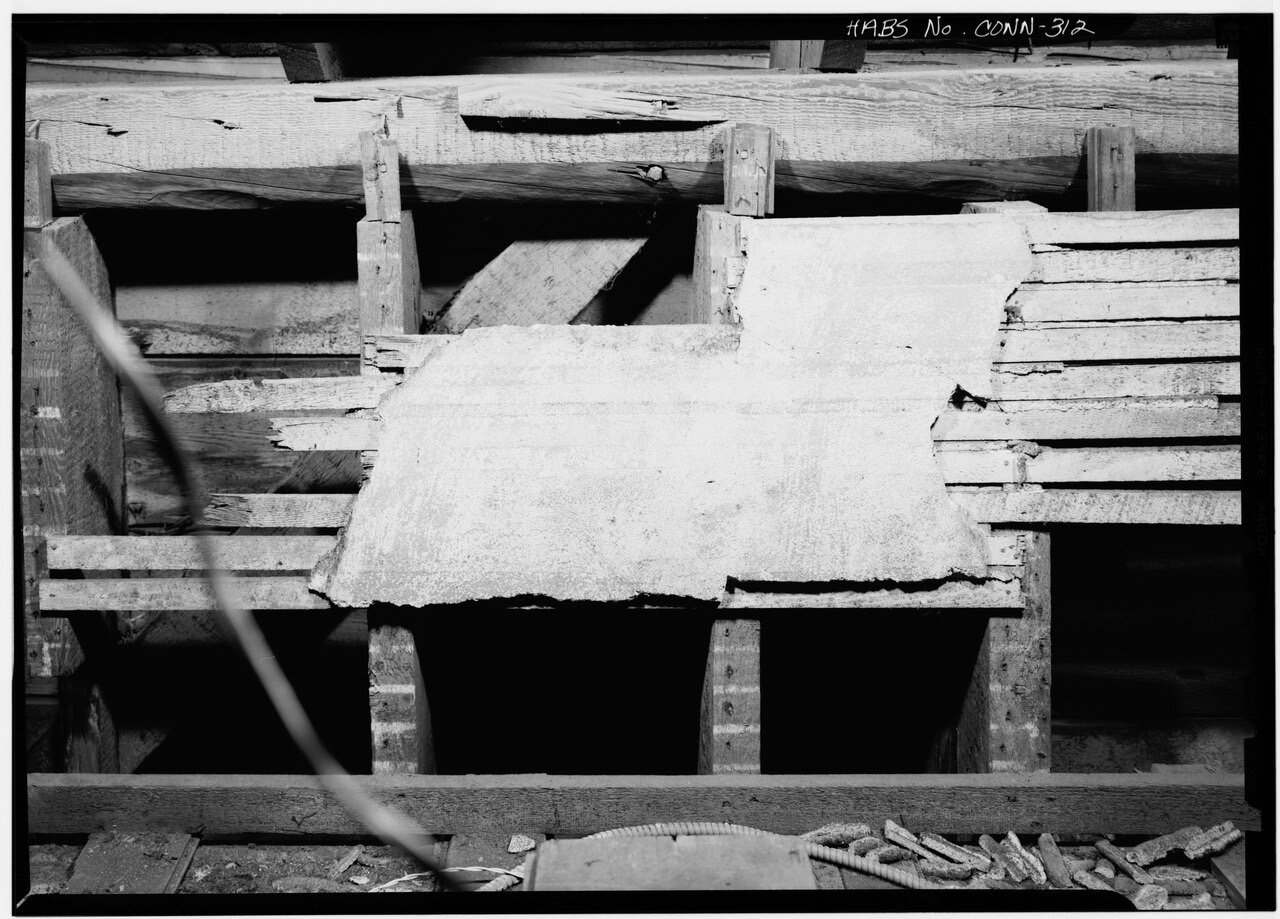
Chemistry · Plaster and GypsumFor most of American building history a ceiling was not a board but a mineral. Workers nailed thin wooden strips called lath across the beams, then pressed wet plaster through the gaps so that it oozed out behind and hardened into hooks, called keys, that gripped the wood from above. The plaster itself came from gypsum — a soft rock made of calcium sulfate and water. Heat it and the water leaves; grind it, add water again, and the powder sets back into stone within minutes. That reaction is why a ceiling can be spread overhead as paste and stay there for eighty years. It is also why ceilings fail. Every slammed door, every slow leak from a pipe, and every season of wood swelling and shrinking snaps a few more keys, so the ceiling hangs by fewer and fewer of them until one afternoon it hangs by none. Builders after the Second World War replaced that whole slow craft with factory-pressed gypsum panels — drywall.
Visual AidThe hooks that hold a ceiling up
A black-and-white photograph looking down into an attic: thin wooden strips are nailed across the joists, and a broad slab of hardened plaster has squeezed through the gaps and set on top of them
Photograph made inside a church attic in Southport, Connecticut, in May 1968 — the same spring as this part of the novel. You are looking at a ceiling from above: the thin wooden strips are lath, and the pale slab is plaster that was pushed up through the gaps from the room below and hardened there. Those hardened lumps are the keys the Knowledge Bank on plaster names, and they are the only thing holding the ceiling on. The picture shows the underside of nothing and the inside of everything; it is a church, not a house, and the ceiling in it did not fall.
General view of original plaster and lath in the attic, Trinity Church, 651 Pequot Road, Southport, Fairfield County, Connecticut, May 1968; photograph by Jack Boucher, Historic American Buildings Survey, Library of Congress. Source: Wikimedia Commons, file HABS CONN,1-SOUPO,22-56, public domain.
banquetn.February
A large formal dinner held in someone’s honor
“The Chamber of Commerce banquet honored one businessman each year.”
plastern.February
A paste that hardens into a smooth coating on walls and ceilings
“A crack crossed the plaster before the ceiling gave way.”
debrisn.February
Scattered broken pieces left after something is destroyed
“Debris covered the carpet in the room nobody used.”
tragedyn.February
A serious play that ends in disaster for its main characters
“Mrs. Baker assigned a tragedy and waited for Holling to complain.”
feudn.February
A long, bitter quarrel between two families or groups
“The feud in the play keeps two households at war for years.”
rivaln.February
A person or company competing for the same prize
“A rival firm presented a model at the same meeting.”
blueprintn.February
A detailed plan drawing that shows how a building will be built
“The blueprint for the new school was supposed to stay private.”
betrayv.February
To break the trust of someone who counted on you
“Holling was sure a friend had betrayed him.”
reconcilev.February
To become friendly again after a quarrel
“The two of them reconcile before the month is over.”
dismayn.February
A feeling of worry and disappointment
“He watched in dismay as the wrong model won.”

ⓘ The vocabulary words in this list are selected to help you understand and complete this workbook. Some may not appear verbatim in the original novel.

🧠Knowledge Bank question
1According to the Knowledge Bank, wet plaster holds a ceiling overhead because it ___.February
2‘Plaster’ hardens into a smooth coating on walls and ceilings.February
3‘Debris’ means ___.February
4A ‘feud’ is a ___.February
5Fill in each blank with the correct word.February
Word choices:banquetblueprintfeuddismay- some words will not be used
The award filled the hotel dining room.
A shows exactly how a building will be built.
6To ‘reconcile’ with someone means to end the friendship for good.February
7To ‘betray’ someone is to ___.February
8A ‘tragedy’ is a play that ends in disaster for its main characters.February
9‘Dismay’ is a feeling of ___.February
10Fill in each blank with the correct word.February
Word choices:rivalreconcileplasterdebris- some words will not be used
A firm presented a design at the same meeting.
Holling and Meryl Lee before the month ends.
Part 2
Comprehension
Show you understood what happens in February.
💵Knowledge Bank · What Three Dollars Bought
Social History · Money in 1968Holling counts his savings before Valentine’s Day and comes up with a little under four dollars, and to feel that number you have to price the year. The federal minimum wage in 1968 was one dollar and sixty cents an hour, so his whole fortune was about two and a half hours of an adult’s paid work. A movie ticket averaged roughly one dollar and thirty cents. A Coke at a lunch counter — the long counters inside five-and-ten-cent stores, where a stool and a cold glass were the cheapest public treat in town — cost around a dime. Dinner for two at a proper inn could swallow a month of that fortune in an hour. Money was also more visible then. A seventh grader carried no credit card, could not pay later, and could not check a balance on a screen; what he could offer another person was exactly the coins in his pocket, counted to the nickel.
Visual AidFour prices on one dollar scale
Four prices on one dollar scaleFour horizontal bars share one scale marked in dollars at 1968 prices: Holling's whole savings, a little under four dollars; one hour of minimum-wage work, one dollar sixty; one movie ticket, about one dollar thirty; and a Coke at a lunch counter, about ten cents. An axis below is ticked from zero to four dollars. Notes say his whole fortune is about two and a half hours of an adult's paid work, and that there was no card, no paying later and no balance on a screen, only the coins in a pocket.WHAT MONEY MEASURED IN 1968Holling’s whole savingsa little under $4.00one hour of minimum-wage work$1.60one movie ticketabout $1.30a Coke at a lunch counterabout $0.10$0$1$2$3$4dollars, at 1968 priceshis whole fortune is about two and a half hours of an adult’s paid workno card, no paying later, no balance on a screen — only the coins in a pocket, counted to the nickel
Measure diagram of the four sums the Knowledge Bank on money in 1968 asks a reader to hold together: a boy’s whole savings of just under four dollars, an hour of minimum-wage work at a dollar sixty, a movie ticket at about a dollar thirty, and a Coke at a lunch counter for about a dime. The bars share one scale so their lengths can be compared directly; the figures are national averages, rounded, and prices differed from town to town. The point is not that things were cheap — it is how few hours of adult work that fortune represents.
1968 federal minimum wage, average movie admission and lunch-counter prices as given in the Knowledge Bank. Drawn for Garden Heights Academy.
🧠Knowledge Bank question
1The Knowledge Bank explains that Holling's savings of about four dollars equaled roughly ___.February
2What happens to the Hoodhood living room?February
3Mrs. Baker assigns Holling a comedy about shipwrecked sailors this month.February
4Holling counts his savings for Valentine’s Day and finds ___.February
5Write the numbers 1–5 in the boxes to show the correct order of events. Number 1 = what happens first.February
  • Mrs. Baker assigns a play about two feuding families.
  • Word arrives that Mrs. Baker’s husband is missing.
  • Holling and Meryl Lee spend Valentine’s Day at the theater.
  • The living room ceiling collapses before the award dinner.
  • A rival firm wins the contract for the new junior high.
6What do Holling and Meryl Lee do on Valentine’s Day?February
7Mrs. Baker quietly helps make Holling’s Valentine’s evening possible.February
8What does Holling draw on the placemat?February
9Meryl Lee planned from the start to take the drawing to her father.February
10What news reaches Mrs. Baker at the end of the month?February
Part 3
Literary Elements
Understanding HOW and WHY Gary D. Schmidt tells the story across February.
🏠Knowledge Bank · The Room Nobody Sat In
Narrative Craft · SymbolismA symbol is an ordinary object that a writer loads with meaning until it stands for something larger than itself. Schmidt (author) builds one out of a room. The Hoodhood living room is spotless, arranged, and unused; it exists to be admired by clients rather than lived in by a family. So when its ceiling comes down in dust and broken plaster, a reader takes in two collapses at once: the literal one on the carpet, and the quieter one in a household organized around appearances. Notice that good symbolism never announces itself. No character stands in the wreckage and explains that the house stands for the family; the meaning arrives only because the writer has spent months showing us what that room is for. Watch, too, for the line between a symbol and a plain detail. A detail tells you what a place is like. A symbol quietly tells you what a story is about, which is the whole job of this ruined ceiling.
Symbolism
The spotless living room nobody is allowed to use stands for a family organized around appearances — so its ceiling falling is two collapses at once.
Situational Irony
The perfect room breaks, the award-winning father loses the job he wanted most, and the boy who mocks a love story wins a date by quoting it.
Foil
Two adults are set side by side without ever sharing a scene: a father who performs generosity at a banquet, and a teacher who practices it where nobody is watching.
Allusion
The novel keeps pointing at a famous stage tragedy, and readers who catch the reference hear a second story running under the first.
🧠Knowledge Bank question
1According to the Knowledge Bank, a symbol differs from a plain detail because it ___.February
2A character placed beside another so that the contrast sharpens both is ___.February
3Situational irony is the gap between what ought to happen and what does.February
4A father who wins businessman of the year and then loses the job he wanted is ___.February
5Fill in each blank with the correct literary term.February
Word choices:symbolismfoilglossaryrhyme- some words will not be used
Mrs. Baker set beside Holling’s father is a .
A ceiling that stands for a family is .
6A foil has to be the villain of the story.February
7Naming a famous stage tragedy inside a modern novel is ___.February
8An allusion is a reference to another work that readers may recognize.February
9Which detail is the clearest symbol?February
10Fill in each blank with the correct literary term.February
Word choices:allusionironyindexmargin- some words will not be used
Borrowing a line from a famous play is an .
A man beaten by his own stolen idea is .
Part 4
Think Deeper
Four deeper challenges — no single-word recall. Read, weigh the evidence, and reason it out.
💡Knowledge Bank · Whose Drawing Was It?
Ethics · Owning an IdeaFebruary hands Holling a hard question with no comfortable answer: what happens when an idea is taken? Ideas are strange property. A stolen bicycle leaves an empty rack, but a copied design leaves the original exactly where it was, because the loss is an advantage rather than an object. American law has drawn lines around that problem for two centuries. A patent protects an invention and a copyright protects the particular way something is expressed, yet neither one protects a bare idea floating in conversation. Professions close the gap with ethics instead: designers, engineers, and writers work on a shared understanding that credit follows the person who did the thinking. The novel makes the question sharper by having the drawing handed over freely. Nobody breaks in. A boy shows off, a girl keeps a souvenir, and an adult decides what to do with it, which is where a reader has to settle the blame.

Picture a living room nobody is allowed to sit in. The carpet has no footprints, the furniture is arranged for people who are coming to sign contracts, and the whole room exists to prove that the family inside the house is doing well. Now picture the ceiling of that room coming down in a white avalanche of dust and broken plaster, on the very afternoon the man of the house is dressing for an award dinner. February is the month the Hoodhood front cracks. It is also the month Holling gets handed a play about two families who cannot stop fighting, discovers that a boy with three dollars and change can still take a girl out if a teacher quietly clears the way, and learns the hard way what happens when you show off something that was never yours to show. And at the end of it, while everyone is busy with contracts and Valentines, a telegram reaches the one adult in this book who has been carrying her own war alone.

Original passage written for Garden Heights — not a quotation from the novel.
1Claim: “February shows that Holling’s father cares more about how things look than about the people living in his house.” — choose the two details that best prove it.Claim & Evidence
2The father’s way of giving, or Mrs. Baker’s way of giving? Tap each detail to send it left or right.Sort into two
◄ The father’s way of givingMrs. Baker’s way of giving ►
3Match each cause to its result. For each cause, pick its result.Cause & Effect
Holling sketches a private design on a placemat
Mrs. Baker arranges an evening he can afford
The ceiling of the showpiece room gives way
A message reaches the school about a downed helicopter
🧠Knowledge Bank question
4Fill both blanks to complete the reasoning.Build the Argument
According to the Knowledge Bank, a copied design is hard to treat like theft because , which is why .
Part 5
Standardized Test
The Last Seasons of a Slugger · Reading & Vocabulary · SAT & TOEFL-style practice
The Last Seasons of a Slugger

Mickey Mantle joined the New York Yankees in 1951, at nineteen, and within a few seasons he was the most famous ballplayer in America. He batted from both sides of the plate and hit home runs people described for the rest of their lives. He also played hurt from the start. He tore up his right knee chasing down a fly ball in his first World Series, and the damage never healed. For eighteen seasons he taped and wrapped and limped onto the field.

The team around him faded first. The Yankees won fourteen American League pennants in the sixteen seasons ending in 1964, then fell to last place in 1966 and never contended again while he played. To the dismay of fans who had never watched it lose, the great years were over. Mantle's own numbers fell with them, and the club moved him from the outfield to first base in 1967 to spare his legs. The 1968 season was his last, and he retired the following spring with 536 home runs, third in the game's history then.

It is hard now to explain what such a player meant to a boy. The reserve clause — a contract rule tying a player to one team until it chose to trade him — meant stars rarely changed uniforms, so no rival club could buy him away and a fan followed the same man for years. Salaries stayed modest; Mantle's best pay of one hundred thousand dollars a year looked enormous then but small beside the contracts free agency brought in the 1970s. Autographs were free as well. Players signed at store counters as a favor to the club, so a coveted signature cost only a wait in line.

Original passage written for Garden Heights — not a quotation from the novel.
1What is the main idea of the passage?SAT · Central Ideas
2According to the passage, Mantle first hurt his knee ___.TOEFL · Factual Information
3The passage says the Yankees finished last in ___.TOEFL · Factual Information
4The club moved Mantle to first base in order to ___.TOEFL · Factual Information
5The reserve clause suggests that a 1960s fan could expect ___.SAT · Inference
6Why does the writer mention free agency in the last paragraph?SAT · Author’s Purpose
7It can be inferred that being refused an autograph in the 1960s would feel ___.SAT · Inference
8In the passage, <b>dismay</b> most nearly means ___.SAT · Words in Context
9In the passage, <b>rival</b> most nearly means ___.TOEFL · Vocabulary
10In the passage, coveted most nearly means ___.TOEFL · Vocabulary
Part 6 · Optional
Creative Writing
A bonus challenge to practice your English. Take your time and have fun with it.
About This Section

This writing task is optional and is not part of your auto-graded score. The feedback below checks only the basics — length, spelling, and grammar — not whether your ideas are right or wrong. It is meant for classroom discussion and creative practice, so feel free to use your imagination!

Writing Task — Part 5 “The Thing You Showed Off”

Holling draws something private on a placemat because he wants to look impressive, and it costs his family a great deal. Write about a time you shared something that was not really yours to share — a secret, a plan, a photo, a family story — or a time someone did that to you. Describe why it felt good in the moment, what happened afterward, and how the two people involved ended up. 6–10 sentences. Finish by explaining what you would do differently.

You can start with: “It felt harmless when I said it, because...”
0 / 40 words minimum
🗣 Teach It · Just for Fun (optional)

No right or wrong — close the screen and tell someone nearby what happened in this part. Can’t find anyone? Tell yourself out loud. The moment you teach it, you truly understand it.

Garden Heights

Part 5 Complete!

You finished February of The Wednesday Wars.

Here are your auto-graded results:

-
points out of 100
🗣 Teach It · Just for Fun (optional)
Move on to Part 6 →

Independent study guide by Garden Heights. Not affiliated with or endorsed by Gary D. Schmidt. Contains original analysis only; no text from the novel is reproduced. Reference text: This workbook follows Gary D. Schmidt’s classic text (the standard Puffin edition sold worldwide). Revised 2023 UK editions change some wording and may not match the vocabulary studied here.