New here? Just sign up with Google — your account includes Matilda, our gift book, forever.
The Wednesday Wars · Garden Heights
Part 6
for The Wednesday Wars · Part 6 · March
8 Parts40 min
What Happens in Part 6
The Ides of March brings a school board visit, a track tryout, two dead rats, and an apology.
Beware the IdesMarch 1968 opens with the evening news worsening while officials insist the war goes well, and Holling notices the gap. At school, ceiling tiles chewed by the class rats Sycorax and Caliban are replaced, and Mrs. Baker announces that the school board will observe the classroom on the Ides of March. Coach Quatrini schedules cross-country tryouts for the same afternoon, and Holling, reading Julius Caesar, wonders whether the calendar is out to get him.
The family firmAt home the family business fills every conversation. Hoodhood and Associates needs a spring receptionist, and Holling's father has decided Heather will be it; she refuses, preferring Robert Kennedy's campaign, and the argument leaves the table cold. Holling silently agrees with his sister and says nothing, which is its own answer. His own future is already assigned: the firm, the drafting tables, the name on the door.
A silver medalBefore the board arrives, Mrs. Baker takes Holling outside and fixes his running form. When he thanks her, she opens a wooden box in her bottom desk drawer and shows him a silver medal from the 1956 Olympic Games in Melbourne, won in the four-by-one-hundred-meter relay. It is the first time Holling has considered that his teacher had a life before the chalkboard. He also learns her husband is missing in action.
Rats and an apologyThe observation goes spectacularly wrong: the rats drop from the ceiling near Mrs. Sidman, who seizes them while Mai Thi swings a shoe and leaves a hero. At tryouts the rats chase Holling to his fastest time and a varsity place; Danny Hupfer hauls him from the road as a bus flattens both rats. When students turn that into an ugly joke about Mai Thi, Danny answers with his tray and earns a suspension. Mrs. Bigio brings food and apologizes.
What We Will Learn
Section
What you will practice
Vocabulary
Offices, omens, and running: commission, receptionist, soothsayer, scrutiny, varsity, endurance…
Literary Elements
Allusion that loads a plain school day with dread, comic relief dropped into a tense month, and situational irony hidden in a desk drawer
Cross-Curricular
Architecture in the 1960s — drafting tables and blueprints, the commission a firm lives on, and the Long Island building boom that filled the suburbs with new schools
Chapter Summary
Ch.
What happens
March · Before the Ides
A Date on the Calendar — The war news worsens, the chewed ceiling tiles are replaced, and Mrs. Baker announces a school board observation for the fifteenth. Coach Quatrini sets cross-country tryouts for the same day. Reading Julius Caesar, Holling meets a soothsayer warning about that exact date. At home his father assigns Heather the receptionist’s desk at Hoodhood and Associates; she refuses in favor of Robert Kennedy’s campaign, and Holling keeps his agreement to himself.
March · The Ides and After
Rats, a Medal, and a Record — Mrs. Baker corrects Holling’s running form, then shows him a silver medal from the 1956 Melbourne Olympics; he also learns her husband is missing in action. During the observation Sycorax and Caliban drop from the ceiling, Mrs. Sidman grabs them, and Mai Thi swings a shoe. At tryouts the rats chase Holling to a record and a varsity place, Danny pulls him from the road, and a cruel joke about Mai Thi costs Danny four days of suspension — before Mrs. Bigio arrives with food and an apology.
Part 1
Vocabulary
Study 10 key words from March, then answer each question.
📏Knowledge Bank · Before Computers Drew Buildings
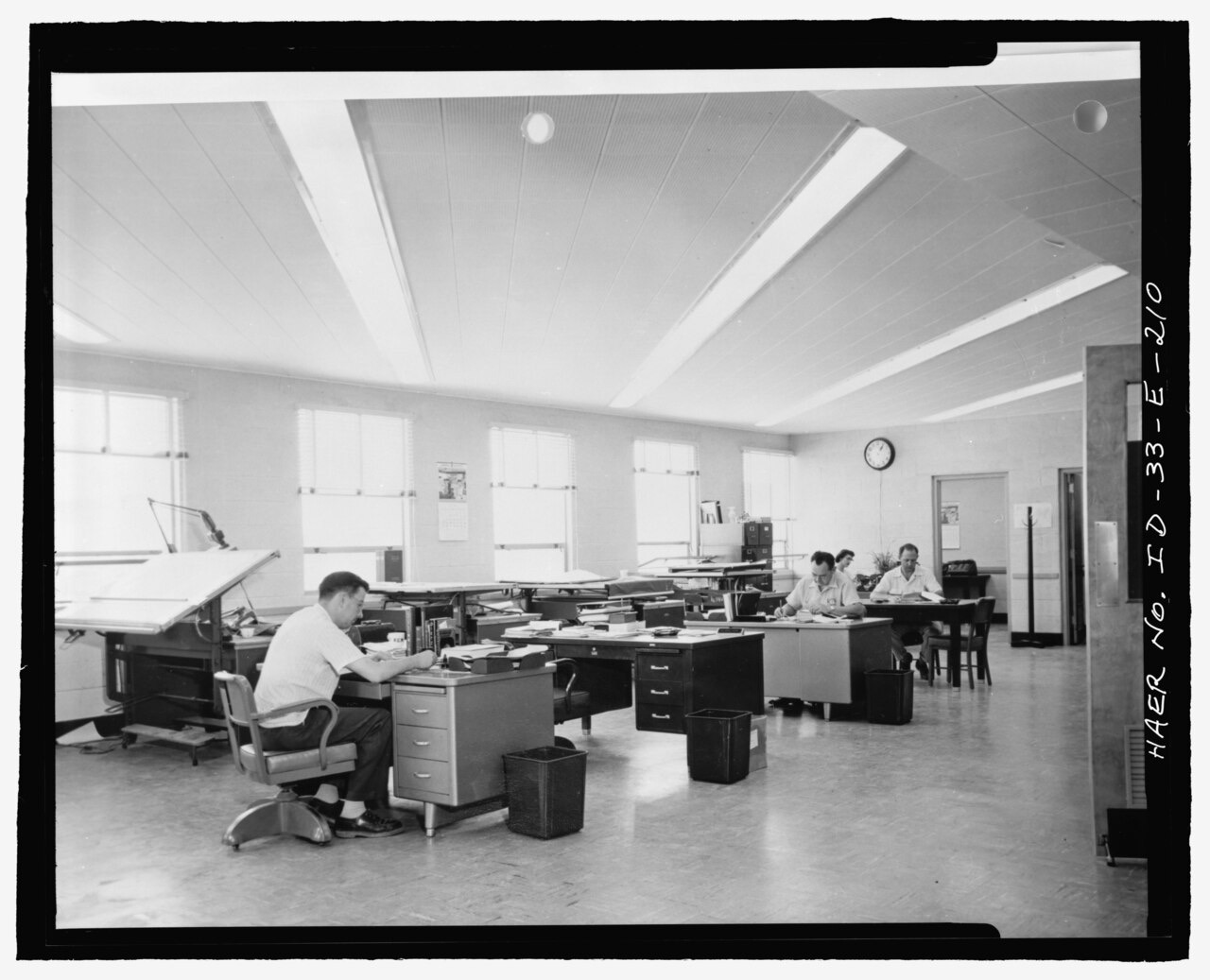
Technology · The Drafting RoomMarch keeps circling a room most students have never seen: the drafting room of an architecture office. In 1968 nobody drew a building on a screen. A draftsman stood at a wide table tilted toward the window, taping down a sheet of tracing paper or vellum — a tough, semi-transparent sheet that ink will not soak into — and worked with hard pencils sharpened on a sandpaper block. A T-square slid along the edge of the table to keep every horizontal line exactly parallel, and plastic triangles pushed against it supplied the verticals. Lettering was done freehand in a plain block alphabet, because a builder reading a soaked sheet on a windy site could not afford a stylish letter he might misread. Finished drawings were copied by machine onto chemically coated paper, and for decades those copies came back white on a deep blue field. The building did not exist yet, but its instructions did, and the trade still calls a set of them a blueprint.
Visual AidA room where buildings were drawn
Photograph of a working drafting room, made in July 1954. The tilted tables under the windows, the steel desks, the flat file and the plain overhead light are the whole technology the Knowledge Bank on the drafting room describes: paper taped down, hard pencils, a T-square sliding along the table edge for every horizontal line. This is an engineering office at a government laboratory, not an architecture firm and not Hoodhood and Associates — but it is the same room, and the same year’s equipment. What you cannot see here is a single screen.
Drafting room in use, Administration Building (TAN-602), Test Area North, Idaho National Engineering Laboratory, July 12, 1954; Historic American Engineering Record, Library of Congress. Source: Wikimedia Commons, file HAER ID-33-E-210, public domain.
soothsayern.March
A person who claims to be able to foretell the future
“A soothsayer in the play warns about a date on the calendar.”
idesn.March
In the ancient Roman calendar, the middle day of a month, which fell on the fifteenth in March
“The board chose the ides for its visit without knowing the joke.”
conspiracyn.March
A secret plan made by several people to do something harmful
“The conspiracy in the play turns friends into assassins.”
scrutinyn.March
Close, careful examination of something or someone
“A whole afternoon of scrutiny made the classroom nervous.”
receptionistn.March
An office worker who greets visitors and answers the telephone
“The firm needed a receptionist at the front desk for the spring.”
commissionn.March
A formal, paid order for a professional to design or make something
“A school building would be the largest commission of the year.”
varsityn.March
The top team that represents a school in a sport
“Holling had never expected to end the day on varsity.”
striden.March
One long, complete step taken while running
“Mrs. Baker worked on the length of his stride.”
endurancen.March
The ability to keep going through strain over a long time
“Cross-country is a test of endurance rather than of speed alone.”
composuren.March
Calm control over one’s feelings, especially under pressure
“She kept her composure even on the worst mornings.”
ⓘ The vocabulary words in this list are selected to help you understand and complete this workbook. Some may not appear verbatim in the original novel.
🧠Knowledge Bank question
1According to the Knowledge Bank, plain block lettering survived a builder's scrutiny because it ___.March
2In the ancient Roman calendar, the ides of March fell on the fifteenth of the month.March
3A ‘conspiracy’ is a secret plan made ___.March
4‘Scrutiny’ means ___.March
5Fill in each blank with the correct word.March
Word choices:commissionreceptionistendurancescrutiny- some words will not be used
Hoodhood and Associates hoped for a large .
Heather refused to spend the spring as the firm’s .
6A school’s ‘varsity’ team is its ___.March
7‘Stride’ describes the shoes a runner wears rather than the step itself.March
8‘Endurance’ is the ability to ___.March
9Fill in each blank with the correct word.March
Word choices:composurestridesoothsayervarsity- some words will not be used
Mrs. Baker worked on the length of his .
She kept her even when her eyes were red.
10A ‘commission’ is a paid order for someone to do a piece of professional work.March
Part 2
Comprehension
Show you understood what happens in March.
💼Knowledge Bank · Chasing the Commission
Economics · How a Design Firm Wins WorkAn architecture firm has nothing on a shelf to sell. It sells a promise to draw, and it is paid only when a client hands it a commission — a formal order to design one particular building. Public work such as a school usually arrives through a competition: a board announces what it needs, several firms submit designs and prices, and the board chooses one. Each submission is a bid, and preparing one can cost weeks of unpaid drawing with no guarantee at all, since losing drawings cannot be sold to anybody else. That is why local honors mattered so much to the men who ran these offices. A Chamber of Commerce award or a seat at the right lunch table was not vanity alone; in a town where the people awarding contracts all knew one another, it was advertising. A school board sitting in a seventh-grade classroom is, to Holling’s father, a matter of reputation.
Visual AidChasing the commission
Sequence diagram of the competition the Knowledge Bank on winning work walks through: a board announces what it needs, several firms spend weeks drawing and pricing a bid for nothing, and one bid becomes the commission while the losing sets turn into waste. Real selections add interviews, revisions and negotiated fees that are left out here, and the drawing does not claim that any contract in the novel was decided this way. Notice the gray arrow — the unpaid drawings are the reason reputation is worth so much to a small firm.
Design competitions, bids and commissions in mid-century American architectural practice, as summarized in the Knowledge Bank. Drawn for Garden Heights Academy.
🧠Knowledge Bank question
1The Knowledge Bank explains that a losing bid costs an architecture firm dearly because ___.March
2Which Shakespeare play does Holling read this month?March
3Coach Quatrini schedules the cross-country tryouts for the same day as the board’s visit.March
4Why does Heather refuse the job at her father’s firm?March
5Write the numbers 1–5 in the boxes to show the correct order of events. Number 1 = what happens first.March
Holling reads the soothsayer’s warning about the ides.
Sycorax and Caliban come down out of the ceiling.
Mrs. Baker announces the school board’s visit.
Mrs. Baker shows Holling her silver Olympic medal.
Holling runs a record time and makes the varsity team.
6Mrs. Baker tells Holling that her husband has come safely home.March
7What is inside the wooden box in Mrs. Baker’s desk?March
8Who takes hold of the escaped rats during the observation?March
9Danny Hupfer is suspended for four days after standing up for Mai Thi at lunch.March
10How does Holling end up running the fastest time of his life?March
Part 3
Literary Elements
Understanding HOW and WHY Gary D. Schmidt tells the story across March.
🎭Knowledge Bank · Why the Rats Are Funny
Authorial Craft · Comedy Beside CatastropheA writer who wants a reader to feel dread cannot simply pile dread on for a hundred pages; past a point the reader goes numb. So March is built out of contrast. One thread carries a telegram, a missing husband, and a war that the evening news keeps getting wrong. The other thread carries two rats, a room of dignified visitors, and a shoe swung in self-defense. The funny thread is not a break from the serious one; it sits directly beside it, and each makes the other sharper. That deliberate lightening is called comic relief, and it works because laughter resets a reader’s attention, so the next blow lands fresh. Layered over both threads is an allusion: borrowing the most famous warning about a date in English drama costs one sentence and hangs a whole month with dread. Watch how much weight a book can carry when it refuses to be only one tone.
Allusion
A passing reference to something outside the story that the reader is expected to recognize — here, one famous date borrowed from a play and dropped onto a school calendar.
Comic Relief
A funny scene set inside a serious story: dignified adults in folding chairs, and two rats coming down out of the ceiling on top of them.
Situational Irony
The outcome is the opposite of what everyone expected — the teacher known for stern discipline turns out to keep an Olympic medal in her desk.
🧠Knowledge Bank question
1According to the Knowledge Bank, comic relief works because laughter ___.March
2A funny scene dropped into a tense story is called ___.March
3Situational irony means an outcome turns out the opposite of what was expected.March
4A stern teacher turning out to be an Olympic runner is ___.March
5Comic relief is used to keep a story light from its first page to its last.March
6Fill in each blank with the correct literary term.March
Word choices:allusioncomic reliefsuspenseepilogue- some words will not be used
Borrowing a famous date from a play is .
A rat landing beside a visitor is .
7Why does the soothsayer’s warning unsettle the reader before anything happens?March
8Allusion means an author invents a brand-new word for a familiar object.March
9Which detail is the clearest example of comic relief?March
10Fill in each blank with the correct literary term.March
Word choices:situational ironyallusionforeshadowingdialogue- some words will not be used
A feared teacher hiding an Olympic medal is .
A warning about a date still to come is .
Part 4
Think Deeper
Four deeper challenges — no single-word recall. Read, weigh the evidence, and reason it out.
💭Knowledge Bank · The Life Chosen for You
Psychology · Living Someone Else’s PlanA firm called Hoodhood and Associates carries an assumption inside its name: a Hoodhood will still be running it in thirty years. Family businesses have always worked that way, and in the middle of the twentieth century the expectation was rarely even spoken. A son was raised toward succession, a daughter was more often offered the front desk than the drafting table, and both arrangements were called common sense. Psychologists have a name for what happens when a young person accepts a role handed down before trying any other: identity foreclosure — closing the question of who you are before you have opened it. Foreclosure is comfortable, because the path is already paved, and it can be costly later, when the person discovers a life that fits somebody else’s ambition. March sets two responses side by side. Heather refuses out loud and pays for it at once. Holling agrees with her silently and pays nothing yet. Both are arguments about the same thing, which is autonomy.
Picture a seventh-grade classroom on the fifteenth of March, scrubbed to a shine. Folding chairs stand at the back for the school board. A man on a ladder has just finished pushing new tiles into the ceiling grid, because something living up there chewed through the old ones. Down the hall a coach has posted a sign: cross-country tryouts, this afternoon. And on the desk of the boy in the third row lies a play in which a man is told, plainly and in public, to beware this exact date. Nobody in the room believes in soothsayers. Everybody in the room is about to have a very strange day anyway. Meanwhile, twenty minutes away, a drafting table waits in an office with the family name on the door — an office the boy has been told, more than once, will belong to him someday whether he wants it or not. Part 6 is a month in which other people’s plans meet the ides.
Original passage written for Garden Heights — not a quotation from the novel.
1Claim: “March shows that Holling’s future has been drawn for him by other people.” — choose the two details that best prove it.Claim & Evidence
2Pressure from the Hoodhood house, or Pressure from Camillo Junior High? Tap each detail to send it left or right.Sort into two
◄ Pressure from the Hoodhood housePressure from Camillo Junior High ►
3Match each cause to its result. For each cause, pick its result.Cause & Effect
A soothsayer names a date in the play Holling is reading→
Heather refuses the receptionist’s desk at the firm→
Mrs. Baker takes Holling outside to correct his running→
Sycorax and Caliban drop out of the ceiling grid→
🧠Knowledge Bank question
4Fill both blanks to complete the reasoning.Build the Argument
According to the Knowledge Bank, identity foreclosure feels comfortable because , and it can cost a person later when .
Part 5
Standardized Test
The Room Where Buildings Begin · Reading & Vocabulary · SAT & TOEFL-style practice
Read the passage — the highlighted words are tested — then answer. Tap an answer, then tap it again to confirm.
SATCentral Ideas — the passage's main point
SATWords in Context — a word's meaning in this passage
SATInference — a conclusion the passage implies
SATAuthor’s Purpose — what the author wants to achieve
TOEFLFactual Information — a fact stated in the passage
TOEFLVocabulary — a tested word's meaning here
TOEFLProse Summary — the three sentences that sum it up
The Room Where Buildings Begin
Before a building exists anywhere else, it exists on paper. In the middle of the twentieth century an architecture office was a long room of wide wooden tables tilted toward the windows, each holding a taped-down sheet of tracing paper. A receptionist at the front desk answered the telephone and walked clients back to the partner they wanted. A draftsman worked standing, sliding a T-square along his board and pressing plastic triangles against it so every line landed exactly level or upright. What grew there was not a picture but an instruction manual strangers would follow a year later.
Work arrived as a commission, a paid order from a client who needed a house, a bank, or a school. The office answered with a whole family of drawings, because no single view can describe a building. A plan looks straight down, as though the roof were lifted away; a section slices the building open like a loaf of bread; an elevation stands outside and draws one flat face of the wall. Beside them went the specifications, pages of written orders naming every material down to the grade of the door hinges.
Copying gave the profession one of its most familiar words. A finished drawing was laid over paper coated with light-sensitive chemicals and exposed to bright light, and the copy came back with white lines on a deep blue field — hence the word blueprint. By the 1960s a faster machine using ammonia — a sharp-smelling gas — had replaced that process, printing dark lines on white, though builders said blueprints anyway. Every sheet went out under close scrutiny, because a line a quarter of an inch out of place could become a doorway too narrow for its door.
Original passage written for Garden Heights — not a quotation from the novel.
1What is the main idea of the passage?SAT · Central Ideas
2According to the passage, a draftsman slid a T-square along ___.TOEFL · Factual Information
3In the passage, commission most nearly means ___.SAT · Words in Context
4The passage says a section drawing ___.TOEFL · Factual Information
5The passage suggests that a builder given only a plan drawing would ___.SAT · Inference
6In the passage, <b>receptionist</b> most nearly means ___.TOEFL · Vocabulary
7Why does the writer explain how copies were printed on blue paper?SAT · Author’s Purpose
8In the passage, <b>scrutiny</b> most nearly means ___.SAT · Words in Context
9Prose Summary (TOEFL).The passage explains how a design office turned a client’s order into buildable instructions. This TOEFL task lists six sentences; choose the THREE that best capture the passage’s main ideas. The other three do not belong — they state minor details or ideas the passage does not present.TOEFL · Prose Summary
10The detail about the door hinges suggests that specifications ___.SAT · Inference
Part 6 · Optional
Creative Writing
A bonus challenge to practice your English. Take your time and have fun with it.
About This Section
This writing task is optional and is not part of your auto-graded score. The feedback below checks only the basics — length, spelling, and grammar — not whether your ideas are right or wrong. It is meant for classroom discussion and creative practice, so feel free to use your imagination!
Writing Task — Part 6 “The Plan Somebody Made for You”
Holling is told what he will do with his life long before anyone asks him what he wants, and Heather refuses the same kind of instruction out loud. Write about a time somebody made a plan for you — an activity, a subject, a future — without asking first. Describe what the plan was, who made it, and what you did about it. 6–10 sentences. End with what you would want that person to understand now.
You can start with: “Nobody ever asked me whether I wanted it...”
0 / 40 words minimum
🗣 Teach It · Just for Fun (optional)
No right or wrong — close the screen and tell someone nearby what happened in this part. Can’t find anyone? Tell yourself out loud. The moment you teach it, you truly understand it.
Independent study guide by Garden Heights. Not affiliated with or endorsed by Gary D. Schmidt. Contains original analysis only; no text from the novel is reproduced. Reference text: This workbook follows Gary D. Schmidt’s classic text (the standard Puffin edition sold worldwide). Revised 2023 UK editions change some wording and may not match the vocabulary studied here.