New here? Just sign up with Google — your account includes Matilda, our gift book, forever.
The Wednesday Wars · Garden Heights
Part 7
for The Wednesday Wars · Part 7 · April and May
8 Parts40 min
What Happens in Part 7
Spring 1968 brings assassination, a father's broken promise, a runaway sister, and news that Lieutenant Baker is alive.
Running and a bulletinApril opens with Holling running. Mrs. Baker has given up Wednesday Shakespeare to coach him, and at his first cross-country meet he beats a field of eighth graders and wins a hundred-dollar savings bond. Then the class returns from spring break to news that Martin Luther King Jr. has been shot in Memphis. Holling is at the Kowalski house with Meryl Lee when the bulletin comes on, and they watch holding hands.
Opening DayNothing at home is steady. Mrs. Baker waits on word from Vietnam, where marines push toward Khe Sanh searching for missing men, her husband among them. Opening Day at Yankee Stadium falls on a Wednesday, and Mr. Hoodhood, who promised to drive his son to the ballpark, does not come. Mrs. Baker waits until the last student has gone home, then takes Holling to the game herself.
Heather runsMay is Atomic Bomb Awareness Month, and the whole school practices crouching under desks. Holling reads Hamlet on Wednesdays, helps Danny Hupfer rehearse his bar mitzvah speech, and gets taunted by eighth graders who dislike losing to him. At home the year's argument goes off: Heather still means to attend Columbia, her father still refuses, sourer after Kowalski and Associates wins the Yankee Stadium renovation. Heather leaves for California with Chit, leaving a note about finding herself.
Port AuthorityDays later she telephones from Minneapolis, broke, alone, and out of Chit. Holling sends her to a Western Union and wires her every dollar of the bond he ran for. Mr. Kowalski drives him to the Port Authority, where he meets the bus from Chicago and tells his sister he will always be there for her. Asked whether she found herself, Holling answers that she found him. Then word comes: Lieutenant Baker is alive and coming home.
What We Will Learn
Section
What you will practice
Vocabulary
Words for a spring of loss and defiance: assassination, solemn, stamina, ultimatum, reconcile…
Literary Elements
History delivered through a thirteen-year-old narrator, public catastrophe set beside private trouble, and a hundred-dollar prize that turns into a symbol
Cross-Curricular
American history — the spring of 1968, from a motel balcony in Memphis to a camp of plywood shelters on the lawn of the nation’s capital
Chapter Summary
Ch.
What happens
April
The News Comes into the Living Room — Mrs. Baker coaches Holling instead of assigning a play, and he wins his first cross-country meet and a hundred-dollar savings bond. After spring break, word arrives that Martin Luther King Jr. has been killed in Memphis; Holling is at the Kowalskis’ with Meryl Lee and watches the broadcast with her family. Marines are moving toward Khe Sanh to look for the missing, Lieutenant Baker among them. When Mr. Hoodhood breaks his promise to take his son to Opening Day at Yankee Stadium, Mrs. Baker drives him to the ballpark herself.
May
What a Bond Is For — The school drills for an atomic attack, Holling reads Hamlet with Mrs. Baker, coaches Danny through his bar mitzvah speech, and takes abuse from the eighth graders he beat. Heather and her father deadlock over Columbia, and she leaves for California with Chit. She telephones from Minneapolis with no money and no ride; Holling cashes his bond and wires it to her, then rides with Mr. Kowalski to the Port Authority to meet her bus. He answers their father for her. Word comes that Lieutenant Baker is alive near Khe Sanh and coming home.
Part 1
Vocabulary
Study 10 key words from April and May, then answer each question.
📺Knowledge Bank · How the News Got into a Living Room
Media History · Television in 1968In 1968 almost every American household owned one television set, and that set received three national networks and perhaps a local channel or two. There was no way to look anything up and no way to watch later. The evening newscast had run fifteen minutes until 1963, when two of the networks stretched it to half an hour and hired camera crews to fill it, so by 1968 a family sat down to a nightly broadcast of film shot a day or two earlier and flown home for developing. When something enormous happened between newscasts, an announcer cut into whatever program was playing with a bulletin, sometimes with nothing to show but a desk and a piece of paper. That is why the spring of 1968 lives in so many memories as a room rather than a headline: there was one screen, everyone in the house faced it, and the worst news of the decade arrived while the family was standing there together.
Visual AidHow the news reached a living room
Sequence diagram of the route the Knowledge Bank on television in 1968 traces: film shot in the field, flown home, developed and cut, broadcast on a half-hour evening newscast, and watched on the one set in the house. A bulletin is the exception, drawn underneath, because it could interrupt with nothing to show but a desk and a sheet of paper. The delay was not always a day or two, and local stations are left out. The drawing describes a system, not any particular broadcast — and none of the boxes is a way to look something up or watch it again.
Network evening news production, film delivery and bulletins in 1968, as summarized in the Knowledge Bank. Drawn for Garden Heights Academy.
assassinationn.April
The murder of a well-known public figure, usually for political reasons
“The class returns from spring break to news of an assassination.”
solemnadj.April
Serious and grave, with no trace of joking
“The Kowalskis’ living room goes solemn the moment the bulletin starts.”
staminan.April
The strength to keep going through long, hard effort
“Weeks of Wednesday afternoons build Holling’s stamina.”
endurev.April
To go through something painful or difficult without giving up
“Mrs. Baker endures the waiting without letting the class see it.”
tauntv.May
To mock someone on purpose in order to hurt or provoke
“The beaten eighth graders taunt Holling in the hallway.”
futileadj.May
Certain to fail; useless however hard it is tried
“Crouching under a school desk against a bomb is futile.”
defiancen.May
Open refusal to obey someone in authority
“Heather leaves a note, which is defiance written down.”
ultimatumn.May
A final demand that leaves the other side no room to bargain
“Her father delivers an ultimatum about college instead of an answer.”
strandedadj.May
Left somewhere with no money and no way to get home
“She telephones from Minneapolis stranded and out of options.”
reconcilev.May
To make peace after a quarrel
“Holling answers for his sister and helps the family reconcile.”
ⓘ The vocabulary words in this list are selected to help you understand and complete this workbook. Some may not appear verbatim in the original novel.
🧠Knowledge Bank question
1According to the Knowledge Bank, the solemn evening newscast of 1968 usually showed film that was ___.April
2‘Solemn’ means serious and grave.April
3‘Stamina’ is the strength to ___.April
4Something ‘futile’ is ___.May
5Fill in each blank with the correct word.April and May
Word choices:staminatauntsolemnfutile- some words will not be used
Weeks of running build Holling’s .
The eighth graders him after he beats them.
6‘Defiance’ means openly ___.May
7An ‘ultimatum’ is a friendly offer that invites bargaining.May
8Someone who is ‘stranded’ is ___.May
9Fill in each blank with the correct word.May
Word choices:reconcileultimatumendurestranded- some words will not be used
Her father hands down an about college.
Holling helps the family at the door.
10To ‘endure’ something is to get through it without giving up.April
Part 2
Comprehension
Show you understood what happens in April and May.
☢Knowledge Bank · Crouching Under a School Desk
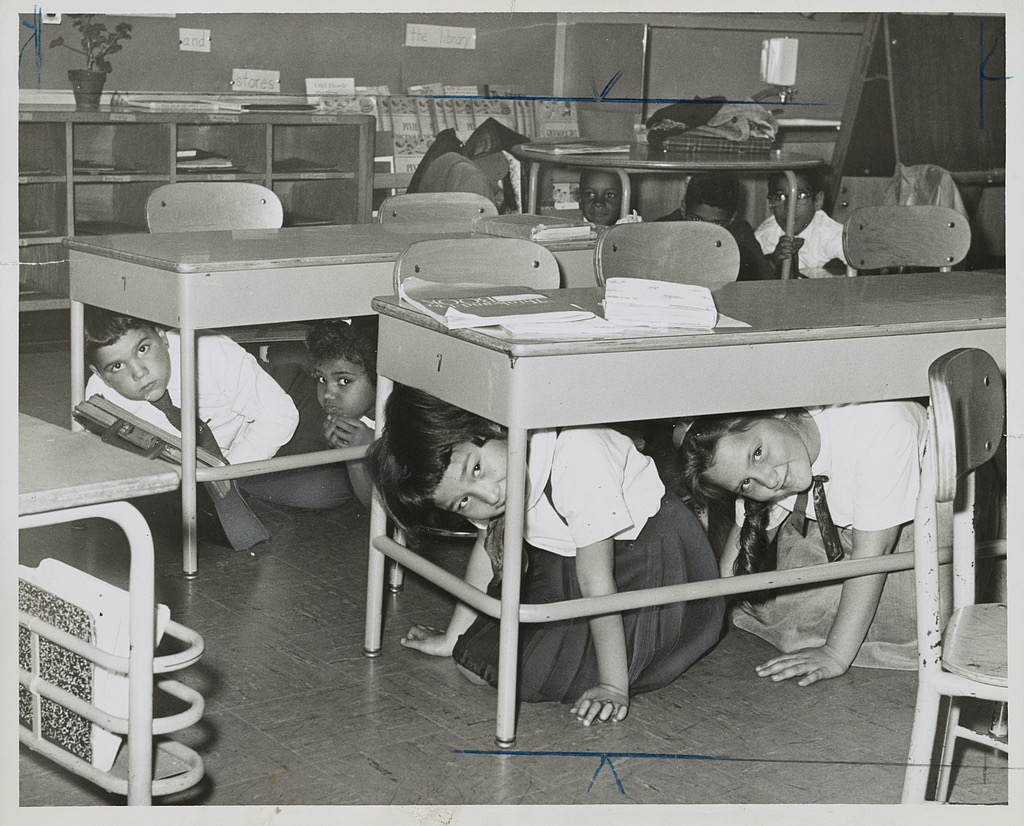
Civil Defense · Duck and CoverThe drill Holling’s school practices in May was twenty years old by 1968. After the Soviet Union tested an atomic bomb in 1949, the federal government built a civil defense program around the idea that ordinary people could be trained to survive an attack. A 1952 film starring a cartoon turtle taught schoolchildren to duck under a desk and cover their heads at the flash; cities sounded sirens on a schedule; basements were stocked as public shelters with water drums, crackers, and radiation meters. The Cuban missile crisis of October 1962 made all of it feel briefly real. Scientists, though, already knew the truth: near a target, a desk is nothing against blast, heat, or fallout — the radioactive dust that drifts down for days afterward. Farther away, the drill helped a little, and school officials liked it for another reason. A rehearsed room does not stampede, and what the drills mostly practiced was calm.
Visual AidUnder the desks, 1962
Photograph of a take-cover drill in a Brooklyn public school in 1962, the autumn of the Cuban missile crisis. The children have done exactly what the Knowledge Bank on duck and cover describes: down, under the desk, head covered, hold the position. The blue grease-pencil marks at the edges are a newspaper picture desk cropping the print, not part of the room. These are younger children than Holling and his classmates, and no drill like this was ever going to help near a target — what the practice really rehearsed, as the Knowledge Bank says, was calm.
Take-cover drill at P.S. 58, Carroll and Smith Streets, Brooklyn, New York, 1962; photograph by Walter Albertin, New York World-Telegram and the Sun Newspaper Photograph Collection, Library of Congress (digital id ds.01489). Source: Wikimedia Commons, file "P.S. 58 Brooklyn hold a take cover drill" (LC ds.01489), public domain.
🧠Knowledge Bank question
1The Knowledge Bank explains that school officials valued the duck-and-cover drill mainly because ___.April
2What does Holling win at his first cross-country meet?April
3Mr. Hoodhood keeps his promise and drives Holling to Opening Day.April
4Why is Mrs. Baker anxious about the fighting near Khe Sanh?April
5Write the numbers 1–5 in the boxes to show the correct order of events. Number 1 = what happens first.April and May
Mrs. Baker drives Holling to Opening Day at Yankee Stadium.
News about Lieutenant Baker reaches the classroom.
Heather leaves for California with Chit.
Holling and Meryl Lee watch the news of the assassination together.
Holling cashes his savings bond and wires the money to Minneapolis.
6In May the school practices crouching under desks in case of an atomic attack.May
7What does Heather and her father argue about before she leaves?May
8How does Holling get money to his stranded sister?May
9Holling waits alone at home while his sister rides the bus back to New York.May
10What news reaches Mrs. Baker in May?May
Part 3
Literary Elements
Understanding HOW and WHY Gary D. Schmidt tells the story across April and May.
📜Knowledge Bank · History Arriving Sideways
Literature · Historical FictionA thirteen-year-old narrator cannot summarize a nation, and Gary D. Schmidt (author) never lets him try. History reaches this book sideways, at the size a boy can actually hold: a bulletin on somebody else’s television, a teacher who keeps teaching while she waits for word from Vietnam, a hallway full of eighth graders. That restriction is called limited viewpoint, and it buys a historical novel two things a textbook cannot have. First, the reader learns things exactly when the narrator does, so April 1968 feels like an ambush rather than a chapter heading. Second, it makes room for juxtaposition — setting two unlike things side by side so each sharpens the other. Schmidt puts a national catastrophe next to a father who skips a ball game, and a war telegram next to a school bomb drill. Neither is a comment on the other; the reader supplies the comparison, and that quiet demand on the reader is what keeps the history in this novel feeling personal.
Historical fiction
Invented characters live through documented events. The Hoodhoods are made up; the assassination, the fair housing law, and the bomb drills are not.
First-person narrator
Everything reaches the reader through a thirteen-year-old. National news arrives at the size a boy can hold: one television, one living room, one held hand.
Juxtaposition
A country’s worst week sits directly beside a father who misses a ball game, so each event sharpens the other.
Symbol
The savings bond stops being money the moment Holling spends it. What he ran for turns into a bus ticket for his sister.
🧠Knowledge Bank question
1According to the Knowledge Bank, a limited viewpoint helps a historical novel because the reader ___.April
2Invented characters living through documented events makes this book ___.April
3A first-person narrator limits the reader to what one character sees and knows.April
4The savings bond becomes a symbol chiefly because it ___.May
5Historical fiction requires that every character in the book be a real person.May
6Fill in each blank with the correct literary term.April
Word choices:juxtapositionnarratorindexfootnote- some words will not be used
A bomb drill beside a war telegram is .
Holling is the who tells us everything.
7Why does the news feel like an ambush rather than a headline in this part?April
8A symbol is an object that carries meaning beyond its ordinary use.May
9Which detail best shows the narrator’s limited viewpoint?April
10Fill in each blank with the correct literary term.May
Word choices:symbolhistoricalglossarypreface- some words will not be used
The cashed bond works as a of what Holling values.
A novel set in a documented year is fiction.
Part 4
Think Deeper
Four deeper challenges — no single-word recall. Read, weigh the evidence, and reason it out.
💰Knowledge Bank · What a Hundred Dollars Could Buy
Economics · Bonds and Money WiresThe prize Holling wins is a loan to the federal government. A savings bond was sold below its face value — a hundred-dollar bond typically cost seventy-five dollars — and it grew to the full amount over about seven years, its maturity. Bonds like these had been sold to fund the Second World War, and afterward they became the standard gift for a child and the standard prize at a school-level contest: safe, official, and impossible to spend on candy. Cashing one early was allowed, at a bank, with identification, though it paid less than the full value. Two numbers make Part 7 land harder. A hundred dollars in 1968 bought roughly what nine hundred dollars buys today, and a bus ticket from Minneapolis to New York cost a small fraction of that. Sending it was the other trick: for a few dollars you could hand cash to a telegraph clerk in one city and have a person collect cash in another the same day, which is what people meant when they said they would wire.
Picture a seventh grader on a living-room rug in April 1968, a history project spread out in front of him and a girl he likes sitting close enough to matter. Then a television set at the end of the room changes everything in it. The picture goes to a motel balcony in Memphis, Tennessee, and to a face the whole country knows, and nobody in the room says anything at all. Her parents sit down. Somebody turns the volume up. The two of them hold hands, because there is nothing else to do with their hands. Outside that room the spring keeps its schedule anyway — a cross-country meet with a ribbon and a savings bond at the end of it, a ball game his father promises to take him to and does not, bomb drills under the desks in May, an argument at the dinner table that finally empties one bedroom in the house. Part 7 is the two months when the news stops being something that happens to other people, and a boy finds out what he will spend, and how far he will travel, for somebody who needs him.
Original passage written for Garden Heights — not a quotation from the novel.
1Claim: “Part 7 shows Holling growing up through what he spends and where he stands, not through anything he says about himself.” — choose the two details that best prove it.Claim & Evidence
2Public history in Part 7, or Private life in Part 7? Tap each detail to send it left or right.Sort into two
◄ Public history in Part 7Private life in Part 7 ►
3Match each cause to its result. For each cause, pick its result.Cause & Effect
Holling finishes first at his cross-country meet→
Heather and her father deadlock over college→
Heather telephones from Minneapolis with no money→
Marines reach the missing men near Khe Sanh→
🧠Knowledge Bank question
4Fill both blanks to complete the reasoning.Build the Argument
According to the Knowledge Bank, a savings bond made a fitting school prize because , and it gained value because .
Part 5
Standardized Test
The Spring of 1968 · Reading & Vocabulary · SAT & TOEFL-style practice
Read the passage — the highlighted words are tested — then answer. Tap an answer, then tap it again to confirm.
SATCentral Ideas — the passage's main point
SATInference — a conclusion the passage implies
SATAuthor’s Purpose — what the author wants to achieve
SATWords in Context — a word's meaning in this passage
TOEFLFactual Information — a fact stated in the passage
TOEFLVocabulary — a tested word's meaning here
The Spring of 1968
On the evening of April 4, 1968, Martin Luther King was shot on a motel balcony in Memphis, Tennessee. He was thirty-nine years old. He had come to stand with striking sanitation workers, whose complaints were old: dangerous trucks, no pay when a man was injured, and wages low enough that full-time workers qualified for public assistance. Their walkout was an act of open defiance in a city whose leaders had refused for years to listen. Within hours the news reached nearly every home in the country, and within days more than a hundred cities saw violent unrest.
The country answered the assassination in two directions at once. One week later, a fair housing law made it illegal to refuse to rent or sell a home because of race, the last great civil rights law of the decade. The movement itself was turning north and toward money: not only the segregation signs of the South but rents, wages, schools, and jobs in northern cities. King had been planning a poor people's march when he died, and in May his colleagues carried it out, building a camp of plywood shelters on the capital's lawn.
Robert Kennedy, then running for president, heard the news in Indianapolis, climbed onto a flatbed truck, told a crowd that had not yet heard, and asked for calm rather than revenge. Two months later he won the California primary election and was shot as he left the ballroom. For children, none of this could be avoided, because a single television set stood in most living rooms and a bulletin could interrupt any program at any hour. Millions of them learned that spring what the adults around them looked like when the adults were frightened.
Original passage written for Garden Heights — not a quotation from the novel.
1What is the main idea of the passage?SAT · Central Ideas
2According to the passage, why had King come to Memphis?TOEFL · Factual Information
3What did the new fair housing law make illegal?TOEFL · Factual Information
4According to the passage, what did King’s colleagues do in May?TOEFL · Factual Information
5The passage suggests that the movement turned north because ___.SAT · Inference
6What did Robert Kennedy ask the Indianapolis crowd for?TOEFL · Factual Information
7The author mentions the single television set mainly to show that ___.SAT · Author’s Purpose
8In the passage, <b>defiance</b> most nearly means ___.SAT · Words in Context
9In the passage, <b>assassination</b> most nearly means ___.TOEFL · Vocabulary
10In the passage, bulletin most nearly means ___.SAT · Words in Context
Part 6 · Optional
Creative Writing
A bonus challenge to practice your English. Take your time and have fun with it.
About This Section
This writing task is optional and is not part of your auto-graded score. The feedback below checks only the basics — length, spelling, and grammar — not whether your ideas are right or wrong. It is meant for classroom discussion and creative practice, so feel free to use your imagination!
Writing Task — Part 7 “The Person You Went to Get”
Holling spends every dollar of a prize he trained for months to win, and then goes to a bus terminal to stand where his sister will be able to see him. Write about a time you gave up something that mattered to you for someone else — or a time somebody did that for you. Describe what it cost, why you decided the way you did, and what happened when the two of you finally met. 6–10 sentences. End with what you understood afterward that you had not understood before.
You can start with: “I had wanted that thing for months, and then the phone rang...”
0 / 40 words minimum
🗣 Teach It · Just for Fun (optional)
No right or wrong — tell someone nearby what happened in this part. Can’t find anyone? Tell yourself out loud. The moment you teach it, you truly understand it.
Independent study guide by Garden Heights. Not affiliated with or endorsed by Gary D. Schmidt. Contains original analysis only; no text from the novel is reproduced. Reference text: This workbook follows Gary D. Schmidt’s classic text (the standard Puffin edition sold worldwide). Revised 2023 UK editions change some wording and may not match the vocabulary studied here.