New here? Just sign up with Google — your account includes Matilda, our gift book, forever.
The Westing Game · Garden Heights
Part 4
for The Westing Game · Part 4 · Chapters 13–16
8 Parts40 min
What Happens in Part 4
A second bomb hits Hoo's restaurant, old Westing tragedies surface, and a shower-gift bomb burns Angela alone.
Bomb TwoA second firework bomb tears through the kitchen of Shin Hoo's restaurant just as business finally arrives, and Sydelle Pulaski — who faked her limp — leaves with a genuinely fractured ankle. Over dinner secrets slip: Theo has traded college for his brother's operation, Angela once meant to become a doctor, and Flora Baumbach confides she sewed a wedding dress for Violet Westing, whose face resembled Angela's.
Violet's StoryWhile Turtle and her sinking stocks keep Flora busy at the broker's office, Sandy compares clue deductions with Judge Ford and brings clippings: Violet loved George Theodorakis but was steered toward a politician, and drowned before the wedding — so the judge begins hunting for the vanished Mrs. Westing.
The Shower BombAngela finds an unsigned apology in her bag holding two clue words. A gold-wrapped gift explodes at her bridal shower — and because she yanks it from a leaning Turtle, the burns are hers alone, a detail the police captain finds strange, a hospital visit from Turtle quietly buries, and Sydelle, listening from the next bed, finally understands.
Foil characters, red herrings, and a bomb that reveals more than it destroys
Cross-Curricular
Chess thinking: notation, tempo, and why giving up a queen can win a game
Chapter Summary
Ch.
What happens
13
The Second Bomb — with the coffee shop closed, Shin Hoo’s restaurant finally fills; Grace plays hostess while Theo and Angela trade the futures they each gave up, and Flora tells Judge Ford she once sewed Violet Westing’s wedding dress — then the kitchen erupts as Otis Amber walks in, and Sydelle Pulaski leaves with a fractured ankle.
14
Pairs Repaired — the snow melts and the pairs regroup: Angela checks beneath car hoods for clues, Turtle and Flora watch their sinking stocks at a broker’s office, Sandy compares clue deductions with the judge, Otis accuses Crow of losing their clues — and Angela finds an unsigned apology in her bag holding two clue words.
15
Fact and Gossip — Sandy and Judge Ford sort rumor from record as his old newspaper clippings tell how Violet Westing loved George Theodorakis but was steered toward a politician; a photograph sharpens Angela’s resemblance to Violet, and the judge begins hunting for the absent Mrs. Westing.
16
The Third Bomb — at Angela’s bridal shower a gold-wrapped gift explodes; Angela yanks it away from a curious Turtle and takes the burns herself, a police captain calls the injury strange, Turtle quietly removes something from her sister’s bag — and Sydelle suddenly understands.
Part 1
Vocabulary
Study 10 key words from Chapters 13–16, then answer each question.
♛Knowledge Bank · The Language of the Chessboard
Strategy · Chess VocabularyChess gave English a vocabulary for careful thinking, and these chapters borrow it constantly. A tactic is a short, forcing sequence — a threat, a capture, a trap that pays off within a few moves — while strategy names the long plan behind it. A gambit is an opening offer: one side gives up a pawn hoping to win faster development or open lines in return. The most dramatic idea is the sacrifice, the deliberate surrender of a valuable piece to gain something the point count cannot measure, such as an exposed king or an unstoppable attack. Players call each unit of time a tempo, and wasting one by shuffling a piece to nowhere is often worse than losing a pawn. When a plan hangs on hope instead of calculation, players dismiss it as speculation. Watch the sixteen heirs through this lens: every pair is weighing material, time, and risk like players hunched over one enormous board.
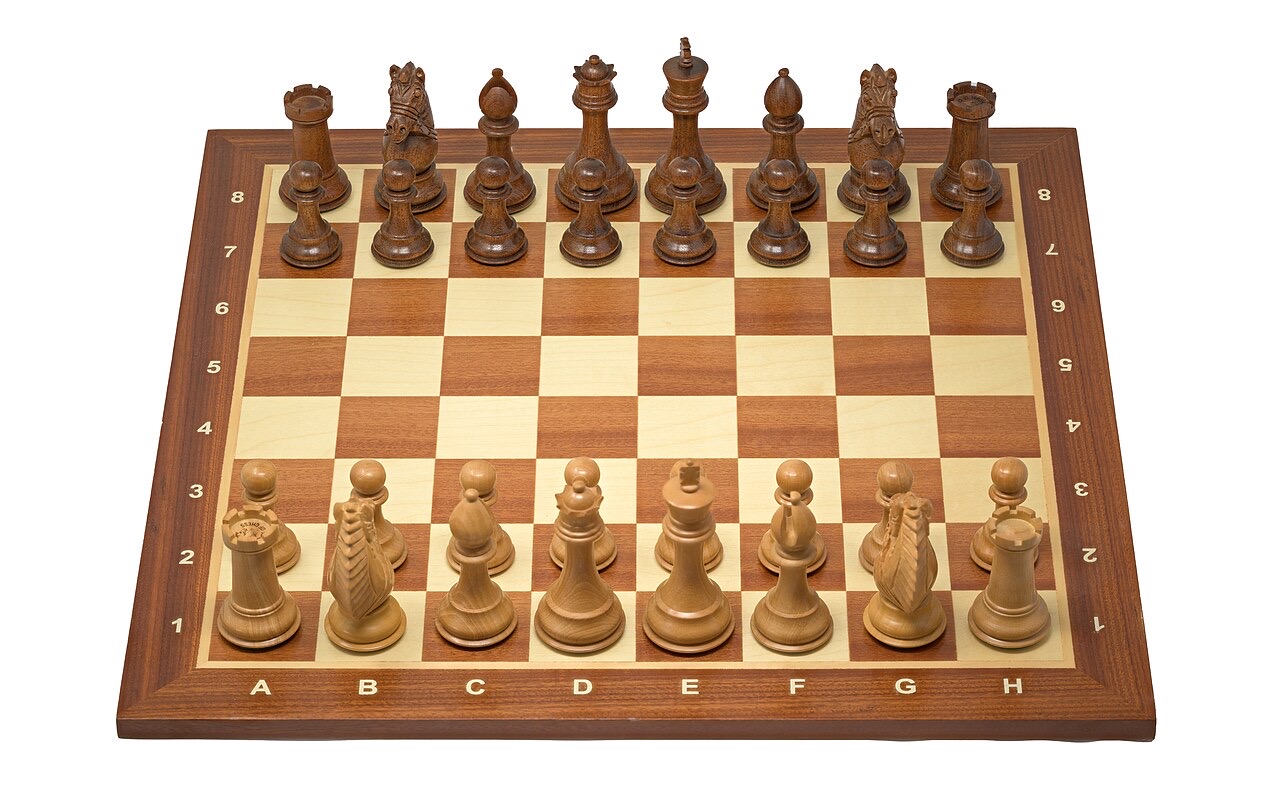
Visual AidThe board the words come from
Photograph of a Staunton-pattern chess set at the starting position — the standard design of tournament chess since 1849, on a board with the lettered files and numbered ranks players use to record moves. This is the game whose language the Knowledge Bank on chess vocabulary borrows: every gambit, sacrifice, and tempo begins from this quiet arrangement, where nothing has yet been risked. The set is a modern photographer’s, not a portrait of any board in the novel — the game Sam Westing plays is scattered through twenty chapters, and its board is the building.
Staunton-pattern chess set on a wooden tournament board; photograph by Wilfredor, 2024. Source: Wikimedia Commons, File:Chess game Staunton No. 6.jpg, CC0.
sacrificen.Ch.16
Giving up something valuable to gain a greater goal
“A queen sacrifice trades the strongest piece for the win.”
tacticn.Ch.14
A planned move designed to gain an advantage
“Her favorite tactic was asking questions she could already answer.”
gambitn.Ch.14
An opening move that risks a small loss to gain position
“The gambit offered a pawn to pry open the center files.”
deliberateadj.Ch.16
Done slowly and on purpose, not by accident
“Every fold of the wrapping paper came away in slow, deliberate turns.”
resemblancen.Ch.15
A likeness between two people or things
“The resemblance between the two young faces startled the dressmaker.”
speculationn.Ch.15
Guessing, or risky investing, without solid proof
“Wild speculation swept the lobby after the second blast.”
deductionn.Ch.14
A conclusion reached by reasoning from clues
“Judge Ford tested each deduction against what she knew.”
clippingn.Ch.15
An article cut out of a newspaper
“One yellowed clipping showed the whole Westing family together.”
fracturen.Ch.13
A crack or break, usually in a bone
“The X-ray showed a clean fracture above the ankle.”
shieldv.Ch.16
To protect someone by putting yourself in the way
“She moved to shield her sister from the blast.”
ⓘ The vocabulary words in this list are selected to help you understand and complete this workbook. Some may not appear verbatim in the original novel.
💡Knowledge Bank question
1According to the Knowledge Bank, a gambit is ___.Ch.16
2A planned move designed to gain an advantage is a ___.Ch.14
3‘Deliberate’ describes something done quickly and by accident.Ch.16
4A likeness between two people or things is a ___.Ch.15
5Fill in each blank with the correct word.Ch.13–15
Word choices:deductionfracturegambitspeculation- some words will not be used
Judge Ford tested each against the available facts.
The X-ray showed a clean above the ankle.
6‘Speculation’ always rests on solid, confirmed proof.Ch.15
7To ‘shield’ someone is to protect them by putting yourself in the way.Ch.16
8An article cut out of a newspaper is a ___.Ch.15
9Fill in each blank with the correct word.Ch.14–16
Word choices:sacrificeshielddeliberategambit- some words will not be used
She moved to her sister from the blast.
The offered a pawn to pry open the center files.
10Done slowly and on purpose, not by accident, is ___.Ch.16
Part 2
Comprehension
Show you understood what happens in Chapters 13–16.
💡Knowledge Bank · Thinking Three Moves Ahead
Strategy · Planning Under UncertaintyStrong players do not examine every possible move; they choose a handful of candidate moves and test each one a few steps into the future. For every candidate the question is the same: if I do this, what is my opponent’s best reply, and what would I do then? This habit is called calculation, and it works only when paired with honest evaluation — a cold judgment of who stands better and why. Good planners also study the opponent, building a mental profile of habits: does this rival grab material, avoid risk, bluff under pressure? Detectives work the same way. Judge Ford and Sandy list the players, weigh each one’s motive and opportunity, and follow the strongest line before spending effort on the rest. The heirs who pool facts — trading stories over dinner, comparing clues — see more of the board than the pairs who hoard them. In chess and in mysteries, information is material, and the side holding more of it usually keeps the advantage.
Visual AidThinking a few moves ahead
Structure diagram of the habit the Knowledge Bank on planning under uncertainty calls calculation: choose a few candidate moves, meet each with the opponent’s best reply — never the reply you hope for — and evaluate coldly. Only two candidates and one reply apiece are drawn where a strong player weighs several, layers deep. The tree shows no real game and no move from the novel; it shows the shape of the thinking, which is why Judge Ford’s suspect list and a grandmaster’s scoresheet look so much alike.
Candidate moves and calculation as taught in standard chess manuals (e.g., Kotov, Think Like a Grandmaster, 1971). Drawn for Garden Heights Academy.
💡Knowledge Bank question
1According to the Knowledge Bank, strong players choose their move by ___.Ch.13
2What does Flora Baumbach reveal over dinner with Judge Ford?Ch.13
3Theo tells Angela he is giving up college so the money can pay for his brother’s operation.Ch.13
4Who is injured when the bomb goes off in the restaurant kitchen?Ch.13
5Write the numbers 1–5 in the boxes to show the correct order of events in Chapters 13–16. Number 1 = what happens first.Ch.13–16
Sandy’s clippings show that Violet Westing loved George Theodorakis.
Turtle and Flora watch their stock prices sink at the broker’s office.
A gold-wrapped gift explodes at Angela’s bridal shower.
The kitchen of Shin Hoo’s restaurant erupts as Otis Amber walks in.
Angela finds an unsigned letter of apology tucked in her bag.
6Sandy and Judge Ford compare deductions about their clues and the other heirs.Ch.14
7What does Angela discover hidden inside her bag?Ch.14
8What do Sandy’s newspaper clippings suggest about Violet Westing?Ch.15
9The blast at the bridal shower injures every guest in the Wexler apartment.Ch.16
10What does Turtle let Angela know during her hospital visit?Ch.16
Part 3
Literary Elements
Understanding HOW and WHY Ellen Raskin (author) tells the story across Chapters 13–16.
🎭Knowledge Bank · How a Mystery Misleads You Fairly
Literary Craft · Foils and False TrailsMystery writers must fool readers without cheating, and Raskin uses three honest tricks in these chapters. A foil is a character whose contrast lights another up: Turtle kicks shins and says exactly what she thinks, so Angela’s silence and obedience become visible as choices, not blankness. A red herring is a false trail laid in plain sight — Otis Amber bursting through doors shouting about explosions is so obvious a suspect that suspicion slides right past the quiet bride opening gifts. Raskin also relies on indirect characterization: she rarely opens Angela’s mind, so readers must judge her from the outside — the slow unwrapping, the box held close, the sudden jerk away from Turtle. Fair-play mysteries plant every clue where an alert reader could notice it, then trust the reader to look in the wrong direction anyway. When Sydelle finally puts it together, the surprise lands precisely because the evidence was never hidden.
Foil
Two sisters side by side: Turtle kicks shins and speaks her mind, so Angela’s smiling silence finally shows up as a choice.
Red herring
A false trail laid in plain sight — a delivery boy who bursts through doors yelling about explosions is almost too easy to suspect.
Indirect characterization
Character shown through action: a gold box unwrapped slowly, held close, and jerked away from a leaning little sister.
💡Knowledge Bank question
1According to the Knowledge Bank, a foil works by ___.Ch.13–16
2Fill in each blank with the correct literary term.Ch.13–16
Word choices:herringfoilsonnetallusion- some words will not be used
A false trail planted to mislead the reader is a red .
A character whose contrast lights up another is a .
3Otis Amber bursting in and shouting about explosions mainly works as ___.Ch.14–16
4The narrator states directly in Chapter 16 that Angela set the bombs.Ch.16
5Why does Raskin keep pointing out that Angela looks like Violet Westing?Ch.13–15
6Readers learn who Angela is mostly through what she does — the slow unwrapping, the sudden jerk away. This technique is ___.Ch.16
7Raskin slows the shower scene down while Angela unwraps the gold box, which builds suspense.Ch.16
8Fill in the blank with the correct literary term.Ch.16
Word choices:suspenseironymetersetting- some words will not be used
Stretching out the unwrapping of a package the reader distrusts builds .
9Chapter 16 closes on Sydelle’s sudden realization, which lands like a cliffhanger.Ch.16
10Across Chapters 13–16, the bombs mainly work in the plot to ___.Ch.13–16
Part 4
Think Deeper
Four deeper challenges — no single-word recall. Read, weigh the evidence, and reason it out.
⚖Knowledge Bank · When Losing a Piece Wins the Game
Ethics · Sacrifice and ProtectionIn chess, a queen sacrifice looks like madness until the follow-up appears: the strongest piece is surrendered so that something more important — the king’s safety, a forced checkmate — can be won. Ethics asks the same question about people. A true sacrifice has three parts: the cost is real, the giver accepts it knowingly, and the goal outweighs what is lost. Theo setting aside college so Chris can have an operation meets every test; so does Angela pulling the dangerous package against her own hands as her little sister leans in. But sacrifice has a shadow side worth examining. Giving things up can harden into a habit that invites others to keep taking, and a person who always plays the shield may never ask what she herself wants — a question Angela has clearly stopped asking. Thinkers therefore separate generosity, which flows from strength, from self-erasure, which flows from fear. These chapters ask which one Angela’s burns really prove.
Think back over these chapters. A restaurant finally full, a hostess gliding between tables — then a crash from the kitchen, and a pair of painted crutches rides to the hospital with a break that is, for once, real. A doorman’s careful deductions, a stack of yellowed clippings, and a drowned bride who loved the wrong man surface quietly out of the past. Then a shower: ribbon after ribbon peeled away from a thin gold box that is unwrapped too slowly and held too close, until the bang comes and the only burned hands belong to the sister who jerked it away from a leaning thirteen-year-old. A chess player would recognize the move at once: the queen takes the hit so the smallest piece can stay on the board.
Original passage written for Garden Heights — not a quotation from the novel.
1Claim: “In these chapters, love keeps showing itself as sacrifice.” — choose the two details that best prove it.Claim & Evidence
2Playing to win, or Playing to protect? Tap each detail to sort it — tap again to switch sides. You can keep tapping to change your answer.Sort into two
◄ Playing to winPlaying to protect ►
3Match each cause to its result. For each cause, pick its result.Cause & Effect
The first bomb shuts the coffee shop for repairs→
Flora sees Violet’s face when she looks at Angela→
Angela unwraps the gold box slowly and holds it close→
Turtle peeks inside Angela’s bag before the adults can→
💡Knowledge Bank question
4Fill both blanks to complete the reasoning.Build the Argument
Angela pulling the dangerous package toward herself counts as a true sacrifice because , which shows that .
Part 5
Standardized Test
Reading passage · The Queen’s Sacrifice · Central Ideas & Words in Context · SAT & TOEFL-style practice
Read the passage — the highlighted words are tested — then answer. Tap an answer, then tap it again to confirm.
SATCentral Ideas — the passage's main point
SATWords in Context — a word's meaning in this passage
SATInference — a conclusion the passage implies
SATAuthor’s Purpose — what the author wants to achieve
TOEFLFactual Information — a fact stated in the passage
TOEFLInsert Text — where a sentence best fits
TOEFLVocabulary — a tested word's meaning here
Sacrifice and Tempo in Chess
Serious chess begins with arithmetic. Players learn early that the pieces carry rough values — a pawn counts as one point, knights and bishops as three, a rook as five, and the queen, sweeping whole ranks and diagonals, as nine. Every tournament game is written down in algebraic notation, a compact code in which letters name the files, numbers name the ranks, and a move like Qe5 records exactly where the queen landed. Because of that written score, a game played a century ago can be replayed move for move and studied like a document.
Time matters as much as material. Each turn is a unit that chess players call a tempo, and a quick tactic — a move that develops a piece while making a threat — gains time, since the opponent must stop and respond. A player who keeps producing threats holds the initiative, forcing the other side to react instead of pursuing plans of its own. Shuffling one piece back and forth wastes tempo, and against sharp opposition a wasted turn can cost more than a lost pawn.
The deepest idea in the game is the sacrifice. A player deliberately gives up material — sometimes the nine-point queen — because calculation shows that the position gained is worth more than the points surrendered. Masters judge such an offer sound only when deduction, careful step-by-step reasoning, can check the follow-up line by line; a sacrifice built on hope alone is just a blunder wearing a costume. Greed is the classic losing reply, because a defender who grabs every offered piece may open the very files and diagonals the attacker needs. The final lesson travels beyond the board: the value of a move is not what it costs, but what it buys.
Original passage written for Garden Heights — not a quotation from the novel.
1What is the main idea of the passage?SAT · Central Ideas
2According to the passage, what does a written game score make possible?TOEFL · Factual Information
3In the passage, tactic most nearly means ___.SAT · Words in Context
4According to the passage, a move that develops a piece while making a threat ___.TOEFL · Factual Information
5Insert Text (TOEFL). Look at the four squares [1]–[4] in the excerpt below. They show where this sentence could be added: “A famous example ends with the queen deliberately left where a pawn can take her, three moves before checkmate.”
Chess literature sorts sacrifices into two families. [1] A true sacrifice offers material with no forced way to win it back, staking the game on judgment. [2] A sham sacrifice, by contrast, only lends material, because a forced sequence returns it within a few moves — often with interest. [3] Annotators mark the brilliant kind with an exclamation point, a small badge of courage printed beside the move. [4]
Where would the sentence fit best?TOEFL · Insert Text
6In the passage, deduction most nearly means ___.TOEFL · Vocabulary
7According to the passage, when is a sacrifice judged sound?TOEFL · Factual Information
8In the passage, sound means ___.SAT · Words in Context
9The passage suggests that a defender who grabs every offered piece ___.SAT · Inference
10The last sentence of the passage mainly works to ___.SAT · Author’s Purpose
Part 6 · Optional
Creative Writing
A bonus challenge to practice your English. Take your time and have fun with it.
About This Section
This writing task is optional and is not part of your auto-graded score. The feedback below checks only the basics — length, spelling, and grammar — not whether your ideas are right or wrong. It is meant for classroom discussion and creative practice, so feel free to use your imagination!
Writing Task — Part 4 “The Cost of the Move”
In Chapter 16 Angela pulls a dangerous package toward herself so Turtle will not be hurt, and in Chapter 13 Theo admits he gave up college so his brother could have an operation. Write about a time you gave up something that mattered to you for someone else — or watched someone give something up for you. What did the choice cost, and what did it win? 6–10 sentences. End by saying whether you would make the same move again.
You can start with: “The moment I let it go, I understood what it was worth...”
0 / 40 words minimum
🗣 Teach It · Just for Fun (optional)
No right or wrong — close the screen and tell someone nearby what happened in this part. Can’t find anyone? Tell yourself out loud. The moment you teach it, you truly understand it.
Part 4 Complete!
You finished Chapters 13–16 of The Westing Game.
Here are your auto-graded results:
-
points out of 100
Teach it to someone
The best last step is to teach it. In your own words, explain what happened — retell a favorite scene, teach a character’s big choice, or sum up the main idea for a parent, friend, or classmate. When you can teach it clearly, you truly own it.
Independent study guide by Garden Heights. Not affiliated with or endorsed by Ellen Raskin. Contains original analysis only; no text from the novel is reproduced. Reference text: This workbook follows Ellen Raskin’s classic text (the standard Puffin edition sold worldwide). Revised 2023 UK editions change some wording and may not match the vocabulary studied here.
SAT® is a registered trademark of College Board, which is not affiliated with, and does not endorse, these materials. TOEFL® is a registered trademark of ETS. These materials are not endorsed or approved by ETS. Garden Heights is an independent provider of test-style reading practice.