New here? Just sign up with Google — your account includes Matilda, our gift book, forever.
The Westing Game · Garden Heights
Part 5
for The Westing Game · Part 5 · Chapters 17–20
8 Parts40 min
What Happens in Part 5
Detective reports, a stock windfall, and shadowed suspects — until Judge Ford concludes Westing's target is his ex-wife.
Reports and TheoriesSandy fills a fresh notebook with the detective's reports — Mr. Hoo added 'Shin' for the restaurant trade and once sued Westing over a stolen invention — while Theo cooks his clues, chemistry-style, into the formula for an explosive, with the name Otis left over.
Turtle's WindfallTurtle, her hair braided daily by the dressmaker she now calls Baba, hears the new Westing Paper chairman predict doubled earnings, moves everything into WPP and rides it to fifty-two dollars before selling. Doug quits track practice to shadow Otis Amber across town as notices summon every heir back to the Westing house Saturday.
Crow's FileOtis's theory that Hoo bombed his own restaurant enrages Crow — whose file, Judge Ford learns, reads Berthe Erica Crow, divorced from Windy Windkloppel, and whose old friend Sybil Pulaski was Westing's intended guest, not Sydelle.
The Judge's ConclusionAfter Theo's explosive theory blows up in the chemistry lab, costing only a warning, George Theodorakis tells the judge how Violet's mother steered her toward a crooked politician — and Judge Ford resolves the real target may be his ex-wife, who must be protected.
What We Will Learn
Section
What you will practice
Vocabulary
Words for files, funds, and fresh starts: dossier, surveillance, speculate, assimilate…
Literary Elements
Red herrings, exposition through dialogue, and a motif of changed names
Cross-Curricular
Immigration and reinvention — why so many American families changed their names
Chapter Summary
Ch.
What happens
17
Some Solutions — False alarms keep the bomb squad busy while Sandy fills a fresh notebook with the detective’s findings, starting with the Hoos: ‘Shin’ was added for the restaurant trade, and a lawsuit accusing Westing of stealing an invention was settled for twenty-five thousand dollars. Jake coaches Madame Hoo in English and steers ‘purple fruited’ toward the lawyer Ed Plum. Theo mixes his clues like a chemistry problem and gets the formula for an explosive — with the name Otis left over.
18
The Trackers — Flora braids while Turtle reads the stock pages; when the new chairman of Westing Paper Products predicts doubled earnings, Turtle orders everything into WPP and asks to call the dressmaker Baba. Sandy’s files note that Flora once sewed Violet Westing’s wedding dress. Theo pulls Doug off track practice to shadow Otis Amber all over town, and notices go out summoning every heir back to the Westing house on Saturday.
19
Odd Relatives — after the nurse refuses to send her home, Turtle follows the climbing stock through repeated trips from class to the lavatory. Crow, cleaning the Wexler apartment, dreads Saturday; Otis arrives with his theory that Mr. Hoo bombed his own restaurant to dodge suspicion, and Crow flares at the thought of Angela scarred — then wavers when Hoo gives her free paper innersoles for her aching feet. Judge Ford’s file reads: Berthe Erica Crow, divorced from Windy Windkloppel — and Sydelle, it turns out, was invited by mistake in place of Crow’s old friend Sybil Pulaski.
20
Confessions — Turtle skips school, and she and Baba sell their Westing Paper shares at fifty-two dollars. Doug jogs for hours behind Otis in his father’s innersoles. Theo lands in the emergency room after testing his explosive idea in the chemistry lab; a detective questions him, but his alibi holds. Delivering an order upstairs, George Theodorakis tells Judge Ford about Violet Westing: childhood sweethearts parted by a mother who steered Violet toward a crooked politician — and the judge resolves to protect Westing’s ex-wife.
Part 1
Vocabulary
Study 10 key words from Chapters 17–20, then answer each question.
📚Knowledge Bank · Words for Starting Over
Language · Words of ArrivalThe vocabulary of these chapters splits into two families, and both are about information. The mystery words describe how facts are gathered: a dossier is a file of everything known about one person, built by patient surveillance and compiled page by page, while an alibi is the fact that clears you and an anonymous note is information that refuses to sign its name. The immigration words describe what people do with a new country. To assimilate is to take on the habits, language, and often the very name of the majority until you blend in; heritage is everything carried from before — recipes, faiths, spellings — that assimilation asks a family to set down. Between the two sits the gambler’s verb: to speculate is to bet on an uncertain future, whether the bet is a paper company’s stock or a brand-new name in a brand-new town. Every heir in Sunset Towers is running one of these bets, hoping, like Turtle’s shares, to prosper.
dossiern.Ch.17–20
A file of collected information about a person
“Sandy filled a dossier with facts about each heir.”
speculatev.Ch.17–20
To buy something risky hoping its price will rise
“Turtle loves to speculate, but only after reading the news.”
surveillancen.Ch.17–20
The close, secret watching of a person or place
“A day of surveillance left Doug with aching legs.”
anonymousadj.Ch.17–20
Written or given without a name attached
“An anonymous note is information that refuses to sign itself.”
alibin.Ch.17–20
Proof that a suspect was somewhere else at the time
“Theo’s alibi placed him far from the third bomb.”
heritagen.Ch.17–20
Traditions and identity handed down in a family
“A surname can carry a whole heritage inside it.”
assimilatev.Ch.17–20
To blend into a new culture by adopting its ways
“Newcomers often felt pressure to assimilate quickly.”
compilev.Ch.17–20
To gather many pieces of information into one collection
“It took weeks to compile a file on all sixteen players.”
prosperv.Ch.17–20
To succeed and grow stronger, especially in money matters
“Turtle expected the paper company to prosper.”
reinventv.Ch.17–20
To make yourself over as something new
“Grace Windsor Wexler reinvented even the sound of her own name.”
ⓘ The vocabulary words in this list are selected to help you understand and complete this workbook. Some may not appear verbatim in the original novel.
💡Knowledge Bank question
1The Knowledge Bank explains that to speculate is to ___.Ch.17–20
2To ‘speculate’ means to know for certain how an investment will turn out.Ch.17–20
3The close, secret watching of a person or place is ___.Ch.17–20
4Written or given without a name attached is ___.Ch.17–20
5Fill in each blank with the correct word.Ch.17–20
Word choices:dossieralibiheritageprosper- some words will not be used
Sandy filled a with facts about each heir.
Theo’s placed him far from the third bomb.
6‘Heritage’ refers to the traditions and identity handed down in a family.Ch.17–20
7To ‘assimilate’ into a group means to stand apart from it on purpose.Ch.17–20
8To gather many pieces of information into one collection is to ___.Ch.17–20
9Fill in the blanks with the correct words.Ch.17–20
Word choices:assimilateprosperspeculatesurveillance- some words will not be used
Newcomers often felt pressure to quickly.
Turtle expected the paper company to .
10To make yourself over as something new is to ___ yourself.Ch.17–20
Part 2
Comprehension
Show you understood what happens in Chapters 17–20.
📋Knowledge Bank · The Ellis Island Name Myth
History · American ImmigrationBetween 1892 and 1954, roughly twelve million people entered the United States through Ellis Island, and many of their descendants tell the same story: a tired clerk misheard great-grandfather’s name and wrote down a new one. Historians who work with the records call this a myth. Island inspectors did not write names at all; they checked each arrival against the ship’s manifest, a passenger list prepared at the port of departure, usually by agents who spoke the traveler’s own language. Name changes came later, and they were chosen. A tailor named Mueller could reopen his shop as Miller; a family called Piccolo could shrink to Little; naturalization papers offered a free, legal moment to start over. The choices were rarely casual. A familiar-sounding name could mean a job interview granted instead of refused, a lease signed, a child spared teasing at school. When Sandy’s notebook records that a restaurant owner added ‘Shin’ to sound more Chinese, it records the same American transaction running in reverse: a name adjusted to match what customers expect to buy.
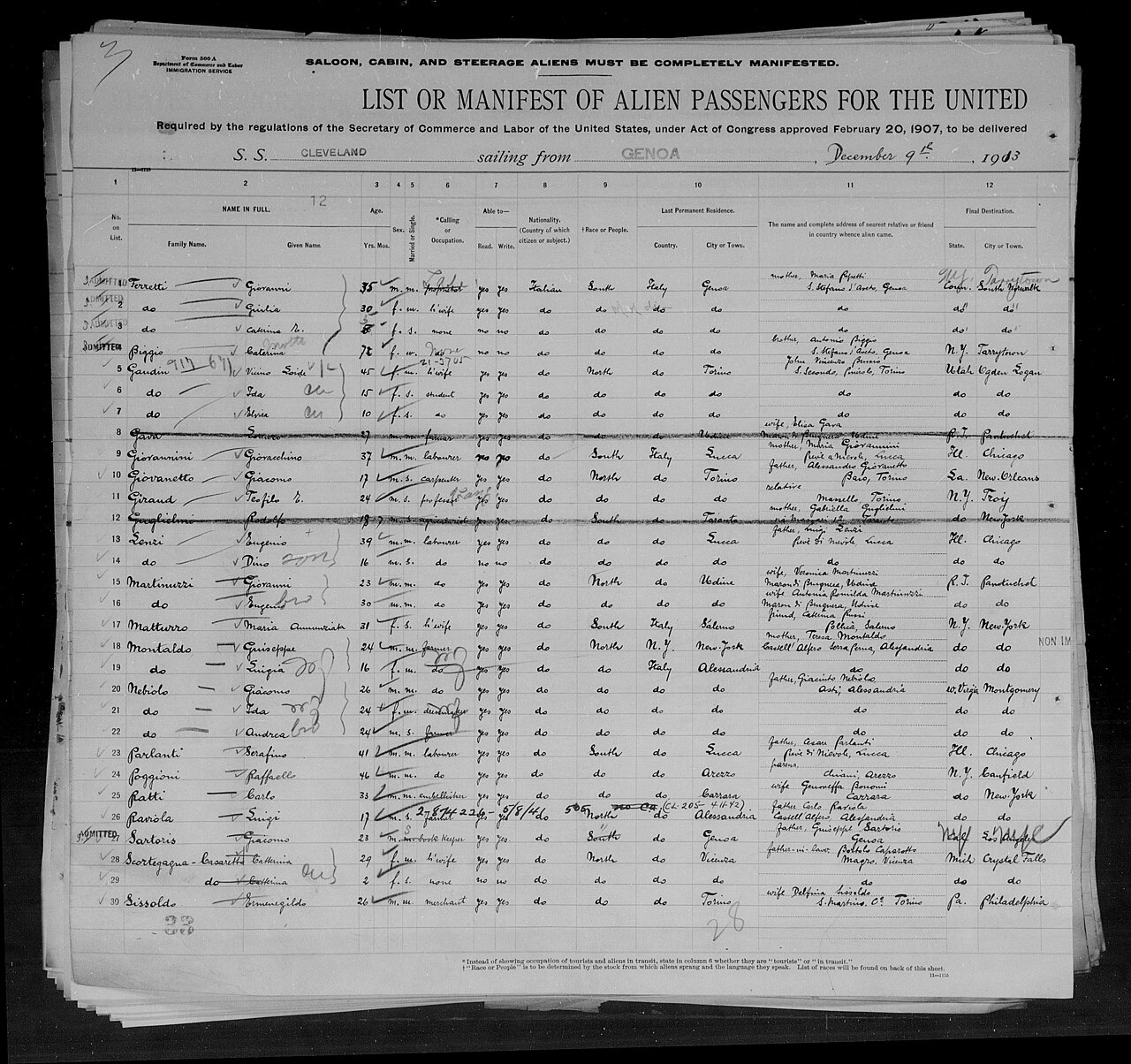
Visual AidThe manifest, written before the voyage
Photograph of a real List or Manifest of Alien Passengers: the S.S. Cleveland, sailing from Genoa on December 9, 1913 — the very kind of document the Knowledge Bank on the Ellis Island name myth describes. Every name was written down at the port of departure, before the ship sailed, which is why no island clerk could have misheard one; the stamps and check marks were added by inspectors comparing arrivals against this page. Partway down sits an eighteen-year-old named Rodolfo Guglielmi, who later chose a new name in Hollywood: Rudolph Valentino. The change came years after this page, and by his own choice — exactly the pattern the Knowledge Bank records.
List or Manifest of Alien Passengers, S.S. Cleveland, sailing from Genoa, December 9, 1913; U.S. National Archives. Source: Wikimedia Commons, File:Valentino departed Genoa, Italy aboard the S.S. Cleveland (manifest).jpg, public domain.
💡Knowledge Bank question
1According to the Knowledge Bank, historians call the Ellis Island renaming story a myth because inspectors there ___.Ch.17
2What does Theo’s chemistry ‘solution’ to the clues produce?Ch.17
3In Chapter 18, Turtle tells Flora Baumbach to sell every share of Westing Paper at once.Ch.18
4Why does Doug Hoo spend a whole day jogging around town?Ch.18–20
5Write the numbers 1–5 in the boxes to show the correct order of events in Chapters 17–20. Number 1 = what happens first.Ch.17–20
Turtle and Baba sell their shares at fifty-two dollars.
Theo mixes his clues like a chemistry problem and gets an explosive formula.
George Theodorakis tells Judge Ford about Violet Westing.
Otis tells Crow his theory that Mr. Hoo planted the bombs.
Turtle urges Flora to move everything into Westing Paper stock.
6Otis Amber tells Crow that Mr. Hoo bombed his own restaurant to draw suspicion away from himself.Ch.19
7What does Judge Ford’s file reveal about Crow?Ch.19
8What does George Theodorakis explain about Violet Westing?Ch.20
9Theo is arrested as the Sunset Towers bomber after the explosion in the school chemistry lab.Ch.20
10By the end of Chapter 20, what have Judge Ford and Sandy decided?Ch.20
Part 3
Literary Elements
Understanding HOW and WHY Ellen Raskin (author) tells the story across Chapters 17–20.
💡Knowledge Bank · A Name Is a Clue
Literary Craft · Names & MisdirectionMystery writers owe readers a fair chance, so every real clue must appear on the page — the craft lies in making you look straight at it and see nothing. Raskin’s favorite camouflage is the name. A dossier mentions that ‘Shin’ was added for business; another file traces a cleaning woman to a marriage under the name Windkloppel; the details read like gossip, so the eye slides past what it will later need. Around these true clues she plants a red herring or two: Theo’s chemistry solution points to an explosive and to Otis, and Otis himself points to Mr. Hoo, and both accusations are loud enough to drown the quieter evidence. The chapters also show exposition handled the hard way — George’s account of Violet Westing arrives as conversation, not lecture, so backstory feels like discovery. Track the pattern: whenever this novel changes a name, it is hiding something, and whenever a character shouts an answer, the real one is sitting nearby in silence.
Red herring
Theo’s explosive formula points at Otis, and Otis points at Mr. Hoo — two loud wrong answers planted to pull readers away from the quiet right ones.
Exposition through dialogue
George’s account of Violet Westing arrives as conversation over a delivered order — backstory that feels like discovery instead of lecture.
Motif
Changed names keep surfacing — Shin added, Windkloppel dropped, Windsor invented — until renaming itself becomes a pattern worth watching.
💡Knowledge Bank question
1The Knowledge Bank explains that when this novel changes a character's name, readers should suspect ___.Ch.19
2Fill in each blank with the correct literary term.Ch.17–20
Word choices:motifexpositionallegorycliffhanger- some words will not be used
Changed names repeat as a across these chapters.
George’s story about Violet works as .
3Raskin cuts among the notebook, the sickroom, and the stock pages mainly to ___.Ch.17–20
4The braiding scenes between Turtle and Flora exist mainly to give readers comic relief.Ch.18–20
5George telling Judge Ford about Violet is an example of ___.Ch.20
6In craft terms, the detail that ‘Shin’ was an added name works as ___.Ch.17
7A red herring is a clue the author plants to mislead readers on purpose.Ch.17–20
8Fill in each blank with the correct literary term.Ch.17–20
Word choices:herringdialoguesonnetmeter- some words will not be used
Theo’s explosive theory is a red .
Backstory arrives through at the judge’s door.
9Because Otis accuses Mr. Hoo, readers can be certain that Hoo is the bomber.Ch.19
10Chapters 17–20 mainly work to ___.Ch.17–20
Part 4
Think Deeper
Four deeper challenges — no single-word recall. Read, weigh the evidence, and reason it out.
💡Knowledge Bank · The Price of Fitting In
Sociology · Assimilation & IdentityChanging a name to fit in looks, from one angle, like simple good sense, and from another like a quiet loss. Sociologists who study assimilation describe it as a trade: newcomers give up markers that make them stand out — language, dress, sometimes a surname — and receive in return easier access to jobs, housing, and belonging. The costs land unevenly. The first generation often makes the trade willingly, because rent is due; the second generation may grow up unable to speak with its own grandparents; the third frequently goes searching for what was traded away, restoring old spellings and relearning a lost language. Ellen Raskin’s heirs sit at every point on this curve: a restaurateur adds a syllable to sell more dinners, a new arrival studies English word by word, a social climber invents an aristocratic middle name. The novel does not scold any of them. It asks a harder question instead — whether, in a country where anyone can become someone new, some part of a self should stay off the market, priceless and never for sale.
Visual AidWhat assimilation trades away, and when
Sequence diagram of the three-generation curve the Knowledge Bank on the price of fitting in describes: the first generation trades markers away for jobs and belonging, the second grows up unable to speak with its own grandparents, and the third goes searching for what was traded. It is a pattern sociologists map, not a law — families skip steps, stall, and double back, and none of the timing is to scale. The drawing judges nobody, which is the novel’s own stance; it asks the Knowledge Bank’s question instead: which part of a self should stay off the market.
Three-generation assimilation pattern per standard introductions to the sociology of immigration (after Hansen’s principle, 1938). Drawn for Garden Heights Academy.
Think back over these chapters. A doorman’s notebook fills with other people’s names, and half of them turn out to be invented: a syllable added to sound more Chinese, a long surname traded away in a divorce, a middle name nobody was born with. A girl reads the stock pages while her hair is braided and renames a dressmaker Baba. A chemistry problem turns into a formula for an explosive, and a delivery boy’s theory turns a cleaning woman’s grief into anger. Then, late one evening, a man from the coffee shop sets down a tray and tells a judge about a girl named Violet, a mother with plans, and a wedding that never happened.
Original passage written for Garden Heights — not a quotation from the novel.
1Claim: “In Chapters 17–20, names at Sunset Towers work as masks that people put on or take off.” — choose the two details that best prove it.Claim & Evidence
2Keeping heritage (holding on), or Reinventing (making over)? Tap each detail to sort it — tap again to switch sides. You can keep tapping to change your answer.Sort into two
3Match each cause to its result. For each cause, pick its result.Cause & Effect
Theo treats his clues like a chemistry problem→
The new chairman of Westing Paper predicts doubled earnings→
Otis floats his theory that Mr. Hoo set the bombs→
George describes how Violet’s mother arranged her engagement→
💡Knowledge Bank question
4Fill both blanks to complete the reasoning.Build the Argument
According to the Knowledge Bank, sociologists describe assimilation as a trade because newcomers give up , which explains why the third generation often .
Part 5
Standardized Test
Reading passage · New Names in a New Country · Central Ideas & Words in Context · SAT & TOEFL-style practice
Read the passage — the highlighted words are tested — then answer. Tap an answer, then tap it again to confirm.
SATCentral Ideas — the passage's main point
SATWords in Context — a word's meaning in this passage
SATInference — a conclusion the passage implies
TOEFLFactual Information — a fact stated in the passage
TOEFLVocabulary — a tested word's meaning here
The Ellis Island Name Myth
Nearly every American family with immigrant roots seems to own the same story: a tired clerk at Ellis Island misheard great-grandfather’s name and wrote down a new one. Historians who have searched the island’s records call the story a myth. Inspectors there did not write names at all; they checked each arrival against the ship’s manifest, a passenger list drawn up at the port of departure, usually by agents who spoke the traveler’s own language. If a family’s name changed, it almost always changed later — because someone in the family chose it.
The pressure to choose was real. In the early twentieth century, a foreign-sounding name could cost a worker a job interview, a family an apartment, a child an easy day at school, so many newcomers chose to assimilate, shortening, translating, or replacing what they had carried across the ocean. A Mueller could reopen his tailor shop as Miller; a Piccolo could become a Little. Anyone wanting the change made official could petition a court, but the easiest moment came with citizenship itself, since naturalization papers offered a free and legal chance to write a new name onto a new life.
What was gained is easy to measure; what was lost is harder. A surname is a piece of heritage: it can carry a family’s region, religion, or trade, and when the name went, the map back to the old country often went with it. That is why so many descendants now work to recover original spellings, hunting through old passenger lists for the name the family answered to before America. The clerk of legend never held the pen; the newcomers held it themselves, and their choices still show what fitting in once cost.
Original passage written for Garden Heights — not a quotation from the novel.
1What is the main idea of the passage?SAT · Central Ideas
2According to the passage, inspectors at Ellis Island checked each arrival against ___.TOEFL · Factual Information
3In the passage, manifest means ___.SAT · Words in Context
4According to the passage, why did many newcomers change their names?TOEFL · Factual Information
5In the passage, assimilate most nearly means ___.TOEFL · Vocabulary
6What free and legal chance did naturalization papers offer?TOEFL · Factual Information
7In the passage, heritage most nearly means ___.SAT · Words in Context
8According to the passage, what can a surname carry?TOEFL · Factual Information
9The passage suggests the island-clerk legend survives because ___.SAT · Inference
10Which detail from Chapters 17–20 does this passage BEST explain?SAT · Inference
Part 6 · Optional
Creative Writing
A bonus challenge to practice your English. Take your time and have fun with it.
About This Section
This writing task is optional and is not part of your auto-graded score. The feedback below checks only the basics — length, spelling, and grammar — not whether your ideas are right or wrong. It is meant for classroom discussion and creative practice, so feel free to use your imagination!
Writing Task — Part 5 “The Name You Answer To”
Half the people in these chapters carry a name somebody chose on purpose — a syllable added for customers, a surname dropped after a divorce, a middle name invented to impress the neighbors. Think about your own name: where it came from, who chose it, and what it carries. Would you ever change it, and what would you refuse to give up? 6–10 sentences. End by telling what you hope your name will mean to people someday.
You can start with: “My name has a story of its own, and it starts with...”
0 / 40 words minimum
🗣 Teach It · Just for Fun (optional)
No right or wrong — close the screen and tell someone nearby what happened in this part. Can’t find anyone? Tell yourself out loud. The moment you teach it, you truly understand it.
Part 5 Complete!
You finished Chapters 17–20 of The Westing Game.
Here are your auto-graded results:
-
points out of 100
Teach it to someone
The best last step is to teach it. In your own words, explain what happened — retell a favorite scene, teach a character’s big choice, or sum up the main idea for a parent, friend, or classmate. When you can teach it clearly, you truly own it.
Independent study guide by Garden Heights. Not affiliated with or endorsed by Ellen Raskin. Contains original analysis only; no text from the novel is reproduced. Reference text: This workbook follows Ellen Raskin’s classic text (the standard Puffin edition sold worldwide). Revised 2023 UK editions change some wording and may not match the vocabulary studied here.
SAT® is a registered trademark of College Board, which is not affiliated with, and does not endorse, these materials. TOEFL® is a registered trademark of ETS. These materials are not endorsed or approved by ETS. Garden Heights is an independent provider of test-style reading practice.