New here? Just sign up with Google — your account includes Matilda, our gift book, forever.
The Westing Game · Garden Heights
Part 6
for The Westing Game · Part 6 · Chapters 21–24
8 Parts40 min
What Happens in Part 6
A fourth bomb singes Turtle's braid, every answer fails, and pooled clues spell Berthe Erica Crow — then Sandy dies.
Elevator BombThe fourth bomb explodes in the Sunset Towers elevator, badly singeing five inches (12.7 cm) of Turtle's braid — and the bomber's boast is on the back of her own school essay. Judge Ford questions her and learns something stranger: on Halloween Turtle stood over the body, and it looked oddly waxy. Next morning she claims the bombings with a public sign.
Wrong AnswersAt the second gathering each pair banks a fresh check and hands in an answer — a stock-market total, lawyer Ed Plum, deliveryman Otis Amber — and Sydelle Pulaski performs hers by fitting the clues to a patriotic song. The will's reply is blunt: every answer is wrong.
The Name AppearsTheo talks the heirs into pooling their clues. Sydelle arranges the pooled words in song order, and the missing fragments spell Berthe Erica Crow — then Sandy McSouthers collapses and dies, and Crow quietly steps forward to claim the answer.
What We Will Learn
Section
What you will practice
Vocabulary
Words of hidden writing: anagram, acrostic, decode, omission, shorthand…
Literary Elements
A fair-play mystery: red herrings, misdirection, and a twist timed to the second
Cross-Curricular
How messages hide in plain sight — acrostics, anagrams, and the power of what is missing
Chapter Summary
Ch.
What happens
21
The Fourth Bomb — fireworks tear out of the elevator and badly singe five inches (12.7 cm) of Turtle’s braid; the bomber’s boast turns up on the back of her own school essay; Theo follows Crow and Otis and finds them serving food at a soup kitchen; and under Judge Ford’s questioning Turtle admits she was inside the Westing house on Halloween and that the body she saw looked strangely waxy.
22
Losers, Winners — Turtle posts a sign claiming the bombings for herself; Chris, steadied by new medicine, greets Judge Ford with startlingly clear speech; Doug wins his mile race; the judge identifies Crow as Mrs. Westing and resolves to protect her, while she and Sandy debate whether Barney Northrup or Otis could be Westing in disguise.
23
Strange Answers — back at the Westing house every pair receives a ten-thousand-dollar check and hands in an answer, from Turtle and Flora’s stock-market total to Grace and Mr. Hoo’s vote for the lawyer Ed Plum; Sydelle performs her team’s answer by fitting the clue words into a patriotic song, and the will orders everyone to the library.
24
Wrong All Wrong — the will declares every answer wrong; Theo persuades the heirs to pool their clues, Sydelle arranges the pooled words in song order, and the missing fragments spell out Berthe Erica Crow; Judge Ford insists a name is not proof of guilt, Sandy collapses and dies, and Crow steps forward to claim the answer.
Part 1
Vocabulary
Study 10 key words from Chapters 21–24, then answer each question.
📚Knowledge Bank · The Words of Hidden Writing
Cryptography · Message VocabularyA hidden message has its own toolbox, and each tool works differently. To conceal a message is simply to keep it from being noticed, and the cleverest concealment uses no locks at all — the message sits inside something so ordinary that nobody thinks to examine it. An anagram rearranges the letters of a word or name until the original vanishes into new words, so the message survives in scrambled form. An acrostic hides a word letter by letter, spelling it out through the first letters of lines that seem to be about something else entirely. An omission hides the message by leaving it out: copy a text everyone knows, drop the key words, and the gaps themselves become the message for any reader alert enough to compare. Reading any of these requires the same act — refusing to take a text at face value and hunting for the pattern underneath it. The word for translating that pattern back into plain meaning is decode.
Visual AidAnagram, acrostic, omission
Structure diagram of the three hiding tools the Knowledge Bank on the words of hidden writing defines, each shown with an invented example: an anagram keeps the letters and scrambles the order, an acrostic spells its word down the first letters, and an omission hides the message in a gap everyone can fill. The examples are made up for this figure — none comes from the novel, so the will’s own puzzle stays unspoiled. Notice what all three demand of a reader: the refusal to take a text at face value, which the Knowledge Bank names decoding.
Anagram, acrostic, and omission as defined in the Knowledge Bank; examples invented for this figure. Drawn for Garden Heights Academy.
anagramn.Ch.24
A word or name made by rearranging the letters of another
“The letters of a name can hide inside an anagram for years.”
acrosticn.Ch.24
A message spelled out by particular letters or positions in a text
“The first letters of each line formed a neat acrostic.”
decodev.Ch.24
To work out the plain meaning of a hidden or coded message
“Nobody could decode the clues until every scrap reached one table.”
concealv.Ch.21
To hide something from notice
“The safest way to conceal a message is inside something ordinary.”
omissionn.Ch.24
Something deliberately left out
“Each omission in the song turned out to be part of the answer.”
shorthandn.Ch.23
A quick symbol system for recording speech
“Her shorthand looked like scribbles but held every word of the will.”
transcribev.Ch.23
To write out a full copy of spoken or recorded words
“She could transcribe a whole speech without missing a word.”
poolv.Ch.24
To combine separate resources into one shared supply
“The players finally pool their clues, and the pattern appears.”
accusationn.Ch.21
A claim that someone has done something wrong
“An accusation is easy to make and hard to take back.”
confessv.Ch.22
To admit that you did something wrong
“A sign in the elevator was a strange way to confess.”
ⓘ The vocabulary words in this list are selected to help you understand and complete this workbook. Some may not appear verbatim in the original novel.
💡Knowledge Bank question
1According to the Knowledge Bank, an omission hides a message by ___.Ch.21–24
2To ‘conceal’ something means to put it on display where everyone will see it.Ch.21–24
3To work out the plain meaning of a hidden or coded message is to ___ it.Ch.21–24
4An ‘omission’ is something that has been left out.Ch.21–24
5Fill in each blank with the correct word.Ch.21–24
Word choices:shorthandomissionanagramconceal- some words will not be used
Notes taken in quick symbols are written in .
A word left out on purpose is an .
6A message spelled out by particular letters or positions inside an ordinary text is an ___.Ch.21–24
7To ‘transcribe’ a speech is to destroy every written trace of it.Ch.21–24
8When the heirs combine all their separate clues into one shared set, they ___ the clues.Ch.21–24
9Fill in the blanks with the correct words.Ch.21–24
Word choices:accusationconfessdecodeacrostic- some words will not be used
To admit you did something wrong is to .
A public claim that someone is guilty is an .
10In this part, the word shorthand names ___.Ch.21–24
Part 2
Comprehension
Show you understood what happens in Chapters 21–24.
🔑Knowledge Bank · Reading What Is Not There
Codes · Solving by ComparisonCodebreakers rarely solve a puzzle by staring harder at it; they solve it by comparing it with something else. The first tool is the original: if a suspicious text imitates a document people already know — a song, a pledge, a famous poem — a solver sets the two side by side and lists every difference. Familiar texts make powerful hiding places precisely because they carry redundancy, information a reader can predict in advance; everyone knows the next line, so every missing or altered word stands out the moment someone thinks to look. The second tool is pattern. Accidents scatter randomly, but designed changes tend to land in a rhythm — every fourth word, the first letter of every line, one gap per verse. The third tool is pooling: a message split among many holders cannot be read until the pieces sit on one table, which is why secretive solvers stay stuck and cooperative ones break through. Comparison, pattern, and pooling turn a wall of words into a short list of differences — and somewhere in that list waits the answer.
Visual AidA real message wearing a disguise
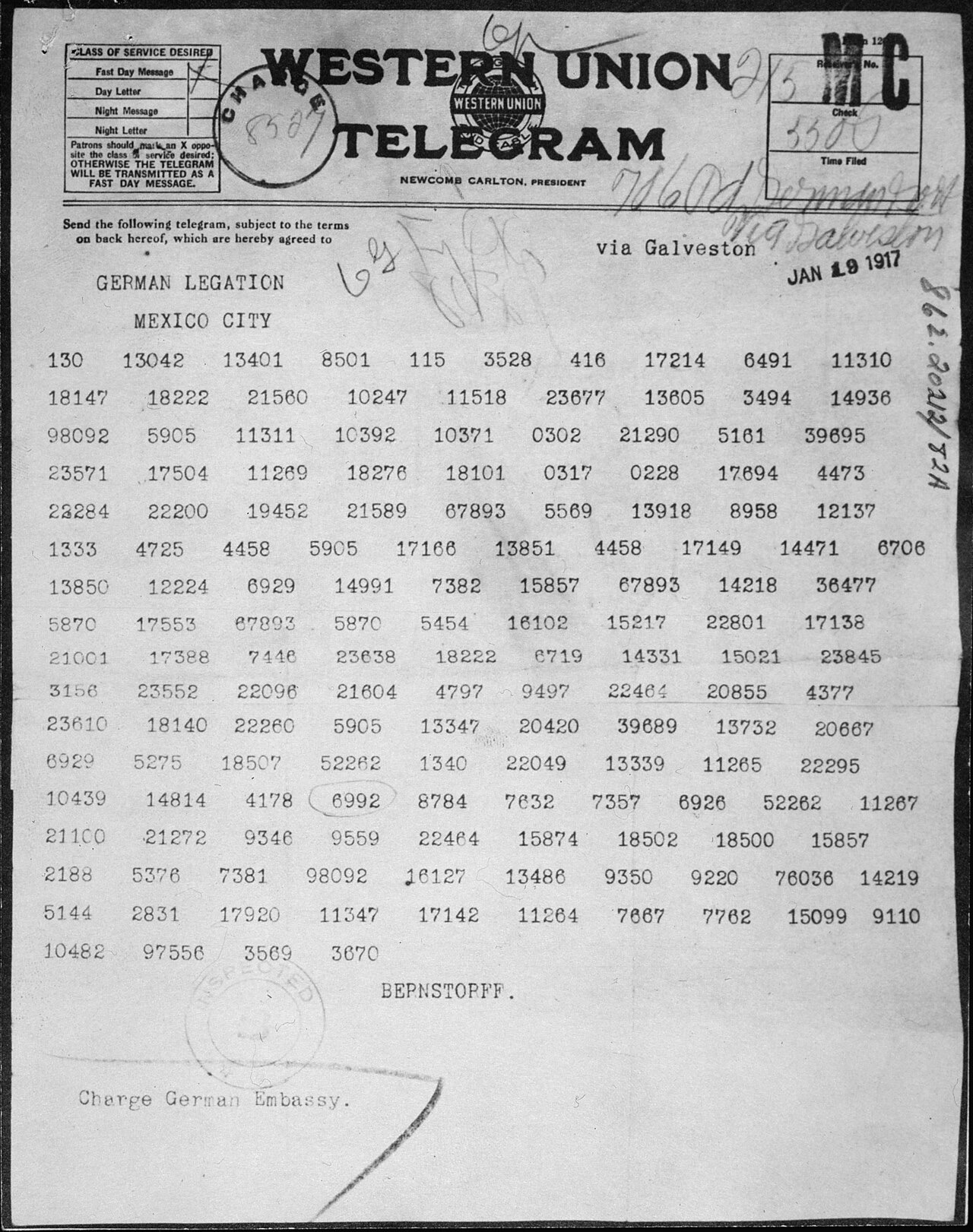
Photograph of the Zimmermann Telegram as Western Union carried it in January 1917: a German diplomatic message reduced to rows of number groups, each group standing for a word in a secret codebook. British codebreakers turned it back into words — an offer of alliance to Mexico — and its publication helped pull the United States into the First World War. They broke it with captured codebooks and patient comparison across many messages, a heavier version of the compare-and-spot-the-difference method the Knowledge Bank on solving by comparison teaches. Nothing here touches the novel; the Westing game hides its message in a far gentler place — inside words everyone already knows.
The Zimmermann Telegram as received by the German ambassador to Mexico, January 19, 1917; U.S. National Archives (NARA 302025). Source: Wikimedia Commons, File:Zimmermann Telegram as Received by the German Ambassador to Mexico - NARA - 302025.jpg, public domain.
💡Knowledge Bank question
1The Knowledge Bank explains that designed changes in a text differ from accidents because designed changes ___.Ch.21
2Where does Theo end up when he secretly follows Crow and Otis?Ch.21
3The note left after the elevator blast is written on the back of Turtle’s own school essay.Ch.21
4What does Turtle admit when Judge Ford questions her privately?Ch.21
5Write the numbers 1–5 in the boxes to show the correct order of events in Chapters 21–24. Number 1 = what happens first.Ch.21–24
The pooled clues reveal a name hidden in missing words.
Fireworks burst out of the elevator and singe Turtle’s braid.
Sandy collapses, and Crow claims the answer.
Turtle posts a sign announcing that she is the bomber.
Every pair hands in an answer at the Westing house.
6Chris’s new medicine leaves his speech exactly as hard to follow as before.Ch.22
7What do Turtle and Flora Baumbach offer as their answer?Ch.23
8How does Sydelle Pulaski deliver her team’s answer?Ch.23
9The will names the winner directly, so the heirs never need to pool their clues.Ch.24
10What happens moments after the missing words are shown to spell out a name?Ch.24
Part 3
Literary Elements
Understanding HOW and WHY Ellen Raskin (author) tells the story across Chapters 21–24.
💡Knowledge Bank · The Answer on the Table All Along
Literary Craft · Fair-Play MysteryDetective fiction has a rule older than most of its readers: play fair. In a fair-play mystery, the mechanism of the solution must be established before the reveal, so the answer lands as recognition rather than as a trick. Raskin seeds that mechanism with the paper-towel clue squares and Sydelle’s growing recognition of a familiar song. What keeps the game alive is misdirection: the author surrounds the real clue with louder ones. Wrong answers pile up on purpose — a lawyer, a deliveryman, a sum of money — and each is a red herring dragged across the trail, plausible enough to chase and empty enough to waste a chapter on. Then structure does the rest. The moment the hidden name finally surfaces, Raskin detonates a twist in the same breath — the friendliest man in the building falls — so triumph and shock arrive together and nobody, in the book or out of it, has time to think. Fairness supplies the clues; timing supplies the drama.
Fair-play mystery
The clue squares and song pattern are established before the solution — concealed, but not invented at the reveal.
Red herring
Otis Amber, Ed Plum, a sum of money — loud wrong answers dragged across the real trail.
Twist
The instant the hidden name surfaces, Sandy falls — revelation and shock timed to the same breath.
💡Knowledge Bank question
1According to the Knowledge Bank, a fair-play mystery must ___.Ch.21–24
2Fill in the blank with the correct literary term.Ch.21–24
Word choices:herringtwiststanzamoral- some words will not be used
A false lead is a red .
Sandy’s sudden death is a shocking .
3The accusations of Otis Amber and Ed Plum function as ___.Ch.21–24
4Raskin builds the breakthrough from clue squares and a song pattern introduced before the solution.Ch.21–24
5Raskin gives the game’s decisive breakthrough to Sydelle — the most overlooked heir — to show ___.Ch.21–24
6Placing Sandy’s collapse in the same scene as the decoded name creates ___.Ch.21–24
7By the end of Chapter 24, the mystery of Sam Westing is fully and finally solved.Ch.21–24
8Fill in the blanks with the correct literary terms.Ch.21–24
Word choices:misdirectionfaircoupletsequel- some words will not be used
Loud wrong clues are .
Showing readers every clue is playing .
9The eight wildly different answers — a sum, a lawyer, a single word — mainly show that ___.Ch.21–24
10These chapters rely on information that was deliberately hidden from the reader until now.Ch.21–24
Part 4
Think Deeper
Four deeper challenges — no single-word recall. Read, weigh the evidence, and reason it out.
⚖Knowledge Bank · A Name Is Not a Verdict
Logic · Evidence & ProofWhen the pooled clues spell out one heir’s full name, nearly everyone in the room makes the same leap: the puzzle points at her, so she must be guilty. Judge Ford refuses the leap, and her refusal is a lesson in how evidence actually works. A decoded name is a fact about the puzzle — it proves the puzzle-maker chose that name, and nothing more. Guilt is a fact about the world, and it needs its own support: actions, opportunity, testimony. Confusing the two is how an accusation gets mistaken for a verdict. The distinction matters because the game’s designer controls what the clues say; whoever wrote the message decided in advance whose name would appear, which makes the message evidence about the writer’s intentions, not the named person’s deeds. Courts formalize this caution as the burden of proof: the accuser must supply it, and the accused owes nobody a defense until it arrives. A puzzle can name a person. Only facts can convict one — and the space between those two sentences is called justice.
Think back over these chapters. Smoke clears in an elevator and a girl touches the singed end of her braid. A sign goes up the next morning, claiming the blame before anyone can pin it somewhere worse. Eight tables hand in eight answers, and one of them arrives as a song with certain words strangely absent. In a locked library the game turns over: pool the clues, line them up, and read not the words but the gaps between them. A name assembles itself out of what is missing — and before anyone can breathe, the friendliest man in the building is on the floor, and a quiet woman in black says the answer is her.
Original passage written for Garden Heights — not a quotation from the novel.
1Claim: “In these chapters the Westing game rewards players who share information, not players who hoard it.” — choose the two details that best prove it.Claim & Evidence
2Clue (points toward the hidden answer), or Red herring (leads the players astray)? Tap each detail to sort it — tap again to switch sides. You can keep tapping to change your answer.Sort into two
◄ Clue (points toward the hidden answer)Red herring (leads the players astray) ►
3Match each cause to its result. For each cause, pick its result.Cause & Effect
A firework display bursts out of the elevator→
New medicine reaches Chris at the hospital→
The will declares every answer wrong→
Sydelle arranges the pooled words against the song→
💡Knowledge Bank question
4Fill both blanks to complete the reasoning.Build the Argument
According to the Knowledge Bank, Judge Ford refuses to treat the decoded name as proof of guilt because , so guilt still needs .
Part 5
Standardized Test
Reading passage · Hiding a Message in Plain Sight · Words in Context & Central Ideas · SAT & TOEFL-style practice
Read the passage — the highlighted words are tested — then answer. Tap an answer, then tap it again to confirm.
SATCentral Ideas — the passage's main point
SATWords in Context — a word's meaning in this passage
SATInference — a conclusion the passage implies
TOEFLFactual Information — a fact stated in the passage
TOEFLVocabulary — a tested word's meaning here
TOEFLProse Summary — the three sentences that sum it up
Hiding Messages in Plain Sight
A code scrambles a message so that outsiders cannot read it. Steganography takes the opposite path: its goal is to conceal the message inside something that looks harmless, so that outsiders never think to read it at all. A shopping list, a friendly letter, or a familiar song can carry a second meaning meant for one reader alone. Two classic tools are the acrostic, which spells a word with the first letters of successive lines, and the anagram, which keeps every letter of a name but scrambles the order until the name disappears.
A message can even hide in what a text leaves out. If a writer copies a document that readers already know — a beloved poem, an anthem, a pledge — and quietly drops certain words, the missing words become the message. The method works because familiar texts carry redundancy, information a reader can predict in advance; everyone knows what the next line should say, so a gap that would be invisible in ordinary prose stands out sharply once someone thinks to compare. The hardest part is not hiding the words. It is trusting that the right reader will notice they are gone.
Finding such messages is a matter of comparison rather than luck. A solver sets the suspicious text beside the version it imitates and lists every discrepancy — an added word, a dropped line, an odd spelling. Patterns then finish the job, because accidents scatter randomly while designed changes fall into rhythms, such as one missing word in every verse. That is why hiding a message in plain sight is always a gamble: the disguise fools a careless reader completely, and it hands a careful one everything needed to decode it.
Original passage written for Garden Heights — not a quotation from the novel.
1What is the main idea of the passage?SAT · Central Ideas
2According to the passage, an acrostic hides a word by ___.TOEFL · Factual Information
3In the passage, conceal most nearly means ___.SAT · Words in Context
4In the passage, redundancy refers to ___.TOEFL · Vocabulary
5According to the passage, how does a solver detect an omission message?TOEFL · Factual Information
6In the passage, decode most nearly means ___.SAT · Words in Context
7The passage suggests that hiding a message in a well-known song is a gamble because ___.SAT · Inference
8Prose Summary (TOEFL).The passage explains how messages hide inside ordinary texts and how solvers uncover them. This TOEFL task lists six sentences; choose the THREE that best capture the passage’s main ideas. The other three do not belong — they state minor details or ideas the passage does not present.TOEFL · Prose Summary
9Which of these does the passage name as a possible hiding place for a message?TOEFL · Factual Information
10Which event from these chapters best matches the passage’s idea of an omission message?SAT · Inference
Part 6 · Optional
Creative Writing
A bonus challenge to practice your English. Take your time and have fun with it.
About This Section
This writing task is optional and is not part of your auto-graded score. The feedback below checks only the basics — length, spelling, and grammar — not whether your ideas are right or wrong. It is meant for classroom discussion and creative practice, so feel free to use your imagination!
Writing Task — Part 6 “The Message in What Is Missing”
The heirs stare at their clues for weeks and see nothing, because the answer hides in the words that are NOT there. Write about a time you finally understood something because of what was missing — a friend who went quiet, an empty seat, a question nobody would answer. What was absent, and how did you finally notice it? 6–10 sentences. End with what the gap turned out to mean.
You can start with: “For a long time I only noticed what was in front of me, until...”
0 / 40 words minimum
🗣 Teach It · Just for Fun (optional)
No right or wrong — close the screen and tell someone nearby what happened in this part. Can’t find anyone? Tell yourself out loud. The moment you teach it, you truly understand it.
Part 6 Complete!
You finished Chapters 21–24 of The Westing Game.
Here are your auto-graded results:
-
points out of 100
Teach it to someone
The best last step is to teach it. In your own words, explain what happened — retell a favorite scene, teach a character’s big choice, or sum up the main idea for a parent, friend, or classmate. When you can teach it clearly, you truly own it.
Independent study guide by Garden Heights. Not affiliated with or endorsed by Ellen Raskin. Contains original analysis only; no text from the novel is reproduced. Reference text: This workbook follows Ellen Raskin’s classic text (the standard Puffin edition sold worldwide). Revised 2023 UK editions change some wording and may not match the vocabulary studied here.
SAT® is a registered trademark of College Board, which is not affiliated with, and does not endorse, these materials. TOEFL® is a registered trademark of ETS. These materials are not endorsed or approved by ETS. Garden Heights is an independent provider of test-style reading practice.