New here? Just sign up with Google — your account includes Matilda, our gift book, forever.
The Trumpet of the Swan · Garden Heights
Part 1
for The Trumpet of the Swan · Part 1 · Chapters 1–3
8 Parts40 min
What Happens in Part 1
Deep in the Canadian wilderness, eleven-year-old Sam Beaver is camping with his father — and Sam is that rare kind of boy who would rather watch the woods than talk about them. Exploring alone, he discovers a hidden pond, and on it something magnificent: a pair of trumpeter swans, huge and white and wild, building a nest on a small island. Sam keeps their secret in the place he keeps everything — his notebook, where each night he writes what he saw and ends with a question to puzzle over. Day after quiet day he returns to watch the female warm her eggs. Then his stillness pays a debt he didn’t know he owed: when a hungry fox creeps toward the nesting swan, Sam’s warning saves her — and the great birds, who trust almost nothing on two legs, decide that this particular boy is a friend. The swans’ world and the boy’s world have touched, gently — and the story’s most important friendship has quietly hatched before any egg does.
The boy and the pond — Sam Beaver, camping in wild Canada, discovers a hidden pond where trumpeter swans are nesting; he watches in secret, records everything in his notebook, and saves the nesting female from a fox — earning the wild birds’ trust.
Part 1
Vocabulary
Study 10 key words from Chapters 1–3, then answer each question.
🧠Knowledge Bank · Cygnets: Ready for the Water
Lexicology · Cygnets: Ready for the Water
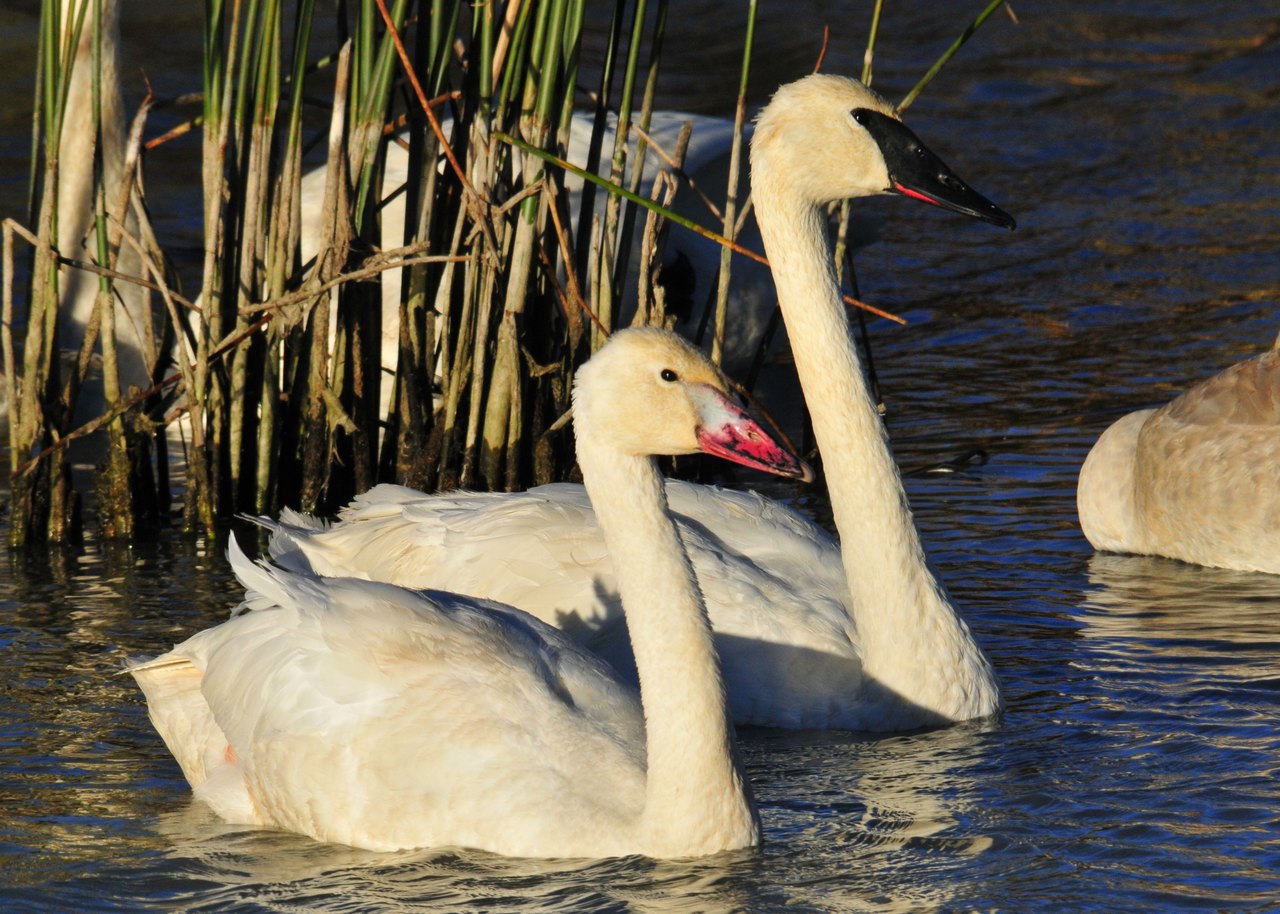
A baby swan is called a cygnet, and the way it enters the world tells you a great deal about swans. The cob and the pen build a broad nest of reeds and grasses at the marsh’s edge, and the pen sits patiently for weeks while the eggs gather warmth beneath her. Scientists call such newborns precocial, meaning ready almost at once: within a day the little swans can walk, swim, and follow their parents across the pond. Compare that to a robin, which hatches naked and helpless in the nest and must be fed for weeks. Understanding this helps you see why the swan family in these chapters can move as a group so soon, gliding out onto the water together as a single watchful, feathered procession.
Visual AidA cygnet on its first water
Photograph of a trumpeter swan with a cygnet at Seedskadee National Wildlife Refuge in Wyoming. The Knowledge Bank explains that scientists call such newborns precocial, meaning ready almost at once, so that within a day the little swans can walk, swim and follow their parents across the pond, unlike a robin that hatches naked and helpless. Notice how close the young one stays. Ready does not mean independent.
Trumpeter swan with cygnet, Seedskadee National Wildlife Refuge, Wyoming; U.S. Fish and Wildlife Service. Source: Wikimedia Commons, public domain.
wildernessn.Ch.1–3
Wild land far from towns and roads
“The camp sat deep in the Canadian wilderness.”
pondn.Ch.1–3
A small body of still water
“A hidden pond lay beyond the spruce woods.”
nestn.Ch.1–3
The structure birds build for their eggs
“The swans built their nest on a little island.”
cygnetn.Ch.1–3
A baby swan
“Soon the eggs would become cygnets.”
observev.Ch.1–3
To watch closely and carefully
“Sam could observe for hours without moving.”
patientadj.Ch.1–3
Able to wait calmly
“A patient watcher sees what hurried people miss.”
notebookn.Ch.1–3
A book for writing things down
“Every evening ended with the notebook.”
prowlv.Ch.1–3
To move quietly, hunting
“A fox began to prowl toward the nest.”
warningn.Ch.1–3
A signal of coming danger
“Sam’s warning came just in time.”
trustn.Ch.1–3
Belief that someone is safe and true
“The wild swans gave the boy their trust.”
ⓘ The vocabulary words in this list are selected to help you understand and complete this workbook. Some may not appear verbatim in the original novel.
🧠Knowledge Bank question
1According to the Knowledge Bank, precocial newborns are ones that are ___.Ch.1–3
2A ‘cygnet’ is a baby swan.Ch.1–3
3To move quietly while hunting is to ___.Ch.1–3
4To ‘observe’ is to glance quickly and move on.Ch.1–3
5Fill in each blank with the correct word.Ch.1–3
Word choices:nestwarningpatientpond- some words will not be used
The swans built their on a little island.
Sam’s saved the nesting swan.
6Belief that someone is safe and true is ___.Ch.1–3
7Someone ‘patient’ cannot wait calmly for anything.Ch.1–3
8A small body of still water is a ___.Ch.1–3
9Fill in the blanks with the correct words.Ch.1–3
Word choices:observetrustnotebookcygnet- some words will not be used
Each evening Sam wrote in his .
Sam could for hours without moving.
10A signal of coming danger is a ___.Ch.1–3
Part 2
Comprehension
Show you understood what happens in Chapters 1–3.
🧠Knowledge Bank · How Writers Introduce a Character
Narrative Logic · How Writers Introduce a Character
Good readers pay close attention to the first pages, because that is where an author quietly hands us a character. This skill is called characterization — the many small ways a writer shows us who someone is. E.B. White rarely stops to announce that Sam Beaver is patient or kind. Instead he shows Sam sitting perfectly still by the pond, writing careful notes in his diary, watching the swans without frightening them. From those actions we infer his gentleness and his love of wild things. Notice, too, how the cob speaks in grand, flowery words while the pen answers plainly — their speech reveals two personalities at once. Add them together and you will know the person on the page long before the author ever spells out a single trait.
Visual AidShown, not announced
Diagram for the Knowledge Bank on characterization. The three numbered cards are the actions the Knowledge Bank points to, and the arrows show them adding up to a description the book never prints. The card on the right is the reader’s conclusion rather than the author’s sentence. The Knowledge Bank says White rarely stops to announce that Sam is patient or kind.
Characterization through action, as described in the Knowledge Bank. Drawn for Garden Heights Academy.
🧠Knowledge Bank question
1The Knowledge Bank says E.B. White shows Sam is gentle by ___.Ch.1–3
2What does Sam discover on his exploration?Ch.1–3
3Sam immediately tells his father everything about the swans.Ch.1–3
4What is Sam’s nightly habit?Ch.1–3
5Write the numbers 1–5 in the boxes to show the correct order of events in Chapters 1–3. Number 1 = what happens first.Ch.1–3
A fox prowls toward the nesting female.
Sam camps in the wilderness with his father.
Sam’s warning saves her — and earns the swans’ trust.
He discovers the hidden pond and the swans.
He returns quietly, day after day, to watch.
6The swans are described as small, common birds.Ch.1–3
7How does Sam save the nesting swan?Ch.1–3
8How do the swans treat Sam after the rescue?Ch.1–3
9Sam would rather talk about the woods than watch them.Ch.1–3
10Why do these quiet chapters matter to the whole story?Ch.1–3
Part 3
Literary Elements
Understanding HOW and WHY E.B. White tells the story across Chapters 1–3.
🧠Knowledge Bank · Seeing Through Sam’s Eyes
Literary Technique · Seeing Through Sam’s Eyes
E.B. White opens his book not with the swans but with a boy watching them, and that choice is a deliberate piece of craft called point of view — the position from which a story is seen. By letting us first meet the swans through Sam Beaver’s quiet, admiring gaze, White teaches us how to look: slowly, respectfully, with wonder. Sam becomes a kind of window, or frame, standing between us and the wild world so that we notice details we might otherwise rush past. This gentle framing also blends two moods that run through the whole book — the plain truth of real nature and the storybook magic of animals who think and feel. Because a patient watcher shows us the marsh first, we are ready to believe in the extraordinary swan we are about to meet.
Precision
Real places, right facts — solid ground that lets the coming fantasy stand.
Quiet hero
Sam’s powers are stillness, attention, and a notebook — heroism at a whisper.
The watcher’s frame
We enter the swans’ world through a boy who loves it — wildness, framed by affection.
🧠Knowledge Bank question
1According to the Knowledge Bank, Sam becomes a kind of ___.Ch.1–3
2Fill in the blank with the correct literary term.Ch.1–3
Word choices:precisionherorhymesequel- some words will not be used
Exact real details show the author’s .
Sam, whose power is stillness, is a quiet .
3Sam is called a ‘quiet hero’ because ___.Ch.1–3
4The fox scene turns Sam’s stillness from a hobby into a rescue.Ch.1–3
5The notebook’s closing questions show that Sam ___.Ch.1–3
6Opening with the human watcher — not the swans — frames the wild through ___.Ch.1–3
7Precision in fiction means avoiding all real-world facts.Ch.1–3
8Fill in the blank with the correct literary term.Ch.1–3
Word choices:framemoralvillainmeter- some words will not be used
Entering the story through a watcher gives it a .
9The swans granting trust ONLY after the rescue establishes the book’s rule that ___.Ch.1–3
10These chapters promise readers a book where ___.Ch.1–3
Part 4
Think Deeper
Four deeper challenges — no single-word recall. Read, weigh the evidence, and reason it out.
🧠Knowledge Bank · Building a Home Together
Ethical Reasoning · Building a Home Together
Before any adventure begins, these chapters show us something quieter and just as important: a family making a home. The cob and the pen choose their nesting spot with care, guard their eggs through cold nights, and greet each new cygnet as a small miracle. White wants us to feel that a home is not a place you are simply given but a thing you build with patience and love, twig by twig and day by day. The security of this first family is the soil in which Louis’s courage will one day take root, because a young creature who is loved at the start carries that steadiness into every hard journey that follows — making a loved beginning itself a kind of armor.
Think back over these chapters. A boy steps carefully through spruce shadow and stops at the edge of still water. Out on a little island, something vast and white folds and unfolds like weather. Day after day he comes back, sits like a stone, and writes it all down at night — ending, always, with a question. Then one afternoon a russet shape flows low through the grass toward the nest, and the stone becomes a boy again, just long enough to shout. Wings thunder. The fox is gone. And two wild giants look across the water at the boy — and decide.
Original passage written for Garden Heights — not a quotation from the novel.
1Claim: “The swans’ trust in Sam is earned, not given.” — choose the two details that best prove it.Claim & Evidence
2What Sam does, or What Sam refuses to do? Tap each detail to sort it — tap again to switch sides. You can keep tapping to change your answer.Sort into two
◄ What Sam doesWhat Sam refuses to do ►
3Match each cause to its result. For each cause, pick its result.Cause & Effect
Sam explores past the spruce woods→
Weeks of stone-still watching→
A fox flows toward the nest→
The nest is saved by a human voice→
🧠Knowledge Bank question
4Fill both blanks to complete the reasoning.Build the Argument
The Knowledge Bank says a home is not a place you are given but a thing you , and it calls that first family .
Part 5
Standardized Test
Reading passage · Trumpeter Swans: Back from the Brink · SAT & TOEFL-style practice
Read the passage — the highlighted words are tested — then answer. Tap an answer, then tap it again to confirm.
SATCentral Ideas — the passage's main point
SATWords in Context — a word's meaning in this passage
SATDetail — a fact stated in the passage
SATInference — a conclusion the passage implies
SATText Connections — how two parts of the text relate
TOEFLFactual Information — a fact stated in the passage
TOEFLVocabulary — a tested word's meaning here
Saving the Trumpeter Swan
The trumpeter swan is a bird built to be noticed: North America’s largest native waterfowl, gleaming white, with wings that can span more than two meters (7 feet) and a call like a French horn across the water. Yet a century ago hardly anyone could notice one, because hardly any were left. Hunted for meat, skins, and especially feathers, since swan quills made prized pens and swan down trimmed fashionable clothes, trumpeters were driven almost to extinction. By the 1930s one famous survey found fewer than a hundred birds in the entire United States, hidden in the wilderness of the northern Rockies.
The rescue was slow and deliberate. Laws ended the hunting; a refuge, land set aside for wildlife, protected the survivors at Red Rock Lakes, Montana; and biologists spent decades guarding every nest and moving young birds to rebuild lost flocks. It worked: today tens of thousands of trumpeters again trumpet across the continent, one of conservation’s proudest comebacks. E.B. White set his novel among these very birds, a boy in the wild, awed by nesting trumpeters, in the exact years when seeing a pair was still a rare wonder. Sam Beaver’s pounding heart at the pond is not storybook exaggeration.
Original passage written for Garden Heights — not a quotation from the novel.
1What is the main idea of the passage?SAT · Central Ideas
2Why were trumpeters hunted, according to the passage?TOEFL · Factual Information
3In the passage, wilderness is ___.SAT · Words in Context
4What did the famous 1930s survey find?SAT · Detail
5In the passage, a refuge is ___.TOEFL · Vocabulary
6In the passage, a nest is ___.SAT · Words in Context
7Which of these was part of the rescue?TOEFL · Factual Information
8How does the passage describe the trumpeter’s call?SAT · Detail
9Why is Sam’s pounding heart ‘not storybook exaggeration’?SAT · Inference
10Which Part 1 detail does this passage BEST help explain?SAT · Text Connections
Part 6 · Optional
Creative Writing
A bonus challenge to practice your English. Take your time and have fun with it.
About This Section
This writing task is optional and is not part of your auto-graded score. The feedback below checks only the basics — length, spelling, and grammar — not whether your ideas are right or wrong. It is meant for classroom discussion and creative practice, so feel free to use your imagination!
Writing Task — Part 1 “The Notebook Page”
Write one page of Sam’s notebook — or your own naturalist’s notebook about any animal you have really watched (a pigeon, an ant, a dog in the park). Record the date, three exact observations, one small event, and end — Sam-style — with a question you genuinely cannot answer yet. 6–10 sentences.
You can start with: “June 14. Today I stayed still for a long time, and here is what I saw...”
0 / 40 words minimum
🗣 Teach It · Just for Fun (optional)
No right or wrong — close the screen and tell someone nearby what happened in this part. Can’t find anyone? Tell yourself out loud. The moment you teach it, you truly understand it.
Part 1 Complete!
You finished Chapters 1–3 of The Trumpet of the Swan.
Here are your auto-graded results:
-
points out of 100
Teach it to someone
The best last step is to teach it. In your own words, explain what happened — retell a favorite scene, teach a character’s big choice, or sum up the main idea for a parent, friend, or classmate. When you can teach it clearly, you truly own it.
Independent study guide by Garden Heights. Not affiliated with or endorsed by E.B. White. Contains original analysis only; no text from the novel is reproduced. Reference text: This workbook follows E.B. White’s classic text (the standard Puffin edition sold worldwide). Revised 2023 UK editions change some wording and may not match the vocabulary studied here.
SAT® is a registered trademark of College Board, which is not affiliated with, and does not endorse, these materials. TOEFL® is a registered trademark of ETS. These materials are not endorsed or approved by ETS. Garden Heights is an independent provider of test-style reading practice.