New here? Just sign up with Google — your account includes Matilda, our gift book, forever.
The Trumpet of the Swan · Garden Heights
Part 2
for The Trumpet of the Swan · Part 2 · Chapters 4–6
8 Parts40 min
What Happens in Part 2
The eggs hatch, and five cygnets tumble into the world — but one of them is different. The little swan his family will call Louis is strong, quick, and completely mute: where his brothers and sisters beep and burble, Louis opens his bill and… nothing. For a trumpeter swan this is no small trouble, and his father — a grand, wordy bird whom readers come to know as the cob — grieves aloud and swears a father’s oath: somehow, Louis shall have a voice. The chapters glow with pond-life — swimming lessons, danger drills, the cygnets riding their mother’s back — and with Louis’s first solution: unable to call to Sam, he learns to greet the boy by tugging his shoelaces. When autumn stirs, the family flies south to Montana, to the Red Rock Lakes where trumpeters winter in safety — and where Louis, watching other swans trade calls across the water, begins to measure exactly what his silence will cost. A swan without a voice, the pond makes plain, is a swan the world cannot hear.
Difference introduced with love, and a father’s promise as engine
Cross-Curricular
Keeping a wilderness notebook — the naturalist’s craft
Chapter Summary
Ch.
What happens
4–6
The cygnet without a voice — five cygnets hatch; Louis is strong, bright, and mute; his father vows to win him a voice; Louis greets Sam by tugging his shoelace; and the family migrates to Montana’s Red Rock Lakes, where silence starts to show its price.
Part 1
Vocabulary
Study 10 key words from Chapters 4–6, then answer each question.
🧠Knowledge Bank · The Syrinx: A Bird’s Hidden Voice-Box
Lexicology · The Syrinx: A Bird’s Hidden Voice-Box
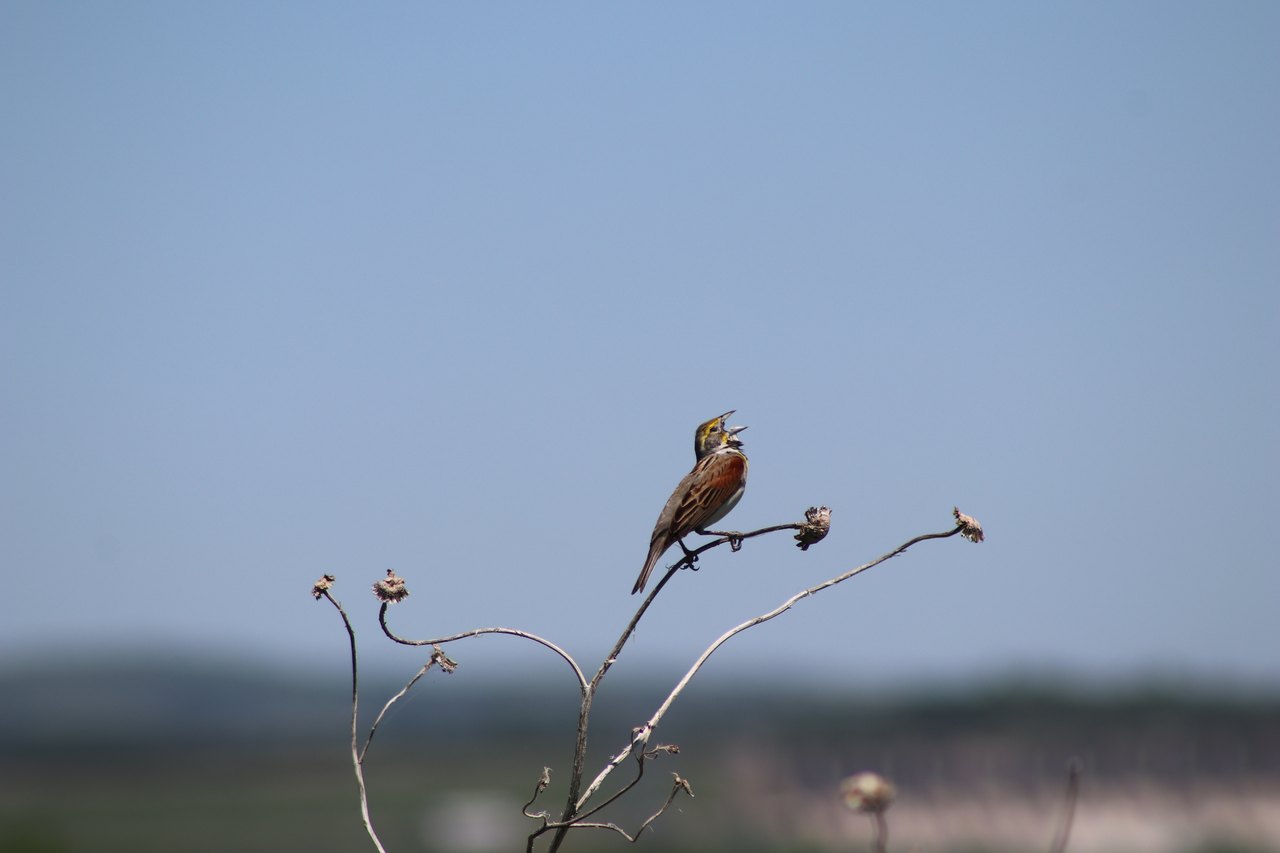
People make sound with a voice-box in the throat, but birds do something stranger and more wonderful. Deep in a bird’s chest, where the windpipe splits toward the two lungs, sits a special organ called the syrinx. As air rushes through, thin membranes vibrate and sing, which is why some birds can even produce two notes at once. A trumpeter swan takes this further still: its windpipe is so long that part of it coils inside the breastbone like a French horn’s tubing, giving the swan its deep, far-carrying trumpet call. He belongs to the loudest, most brass-voiced swan of all, yet the one instrument every trumpeter is born with — that curled, singing syrinx — is the very thing his body lacks. His silence is not laziness or shyness; it is a real, physical difference.
Visual AidA voice-box no human owns
Photograph of a dickcissel singing at Karl E. Mundt National Wildlife Refuge in South Dakota. The Knowledge Bank explains that people make sound with a voice-box in the throat, but that deep in a bird’s chest, where the windpipe splits toward the two lungs, sits an organ called the syrinx, and that thin membranes vibrate there as air rushes through, which is why some birds can produce two notes at once. The open beak is only the exit. The instrument is out of sight.
Dickcissel singing, Karl E. Mundt National Wildlife Refuge, South Dakota; U.S. Fish and Wildlife Service. Source: Wikimedia Commons, public domain.
hatchv.Ch.4–6
To break out of an egg
“Five eggs began to hatch on the island.”
muteadj.Ch.4–6
Unable to make sounds; voiceless
“Louis was born mute — a swan without a call.”
cobn.Ch.4–6
A male swan
“The cob grieved aloud for his silent son.”
oathn.Ch.4–6
A solemn, binding promise
“The father swore an oath: Louis shall have a voice.”
burblev.Ch.4–6
To make soft bubbling sounds
“The other cygnets could beep and burble.”
drilln.Ch.4–6
A practiced safety routine
“The cygnets learned every danger drill.”
signaln.Ch.4–6
An action or sound that carries meaning
“The shoelace tug became Louis’s signal.”
migratev.Ch.4–6
To travel seasonally to another region
“In autumn the family would migrate to Montana.”
refugen.Ch.4–6
A protected safe place
“Red Rock Lakes is a refuge for trumpeters.”
measurev.Ch.4–6
To judge the size or cost of something
“Louis began to measure what silence would cost.”
ⓘ The vocabulary words in this list are selected to help you understand and complete this workbook. Some may not appear verbatim in the original novel.
🧠Knowledge Bank question
1According to the Knowledge Bank, the syrinx sits ___.Ch.4–6
2A ‘cob’ is a male swan.Ch.4–6
3A solemn, binding promise is an ___.Ch.4–6
4To ‘migrate’ is to stay in one place all year.Ch.4–6
5Fill in each blank with the correct word.Ch.4–6
Word choices:hatchsignalrefugedrill- some words will not be used
Five eggs began to on the island.
The shoelace tug became Louis’s .
6A protected safe place is a ___.Ch.4–6
7A ‘drill’ is a practiced safety routine.Ch.4–6
8To judge the size or cost of something is to ___ it.Ch.4–6
9Fill in the blanks with the correct words.Ch.4–6
Word choices:muteoathmigrateburble- some words will not be used
Louis was born .
In autumn the family would south.
10To make soft bubbling sounds is to ___.Ch.4–6
Part 2
Comprehension
Show you understood what happens in Chapters 4–6.
🧠Knowledge Bank · One Cause, Many Effects
Narrative Logic · One Cause, Many Effects
A powerful way to understand a story is to track cause and effect — how one event makes another happen. In these chapters White plants a single, quiet cause: Louis is born without a voice. He cannot greet his family with the beautiful sound the other cygnets make; he cannot say his own name; he begins to fear he will never be able to call to a female swan someday. A good reader follows these ripples like circles spreading from a stone dropped in a pond. Notice, too, that a cause can produce effects of the heart, not just of the plot — Louis feels lonely and set apart. When you can name the cause behind a character’s struggle, the whole story clicks into shape, and you begin to predict what that character must do to change his situation.
Visual AidOne cause, many effects
Diagram for the Knowledge Bank on cause and effect. Card 1 is the single quiet cause the Knowledge Bank identifies, and the three cards below are the consequences it lists. Nothing is dated, because these are not events in order but results of one fact. Notice that the arrows only run downward, since none of the effects can reach back and undo the cause.
One cause and its effects, as described in the Knowledge Bank. Drawn for Garden Heights Academy.
🧠Knowledge Bank question
1The Knowledge Bank says the single quiet cause White plants in these chapters is that ___.Ch.4–6
2How does Louis’s father respond to his son’s silence?Ch.4–6
3Louis invents a way to greet Sam: tugging his shoelace.Ch.4–6
4Where does the family migrate for the winter?Ch.4–6
5Write the numbers 1–5 in the boxes to show the correct order of events in Chapters 4–6. Number 1 = what happens first.Ch.4–6
The father swears his oath about a voice.
The family migrates south to Montana.
Louis greets Sam with a shoelace tug.
Five cygnets hatch on the island.
The family discovers Louis is mute.
6Louis’s muteness is treated as unimportant by the book.Ch.4–6
7What do the cygnets learn in their pond lessons?Ch.4–6
8Why does a voice matter so much to a trumpeter swan?Ch.4–6
9At Red Rock Lakes, Louis watches other swans trade calls across the water.Ch.4–6
10What makes Louis’s problem feel real rather than storybook-simple?Ch.4–6
Part 3
Literary Elements
Understanding HOW and WHY E.B. White tells the story across Chapters 4–6.
🧠Knowledge Bank · The Talkative Father, the Silent Son
Literary Technique · The Talkative Father, the Silent Son
E.B. White builds these chapters on a quiet joke that is also a heartache, and the tool he uses is irony — a gap between what we expect and what actually is. Louis’s father, the cob, is a grand, long-winded talker who loves the sound of his own splendid speeches, using ten words where one would do. That contrast is deliberate: White places endless words beside total silence so we feel the ache of it more sharply. The irony deepens because the cob’s speeches, though sometimes funny, spring from real love and worry for the boy who cannot answer him. Irony is not only a way to be clever; here it lets an author hold humor and sadness in the very same moment. When you spot a contrast this pointed, pause and ask what deeper feeling the author is quietly underlining.
Difference with love
Louis’s muteness arrives wrapped in devotion — readers root before they pity.
Promise-engine
The cob’s oath loads the whole novel — every chapter is that sentence unfolding.
Wordy-father irony
A father with too many words, a son with none — White’s gentlest joke, and its saddest.
🧠Knowledge Bank question
1According to the Knowledge Bank, White places endless words beside total silence so that ___.Ch.4–6
2Fill in the blank with the correct literary term.Ch.4–6
Word choices:ironyenginemetersequel- some words will not be used
A promise that drives the plot is a promise-.
The wordy father beside the silent son is gentle .
3Introducing Louis’s difference through family love makes readers ___.Ch.4–6
4The book treats the shoelace tug as a failure of communication.Ch.4–6
6Ending Part 2 at Red Rock Lakes — among calling swans — lets Louis ___.Ch.4–6
7A promise-engine means the plot is powered by a promise that must be kept.Ch.4–6
8Fill in the blank with the correct literary term.Ch.4–6
Word choices:lovefearpridegreed- some words will not be used
Louis’s difference is introduced with .
9The pond lessons and danger drills ground the fantasy by showing ___.Ch.4–6
10Part 2 leaves readers holding one question, which the rest of the book answers: ___.Ch.4–6
Part 4
Think Deeper
Four deeper challenges — no single-word recall. Read, weigh the evidence, and reason it out.
🧠Knowledge Bank · When You Are Different
Ethical Reasoning · When You Are Different
Louis discovers, in these chapters, that he is not like the others — and that discovery is one of the hardest a young creature can face. Many readers know this feeling in their own way, whether the difference is a stutter, a wheelchair, a hearing aid, or a struggle with reading. Louis is still strong, graceful, and full of feeling — the silence is only one part of a whole and worthy swan. The danger in any difference is not the thing itself but the lie it can whisper: that you are somehow less. Louis will spend the whole book answering that lie with action rather than tears, proving that a life is measured not by what a body lacks but by what a heart is willing to attempt.
Think back over these chapters. On a nest of sticks and down, five shells crack open into five damp, determined little swans. Four of them find their voices before they find their feet. The fifth opens his bill to the morning — and the morning hears nothing. A huge white father paces the shallows, making speeches enough for two lifetimes, and swears the pond his oath. And the silent one? He swims strongest, watches hardest — and one afternoon, finding a boy at the water’s edge, reaches down and tugs, twice, at a shoelace. Hello, says the silence. It’s me.
Original passage written for Garden Heights — not a quotation from the novel.
1Claim: “Louis’s muteness is a practical problem, not just a sad one.” — choose the two details that best prove it.Claim & Evidence
2What Louis lacks, or What Louis has? Tap each detail to sort it — tap again to switch sides. You can keep tapping to change your answer.Sort into two
◄ What Louis lacksWhat Louis has ►
3Match each cause to its result. For each cause, pick its result.Cause & Effect
Five shells crack on the island nest→
The cob grasps his son’s trouble→
Louis cannot call hello to Sam→
Autumn stirs the family south→
🧠Knowledge Bank question
4Fill both blanks to complete the reasoning.Build the Argument
The Knowledge Bank says the danger in any difference is not the thing itself but , and it insists Louis is still .
Part 5
Standardized Test
Reading passage · The Wilderness Notebook · SAT & TOEFL-style practice
Read the passage — the highlighted words are tested — then answer. Tap an answer, then tap it again to confirm.
SATCentral Ideas — the passage's main point
SATWords in Context — a word's meaning in this passage
SATDetail — a fact stated in the passage
SATInference — a conclusion the passage implies
TOEFLFactual Information — a fact stated in the passage
TOEFLVocabulary — a tested word's meaning here
TOEFLRhetorical Purpose — why the author included a detail
TOEFLProse Summary — the three sentences that sum it up
The Naturalist's Field Notebook
Long before cameras were light enough to carry, the naturalist’s most powerful instrument was a notebook. The method, polished over centuries, is simple and strict. First, observe, which means watch closely without disturbing: the notebook-keeper sits still, stays downwind, and lets the wild forget her. Second, record at once, in plain words and quick sketches: what the animal did, when, where, in what weather, because memory, unlike ink, edits itself overnight. Third, and most important, end with questions, since what a watcher cannot yet explain is tomorrow’s assignment.
This humble method built whole sciences. Darwin filled notebooks on the Beagle, and generations of bird scientists established migration routes from thousands of dated, place-marked entries by amateurs: farm kids, teachers, and boys at ponds. A good entry is exact. Not saw some birds, but two trumpeter swans, island nest, female turning eggs at dusk. Notes like that can be compared, mapped, and measured, and so turned into knowledge. Which is why one fictional eleven-year-old, writing up his pond each night and closing with a question he cannot answer, is practicing the oldest science there is.
Original passage written for Garden Heights — not a quotation from the novel.
1What is the main idea of the passage?SAT · Central Ideas
2In the passage, observe means ___.SAT · Words in Context
3Why must a watcher record AT ONCE?TOEFL · Factual Information
4In the passage, ending with questions matters because they are ___.SAT · Detail
5Who does the passage say helped establish migration routes?TOEFL · Factual Information
6In the passage, to measure notes is to ___.TOEFL · Vocabulary
7Why do specific notes matter to science?TOEFL · Rhetorical Purpose
8Which famous naturalist does the passage mention?SAT · Detail
9The passage calls Sam ‘not just a boy with a hobby’ because ___.SAT · Inference
10Prose Summary (TOEFL).The passage explains the naturalist’s notebook method. This TOEFL task lists six sentences; choose the THREE that best capture the passage’s main ideas. The other three do not belong — they state minor details or ideas the passage does not present.TOEFL · Prose Summary
Part 6 · Optional
Creative Writing
A bonus challenge to practice your English. Take your time and have fun with it.
About This Section
This writing task is optional and is not part of your auto-graded score. The feedback below checks only the basics — length, spelling, and grammar — not whether your ideas are right or wrong. It is meant for classroom discussion and creative practice, so feel free to use your imagination!
Writing Task — Part 2 “Hello, Says the Silence”
Louis invents the shoelace tug — a greeting with no sound in it. Invent YOUR soundless signal: a way to say one important thing (hello, help, I’m sorry, well done) without a single word or sound. Describe the signal, teach us how to read it, and tell the story of the first time you would use it. 6–10 sentences.
You can start with: “It looks like nothing much — unless you know what it means...”
0 / 40 words minimum
🗣 Teach It · Just for Fun (optional)
No right or wrong — close the screen and tell someone nearby what happened in this part. Can’t find anyone? Tell yourself out loud. The moment you teach it, you truly understand it.
Part 2 Complete!
You finished Chapters 4–6 of The Trumpet of the Swan.
Here are your auto-graded results:
-
points out of 100
Teach it to someone
The best last step is to teach it. In your own words, explain what happened — retell a favorite scene, teach a character’s big choice, or sum up the main idea for a parent, friend, or classmate. When you can teach it clearly, you truly own it.
Independent study guide by Garden Heights. Not affiliated with or endorsed by E.B. White. Contains original analysis only; no text from the novel is reproduced. Reference text: This workbook follows E.B. White’s classic text (the standard Puffin edition sold worldwide). Revised 2023 UK editions change some wording and may not match the vocabulary studied here.
SAT® is a registered trademark of College Board, which is not affiliated with, and does not endorse, these materials. TOEFL® is a registered trademark of ETS. These materials are not endorsed or approved by ETS. Garden Heights is an independent provider of test-style reading practice.