New here? Just sign up with Google — your account includes Matilda, our gift book, forever.
The Trumpet of the Swan · Garden Heights
Part 3
for The Trumpet of the Swan · Part 3 · Chapters 7–9
8 Parts40 min
What Happens in Part 3
Louis decides that if he cannot speak, he will write — and there is only one human he trusts to help. He flies to Montana, finds Sam Beaver, and asks (in gestures a friend can read) for the impossible: take a swan to school. Sam does. In a classroom of astonished children, Louis learns his letters, and graduates with the tools of his first voice: a small slate and a chalk pencil, worn on a string around his neck. Home at the lakes, the plan meets its flaw. Louis falls achingly in love with a beautiful young swan named Serena — and writes his heart onto the slate — but Serena, being a swan, cannot read. His words mean nothing to the one reader who matters. Watching his son’s despair, the old cob makes a father’s terrible, magnificent decision: he flies to Billings, crashes through a music-store window, and steals a brass trumpet — delivering it to Louis with the truth attached: it is stolen, and the family’s honor now rings inside it. Louis has gained a voice at last — and a debt he will spend the whole book repaying.
A solution that fails forward, and a gift with a price tag
Cross-Curricular
How a trumpet actually makes music
Chapter Summary
Ch.
What happens
7–9
The slate and the stolen trumpet — Sam takes Louis to school, where the swan learns to read and write; the slate fails with Serena, who cannot read; and the old cob crashes into a Billings music store and steals the trumpet that gives Louis a voice — and the family a debt.
Part 1
Vocabulary
Study 10 key words from Chapters 7–9, then answer each question.
🧠Knowledge Bank · How a Trumpet Makes Its Voice
Lexicology · How a Trumpet Makes Its Voice
When Louis’s father sets out to fetch a trumpet, it helps to know what a trumpet actually is. A brass instrument is really a long, coiled tube of metal, and the sound does not come from the metal itself but from the player’s own lips. The musician presses them together and blows so they buzz, and that buzzing sets the air inside the tube trembling in waves — the science of vibration. By pressing the valves and tightening or loosening the lips, a player changes how fast the air shakes, and so changes the note from low to high. This is why a trumpet is such a fitting gift for Louis: it is an instrument that turns moving air into a bright, carrying voice, exactly the job his own body cannot do. The gift is not a consolation prize but a working substitute.
Visual AidThe instrument, laid out flat
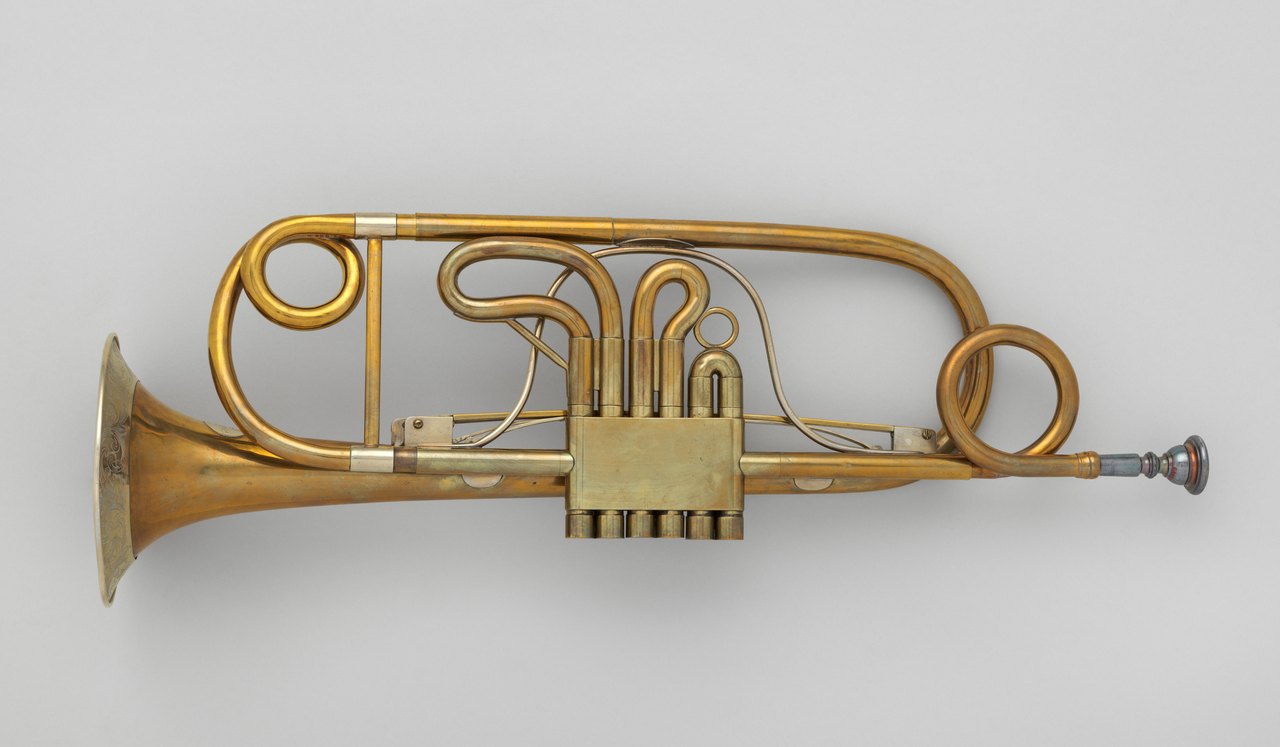
Photograph of a brass valve trumpet from a museum collection. The Knowledge Bank explains that the sound does not come from the metal itself but from the player’s own lips, pressed together and blown until they buzz, and that pressing the valves and tightening or loosening the lips changes the note. Trace the tubing from the mouthpiece to the bell. All that brass is not making the sound; it is shaping one that a pair of lips began.
Brass valve trumpet, Metropolitan Museum of Art, released under CC0. Source: Wikimedia Commons, CC0.
slaten.Ch.7–9
A small writing board used with chalk
“Louis wore a slate on a string around his neck.”
graduatev.Ch.7–9
To finish a course of learning
“The swan managed to graduate with honors of his own.”
astonishedadj.Ch.7–9
Greatly amazed
“The astonished class watched a swan learn letters.”
courtshipn.Ch.7–9
The winning of a mate’s love
“Swan courtship runs on calls and answers.”
despairn.Ch.7–9
The loss of all hope
“Serena’s blank look sank Louis into despair.”
magnificentadj.Ch.7–9
Grand and impressive
“The cob’s crime was terrible and magnificent at once.”
stolenadj.Ch.7–9
Taken without right or payment
“The trumpet was stolen, and the cob said so plainly.”
debtn.Ch.7–9
Money or duty owed to another
“With the trumpet came a debt to repay.”
honorn.Ch.7–9
A family’s good name and integrity
“The family’s honor now rang inside the horn.”
deliverv.Ch.7–9
To bring something to someone
“The cob flew home to deliver his terrible gift.”
ⓘ The vocabulary words in this list are selected to help you understand and complete this workbook. Some may not appear verbatim in the original novel.
🧠Knowledge Bank question
1According to the Knowledge Bank, a brass instrument’s sound comes from ___.Ch.7–9
2‘Despair’ is the loss of all hope.Ch.7–9
3The winning of a mate’s love is ___.Ch.7–9
4Something ‘stolen’ has been fully and fairly paid for.Ch.7–9
5Fill in each blank with the correct word.Ch.7–9
Word choices:debtgraduateastonisheddeliver- some words will not be used
With the trumpet came a .
The class watched a swan learn letters.
6To finish a course of learning is to ___.Ch.7–9
7A family’s ‘honor’ is its good name and integrity.Ch.7–9
8Grand and impressive is ___.Ch.7–9
9Fill in the blanks with the correct words.Ch.7–9
Word choices:slatedespairhonorcourtship- some words will not be used
Louis wore a around his neck.
The family’s rang inside the horn.
10Greatly amazed is ___.Ch.7–9
Part 2
Comprehension
Show you understood what happens in Chapters 7–9.
🧠Knowledge Bank · Reading Between the Lines
Narrative Logic · Reading Between the Lines
Sometimes an author does not tell us everything directly and asks us instead to infer — to combine clues on the page with what we already know in order to reach a conclusion the words only hint at. When Louis’s father flies to the music store and takes the trumpet without paying, White does not lecture us about right and wrong. He trusts us to feel the tangle ourselves: the theft is truly wrong, yet it springs from a father’s desperate love for a son who cannot speak. Notice how much White leaves unsaid, and how the cob’s own guilt later confirms what we inferred. Inference is the reader’s quiet superpower, the bridge between what is printed and what is meant. Whenever a scene stirs a strong feeling the author never named outright, you have just crossed that bridge through your own careful thinking.
🧠Knowledge Bank question
1The Knowledge Bank says White does not lecture us about the theft, but trusts us to ___.Ch.7–9
2What does Sam do with Louis?Ch.7–9
3Louis leaves school with a slate and chalk pencil worn around his neck.Ch.7–9
4Why does the slate fail with Serena?Ch.7–9
5Write the numbers 1–5 in the boxes to show the correct order of events in Chapters 7–9. Number 1 = what happens first.Ch.7–9
The cob steals the trumpet from Billings.
Louis learns to read and write at school.
The slate’s message means nothing to her.
Louis falls in love with Serena.
Louis flies to Montana and finds Sam.
6The cob pays the music store fairly for the trumpet.Ch.7–9
7How does the cob describe his gift to Louis?Ch.7–9
8What TWO things does Louis hold at the end of Part 3?Ch.7–9
9Louis is a poor student at the school.Ch.7–9
10Why does the cob steal rather than beg or borrow?Ch.7–9
Part 3
Literary Elements
Understanding HOW and WHY E.B. White tells the story across Chapters 7–9.
🧠Knowledge Bank · The Trumpet as a Symbol
Literary Technique · The Trumpet as a Symbol
The moment the trumpet enters the story, it becomes more than a musical instrument, and that transformation is called symbolism — when an object stands for a larger idea. On the surface the trumpet is brass and valves; beneath the surface it is Louis’s voice, the answer to the silence he was born with. Because it stands for something so precious, everything that happens to the trumpet carries extra weight: the way it is taken, the debt it creates, the care Louis lavishes on it. Whenever a single object keeps returning at important moments, look closely, because the author is almost surely using it to carry a meaning far larger than any metal could hold, turning a simple purchase into a lifelong promise.
Visual AidWhat an object stands for
Diagram for the Knowledge Bank on symbolism. Card 1 is the trumpet as an object, card 2 is what the Knowledge Bank says it stands for, and card 3 is the consequence: once an object carries that much, everything that happens to it matters. The dotted line marks the surface. Notice that nothing physical changes between card 1 and card 2.
Symbolism as described in the Knowledge Bank. Drawn for Garden Heights Academy.
Failing forward
The slate fails with Serena — but every failure teaches exactly what the next attempt needs.
Gift with a price tag
The trumpet arrives soldered to its theft — love and wrong, in one object.
No-excuses love
The cob is named a thief AND stays beloved — readers are trusted to hold both.
🧠Knowledge Bank question
1According to the Knowledge Bank, beneath the surface the trumpet is ___.Ch.7–9
2Fill in the blank with the correct literary term.Ch.7–9
Word choices:forwardbackwardupwardinward- some words will not be used
A failure that teaches the next step is failing .
3The trumpet is a ‘gift with a price tag’ because ___.Ch.7–9
4White excuses the cob’s theft as perfectly fine because the cause was good.Ch.7–9
5The schoolhouse comedy works because the absurd situation is ___.Ch.7–9
6Serena’s inability to read makes the story’s point that ___.Ch.7–9
7The theft chapter opens a ledger the rest of the book will work to close.Ch.7–9
8Fill in the blank with the correct literary term.Ch.7–9
Word choices:priceribbonsecretcurse- some words will not be used
The trumpet is a gift with a tag.
9Trusting readers to love a character who did wrong treats them as ___.Ch.7–9
10Part 3’s ending hands the story its two great questions: ___.Ch.7–9
Part 4
Think Deeper
Four deeper challenges — no single-word recall. Read, weigh the evidence, and reason it out.
🧠Knowledge Bank · Finding Another Way
Ethical Reasoning · Finding Another Way
Faced with a voice he does not have, Louis refuses to sit still in his sorrow; he goes to school with Sam and learns to read and write. Learning to write is slow, patient work for a swan holding chalk in his beak, and White does not pretend it is easy. But Louis understands something wise beyond his years — that a slate and chalk can carry his thoughts to people even when his throat cannot. Determination like this is not loud or dramatic; it is the daily choice to try again after a hard day. He spends it, instead, building the skills that will let him meet the world on his own terms, proving that a locked door is only an invitation to find a new key. That is the difference between being stopped and being merely delayed.
Think back over these chapters. In a Montana classroom, a trumpeter swan bends over a slate, tongue-tip of chalk squeaking out his first letters while a room of children forgets to breathe. On a summer lake, that same slate hangs useless as a beautiful swan glides past words she cannot read. And over Billings, an old white father folds his wings and drops like judgment through a music-store window, rising again with brass in his bill and his good name left among the broken glass — carrying home to his son the one gift he could not honestly give.
Original passage written for Garden Heights — not a quotation from the novel.
1Claim: “The cob understands exactly what his theft costs — and chooses it anyway.” — choose the two details that best prove it.Claim & Evidence
2What the slate can do, or What only the trumpet can do? Tap each detail to sort it — tap again to switch sides. You can keep tapping to change your answer.Sort into two
◄ What the slate can doWhat only the trumpet can do ►
3Match each cause to its result. For each cause, pick its result.Cause & Effect
Louis asks Sam for the impossible→
The slate meets Serena’s blank gaze→
A father watches his son’s despair→
The gift is named stolen as it is given→
🧠Knowledge Bank question
4Fill both blanks to complete the reasoning.Build the Argument
The Knowledge Bank says learning to write is slow, patient work for a swan, and White , because determination like this is .
Part 5
Standardized Test
Reading passage · How a Trumpet Makes Music · SAT & TOEFL-style practice
Read the passage — the highlighted words are tested — then answer. Tap an answer, then tap it again to confirm.
SATCentral Ideas — the passage's main point
SATWords in Context — a word's meaning in this passage
SATDetail — a fact stated in the passage
SATText Connections — how two parts of the text relate
TOEFLFactual Information — a fact stated in the passage
TOEFLVocabulary — a tested word's meaning here
TOEFLRhetorical Purpose — why the author included a detail
How a Trumpet Makes Its Sound
A trumpet looks like a puzzle of plumbing, but its music begins somewhere surprising: the player’s own lips. Pressed against the cup-shaped mouthpiece, the lips vibrate, buzzing rapidly as air is blown between them, and that buzzing is the raw sound. The trumpet’s coiled tube does not create the note; it amplifies it, strengthening and coloring the buzz as the sound waves race through roughly a meter and a half of brass and bloom out of the flared bell. Tighten the lips and the pitch climbs; relax them and it falls, so a skilled player can find many notes before touching anything else.
The three valves are the trumpet’s gearbox. Each pressed valve reroutes the air through an extra loop of tubing, lengthening the sound’s path and lowering the pitch, and in combination the three unlock the full ladder of notes. This is why playing demands both a musician’s ear and a certain amount of anatomy: lips that can buzz, breath that can drive, and fingers that can dance. A swan, you might object, has none of these, and yet a trumpeter swan’s own magnificent call is made the same essential way, by air driven through a long coiled windpipe that shapes and strengthens the sound. The bird was named for the instrument, and in this story one determined swan returns the compliment.
Original passage written for Garden Heights — not a quotation from the novel.
1What is the main idea of the passage?SAT · Central Ideas
2In the passage, a magnificent call is ___.SAT · Words in Context
3What does the trumpet’s tube do to the buzz?TOEFL · Factual Information
4In the passage, amplifies means ___.TOEFL · Vocabulary
5How does a player raise the pitch WITHOUT the valves?SAT · Detail
6In the passage, the valves work by ___.TOEFL · Factual Information
7What three things does playing demand, per the passage?SAT · Detail
8How is a trumpeter swan’s natural call like a trumpet?TOEFL · Factual Information
9What is E.B. White’s ‘quietly perfect’ joke?TOEFL · Rhetorical Purpose
10Which Part 3 event does this passage BEST help explain?SAT · Text Connections
Part 6 · Optional
Creative Writing
A bonus challenge to practice your English. Take your time and have fun with it.
About This Section
This writing task is optional and is not part of your auto-graded score. The feedback below checks only the basics — length, spelling, and grammar — not whether your ideas are right or wrong. It is meant for classroom discussion and creative practice, so feel free to use your imagination!
Writing Task — Part 3 “The Gift I Could Not Honestly Give”
The cob trades his honor for his son’s chance. Write the scene from the COB’s point of view: circling over Billings, the decision, the window, and the flight home — and what he plans to say to Louis. Keep his grand, wordy voice. 6–10 sentences. End with the exact sentence he says as he hands over the trumpet.
You can start with: “Below me lay the city of Billings, and in a window, the answer to my son’s silence...”
0 / 40 words minimum
🗣 Teach It · Just for Fun (optional)
No right or wrong — close the screen and tell someone nearby what happened in this part. Can’t find anyone? Tell yourself out loud. The moment you teach it, you truly understand it.
Part 3 Complete!
You finished Chapters 7–9 of The Trumpet of the Swan.
Here are your auto-graded results:
-
points out of 100
Teach it to someone
The best last step is to teach it. In your own words, explain what happened — retell a favorite scene, teach a character’s big choice, or sum up the main idea for a parent, friend, or classmate. When you can teach it clearly, you truly own it.
Independent study guide by Garden Heights. Not affiliated with or endorsed by E.B. White. Contains original analysis only; no text from the novel is reproduced. Reference text: This workbook follows E.B. White’s classic text (the standard Puffin edition sold worldwide). Revised 2023 UK editions change some wording and may not match the vocabulary studied here.
SAT® is a registered trademark of College Board, which is not affiliated with, and does not endorse, these materials. TOEFL® is a registered trademark of ETS. These materials are not endorsed or approved by ETS. Garden Heights is an independent provider of test-style reading practice.