New here? Just sign up with Google — your account includes Matilda, our gift book, forever.
The Trumpet of the Swan · Garden Heights
Part 6
for The Trumpet of the Swan · Part 6 · Chapters 16–17
8 Parts40 min
What Happens in Part 6
The telegram arrives: Philadelphia offers Louis a nightclub engagement at the staggering rate of five hundred dollars a week. Louis accepts — the ledger commands it — and takes lodgings the only place a working swan can: Bird Lake at the Philadelphia Zoo, playing his club dates by night and living among the waterfowl by day. Then fate repays a season of hard work: a wild storm blows a lost, exhausted young swan into the zoo lake — and it is Serena. When she wakes, Louis is ready. At dawn he plays her the old love song ‘Beautiful Dreamer,’ and the trumpet does what the slate never could: it speaks her language. Serena is won. But the zoo has plans of its own — a wild trumpeter is a prize, and the keepers prepare to pinion Serena’s wing so she can never leave. Louis, outraged, fights for her freedom the only ways he has: beak, wing, and — more dangerous still — a telegram to Sam Beaver. The lovers’ fate now hangs on a negotiation — and on whether a zoo can be persuaded to open its hand.
The right channel at last, and freedom as the next debt
Cross-Curricular
Courtship in the animal kingdom
Chapter Summary
Ch.
What happens
16–17
Philadelphia and Serena — a $500-a-week nightclub job brings Louis to the zoo’s Bird Lake; a storm delivers Serena herself; ‘Beautiful Dreamer’ at dawn wins her heart; and when the zoo moves to pinion her wing, Louis fights — and wires Sam for help.
Part 1
Vocabulary
Study 10 key words from Chapters 16–17, then answer each question.
🧠Knowledge Bank · The Wings That Carry a Swan
Lexicology · The Wings That Carry a Swan
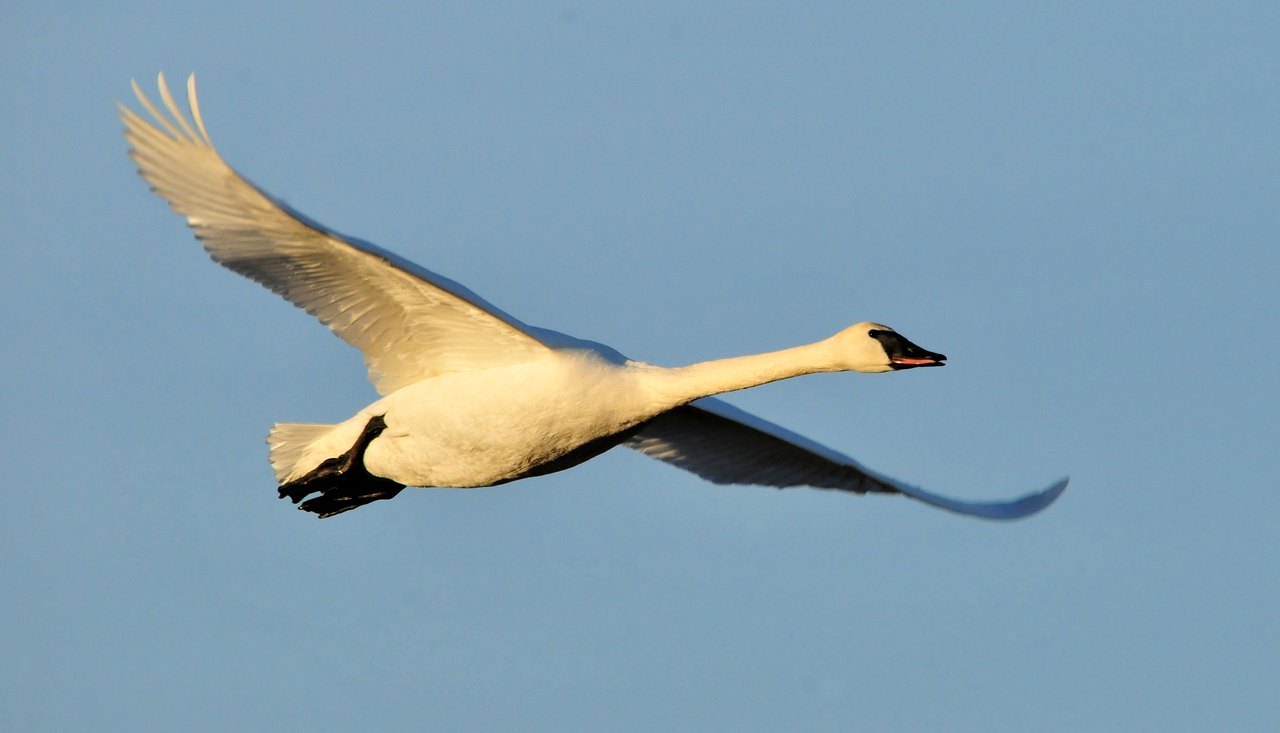
In these chapters the zoo talks of pinioning, and to understand the fear it stirs you must first understand a swan’s wing. A trumpeter swan is one of the heaviest flying birds in the world, and lifting that weight takes enormous, stiff flightfeathers along the outer wing, powered by huge chest muscles anchored to a deep breastbone. Pinioning is the practice of removing the last joint of one wing so a bird can never fly again — a way zoos once kept birds from leaving. For a wild trumpeter, whose whole life is built around long migrating flights, losing the sky would be a terrible price. This is why the threat matters so deeply to Louis and his kind: flight is not a hobby for a swan but the very shape of its freedom.
Visual AidThe wings that carry the weight
Photograph of a trumpeter swan in flight at Seedskadee National Wildlife Refuge in Wyoming. The Knowledge Bank explains that a trumpeter is one of the heaviest flying birds in the world, that lifting that weight takes enormous stiff flight feathers along the outer wing powered by huge chest muscles, and that pinioning removes the last joint of one wing so a bird can never fly again. Look at the outer feathers. Those are the ones the practice takes away.
Trumpeter swan in flight, Seedskadee National Wildlife Refuge, Wyoming; U.S. Fish and Wildlife Service. Source: Wikimedia Commons, public domain.
telegramn.Ch.16–17
A message sent fast over wires
“A telegram brought the Philadelphia offer.”
engagementn.Ch.16–17
A booked series of performances
“The nightclub engagement paid five hundred a week.”
exhaustedadj.Ch.16–17
Completely worn out
“The storm left Serena exhausted on Bird Lake.”
serenaden.Ch.16–17
A love song performed for someone
“The dawn serenade was ‘Beautiful Dreamer.’”
melodyn.Ch.16–17
The tune of a piece of music
“The old melody drifted across the water.”
pinionv.Ch.16–17
To clip a wing so a bird cannot fly
“The keepers planned to pinion Serena’s wing.”
outragedadj.Ch.16–17
Filled with furious protest
“Louis was outraged at the keepers’ plan.”
negotiatev.Ch.16–17
To bargain toward an agreement
“Someone would have to negotiate with the zoo.”
faten.Ch.16–17
What happens to someone; destiny
“The lovers’ fate hung on a telegram.”
duetn.Ch.16–17
Music made by two performers together
“Swan courtship ends in a duet.”
ⓘ The vocabulary words in this list are selected to help you understand and complete this workbook. Some may not appear verbatim in the original novel.
🧠Knowledge Bank question
1According to the Knowledge Bank, pinioning removes ___.Ch.16–17
2To ‘pinion’ a bird is to clip its wing so it cannot fly.Ch.16–17
3A message sent fast over wires is a ___.Ch.16–17
4Someone ‘exhausted’ is full of fresh energy.Ch.16–17
5Fill in each blank with the correct word.Ch.16–17
Word choices:duetoutragedmelodyfate- some words will not be used
The old drifted across the water.
Louis was at the keepers’ plan.
6To bargain toward an agreement is to ___.Ch.16–17
7A ‘duet’ is music made by one performer alone.Ch.16–17
8A booked series of performances is an ___.Ch.16–17
9Fill in the blanks with the correct words.Ch.16–17
Word choices:serenadetelegramexhaustednegotiate- some words will not be used
A brought the Philadelphia offer.
The storm left Serena .
10What happens to someone — their destiny — is their ___.Ch.16–17
Part 2
Comprehension
Show you understood what happens in Chapters 16–17.
🧠Knowledge Bank · Weighing One Thing Against Another
Narrative Logic · Weighing One Thing Against Another
A thoughtful reader learns to compare and contrast — to notice how two things are alike and how they differ, because the differences often reveal a story’s deepest questions. These chapters set freedom beside captivity: the open wild marsh where Louis was hatched against the safe but fenced world of the zoo. Each has something to offer — the wild has liberty, the zoo has safety — and White makes us feel the pull of both. He also invites us to compare Louis with the beautiful Serena, who arrives blown far off course by a storm. Setting characters or places side by side like this is one of an author’s sharpest tools, because a thing shows its true nature most clearly when placed next to its opposite.
🧠Knowledge Bank question
1The Knowledge Bank says the wild offers liberty while the zoo offers ___.Ch.16–17
2Where does Louis live in Philadelphia?Ch.16–17
3Serena arrives at the zoo on purpose, looking for Louis.Ch.16–17
4How does Louis finally win Serena?Ch.16–17
5Write the numbers 1–5 in the boxes to show the correct order of events in Chapters 16–17. Number 1 = what happens first.Ch.16–17
Louis settles at the zoo’s Bird Lake.
The zoo moves to pinion her — and Louis wires Sam.
The telegram offers $500 a week in Philadelphia.
The dawn serenade wins her heart.
A storm delivers an exhausted Serena.
6The zoo plans to pinion Serena so she can never fly away.Ch.16–17
7How does Louis respond to the pinioning plan?Ch.16–17
8Why does the serenade succeed where the slate failed?Ch.16–17
9The nightclub performances are described in long, glamorous detail.Ch.16–17
10What hangs unresolved at Part 6’s end?Ch.16–17
Part 3
Literary Elements
Understanding HOW and WHY E.B. White tells the story across Chapters 16–17.
🧠Knowledge Bank · The Threads That Keep Returning
Literary Technique · The Threads That Keep Returning
By this point in the book, certain images have begun to return again and again, and a detail that recurs in this deliberate way is called a motif. Watch for them: the ever-present trumpet, the growing sack of money, the pull of wild water against the tug of human cities. Each time one of these threads reappears, it carries the memory of everywhere it has been before, gathering meaning like a snowball rolling downhill. The money is not just coins; it is Louis’s honor and his father’s debt. A motif works quietly, stitching far-apart chapters into a single design the reader feels even without naming it. Whenever an image keeps coming back in a story, slow down and ask what it has come to stand for, because the author is weaving it, thread by thread, into the book’s deepest pattern.
Visual AidThree threads that keep returning
Diagram for the Knowledge Bank on motif. Each numbered row is one of the images the Knowledge Bank tells you to watch for, and the circles along the row grow larger at each return. Nothing is dated, because a motif is measured in appearances rather than chapters. Notice that no circle is ever the last one drawn small, which is the Knowledge Bank’s snowball rolling downhill.
Motifs gathering meaning, as described in the Knowledge Bank. Drawn for Garden Heights Academy.
Resolved setup
Part 3’s failed slate returns as Part 6’s triumphant serenade — structure as music.
Honest fate
The storm delivers Serena as weather, not magic — coincidence kept believable.
Won-then-defended
Love secured becomes love at stake — the pinioning turns romance into a freedom fight.
🧠Knowledge Bank question
1According to the Knowledge Bank, a motif gathers meaning ___.Ch.16–17
2Fill in the blank with the correct literary term.Ch.16–17
Word choices:fatesetupmeterchorus- some words will not be used
A storm delivering the plot’s heart is honest .
The slate returning as serenade is a resolved .
3White keeps the storm believable by making it ___.Ch.16–17
4The book lets Louis enjoy his victory with Serena free of any threat.Ch.16–17
5Choosing ‘Beautiful Dreamer’ — a real dawn serenade — shows White’s ___.Ch.16–17
6Keeping the nightclub offstage focuses Part 6 on ___.Ch.16–17
7Louis’s telegram to Sam shows his learned voices working together at last.Ch.16–17
8Fill in the blank with the correct literary term.Ch.16–17
Word choices:defendedforgottenrepeatedhidden- some words will not be used
In this book, happiness won must then be .
9The pinioning threat gives the love story ___.Ch.16–17
10Part 6 proves the whole education was necessary: slate, trumpet, and manners all ___.Ch.16–17
Part 4
Think Deeper
Four deeper challenges — no single-word recall. Read, weigh the evidence, and reason it out.
🧠Knowledge Bank · Finding the Right Way to Be Heard
Ethical Reasoning · Finding the Right Way to Be Heard
The whole book has been a search for the right channel of communication, and here that search grows tender, because Louis longs to win the heart of Serena, a swan who cannot read his slate or understand human words. All his cleverest tools — the chalk, the writing, even the money — suddenly cannot help him with the one creature he most wants to reach. This teaches a subtle truth: communication is not one skill but many, and the right one depends entirely on your listener. Louis will have to reach Serena through sound and beauty, through the trumpet itself, in a language her wild heart already knows. Notice how the book keeps insisting that being understood is one of the deepest of all needs, and that love, most of all, requires finding the one voice another heart can truly receive.
Think back over these chapters. By night, a spotlight somewhere downtown finds a swan with a horn, and five hundred dollars a week flows toward an old debt. By day, Bird Lake glitters with ordinary ducks — until a storm hurls one extraordinary swan across its fence. At first light, a trumpet lifts the gentlest song of the last century over the water, and the dreamer wakes to find the music is for her. And in a shed nearby, someone sharpens the small shears that end a wild bird’s flying — not knowing the swan on the lake has a friend in Montana, and knows how to send a telegram.
Original passage written for Garden Heights — not a quotation from the novel.
1Claim: “Part 6 proves Louis’s whole education was worth its costs.” — choose the two details that best prove it.Claim & Evidence
2What the zoo sees, or What Louis sees? Tap each detail to sort it — tap again to switch sides. You can keep tapping to change your answer.Sort into two
◄ What the zoo seesWhat Louis sees ►
3Match each cause to its result. For each cause, pick its result.Cause & Effect
A telegram offers five hundred a week→
A storm crosses the zoo at night→
A trumpet lifts ‘Beautiful Dreamer’ at dawn→
Keepers reach for the pinioning shears→
🧠Knowledge Bank question
4Fill both blanks to complete the reasoning.Build the Argument
The Knowledge Bank says all Louis’s cleverest tools suddenly cannot help him with , which teaches that communication is .
Part 5
Standardized Test
Reading passage · Courtship in the Animal Kingdom · SAT & TOEFL-style practice
Read the passage — the highlighted words are tested — then answer. Tap an answer, then tap it again to confirm.
SATCentral Ideas — the passage's main point
SATWords in Context — a word's meaning in this passage
SATDetail — a fact stated in the passage
SATInference — a conclusion the passage implies
TOEFLFactual Information — a fact stated in the passage
TOEFLVocabulary — a tested word's meaning here
TOEFLRhetorical Purpose — why the author included a detail
TOEFLProse Summary — the three sentences that sum it up
Courtship Displays in the Animal Kingdom
Before there are nests, there are auditions. Across the animal kingdom, mates are chosen through courtship, ritual displays of song, dance, color and gift-giving in which one animal demonstrates its quality to another. Birds are the virtuosos. Peacocks spread shimmering trains; cranes leap in paired ballets; bowerbirds build and decorate elaborate arbors of twigs and treasures, judged strictly by visiting females. A serenade is the commonest instrument of all, because a strong, complex singing voice honestly advertises health, energy and experience, which is why so many females choose the best singer on the pond.
Swans add their own signature. Trumpeters court with calls and answering calls, synchronized swimming and mirrored head-bobbing, and once the choice is made they are famous for keeping it: trumpeter pairs commonly bond for many years, often for life, returning together to the same nesting waters season after season. Which frames the novel’s central crisis precisely: a mute trumpeter is missing courtship’s main instrument, like a peacock without a train. And it frames the dawn scene’s triumph too, because when Louis’s trumpet finally pours real music across the lake, he is doing the most swan-like thing a swan can do.
Original passage written for Garden Heights — not a quotation from the novel.
1What is the main idea of the passage?SAT · Central Ideas
2In the passage, a serenade is ___.SAT · Words in Context
3What do bowerbirds do?SAT · Detail
4In the passage, a strong song advertises ___.TOEFL · Factual Information
5How do trumpeter swans court?TOEFL · Factual Information
6In the passage, to bond means ___.TOEFL · Vocabulary
7The mute Louis is compared to ___.SAT · Detail
8Why do many females choose the best singer?SAT · Inference
9The passage calls the dawn serenade ‘the most swan-like thing a swan can do’ because ___.TOEFL · Rhetorical Purpose
10Prose Summary (TOEFL).The passage explains animal courtship and the novel’s crisis. This TOEFL task lists six sentences; choose the THREE that best capture the passage’s main ideas. The other three do not belong — they state minor details or ideas the passage does not present.TOEFL · Prose Summary
Part 6 · Optional
Creative Writing
A bonus challenge to practice your English. Take your time and have fun with it.
About This Section
This writing task is optional and is not part of your auto-graded score. The feedback below checks only the basics — length, spelling, and grammar — not whether your ideas are right or wrong. It is meant for classroom discussion and creative practice, so feel free to use your imagination!
Writing Task — Part 6 “The Song That Finally Worked”
The slate failed; the serenade succeeded — because the channel finally matched the listener. Write about reaching someone the RIGHT way after a wrong way failed: a friend, a parent, a pet, a team. What was your slate? What was your trumpet? 6–10 sentences. End with the moment you knew the message had landed.
You can start with: “The first time, I said it the wrong way, and it bounced right off...”
0 / 40 words minimum
🗣 Teach It · Just for Fun (optional)
No right or wrong — close the screen and tell someone nearby what happened in this part. Can’t find anyone? Tell yourself out loud. The moment you teach it, you truly understand it.
Part 6 Complete!
You finished Chapters 16–17 of The Trumpet of the Swan.
Here are your auto-graded results:
-
points out of 100
Teach it to someone
The best last step is to teach it. In your own words, explain what happened — retell a favorite scene, teach a character’s big choice, or sum up the main idea for a parent, friend, or classmate. When you can teach it clearly, you truly own it.
Independent study guide by Garden Heights. Not affiliated with or endorsed by E.B. White. Contains original analysis only; no text from the novel is reproduced. Reference text: This workbook follows E.B. White’s classic text (the standard Puffin edition sold worldwide). Revised 2023 UK editions change some wording and may not match the vocabulary studied here.
SAT® is a registered trademark of College Board, which is not affiliated with, and does not endorse, these materials. TOEFL® is a registered trademark of ETS. These materials are not endorsed or approved by ETS. Garden Heights is an independent provider of test-style reading practice.